The post Top 10 Amazon DSP Agencies: Top Partners to Scale Your Advertising appeared first on Amazon-ASIN Blogs - Latest from Amazon Sellers: News, Advice, and Effective Strategies.
]]>After all, DSP is a programmatic advertising platform that helps brands reach customers earlier, before they’re even actively searching. You can run display, video, or audio ads not just on Amazon but across other websites and apps where shoppers spend their time. Meaning, you will need the guidance of seasoned professionals.
What makes DSP special is its access to Amazon’s first-party data. That means you can target audiences based on their shopping behaviors, preferences, and browsing patterns.
Whether it’s someone researching a product or casually watching content online, you can reach them with ads that feel personal and timely. It’s a way to build brand awareness, guide potential customers through the buying journey, and retarget them with ads that encourage them closer to a purchase.
Everything has a price tag, and so does Amazon DSP. There’s a minimum spend requirement of $30,000 per month in liquid assets just to get in. The stakes are high, which means this isn’t an area where you can afford trial and error. To make every dollar count, you need to partner with Amazon DSP agencies that know the ins and outs of DSP and can turn that investment into measurable growth.
For brands that want more than just search ads, Amazon DSP agencies open up tons of opportunities.
The Benefits of Partnering with the Best Amazon DSP Agencies
When you are running a DSP campaign, know that it isn’t something you can just set and hope for the best. It’s a more advanced form of advertising that requires a thorough understanding of customer behavior, creative messaging, and constant optimization.
That’s exactly why you need to work with Amazon DSP agencies that really understand Amazon DSP; it can make all the difference.
First, agencies bring the experience needed to make sense of audience targeting. Sure, Amazon offers tons of data, but knowing who to target, how to segment them, and when to retarget them takes skill. Agencies help identify the right audiences and create campaigns that hit the mark without wasting money.
Then there’s the other side of the coin. A well-designed ad is more than a pretty image or catchy line; it speaks to a shopper’s needs and desires at the right time. Agencies can help you craft messaging that resonates while constantly testing and refining creatives for better engagement.
Measurement and tracking are other areas where agencies can help you with. They go beyond basic click or impression counts and help you understand how campaigns can impact your sales, brand awareness, and long-term customer value. This insight allows for smarter budgeting and faster adjustments.
Let’s not forget technology. Managing hundreds of ads, audiences, and placements is overwhelming. Agencies have the right tools to automate bidding, pacing, and optimization while keeping performance on track. They ensure campaigns scale smoothly, without constant micromanagement.
Amazon DSP agencies also safeguard your brand. With rules, privacy standards, and compliance requirements always evolving, working with a trusted partner ensures you’re on the right side of Amazon’s guidelines while protecting your reputation.
Ultimately, Amazon DSP agencies are your partner that helps you build campaigns thoughtfully, avoid costly mistakes, and grow sustainably, whether you’re just getting started or already competing at scale.
Top 10 Amazon DSP Agencies
Finding the right Amazon DSP agencies is about choosing an agency that can translate data into growth, balance automation with human strategy, and navigate Amazon’s evolving ad ecosystem with confidence.
The best Amazon DSP agencies don’t simply push impressions; they help brands build visibility across the entire funnel, from awareness to repeat purchase. Below, we’ve rounded up ten agencies that stand out for their approach, expertise, and results, giving you a clear view of which partner might be the best fit for your brand.
1. Sellerapp
SellerApp is one of the rare agencies that has blended both technology and human expertise together for over a decade.
Where many Amazon DSP agencies stop at plugging campaigns into Amazon’s system, SellerApp goes further. They provide a full-funnel DSP partnership, combining audience science, predictive modeling, and creative strategy with direct access to experts who understand both retail media and consumer psychology.
Their proprietary tech stack integrates seamlessly with Amazon Marketing Cloud (AMC) and even custom API data that allows brands to unlock cross-channel attribution, build custom dashboards, and track granular data points that most Amazon DSP agencies can’t deliver.
The result is better visibility into shopper behavior, from first impression to repeat purchase.
Their clients highlight that SellerApp’s always-on optimization is not just automated bid tweaks but real-time interventions guided by analysts who monitor brand safety, placement quality, and creative fatigue. For example, they’ve reported a lift in campaign by 60-500% a few weeks after launch, depending on objectives and starting baselines.
The team is incredibly proactive, flagging opportunities before they slip through the cracks, which has translated into measurable ROI growth for brands across highly competitive categories.
Unlike many Amazon DSP agencies that treat DSP as a standalone service, SellerApp takes a consultancy-style approach. Beyond managing ads, they refine product pages, coordinate with retail readiness strategies, and ensure creatives align with shopper intent. From contextual targeting to sequential storytelling ads, SellerApp manages campaigns that balance scale with precision.
For enterprise sellers, one of the biggest challenges with DSP is aligning spending with inventory cycles. SellerApp solves this by offering demand forecasting and inventory planning so campaigns never overspend when stock is tight.
Their support even extends into post-conversion engagement, like retargeting lapsed customers and amplifying review generation, ensuring long-term brand lift instead of short-lived spikes.
SellerApp offers the ideal balance of AI efficiency and human expertise, so smaller advertisers are not under the burden of reporting and strategic depth more than they need. In a crowded DSP landscape, they deliver the rare blend of scale, transparency, and strategic storytelling that makes them one of the most compelling Amazon DSP agencies choices today.
2. BTR Media
Similar to SellerApp, Better AMS (Now BTR Media takes a data-first approach to DSP. They help brands unlock audience segments and build strategies around analytics. Their team helps brands scale their ad reach by integrating DSP into their broader Amazon Advertising strategy.
They emphasize flexibility in setting up DSP campaigns that can adjust as needs shift rather than locking you into rigid plans. Better AMS positions DSP not as an isolated service, but as a continuum from sponsored ads all the way through to more advanced display-and-video buying via Amazon DSP.
On their site, they say they will help brands grow by “scaling up everything Amazon Advertising, from Sponsored Products all the way to Amazon DSP and everything in between,” showing that DSP is one of their core offering areas.
Because they already manage campaigns like Sponsored Products, Better AMS is able to fold in DSP with audience segmentation, targeting, and campaign structure that benefit from the rest of the Amazon ads they run. Their DSP work is about expanding reach and getting into placements and impressions that go beyond just search or standard display.
While they lean on proven techniques and industry insight, their public material is careful to frame their DSP work as part of a full Amazon Advertising stack rather than a separate, experimental add-on.
3. My Amazon Guy
My Amazon Guy helps brands scale with Amazon DSP by bringing in advanced targeting and ad formats that go beyond standard PPC. They run display, video, audio, and static ads both on and off Amazon in order to lift awareness, increase product visibility, and then drive more sales.
They make use of Amazon’s first-party data to build custom audience segments, such as shoppers by location, browsing behavior, or past purchase history, and use those for retargeting and reach campaigns.
Creatively, they integrate different ad formats (video, image banners, and audio) so that the ad messaging can reach customers at different touchpoints on mobile, desktop, streaming, or devices like Alexa or Fire TV.
They also emphasize optimization and campaign management. That means adjusting creative, tweaking targeting or budget, refining which placements work best, and doing frequent testing.
My Amazon Guy positions their DSP offering as a growth step for brands that have already seen decent performance with Amazon PPC and are ready to expand reach.
4. Tinuiti
Tinuiti’s Amazon services cover the full spectrum from Sponsored Ads to DSP and Amazon Marketing Cloud. Much like SellerApp, their team helps brands leverage Amazon’s first-party audience data and custom targeting features to run upper-funnel awareness campaigns, mid-funnel engagement, and lower-funnel retargeting, all with measurement and optimization built in.
One of Tinuiti’s strengths is their mastery of Amazon’s audience tools. They use Amazon Marketing Cloud to pull together organic and paid shopper signals, discover new audiences, and feed those insights back into DSP targeting to improve performance.
They’ve worked with brands to build full-funnel campaigns. For example, Tinuiti helped their client Blueair reduce acquisition costs, raise return on ad spend significantly, and use Custom AMC Audiences to guide shoppers through the funnel using Amazon DSP plus related creative and content work.
Because of their advanced partner status with Amazon, they can access tools and beta programs others might not. Their reporting, analytics, and creative support are fairly sophisticated, making them a strong choice when you need visibility, control, and scale.
Their services are especially well matched with brands that have sizable ad budgets and want to do more than just run display ads. They’re built to help with strategy, analytics, full-funnel campaign execution, and continuous improvement.
For brands that are more experimental with DSP or smaller in budget, Tinuiti’s depth of service is extremely attractive, though the scope and cost can be higher.
5. Perpetua
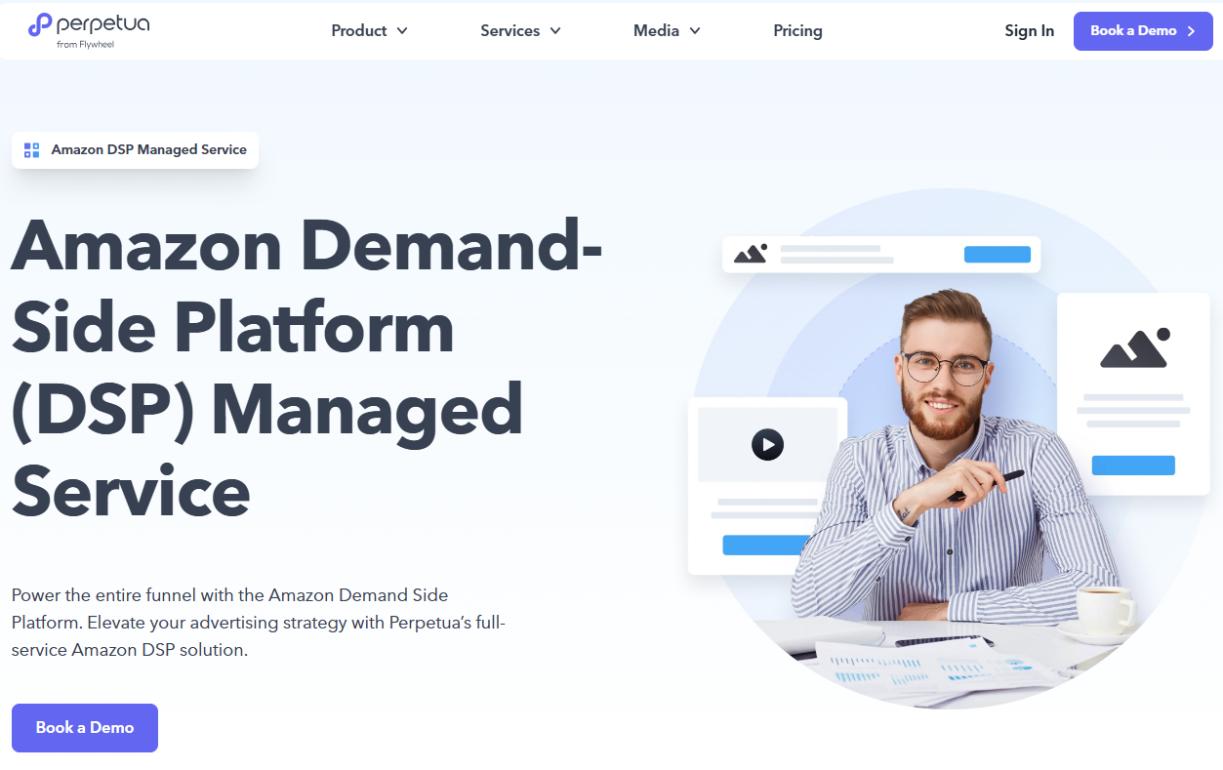
Perpetua offers its Amazon DSP service with a strong emphasis on self-serve tools that simplify how brands build, launch, and optimize full DSP orders.
Their platform lets you create audiences, generate creatives, and attach line items in a single, streamlined workflow instead of juggling multiple steps.
They’ve built out “Target Markets” audience templates, pre-built segments based on best practices that can be customized further, so advertisers get started faster while still being able to refine targeting precisely.
Budget behavior and optimization are central to their DSP product. Perpetua’s ad engine automatically shifts budgets between line items to improve performance and ensure pacing. According to their data, this outperforms Amazon’s native optimization tools by around 20%.
They provide consolidated analytics, including ASIN-level reporting across both DSP and Sponsored Ads, so you see how different ad types are performing together, not in silos.
Always-on campaign optimization is part of their offering: as campaigns run, the platform continuously monitors performance and makes adjustments, including when it comes to placement, audience segments, and budget allocation.
Because of how automated many of the optimizations are, some advertisers may find the trade-off is less granular manual control over every lever, though Perpetua does allow for customization where needed.
6. BellaVix
BellaVix handles Amazon DSP with a data-driven, full-funnel mindset. Their team manages awareness, consideration, purchase, and loyalty stages with tailored DSP campaigns that use precise targeting and performance analytics.
They use Amazon’s first-party data plus their own audience insights to reach customers across devices and ad formats: video, display, audio, and more. Their strategies are built to meet brands where their audience already is, both on and off Amazon.
Performance measurement is central to their DSP services. BellaVix provides regular reporting and audience insights so brands can see what’s driving results. Impressions, conversions, and reach are all part of the picture.
They also integrate DSP into a broader advertising strategy. Alongside Sponsored Products, Sponsored Brands, display ads, and content optimization, BellaVix ensures that DSP campaigns complement other Amazon ad types and strengthen the overall brand presence.
Their approach works very well for brands that want their ads to support not just immediate sales but sustained growth brands that care about awareness, loyalty, and holistic signals, not just click-throughs.
7. Bluewheel

BlueWheel brings together automation and strategic consultation in their Amazon DSP work. Their Amazon DSP service is designed to help brands reach audiences both on and off Amazon with display, video, and streaming placements, supported by tools like Amazon Marketing Cloud to analyze and refine who sees the ads.
They don’t require massive spending minimums to get started, making their DSP services accessible to smaller brands, though they also scale up for larger advertisers. Their team emphasizes daily tracking and optimization monitoring to see which audience segments and placements are delivering results and adjusting bids, creative, and targeting accordingly.
Creative support is part of their DSP service: BlueWheel develops both auto-generated ads and custom creatives, including video and display tailored to audience, device, or placement.
Their approach tends to balance transparency and flexibility. Clients see dashboards, frequent reporting, and campaign insights while having room to scale spending and tweak strategies.
Some clients may miss the boutique agency feel in terms of ultra-hands-on creative direction, since BlueWheel handles many of its processes via tech and optimized flows, but for many brands the trade-off is a smoother, more predictable experience.
8. Incrementum Digital
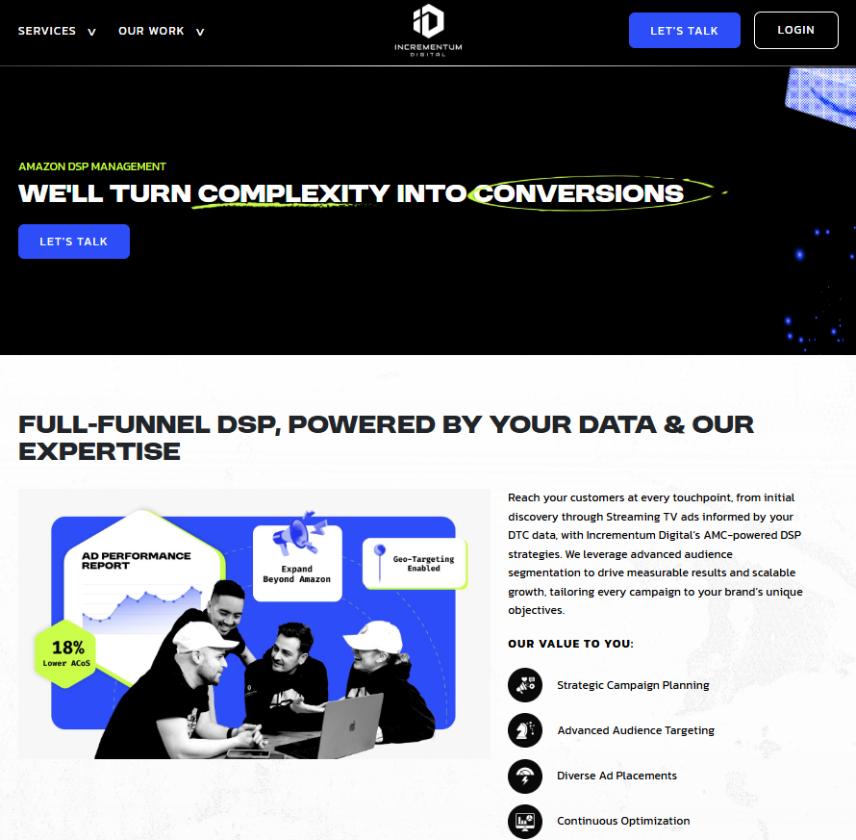
Incrementum Digital runs Amazon DSP with a full-funnel, data-driven mindset. They begin by doing deep onboarding that includes market, competitive, and audience analysis. From there, they build annual or seasonal media plans, setting budgets and custom audiences in line with product launches and promotional windows.
They use both Amazon’s first-party and third-party data, plus insights from Amazon Marketing Cloud (AMC), to target audiences more precisely. Their placements include display ads, video, and streaming TV, so brands can reach people across Amazon and off-Amazon touchpoints.
Once campaigns are live, they don’t just let them run. Incrementum continuously optimizes shifting budget based on performance, refining audience segments, running A/B creative tests, and using dashboard reporting to identify what’s working and what’s not.
Their value to clients lies in transparency and strategy. With their DSP work, clients get custom dashboards and deep reporting so they can see metrics that matter, not just generic impressions. They aim for scalable growth, helping brands improve visibility and awareness while keeping ROI front and center.
For brands ready to take DSP seriously those who want predictable plans, frequent optimization, and reliable measurement. Incrementum Digital is a strong fit. Their approach demands enough budget and clarity of goals, but for those that have both, it offers a pathway to consistent growth.
9. Acadia
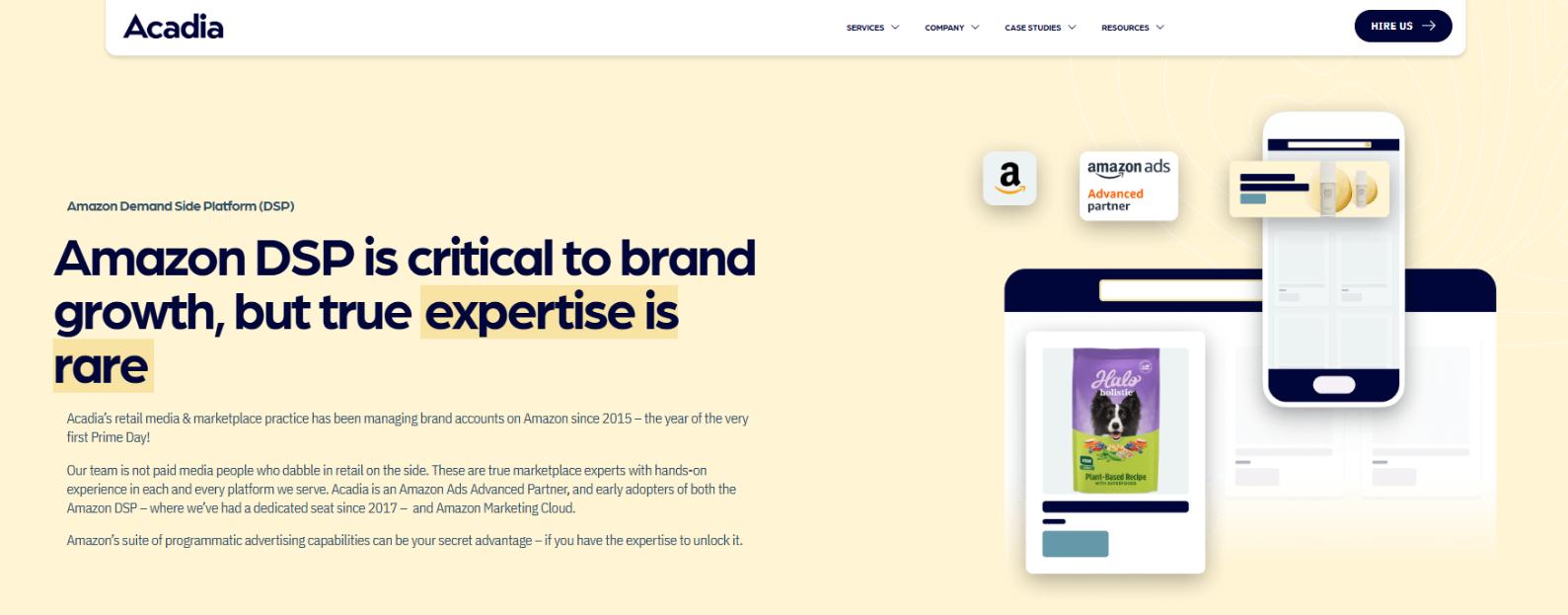
Acadia is an DSP agency with deep roots in Amazon ecosystems (they’ve been managing brand accounts since 2015) and are one of the earlier adopters of Amazon DSP; in fact, they’ve held a dedicated DSP seat since 2017.
When brands work with Acadia, they gain access to expert audience targeting. Acadia uses Amazon’s first-party data, sophisticated segmentation, and creative message testing. They also lean on Amazon Marketing Cloud (AMC) to understand how upper-funnel awareness and consideration efforts feed into actual purchase behavior.
One of Acadia’s differentiators is that they can resell DSP seats, which allows brands to access more inventory or reach, often with reduced platform fees.
They stress strategy over short-term metrics. For example, they created a “Fit for Purpose” ADSP metric framework in 2023, defining next-generation metrics beyond just click-throughs and ROAS to better measure awareness, remarketing performance, and longer-term brand lift.
They also offer full-funnel campaign design. They integrate DSP with sponsored ads, content optimization, product content, and inventory & operations support, making Amazon DSP part of a comprehensive strategy rather than a standalone tool.
A useful case study is with Kenra Professional, where Acadia used Amazon Streaming TV (STV) through Amazon DSP along with AMC to reach new audiences. They excluded existing customers to focus on new buyers, tested homeowners’ creatives, used STV in the upper funnel, and then applied full-funnel tactics. The outcomes were a major lift in brand searches, huge growth in new-to-brand purchases, and increased revenue.
10. Kepler Group
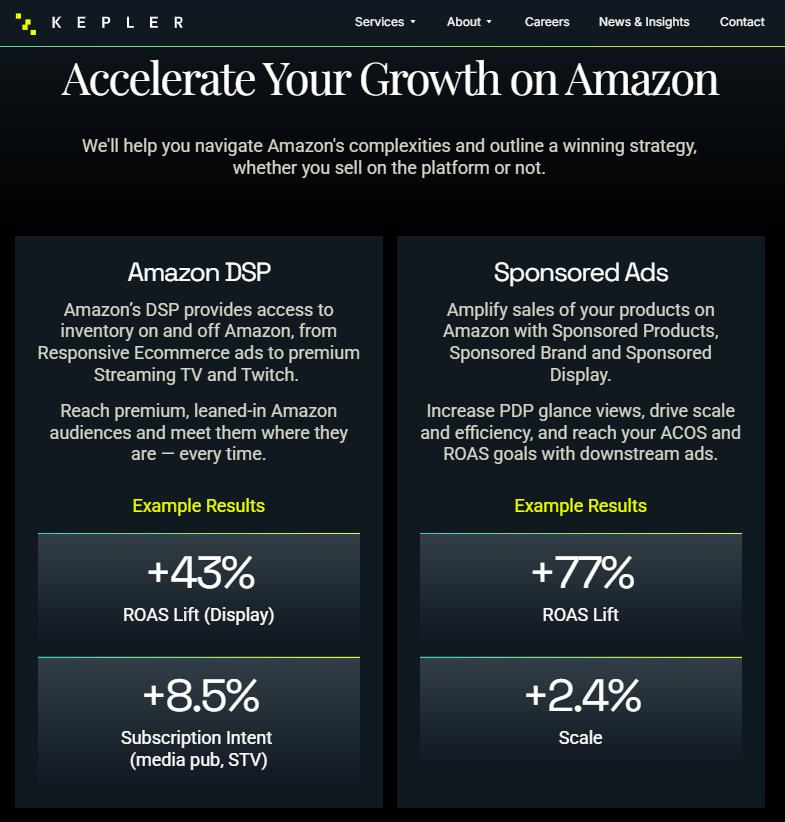
Kepler Group is one of the more mature experts when it comes to Amazon DSP. They aren’t just another ad agency; they’ve earned Amazon Advanced Partner status (including for Amazon Marketing Cloud), which means they’ve been vetted for deeper technical ability and access.
When working with Kepler, brands get flexible service models: you can go fully managed or shift toward more in-house/self-service over time. Their Amazon DSP work covers not just display but premium placements like streaming TV, Twitch, video + audio, and Amazon’s off-Amazon inventory.
They also lean heavily on measurement. Through Amazon Marketing Cloud, Kepler helps clients analyze overlap, audience behavior, and purchase journeys so DSP isn’t just about reach or impressions but understanding what drives new-to-brand acquisition or lifts in ROAS.
Brands that work with Kepler tend to see quick improvements. For example, they’ve reported campaign lifts of 40-400% a few weeks after launch, depending on objectives and starting baselines.
Because of their scale, tools, and experience, Kepler is especially well suited for mid-sized to enterprise brands that want serious Amazon DSP work: premium inventory, cross-format placements, and deep analytics.
That said, brands just getting started with DSP and limited budgets might find their services and requirements more advanced (and possibly more expensive) than boutique providers.
How to Choose the Best Amazon DSP Agencies?
Choosing the right Amazon DSP agencies isn’t just about picking the one with tools that shine from a distance or the lowest rates. It’s about finding a partner that understands your brand’s goals, challenges, and growth trajectory.
Experience is critical. Amazon DSP agencies with a proven track record on Amazon DSP and ideally other retail platforms will bring insights that help you avoid common pitfalls and take advantage of new opportunities.
Equally important is the balance between technology and human insight. While automation is crucial for scaling, campaigns still require strategists who understand customer psychology, creative storytelling, and timing. The best agencies pair smart tools with seasoned experts who know when to intervene.
You also want a profit-first mindset. It’s easy to get lost chasing clicks and impressions, but campaigns should always be aligned with measurable business outcomes. A good agency will help you connect advertising spend with revenue, margins, and customer loyalty.
Creative support is another factor to look for. More than visual ads, they need context and messaging that your audience will find relatable. The right agency helps craft creatives that feel authentic, relevant, and persuasive.
Transparency in reporting is non-negotiable. Look for agencies that offer access to dashboards and detailed reports where you can see how every decision is made, from targeting to bidding to pacing.
Scalability matters as well. Whether you’re managing a handful of products or hundreds, you need Amazon DSP agencies that can scale campaigns smoothly without compromising on strategy or support.
Communication is extremely important. Direct access to account managers and open channels for feedback guarantees that issues are identified early and campaigns remain in sync with changing requirements.
Pricing should be equitable and flexible. Hidden fees or strict contracts should be avoided. The best agencies will provide straightforward price models that help you scale with your company rather than tying you to rigid terms.
At the end, client fit is essential. Every agency has its own sweet spot, whether it’s for startups, mid-market sellers, or major corporations. Choosing an agency whose capabilities coincide with your specific goals ensures that you have the right assistance you need to grow.
Final Thoughts
Amazon DSP is an extremely useful tool, but it needs a mindful strategy and thoughtful approach to truly unlock its potential. Partnering with right Amazon DSP agencies like SellerApp or Bellavix will ensure that your campaigns perform. Whether you’re just beginning in programmatic advertising or managing a complex, data-driven operation, a good agency helps you make informed decisions, scale effectively, and build lasting customer relationships.
Brands benefit greatly from agencies that provide organized support and clear guidance. Analytics-driven strategies, cross-channel insights, and experienced strategists make a significant difference for businesses. At the end of the day, the finest agency is one that blends technology and human knowledge, adjusts to your demands, and helps in focusing on growth, leaving you with no second thoughts.
With the right Amazon DSP agencies you can become not just another marketing channel but a strategic advantage that propels your brand forward with purpose and precision.
Related post:
15 Walmart Advertising Agencies to Scale Profitably in 2025
Top Amazon Automation Software Tools for Sellers
Best Amazon Marketing Agencies for Your E-Commerce Success
Top Analytics and Optimization Tool for Amazon Sellers
The post Top 10 Amazon DSP Agencies: Top Partners to Scale Your Advertising appeared first on Amazon-ASIN Blogs - Latest from Amazon Sellers: News, Advice, and Effective Strategies.
]]>The post Best Amazon PPC Software: 10 SaaS Tools to Help You Improve Your Campaign Performance appeared first on Amazon-ASIN Blogs - Latest from Amazon Sellers: News, Advice, and Effective Strategies.
]]>As a campaign manager, you don’t need another dashboard, you need absolute precision and optimization features. Tools that pinpoint the stuff that matters and help you automate related tasks. Most importantly, give you control when it counts.
An excellent Amazon PPC optimization tool will help you drastically limit waste in ad spend and ensure that your budget is being used to its highest potential.
This breakdown goes beyond marketing fluff. We’ve reviewed the top 10 Amazon PPC software tools for 2025 through the lens of seasoned campaign execution: automation logic, AMC integration, cross-marketplace performance, SKU-level profitability, and how well they actually reduce time-to-decision across accounts.
What is Amazon PPC?
Amazon PPC, or Pay-Per-Click, is essentially Amazon’s internal advertising system. It’s an advertising system that enables Amazon sellers and brands to promote their products more effectively.
Specifically, you pay to have your products appear in front of high-visibility placements across the marketplace. For example, the search results, the product details pages, and even external sites that have partnered with Amazon.
With Amazon PPC, you essentially bid on specific keywords, target products, and even choose audience segments. Unlike other advertising models, with Amazon PPC, you only pay when someone clicks your ad.
That’s the technical definition.
In practice, PPC is the most direct lever you have to drive traffic. After all, paying for visibility can help you effectively scale your brand rather than solely depending on slow organic growth.
Additionally, you can quickly gauge product market fit, test market demand, and generate much-needed sales on Amazon. It’s where you compete for attention in a marketplace that isn’t always fair, isn’t always transparent, but is very much performance-driven.
It’s important to note that you’re always paying for more than just clicks; you’re also paying for signals and data. Every search term that gets a click or doesn’t, or every ASIN that doesn’t get any orders, or every shift in CPC is telling you something about buyer behavior. Not to mention deep insights into competition, seasonality, and much more.
And when you’re managing spend across dozens or hundreds of SKUs, your decisions tend to compound. Are you defending your brand or bleeding on broad match terms? Are your auto campaigns actually harvesting useful data, or just burning through budget? Are you balancing impressions with conversions, or simply chasing ACOS without considering TACOS?
For seasoned campaign managers or brand owners, Amazon PPC isn’t just about advertising. It’s about control. When organic rankings fluctuate, when reviews lag, when listings stall, PPC is the one channel where you can push and get immediate feedback. That speed, when managed well, is a growth advantage. When mismanaged, it can be a significantly expensive lesson.
Different Types of Amazon PPC Ads
If you’re running Amazon Ads day in and day out, you already know that not all campaign types are the same.
Each campaign gives you a different level of control, reach, and risk. Therefore, it’s always important to know when and how to use these campaigns and how they fit into your brand’s overall strategy.
Here are the different types of Amazon PPC Ads:
1. Sponsored Products – Your Workhorse
Sponsored Products are the most common type of ad used on Amazon. You’ll find these ads on the Amazon search results page and on product pages. Typically, blending it with regular product listings. Most campaign managers spend most of their budget on this type of Ad.
Fundamentally, Sponsored Products help increase visibility for individual items, making them ideal for sellers who want to promote specific products and drive direct sales.
Moreover, they’re incredibly versatile. You can run them for branded terms, new launches, bestsellers, or even defense/brand loop plays.
But their simplicity can be a bit deceptive. Auto campaigns can leak spend fast if you’re not refining them. However, Manual campaigns can scale, but only if you’re feeding them clean, high-intent terms and segmenting match types smartly. Of course, it’s always a question of constant optimization. This is where margin is made or lost.
2. Sponsored Brands – Your Brand Story on Display
Sponsored Brands ads effectively let you run headline ads that showcase your brand logo, a custom message, and up to three products.
Most importantly, they sit at the top of search results, which is essentially prime real estate. Of course, you can also find these in the middle. However, they’re still quite effective as they break the monotony.
SB brands tend to do more than just help with conversions. When leveraged properly, these ads can significantly boost awareness and credibility. Especially when someone’s in consideration mode.
If you’re pushing a product line or even trying to own your branded terms, SB brands can help a lot, as they give you a lot more freedom to control the narrative. Honestly, we’d recommend that more sellers use this format to shape their brand. Of course, if you’re only looking at pure ROI, you can always use it to sell your premium products or even cross-sell the rest of your products.
3. Sponsored Display – Retargeting with a Caveat
Sponsored Display is where things get a bit more nuanced. We also wouldn’t recommend you use this until you’ve gained significant experience running Amazon ads. Especially, as these campaigns are incredibly more volatile. You’ll need to monitor CPCs closely and constantly to effectively decide your bid increments. If you don’t, you could either run up your ACoS (Advertising Cost of Sale) or potentially cannibalize what could have been an organic or brand conversion.
When taken advantage of, SD brands can be absolutely brilliant.
You can essentially target your audience based on Amazon or beyond, making it perfect for any retargeting campaigns. SD ads are also incredibly effective when trying to capture market share.
Ultimately, each campaign type has its place. The real skill is in knowing when to dial each one up, how to layer them, and where to pull back. We recommend you think of them less as formats and more as levers, with each one playing a different role in your flywheel.
Challenges of Managing Amazon PPC Campaigns?
If you throw a rock and hit any Amazon PPC Campaign Manager on this brilliant blue planet, all of them will say that Amazon PPC isn’t hard because it’s technical. It’s primarily hard because it’s constant. Meaning you will have to make your peace with constant optimization.
You’ll have no choice but to turn managing your campaigns into a full-time job because you’re always going to be a keyword or a target away from wasting your ad spend or a breakout win!
Now, to ensure sustainability, you will have to understand the challenges. Here are some of the most common challenges of managing Amazon PPC campaigns:
1. Too Much Data, Not Enough Signal
Campaign reports are endless. You’ve got your impressions, CTR, CVR, RoAS, TACoS, NTB%, and that’s just before you grab your morning coffee.
Unfortunately, the real problem? Making sense of it all.
What looks good in isolation might be a bleeding margin at the overall account level. So, you’ll have to constantly toggle between high-level metrics and line-item actions, trying to find clarity.
And unless you’re layering insights from Search Query Performance reports, brand analytics, and Seller Central, you won’t be able to see the full picture.
However, we’re being a bit diplomatic here. Honestly, you’ll need a third-party tool that can consolidate all performance metrics in one unified dashboard. This will help you understand everything as opposed to flitting between several tabs or reports.
2. Bid Adjustments Are a Daily Grind
When it comes to bid adjustments, which is essentially the most important task of a campaign manager, the worst thing you can do is only “increase bids on top performers.”
That’s day-one logic.
To stabilize your performance and, more importantly, scale, you will have to understand performance metrics holistically and consider margins.
After all, there will always be the possibility of inventory risk and other issues.
Manually doing this can sound simple. However, it’ll get challenging when you’re managing 100+ campaigns across several ASINs with different lifecycles. Especially, as this will require you to be precise under pressure.
3. Keyword Management Becomes Chaos Fast
Every keyword you target will have a cost. That obvious. However, there’s also a consequence to adding several keywords. Not only will you have to balance high volume terms that bring traffic but destroy RoAS alongside long tail terms that convert but barely scale.
However, you also have to consider campaign structuring. For example, if you set a low budget but target 100 keywords in one ad group, the ad will only be served to the first couple of keywords before the budget runs out, leading to a cannibalization of potential.
Additionally, you will also need to run auto campaigns to harvest keywords that you can target in manual campaigns. Of course, you will also need to block irrelevant queries and audit match types regularly. All of this becomes challenging if you don’t have a dedicated campaign manager or a performance marketing manager.
4. Budgeting Isn’t Just About Caps
Anyone can set daily budgets. The hard part is allocating those budgets strategically. Do you push more into branded to stabilize RoAS? Or do you shift to defense/brand looping to protect your market share?
You’ll need to understand if you’re burning cash on retargeting that offers no lift. When it comes to budgeting, you’ll need to recognize that each dollar has to do its job, and teams will more often than not work with finite budgets. Meaning, one bad allocation = one missed sales window.
5. Campaign Structure Needs Constant Cleanup
You start out with a neat build. Then a new product launch comes in. Then Prime Day. Then a change in seasonality. Before you know it, you’ve got duplicate targeting, bloated campaigns, and no clear ownership between branded, competitor, and category terms.
Campaigns aren’t “set-and-forget.” They always degrade and require constant optimization. If you’re not actively cleaning and restructuring, performance slowly dies without you noticing.
6. Marketplace Shifts Outpace Reaction Time
Unfortunately, Amazon’s A10 Algorithm is constantly updated and improved. So, much so that there are new ad types, new rules, and new competitors.
And if you’re not reacting in real time, you’re reacting late. That’s the hard truth. What worked last quarter may not hold today, and if you’re stuck waiting on weekly reporting cycles, you’re already behind.
Ultimately, it’s because of all of these challenges that brands tend to hire a dedicated Amazon professional. However, even the dedicated performance marketer will need accurate data, optimization, and automation tools.
Why Using an Amazon PPC Software Important?
Fundamentally, as a brand owner or a campaign manager, you’ll find it significantly challenging to manage and scale campaigns.
Especially, as Amazon Ads have become incredibly competitive and complex. Without optimization or automation tools, you’re not only leaving money on the table but also burning through your budget on irrelevant targets.
Moreover, you’ll need a consolidated hub as running PPC ads involves juggling hundreds, sometimes thousands, of keywords, bids, and budgets across multiple campaigns. Trying to keep up with changes in real-time, analyze performance, and adjust bids manually. Not only is this exhausting, but it’s inefficient and prone to errors.
A good optimization tool will cut through the noise.
With automation features, it can also speed up routine tasks and repetitive tasks like bid adjustments and keyword management, surface insights you might miss when staring at spreadsheets, and give you more precise control over your ad spend.
This means you can focus on the overall strategy instead of grunt work.
More importantly, the tool helps protect your margin by keeping bids aligned with profitability goals, spotting wasted spend, and making sure your budget goes to campaigns that actually drive sales. In a competitive marketplace like Amazon, small mistakes add up fast, and the right tool helps you avoid them.
Ultimately, using a PPC optimization tool lets you manage your ads smarter, move faster, and grow your business without burning out.
Top 10 Amazon PPC Software Tools for 2025
When you’re scaling ad budgets past $100K/month, managing hundreds of SKUs, and balancing TACoS with a really good margin, you need more than a basic campaign manager.
The right PPC optimization platform should not only automate execution but also drive strategic decisions across marketplaces, product lines, and sales cycles.
Below, we evaluate the top 10 Amazon PPC software for 2025 based on what really matters to advanced sellers and agencies: rule-based + AI automation, campaign structuring, data integration, and profitability visibility.
1. SellerApp – End-to-End PPC Intelligence & Profitability Engine
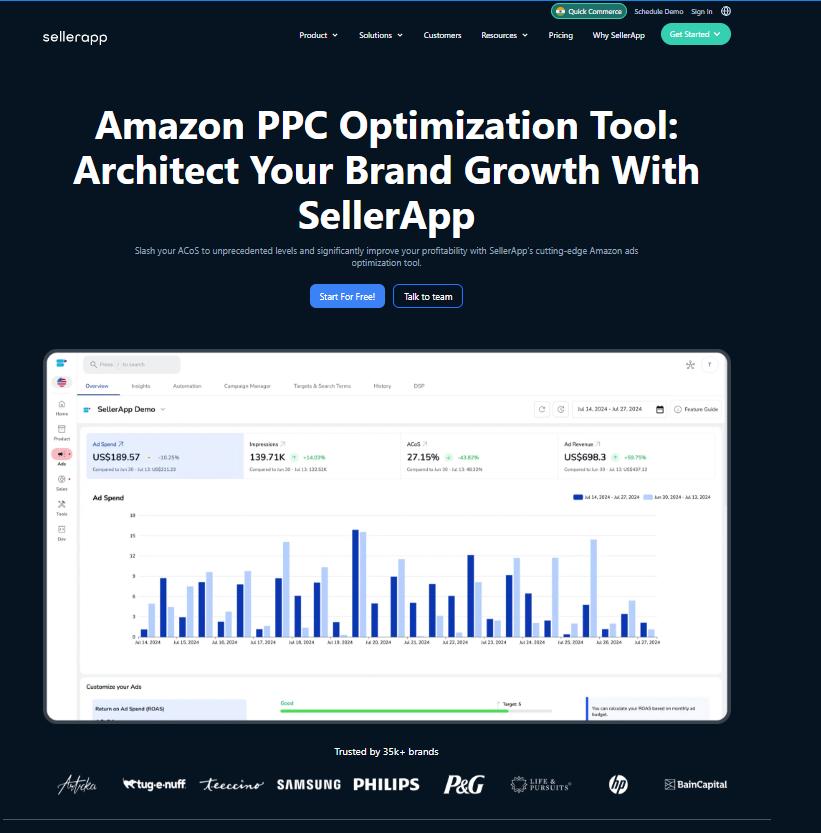
SellerApp isn’t just an Amazon PPC software, it’s an AI-powered PPC command center designed to align advertising, pricing, inventory, and product strategy across global Amazon marketplaces. With its multi-marketplace capabilities, it’s more of an ecommerce business accelerator.
SellerApp combines proprietary data, technology, human expertise, marketplace-specific signals, and real-time automation to help 7–9 figure brands scale profitably. Here’s why it’s one of the most powerful choices in 2025:
Unified PPC Operations Across Marketplaces
- Manage Sponsored Products, Brands, and Display campaigns across Amazon US, UK, DE, IN, CA, and more. All within one interface. We were able to access advanced filtering that allows campaign views by ASIN, portfolio, ACoS, and so much more.
Full-Funnel Data Visibility
- Track every campaign and ad group metric. You have complete access to several performance metrics that can actually help you move the needle. In addition to key metrics like ACoS, TACoS, ROAS, you’ll also be able to understand your campaign performance by new-to-brand sales, wasted spend, impression share, conversion rate, and much more.
- This essentially eliminates the need to toggle between the Amazon Ads console, Excel sheets, and third-party dashboards.
Rule-Based + AI Optimization
- Both SellerApp’s Advanced Rule-based automation and AI automation can help you streamline repetitive tasks, bid adjustments, budget reallocations, keyword pausing, harvesting, and campaign goal tracking.
- There are even features that adapt to the daily data changes, margin inputs, and marketplace seasonality.
- Or, you can define custom rule-based workflows to execute changes based on granular thresholds (e.g., auto-pause non-converting terms after 30 clicks + CTR < 0.25%).
Negative Search Term Management
- This tool enables you to automatically identify and suppress non-converting, high-cost, or irrelevant terms using customizable thresholds and historical patterns. SellerApp’s engine flags negative keywords and applies them at the ad group or campaign level to cut wasted spend as quickly as possible.
Advanced Dayparting + Budget Control
- Like most tools, SellerApp offers Dayparting as well. However, we recognize that it’s significantly more advanced, which can help you control campaign run times based on historical conversion windows.
- Pause low-performing hours, boost peak ROAS slots, or set spend caps by hour/day. Pair this with rules for automatic budget increases during seasonal surges or low ACOS periods.
Amazon Marketing Cloud (AMC) Integration
- SellerApp goes way beyond what Seller Central reports offer. Specifically, this Amazon PPC Optimization tool integrates with AMC to analyze path-to-purchase, audience overlap, branded vs. non-branded impact, and repeat purchase behavior. So, you can tie campaign spend to customer lifetime value. Most importantly, it’s visual in the form of a heatmap, helping you quickly execute your tasks.
Search Term Intelligence Beyond SQP
- SellerApp will dissect all of the converting and non-converting search terms at the match-type level, tied to SKU and margin data. This will enable you to view ASIN-level intent scores, match type volatility, and lifetime revenue per search term, not just clicks or ACoS.
SKU-Level Margin & Promo-Aware Optimization
- Track actual SKU profitability post ads with ease. You’ll be able to adjust for returns, coupons, inventory holding cost, and cross-selling lift. No more optimizing to ACoS in isolation. You get true net margin awareness at the keyword and campaign level.
Trusted by Enterprise + Agency Teams
- Used by brands like Coca-Cola, SellerApp supports agency workflows with account grouping, white-labeled reporting, bulk edits, API integrations, and cross-account benchmarking dashboards.
Best For: Enterprise brands, aggressive private-label sellers, and performance agencies managing complex, multi-geo accounts who need deep intelligence, automation, and real profitability control.
2. Sellozo – Streamlined PPC for Sellers Focused on Growth
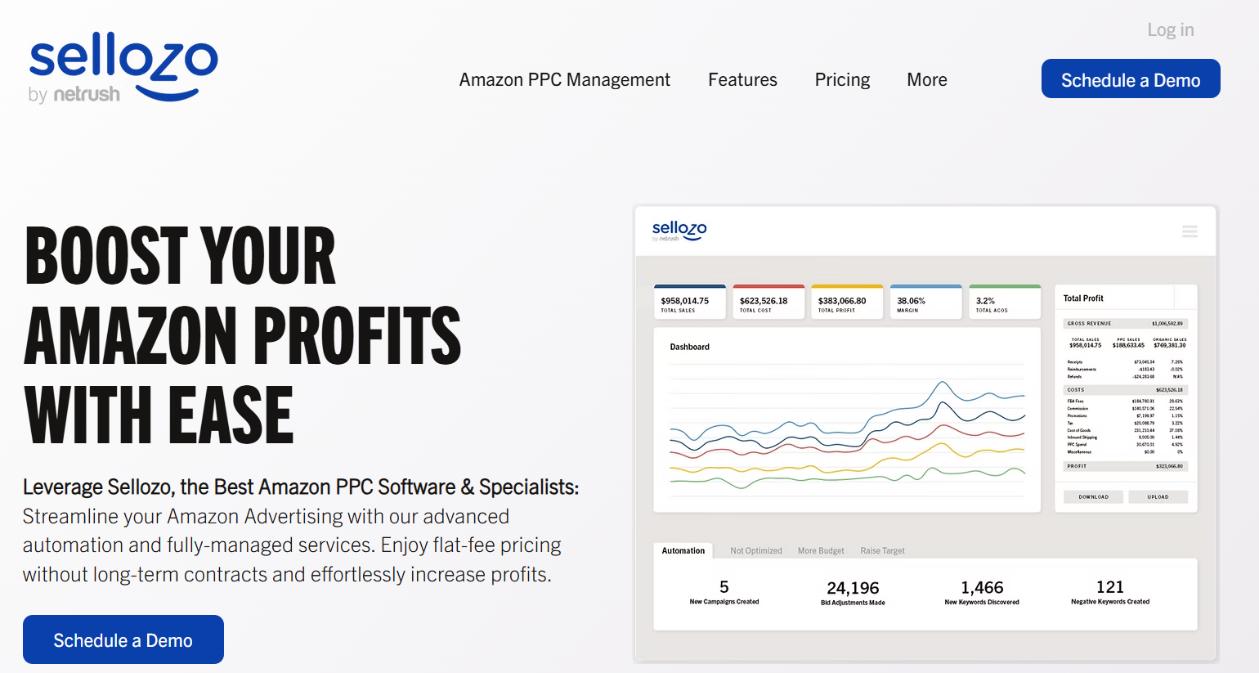
Sellozo simplifies daily campaign optimization with a predictive bidding engine and smart structuring tools. Sellozo is ideal for brands growing past $25K/month in ad spend who want automation without a steep learning curve. Here’s what stands out:
- There’s a brilliant campaign studio that enables a drag-and-drop campaign structuring for funnel builds (Auto > Broad > Exact), keyword transfers, and match-type mirroring.
- This tool runs every 24 hours, adjusting bids based on ACoS targets, historical CVR, and keyword elasticity.
- Similar to SellerApp, Sellozo also offers Dayparting capabilities. Easily set up hourly/day-based schedules to pause campaigns during low conversion windows.
- This tool offers a clean dashboard showing PPC spend vs. gross profit and ad-driven vs. organic sales.
However, there are significant limitations. For example, there’s no Amazon Marketing Cloud integration, it lacks SKU-level profitability adjustments, and doesn’t support custom automation rules, making it less suitable for agencies or enterprise sellers.
Best For: Growing sellers and smaller agencies looking for automation without complexity.
3. PPC Entourage – Profit-Driven Campaign Structuring & Search Term Mining
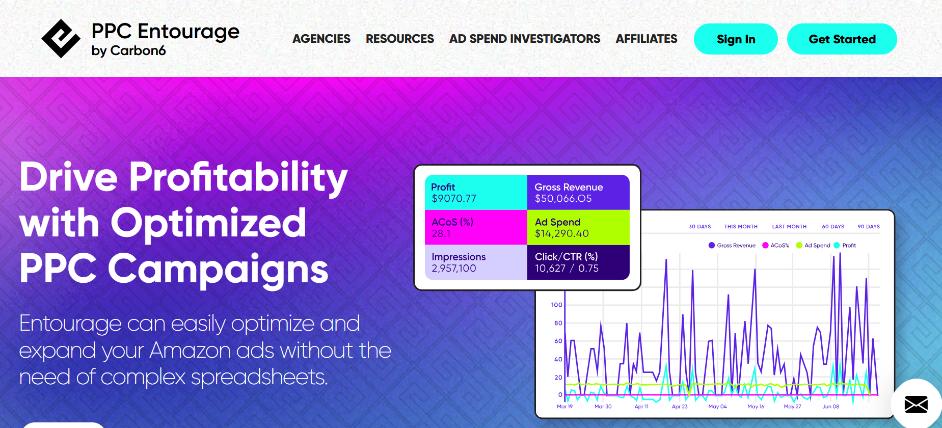
PPC Entourage is an excellent tool that excels with tactical keyword management and excels at tactical keyword management and building clean, margin-aware campaign structures. It’s ideal for private-label brands refining campaign efficiency.
Here are some of the key highlights of PPC Entourage:
- This tool has pretty effective search term expansion and negative marking capabilities. You can easily mine by converting search terms and even auto-flag unprofitable or irrelevant ones.
- PPC Entourage comes with a blueprint campaign builder. Specifically, templates for Sponsored Product campaign architecture from scratch.
- One of the features we absolutely loved was the ability to set threshold-based rules. We managed to set limits to auto-pause wasteful terms after X clicks or high ACoS.
- Another aspect that stood out was the consolidation of PPC cost with product COGS to surface true ROI.
What are the limitations of PPC Entourage?
- Lacks AMC data, real-time AI optimization, and deep automation capabilities.
Best For: Smaller private-label sellers aiming to clean up campaign waste and structure accounts for long-term scale.
4. BidX – AI-Led PPC With Budget-Centric Campaign Control
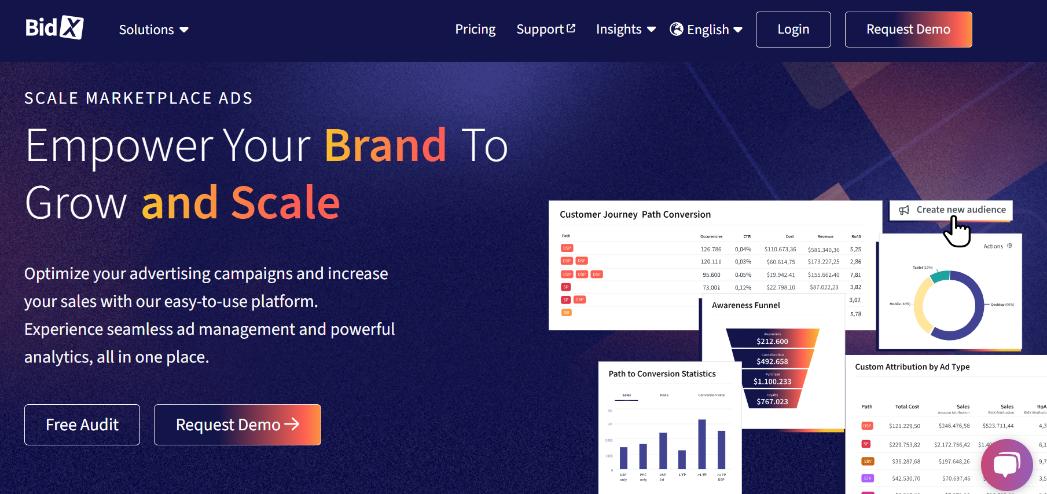
BidX combines full automation with optional manual controls. It’s strong for sellers managing strict budgets or operating across EU marketplaces. Here are some of the top features:
- Trained on conversion and marketplace data, BidX comes with a built-in AI engine that adjusts bids daily based on your goals.
- Allows optional custom rules on CTR, CVR, ACoS, or impressions.
- Useful for EU sellers operating across Germany, France, Italy, UK, which includes currency-adjusted performance tracking.
- Additionally, automatically promotes or demotes keyword & ASIN harvesting.
- BidX offers an incredibly unique advantage. This tool empowers you to plan campaigns around budget ceilings rather than bidding alone. This feature makes it great for sellers who tend to execute controlled ad spend strategies.
Best For: International sellers or agencies needing smart automation without needing to micro-manage campaigns.
5. Helium 10 Adtomic – PPC Inside the Helium 10 Ecosystem

Adtomic is the PPC module inside Helium 10’s suite. While it lacks the depth of standalone tools, it’s powerful if you’re already using Helium 10 for research, tracking, and listing optimization. Here are some of the key strengths of Helium 10’s Adtomic:
- You gain access to campaign templates. Specifically, you can launch Sponsored Products and Brands from keyword clusters found via Cerebro or Magnet.
- Based on profitability targets and conversion data, you get access to smart bid recommendations.
- Assist you in converting high-performing terms from auto to manual campaigns. Like SellerApp, Helium 10 offers search term harvesting capabilities.
- Ultimately, Helium 10 is known for its Keyword research prowess. You can use magnet + Cerebro data inside the PPC interface for better targeting.
Watch-Outs: No advanced rule-based workflows, negative keyword automation, AMC integration, or margin-level insights.
Best For: Helium 10 users adding PPC as part of their broader listing and keyword strategy. Especially in early growth stages.
6. Teikametrics Flywheel 2.0 – Multi-Channel AI Optimization With Retail-Aware Signals
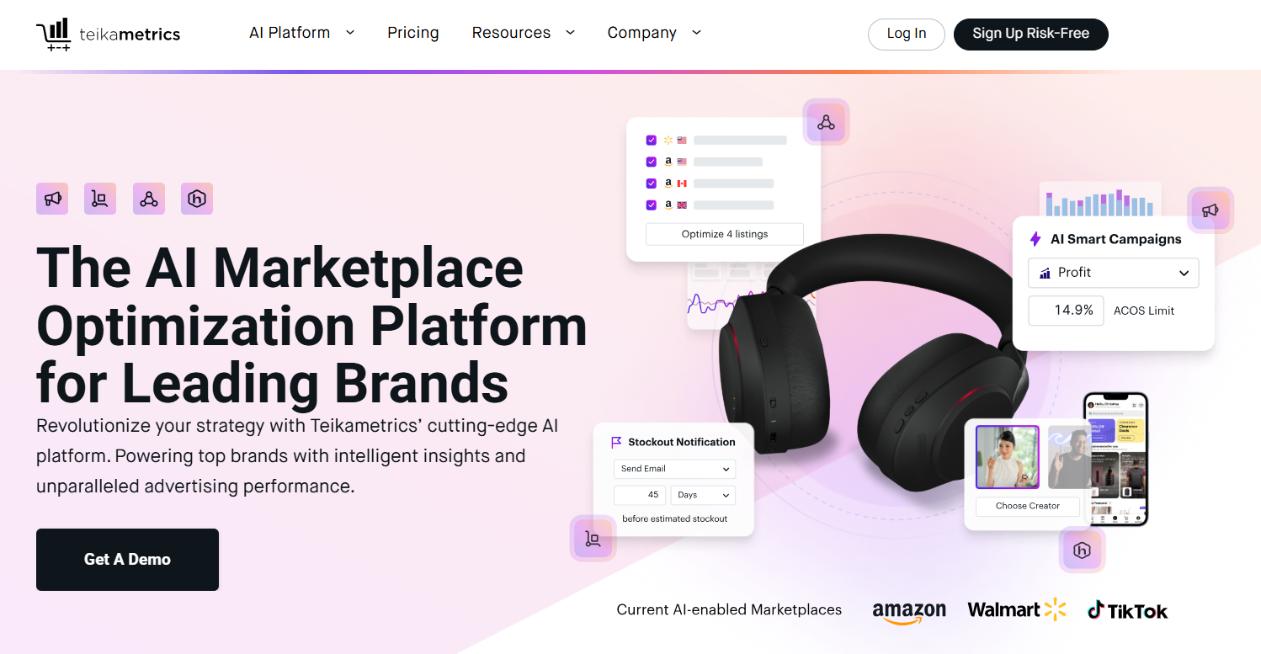
Teikametrics is a strong contender for brands selling across both Amazon and Walmart, especially those looking to tie their advertising to real-time inventory, Buy Box metrics, and profitability thresholds. Here’s what stands out when it comes to Teikametrics:
- You gain access to a pretty powerful AI. Flywheel’s algorithm factors in inventory levels, pricing changes, and Buy Box ownership, ensuring you don’t waste spend on SKUs that are out-of-stock or underperforming on price.
- Supports Amazon, Walmart, and Target, making marketplace expansion incredibly effective. In fact, the process is made significantly easier with a unified dashboard that gives a clean view across platforms without switching UIs.
- You can easily move terms between Auto, Broad, Phrase, and Exact campaigns based on conversion signals, without setting up rules..
- Tracks gross margin impact, ad spend vs. organic lift, and even competitive pricing influence on campaign performance.
Although we loved using the tool, we felt that the rule-based automation was minimal. Most of the system was algorithmically driven, which isn’t great for sellers who want to define their own keyword or bid logic.
Best For: Mid to large brands selling across Amazon and Walmart who want automation that adapts to inventory and Buy Box changes.
7. Perpetua – Goal-Based Advertising With DSP and Video Access
Perpetua is built for performance marketers focused on scaling Sponsored Brands Video, DSP, and core campaigns without getting into the weeds of bid-level tuning. In fact, it’s quite the beast when it comes to DSP. Here are some of the key advantages of Perpetua:
- You can set your ACoS, ROAS, or visibility goals, and Perpetua allocates budget across campaign types accordingly. The AI engine runs continuous bid adjustments.
- Amazingly, you can get native support for SBV and DSP placements. Useful for brand-first campaigns or remarketing.
- What we loved the most was the performance visualizations. Strong visual dashboards showing top-performing creatives, keyword trends, and sales attribution.
- Perpetua gives you real-time performance alerts and snapshots on the go, which is significantly helpful for fast-moving teams.
Now, what we absolutely loved was the creative support. There’s an Integrated creative marketplace if you need help producing SBV assets or optimizing visuals. However, on the PPC side of things, there was a lack of rule-building or deep campaign structuring flexibility.
Best For: DTC brands scaling fast and looking to combine creative campaigns (SBV/DSP) with performance goals under a clean, centralized dashboard.
8. Quartile – Managed AI Advertising for High-Volume Sellers
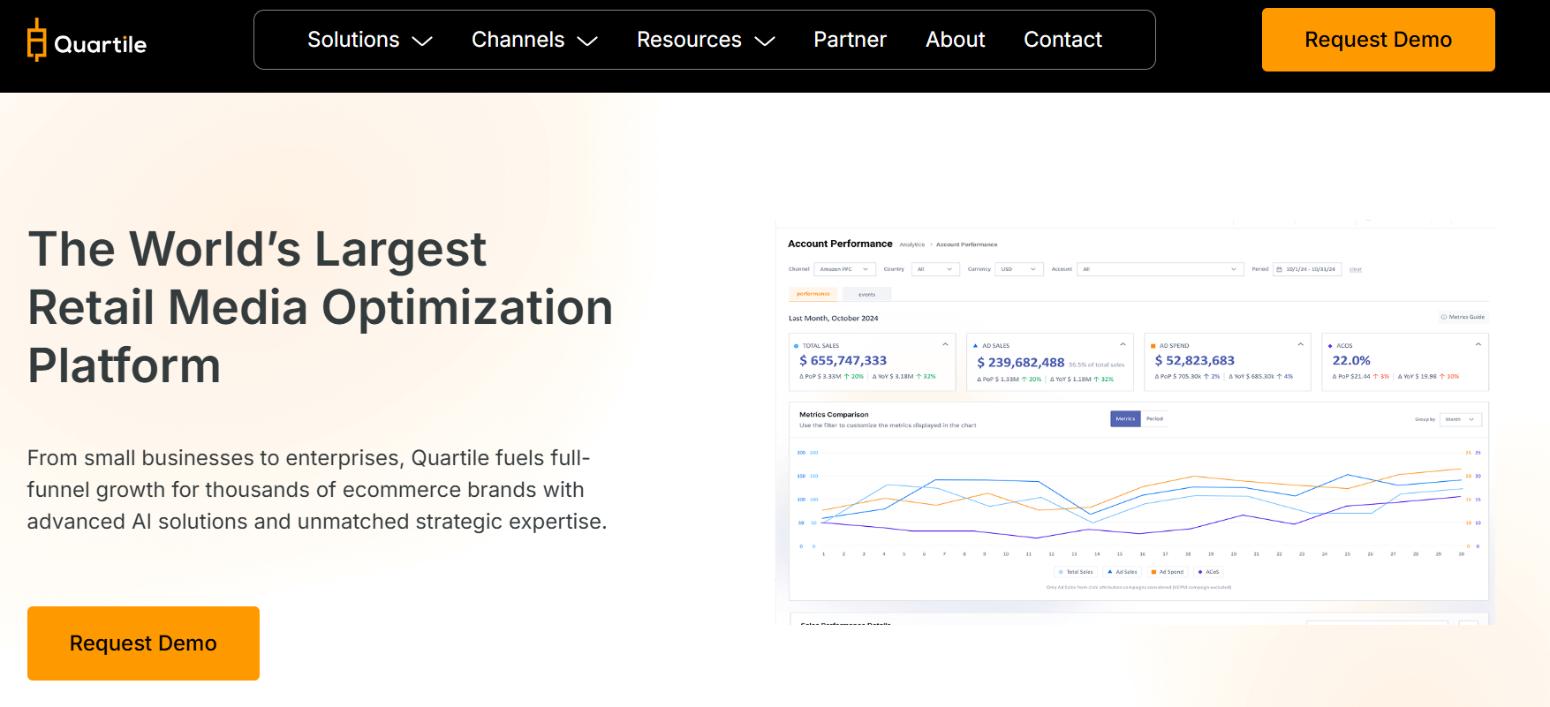
Quartile combines machine learning and account management to offload end-to-end optimization, ideal for sellers spending $ 50 K+ on ads monthly. Here’s what’s included:
- Automatically shifts search terms across match types, manages budgets, and sets negatives, learning over time from performance trends.
- You can segment campaigns by ASIN groupings, goal types (launch vs. scale), and intent tiers.
- Dedicated account managers support strategy, campaign audits, and optimization tracking.
- The tool empowers you to scale Amazon globally and includes built-in localization strategies for expansion.
- Loved the organic rank tracking. You can essentially measure the PPC influence on organic rank changes over time for core products.
However, surprisingly, you don’t get control over workflows, rules, or daily actions. Most of the logic is managed on their end, making transparency a challenge.
Best For: High-volume brands or aggregators who want advertising offloaded but still expect growth tied to efficiency.
9. Zon.Tools – Precision Rule Builder for Advanced PPC Managers
Zon.Tools is built different. It’s a no-frills, high-control automation engine tailored for seasoned managers who want to scale existing strategies. However, it’s still quite niche in execution as there’s no AI to rely on. Here are some interesting capabilities:
- You can create detailed performance rules based on any metric: ACoS, ROAS, CTR, orders, CVR, even hourly time blocks.
- Easily manage bulk campaigns. You can also execute mass edit campaigns, ad groups, and bids across large catalogs with granular filters, which is cool. But we’ve seen it in other tools as well.
- We could also set automated rules for pausing, negating, or quarantining non-converting terms at the keyword or ASIN level.
There’s a pretty effective dayparting feature that can help you schedule campaigns to start/stop by hour or day. Great for brands with data showing peak conversion windows.
Best For: Experienced PPC managers or agencies with strong internal playbooks looking for pure automation flexibility without black-box AI.
10. Downstream by Jungle Scout – Retail Media Analytics With Strategic Visibility
Well, Jungle Scout was bound to make this list. However, it’s important to note that Downstream isn’t a bid management tool; it’s more of a retail media analytics platform that connects advertising to business-level outcomes.
This is Ideal for in-house brand teams reporting to leadership. Here’s what you can do with Downstream:
- Share of Voice & Shelf Metrics. You get to track branded vs. competitor visibility across search placements and page positions.
- You can effectively access Buy Box monitoring features and track the impact of ad spend. See how your campaigns influence Buy Box win rates and price competitiveness.
- Downstream breaks down performance by Sponsored Products, Brands, Display, and retail readiness.
- One of the most amazing features we’ve come across is that this tool has the ability to customize the dashboard for teams. You can tailor reports for execs, marketers, or finance—great for internal storytelling.
Since it’s a part of Jungle Scout, you’ll also find that this tool integrates with the rest of the Jungle Scout Stack, making it useful if you are already using it for product research, tracking, and competitive analysis.
Unfortunately, there’s no campaign or bid automation, and it can’t completely replace a PPC platform. It made this list as it’s incredibly helpful as a secondary tool that sits on top of your PPC tool, as it helps with strategy-level optimization.
Best For: Brand managers, retail media teams, or finance leaders who need to track how ad dollars influence market share and category performance.
How to Choose the Best Amazon PPC Software for Your Business?
Not all PPC tools are built the same. Some offer full automation that’s further split into rule-based automation and AI automation, while others give you too much data without any intuitive features, making it incredibly difficult to use. And, of course, there are several tools that are simply reskinned dashboards that offer zero functionality.
Now, if you need assistance in optimizing your campaigns effectively and not a simple overglorified report dashboard, here’s what you’ll need to look for when you choose your optimization software:
1) Fast, Clean UI (Because You’re In It Every Day)
Ultimately, you’re going to be spending hours inside the tool, and the UI will matter. After all, you don’t want to get fatigued. This is why the best Amazon PPC software out there use fast, intuitive dashboards that have a breakdown of all critical metrics. Bonus points if it’s broken down by inline edits and annotations so your team stays in sync.
2) Built for Both Analysts and Advertisers
It’s important to note that you don’t need to simply have a bunch of raw data. You need answers. The best tools will surface actual insights, not just CTRs and CPCs. Look for software that tells you why a campaign is not performing. Moreover, you also need to understand what’s eating into your margin, if you’re bidding is effective, or how you’re not making the most of your ad budget.
3) Customizability That Doesn’t Break Workflow
A certain level of customization is incredibly important. For example, you should be able to access automation or set rules to stabilize your TACoS at 15% and systematically scale. Or the platform should be capable of effectively helping you achieve specific goals. For example, doubling down on acquiring NTB customers during a product launch.
The tool should be, ultimately, capable of supporting your logic and not just force you into your predefined templates.
3. Search Term-Level Precision
Really good PPC tools will let you manage campaigns at the most granular level: the search terms. Meaning, you’ll be able to find not only insights that drive your business forward by moving high-performing search terms from broad match to exact match. You’ll also be able to effectively understand how each term impacts your overall keyword strategy.
4. Cross-Campaign Budget Intelligence
Seasoned campaign managers will know that budgeting isn’t just about setting daily limits. It’s about knowing which campaigns deserve more fuel and which ones need to be terminated immediately. Now, to pull this off effectively across several campaigns, campaign types, and ASINs without needing several spreadsheets, you’ll need an Amazon PPC software.
5. Data You Can Trust
You’re bid strategy, logic, campaign insights, and overall performance decisions will only be as effective as the data. This is why you’ll need an effective tool that offers direct integration with the Amazon Ads API to avoid delays or sampling errors. These tools are critical as they help maintain high data fidelity as well.
6. Support That Actually Knows Amazon Ads
Now, support is something that you will absolutely need. After all, keeping abreast with the latest Amazon PPC best practices, Algorithm changes, and simultaneously running split testing will result in you running into several roadblocks.
So, when it comes to troubleshooting, you can’t just rely on chatbots. You will need to reach out to a seasoned Amazon ads specialist who can not only guide you but also help you understand how the dashboard ties into solving that specific pain point.
Only an actual human who’s optimized accounts, ad lifecycles, and understands how to solve issues like search suppression, buy boxes, and poor ad relevance scores will be able to help you navigate the PPC Tool and even help you understand its use cases.
Final Thoughts
Amazon advertising in 2025 is way different than than the early 2020s. Now, it’s about who optimizes smarter, faster, and with better data fidelity. To pull this off, you’ll absolutely need to take advantage of one of the PPC tools on this list. Especially, as these tools have been engineered to deliver incredible systems of insights.
With a good Amazon PPC software such as SellerApp, you’ll be able to easily spot a $10,000 leak hiding behind a bloated Sponsored Brands campaign, or a high-converting ASIN buried in an auto campaign.
Moreover, these tools will come in handy if you’re managing multi-geo accounts, integrating AMC workflows, or tracking TACoS across product lifecycles that require a command center of sorts.
The absolute bottom line is to choose the tool that aligns with how you think. Whether you’re a data-heavy operator or a rules-based strategist, or if you’re thrown into the deep end and have been asked to manage 200+ SKUs with thin margins. The tech’s mature enough now to stop settling.
The post Best Amazon PPC Software: 10 SaaS Tools to Help You Improve Your Campaign Performance appeared first on Amazon-ASIN Blogs - Latest from Amazon Sellers: News, Advice, and Effective Strategies.
]]>The post A Comprehensive Guide to Amazon Product Attribute Targeting for Sales Surge appeared first on Amazon-ASIN Blogs - Latest from Amazon Sellers: News, Advice, and Effective Strategies.
]]>Amazon is the largest online retailer globally, with millions of customers searching for products every day. To make your products more visible and increase sales, it’s crucial to understand how to effectively use product attribute targeting.
In this strategic guide, we will explore how to leverage Amazon product attribute targeting to optimize your product listings, reach your target audience, and ultimately boost your sales. By implementing these tactics, you can increase your visibility and improve your chances of success in the competitive world of Amazon sales.
A Quick Peek into the Content:
- What are Amazon product attributes Targeting?
- Understanding the benefits of product targeting on Amazon
- How to identify the right product attributes for targeting
- Best Strategies for Product Attribute Targeting
- Step-by-Step Guide to Setting Up a New Product Targeting Campaign on Amazon
- Optimizing your product targeting ads on Amazon
- Utilizing negative product targeting in Amazon
- Conclusion
What are Amazon product attributes Targeting?
Amazon product attribute targeting allows you to target potential customers based on the attributes of products they’ve viewed or purchased. This powerful targeting option allows you to reach audiences that have expressed interest in specific types of products.
For example, say you sell hiking boots. You could create an ad targeted at customers who have recently viewed or purchased products like:
- Backpacks
- Hiking socks
- Trail snacks
- Camping tents
By targeting these related product attributes, you’ll reach people actively shopping for hiking gear and more likely to be interested in your boots.
How does attribute targeting work?
Amazon uses the product attributes and categories to determine a customer’s interests and likely future purchases. When a customer views or buys a product, Amazon captures attributes like:
- Brand
- Price
- Category
- Color
- Size
- And more
Amazon then uses these attributes to build an interest profile for each customer. Your ads can target specific attributes that match your product to reach the most interested shoppers.
Why is Amazon Attribute Targeting so effective?
Attribute targeting works so well because it allows you to reach high-intent customers at the perfect moment. By targeting recent views and purchases of complementary products, you’ll reach shoppers:
- Already primed for a purchase in your product category.
- Actively researching and comparing options.
- Ready to buy from a brand they trust.
This precision targeting results in higher click-through rates, lower costs, and increased sales. While broad targeting casts a wide net, attribute targeting uses a precision rifle to reach only the most promising prospects.
Understanding the benefits of product targeting on Amazon
On a platform as massive as Amazon, strategically optimizing your product listings is key to driving more traffic and boosting sales. Targeting your products to the right audiences can make a huge difference.
Reach More Potential Customers
By selecting product attributes to target your listings to, you open them up to more shoppers who are specifically searching for those Amazon product attribute. If you’re selling a waterproof fitness tracker, for example, targeting attributes like “waterproof”, “fitness”, and “activity tracker” would expose your listing to anyone searching those terms.
Higher Conversion Rates
When shoppers land on a listing that precisely matches what they were searching for, they’re more likely to buy. Targeting helps ensure your listings are shown to those with a high purchase intent for that type of product. Studies show Amazon product attribute targeting can increase conversion rates by up to 25%.
Improved Ranking
The more relevant your listing is to searchers, the higher Amazon will rank it in results. Targeting product attributes helps establish relevancy, which translates to better ranking. The higher your listing ranks, the more visibility and traffic it will get.
Valuable Insights
The attributes you target also provide insights into what customers are searching for and interested in. You can use this data to make informed decisions around things like product development, bundling, and marketing. The attributes driving the most traffic to your listings are clearly resonating with your target audience.
How to identify the right product attributes for targeting
To boost your sales on Amazon through product attribute targeting, you first need to determine which attributes are most relevant for your products. Some attributes, like brand, size or color, may seem obvious. But dig deeper—there are more niche attributes that could help you reach very specific segments of buyers.
Focus on your product category
Start by evaluating the standard attributes used to describe products in your category. For books, this includes attributes like author, publication date, genre and language. For clothing, consider attributes such as style, pattern, neckline and sleeve length. Choose 3-5 of the most distinguishing attributes for your products. These will be the attributes you want to target.
Consider your customer base
Think about the types of customers who buy your products. What attributes do they commonly filter or sort by? If you sell children’s toys, customers may filter by age range, brand and toy type. For gardening tools, attributes like tool type, blade size and handle material are likely to resonate with buyers. Choose attributes that align with how your target customers shop.
Check competitor’s listings
See what attributes your competitors are using in their product listings and target those same attributes. Some competitors have already done research to determine what attributes resonate most with their shared customer base. You can piggyback off their work. Look for attributes they prominently feature, especially those used in product titles, bullet points and enhanced product descriptions.
Analyze your sales data
If you already have sales data, dig into it to detect patterns. Are certain attributes associated with higher sales volumes or conversion rates? For example, you may find products targeting the “mystery” or “science fiction” genre sell very well for your books. Or clothing in “petite” and “plus” sizes could be top sellers. Let data-driven insights guide your attribute targeting.
With the right Amazon product attributes identified and targeted, you’ll be poised to boost sales on Amazon. Keep testing and optimizing to reach the most potential buyers and truly master the art of attribute targeting.
Best Strategies for Product Attribute Targeting
Identify your best selling products
Take a look at your sales data to see which products are generating the most revenue and selling the fastest. These are your winners that you’ll want to focus on for targeting. See if there are any common attributes among these products, like a specific brand, size, color or other feature. These attributes are resonating with your customers and driving sales.
Research customer reviews and questions
Dig into the reviews and questions on the product pages for your bestsellers. Look for any mentions of attributes that customers say they particularly liked or were interested in. For example, if customers frequently call out a product’s durability or ease of use, those are attributes you’ll want to highlight in your targeting. Pay attention to any attributes that come up again and again.
Choose highly searched attributes
In addition to attributes mentioned in reviews, you’ll want to target attributes that customers are actively searching for. Use a keyword research tool to see which product attributes and related terms are most searched for in your category. The more searched an attribute is, the more customers are interested in and looking for products with that attribute. These highly searched attributes should be priorities in your targeting strategy.
Test and optimize different attributes
Start testing different attributes in your product targeting to see which ones resonate most with your customers. You might target attributes like brand, size, color, features, materials or certifications. Measure which attributes drive the most traffic to your product pages and ultimately the most sales. Then double down on the attributes that are performing the best, and consider dropping or revising any underperforming attributes.
Continuously optimizing your product attribute targeting based on sales data, customer feedback and search trends will help boost visibility of your bestselling products. And the more targeted traffic you drive to those products, the more your sales and revenue will grow. With the right combination of product attributes highlighted, you’ll tap into what your customers want and keep them coming back for more.
Step-by-Step Guide to Setting Up a New Product Targeting Campaign on Amazon
The key to boosting sales on Amazon is reaching the right customers with your product listings. Setting up a product targeting campaign allows you to show your products to shoppers who are most likely to buy them. Here’s how to create a campaign and get started:
Choose Your Product Targeting Type
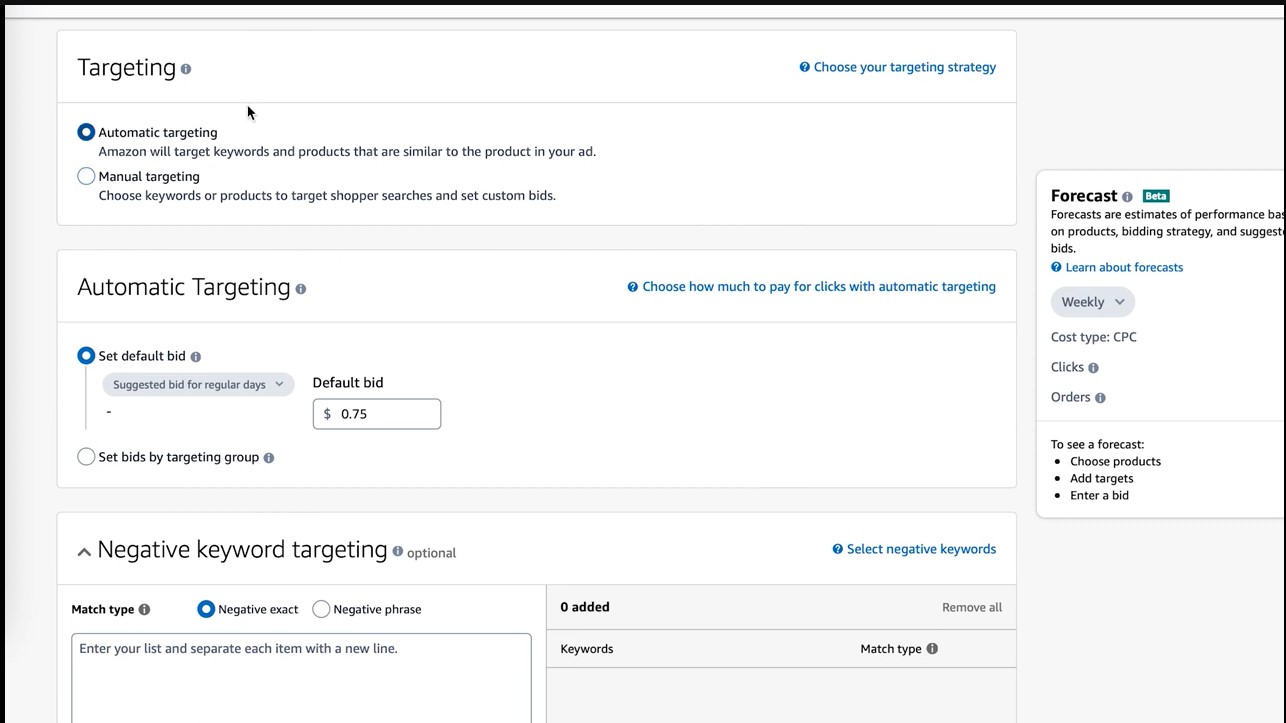
There are two options: automatic targeting and manual targeting. Automatic targeting uses Amazon’s algorithm to determine the best audiences and keywords for your products. Manual targeting gives you full control to choose audiences and keywords yourself. For most sellers, automatic targeting is the easiest way to get started. You can always switch to manual targeting as you gain experience.
Select Campaign Details
Next, give your campaign a name and budget. A good rule of thumb is to start with a budget of at least $25 per day. Choose a duration of either continuous or for a fixed time period. For your first campaign, continuous is a good choice.
Choose Your Products
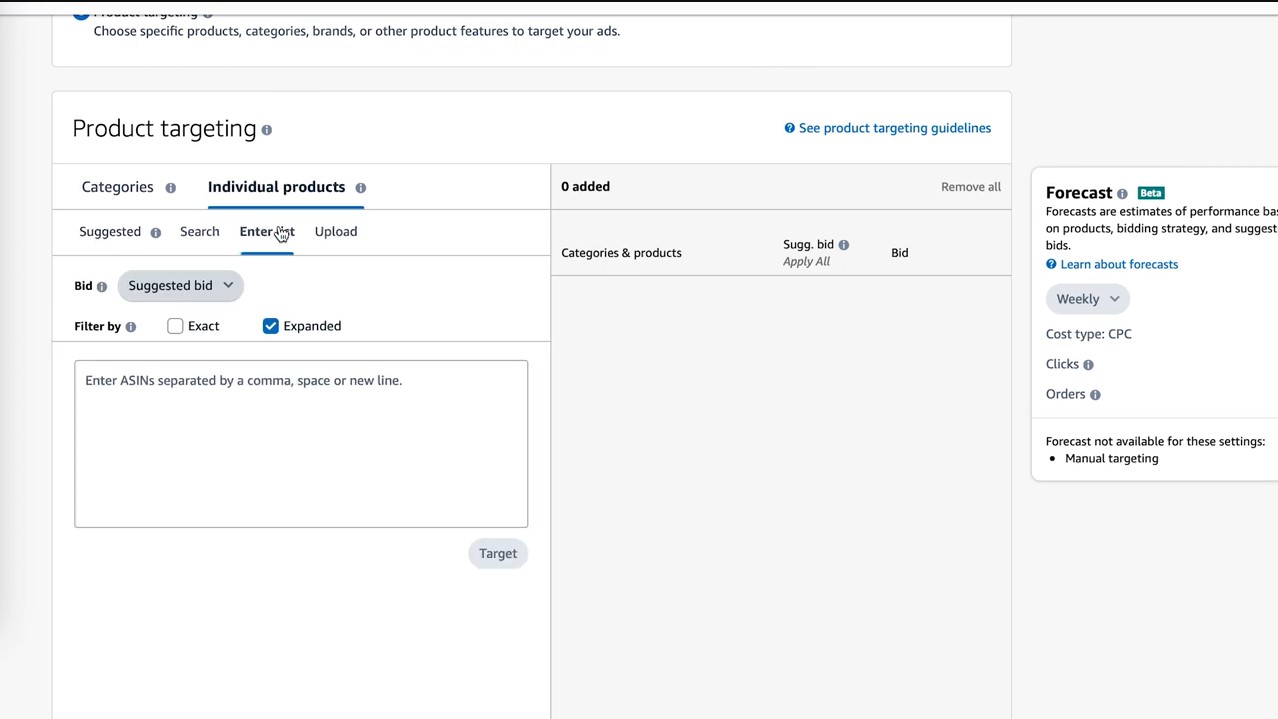
Add the ASINs or SKUs of the products you want to target. You can include up to 100 products in a single campaign. Focus on a small group of related products to start, so you can optimize the campaign before expanding to more products.
Review and Launch
Amazon will automatically generate suggested keywords and audiences for your campaign based on the products you selected. Review these and make any changes you want. When you’re satisfied, launch your campaign to start reaching targeted shoppers right away.
Optimize and Improve
Check on your campaign regularly to see how it’s performing. Look at metrics like impressions, clicks, conversion rate, and sales. Make changes to improve add or remove keywords and audiences, increase or decrease your budget, or edit product listings. Product targeting takes continuous optimization to maximize your results.
With the right audience targeting and content, product targeting campaigns can significantly boost traffic and sales. Start small, track your metrics, and optimize over time for the best performance. You’ll be reaching the perfect customers for your products in no time!
Optimizing your Product Targeting Ads on Amazon
Choose Relevant Keywords
To optimize your product targeting ads, focus on using relevant keywords that accurately describe your product. Think about what words your potential customers might actually search for to find a product like yours. Include product category, function, features, brand, and model names.
For example, if you’re selling a blue casual cotton dress, use keywords like “blue dress,” “casual dress,” “cotton dress,” as well as more specific terms like “short sleeve dress” or “knee length dress.” Also include words that refer to the style, cut or pattern of the dress like “A-line,” “shift,” or “floral print.”
Amazon allows you to use up to 5 keywords for your product ads, so choose them wisely based on potential search volume and relevance. Review the search terms report in your Amazon Seller Account to see what words customers are actually using to find your product.
Optimize Your Copy and Images
Well-written ad copy and high-quality images are key to catching customers’ attention and driving more traffic to your product listing. Focus your copy on the key benefits and features of your product using an enthusiastic and compelling tone. Keep your text brief, around 2 short sentences or a short paragraph.
Use eye-catching product images that show your item clearly against a plain white background. Make sure the main image shows the entire product so customers know exactly what they’re getting. Include close-up detail shots and lifestyle images when possible to give a better sense of your product in use.
Choose Relevant Product Targeting Types
Amazon lets you target ads to specific products, brands, categories or search terms. For the best results, choose targeting options that are highly relevant to your product. Target competing products or brands, or categories and subcategories that directly relate to your item. Broad search term targeting typically leads to lower click-through rates, so start narrowly focused.
Monitor your ad performance and make changes to improve your click-through rate and conversion rate. Adjust your keywords, copy, images or targeting to optimize your ads over time. With the right targeting and optimization, product ads can be an effective way to increase sales on Amazon.
Utilizing negative product targeting in Amazon
Negative product targeting allows you to exclude certain products from showing up as suggested or related items to your listing. This strategic method can help boost your product’s visibility and sales on Amazon.
As a seller, you want shoppers focused on your product, not distracted by competitors. By blocking certain products from appearing alongside yours, you refine the selection and gain more prominent placement. Say you sell a particular model of Bluetooth speaker. You could block suggestion of other brands’ comparable speakers to position yours as the top choice for customers.
To utilize negative product targeting, you will need to provide Amazon the ASINs (Amazon Standard Identification Number) of products you wish to block. You can find a product’s ASIN on the product detail page URL or by using a free ASIN lookup tool.
Once you have the ASINs, here are the steps to block products:
- Log in to Seller Central and go to Advertising > Negative Product Targeting.
- Click “Create targeting rule”. Select the product you want to target by entering its ASIN, UPC or keyword.
- Choose whether you want to target all products under a brand or only specific products. Enter ASINs of individual products or use brand name to block all products of a brand.
- Select the categories and subcategories where you want to block the products. You can choose from categories your product is listed under.
- Name your rule and save it. The rule will start blocking products within 1 hour.
- Check how your negative product targeting is impacting your product and make changes as needed. You can delete or edit rules at any time.
Negative product targeting is a powerful way to optimize your product placement and boost sales on Amazon. Be strategic with your choices and start with blocking your closest competitors. See how customers respond and make adjustments to continue improving your product’s visibility. With the right negative targeting in place, your product can reach more shoppers and sell more units.
Conclusion
You’ve learned the key steps to boosting your Amazon product sales through attribute targeting. By focusing on the product details that set you apart, you can reach high-intent customers and increase conversions.
To recap, start by determining what makes your product unique. This could be a special feature, patented technology, organic ingredients, or anything else that differentiates you from competitors. Emphasize these attributes in your product listings by using emotive and persuasive language, visuals like professional photos, and specific keywords.
Next, build your ad campaigns around these attributes. Use responsive search ads that prominently feature your key selling points. Bid on keywords related to your unique attributes and the benefits they provide. This helps ensure your ads are shown to people specifically looking for what you offer.
Finally, optimize your product detail page to highlight your key attributes. Place attribute information, visuals and persuasive copy “above the fold” where visitors see it first. Use consistent messaging across your title, bullets, description and images. Offer free trials, samples or demos when possible so customers can experience your product attributes firsthand.
By leveraging these strategic techniques, you can achieve product attribute targeting mastery. Your high-value, differentiated offerings will get noticed, desired and purchased by those looking for exactly what you sell. Sales and profits increase as you attract and convert ideal customers effortlessly.
The post A Comprehensive Guide to Amazon Product Attribute Targeting for Sales Surge appeared first on Amazon-ASIN Blogs - Latest from Amazon Sellers: News, Advice, and Effective Strategies.
]]>The post Amazon PPC Strategy Secrets: Proven Tactics for Boosting Sales and Visibility appeared first on Amazon-ASIN Blogs - Latest from Amazon Sellers: News, Advice, and Effective Strategies.
]]>Quick Guide:
- Why is an effective Amazon PPC strategy important?
- Key metrics to track for Amazon PPC success
- Advanced Amazon PPC strategies for driving traffic and sales
- Leveraging Amazon-sponsored products for increased visibility and sales
- Amazon PPC hacks for boosting conversion rates and profitability
- Conclusion
Why is an effective Amazon PPC strategy important?
A good PPC (pay-per-click) strategy on Amazon is crucial for success as a seller. It allows you to drive targeted traffic to your product listings by bidding for ad placements on the Amazon search results page. The more effective your PPC campaigns are, the more visibility and sales your products will get.
Increase Product Visibility
With Amazon PPC ads, your products will appear higher up in the search results, making them more visible to potential customers. The ads feature your product image, title, price and a short promotion to grab attention. For new products, PPC is essential for gaining exposure until you build up organic rankings.
Reach More Potential Customers
PPC ads on Amazon put your products in front of people actively searching for items like yours. Those searchers have a higher chance of converting into customers. With the right targeting, you can reach potential customers interested in your particular product category, brand or niche.
Higher Conversion Rates
Customers who click on your PPC ads tend to have a higher purchase intent since the ads match their search query. This can lead to higher conversion rates compared to organic traffic. By optimizing your PPC campaigns, you can achieve conversion rates of 10-30% or even higher for some products.
Valuable Data to Optimize Campaigns
Amazon PPC provides data and metrics to help you optimize your campaigns. You can see impressions, clicks, spend, sales, ROI and more for each ad and keyword. Analyze what’s working and make changes to improve performance over time. With regular optimization, you’ll achieve lower costs per click and higher returns on your ad spend.
In summary, a well-optimized PPC strategy on Amazon can be a game changer for your business. It allows you to gain more control over your product visibility, reach high-intent customers, boost conversion rates and ultimately drive more sales. The key is starting with a strong PPC foundation and continuously optimizing based on the data.
Key metrics to track for Amazon PPC success
To optimize your Amazon PPC campaigns, you must closely monitor key metrics that provide insights into your ads’ performance. By tracking these numbers, you can make data-driven decisions to improve your PPC strategies over time.
Impressions
This number represents how many times your ad has been shown to shoppers on Amazon. A higher number of impressions means more visibility for your product listing. However, too many impressions with few clicks can signal your ad isn’t compelling or targeted properly. Aim for an impressions-to-clicks ratio of at least 1:10.
Clicks
The number of clicks shows how many shoppers have tapped on your ad. More clicks usually mean a higher product ranking and sales. Track your click-through rate (CTR), which is your clicks divided by impressions. A CTR of 1-3% is average for Amazon PPC ads. If your CTR is low, try changing your ad copy or targeting to improve relevance.
Spend
Your total PPC spend includes how much you’re paying Amazon for each click and impression. Closely monitor your daily and monthly budgets to ensure you’re maximizing your ad’s potential without overspending. Make adjustments as needed to your bids and budgets to achieve a target cost per click (CPC) and return on ad spend (ROAS).
Conversions
The ultimate goal of your PPC campaigns is to drive sales and conversions of your product listings. Regularly check your total orders, units sold, and sales from your PPC ads. Then calculate your conversion rate and ROAS to determine if your PPC strategies are profitable. Tweak your ads and budgets to improve your numbers over time.
By frequently analyzing these key metrics, you’ll gain valuable insights into how to refine your Amazon PPC campaigns for optimal success. Making data-driven decisions based on performance will help you achieve your goals and maximize your advertising ROI.
Advanced Amazon PPC strategies for driving traffic and sales
Once you’ve mastered the basics of Amazon PPC, it’s time to dive into some advanced strategies to boost your traffic and sales.
Target high-value keywords
Rather than bidding on broad match keywords, focus on targeted phrase, exact match keywords and longtail keywords that are relevant to your specific products. These high-value keywords, like product names and model numbers, are more likely to lead to conversions since they show your ads to people who are actively searching for what you sell.
Adjust bids based on performance
Don’t leave your PPC bids static. Monitor how your ads are performing and make regular adjustments to your keyword bids. Increase bids on keywords that are driving a high volume of clicks and sales. Decrease bids or remove underperforming keywords that aren’t generating results.
Use negative keywords
Negative keywords prevent your ads from showing for certain search terms. Add negative keywords like ‘free’ or ‘cheap’ to avoid attracting bargain hunters. You can also add the names of competitors or complementary products as negative keywords. This helps ensure your ads are only shown for relevant searches.
Create product targeting campaigns
Rather than running one big campaign for your entire catalog, create separate campaigns for your key products or product categories. This makes it easier to optimize bids and ad copy based on how each product performs. You have more control over driving traffic to your bestselling and highest margin products.
Use dynamic ad copy
Take advantage of dynamic ad copy to automatically customize your headline and ad copy based on the keyword or product someone searches for. This results in highly targeted ads and higher click-through rates. You can include things like product names, attributes, sizes, etc. in your ad copy which will change dynamically based on the search.
Monitor and optimize regularly
PPC success doesn’t end after launching your campaigns. Monitor your key metrics like impressions, clicks, spend, and sales regularly and make optimizations to improve performance. Pause underperforming ads and keywords. Increase bids on high-performing ones. Update ad copy and images. The more you optimize, the better your results will be.
Leveraging Amazon-sponsored products for increased visibility and sales
Amazon-sponsored products, like Sponsored Products and Sponsored Brands, are advertising opportunities that allow you to promote your listings to shoppers on Amazon. By bidding on targeted keywords, your listings can appear at the top of search results and on product detail pages. This increased visibility leads to more clicks and conversions.
Choose the right campaign type
Sponsored Products campaigns let you bid on individual keywords to promote specific products. This is ideal if you want to drive traffic to bestselling items or new product launches. Sponsored Brands campaigns promote your brand and product portfolio. They appear at the top of search results and include your brand logo, a headline, and up to three of your products. Both campaign types allow you to set custom bids by keyword to maximize your budget.
Optimize your targeting
Carefully choose the keywords you want to bid on based on your products and brand. Look for high-volume search terms that are directly relevant to what you sell. You can also leverage Amazon’s auto-targeting feature to automatically target relevant keywords. Focus on terms that generate a high conversion rate to sales. Review and refine your targeting over time based on performance.
Set the right bid prices
You want to bid high enough to gain strong visibility in search results but not so high that your budget is depleted quickly. A good rule of thumb is to start with the suggested bid and then adjust based on your performance goals. For the best results, you may need to set different bids for different keywords. Monitor your campaign regularly and make changes to capture the most value from your advertising budget.
Measure and optimize
Analyze metrics like impressions, clicks, sales, and return on advertising spend (ROAS) to see how your campaigns are performing. Make adjustments to improve results over time. You may need to add new keywords, remove underperforming ones, or adjust your bids. Small tweaks can lead to big benefits, so ongoing optimization is key to success with Amazon-sponsored products.
With the right strategy, Amazon-sponsored product campaigns can significantly boost your brand visibility and drive more sales. But as with any advertising, you need to invest the time to manage your campaigns properly to gain the best returns.
Amazon PPC hacks for boosting conversion rates and profitability
Optimize your product listings
The content and images in your product listings have a direct impact on your PPC campaign’s performance. Compelling titles, descriptions, and high-quality photos will capture shoppers’ attention and increase click-through rates. Make sure your listings highlight the key benefits and features of your products. Keep your content concise yet persuasive.
Choose the right match types
Amazon PPC offers three match types: broad, phrase, and exact. Broad and phrase matches will show your ads to more potential customers but may result in lower conversion rates. Exact matches target shoppers specifically searching for your product by name, so they often convert better. Testing different match types for your campaigns can help find the right balance to optimize your ad spend.
Set a reasonable daily budget
While it can be tempting to set an aggressive daily budget in hopes of gaining more traffic and sales, this strategy often backfires. Start with a modest daily budget that you can afford, even during slow periods. As your PPC performance improves over time through optimization, you can consider gradually increasing your budget. It’s best to make incremental changes so you can monitor the impact on your key metrics like ACoS and ROAS.
Bid for high-performing keywords
Not all keywords perform equally for driving sales and profits. Focus your PPC spend on keywords that have historically generated the most revenue or conversions for your products. You can view keyword performance data within your Sponsored Products campaign dashboard to determine which search terms deserve the highest bids. Reduce or eliminate bids for underperforming keywords.
Monitor and optimize regularly
The key to successful Amazon PPC is continuous optimization based on performance data. Check your campaign metrics regularly, at least weekly. Look for opportunities to improve click-through rates, conversion rates, and profitability over time. Make incremental changes to your product listings, bids, budgets, and targeting to optimize your ad spend and achieve the best possible ROI. With regular monitoring and optimization, your PPC performance and profits will improve month over month.
Conclusion
So, it’s clear that mastering Amazon PPC strategies is important for success in the highly competitive e-commerce arena. Through employing a mix of techniques such as thorough keyword research, optimizing ads, and managing budgets effectively, sellers can significantly boost their visibility and attract the right audience to their products. Adopting innovative methods like dynamic bidding and segmenting campaigns can also amplify the impact of PPC efforts. Consistently monitoring and analyzing key performance metrics is essential for pinpointing areas needing improvement and refining strategies for optimal outcomes. With dedication, perseverance, and a readiness to adapt to evolving trends, sellers can unleash the full potential of Amazon PPC advertising to drive their business forward. Start incorporating these strategies today to elevate your Amazon business to greater heights!
The post Amazon PPC Strategy Secrets: Proven Tactics for Boosting Sales and Visibility appeared first on Amazon-ASIN Blogs - Latest from Amazon Sellers: News, Advice, and Effective Strategies.
]]>The post Amazon Marketing Strategies – A Comprehensive guide appeared first on Amazon-ASIN Blogs - Latest from Amazon Sellers: News, Advice, and Effective Strategies.
]]>Quick Guide:
- Importance of Effective Marketing Strategies for Sellers on Amazon
- Understanding Amazon’s Marketing Strategy
- Why Marketing on Amazon is Crucial
- Enhancing Your Amazon Marketing Strategy
- Amazon Marketing Strategies to Boost Sales
- Amazon Marketing Channel Types
- Marketing Mix of Amazon
- Platforms and Channels of Amazon Marketing
- Amazon’s Marketing Strategies
- Tips for Your Amazon Marketing Strategy 2023
- Conclusion
Importance of Effective Marketing Strategies for Sellers on Amazon
In a virtual marketplace teeming with competition, the need for a well-crafted marketing strategy on Amazon cannot be overstated. While the platform provides an immense opportunity for sellers to showcase their products, it also presents a daunting challenge – standing out amid the vast array of choices available to consumers. This is where effective marketing strategies come into play, acting as the catalyst for visibility, engagement, and success.
Sellers on Amazon must recognize that beyond offering quality products, a strategic marketing approach is the key to carving a niche in this bustling digital marketplace. Whether you’re a seasoned seller or just dipping your toes into the Amazon waters, understanding and implementing effective marketing tactics will be the linchpin of your success in 2023 and beyond.
Understanding Amazon’s Marketing Strategy
To decode Amazon’s unparalleled success, it’s essential to embark on a journey into the heart of its overarching marketing approach. Amazon’s strategy isn’t a monolithic entity; it’s a dynamic fusion of customer-centric philosophies, technological innovations, and a relentless pursuit of efficiency.
At its core, Amazon’s marketing approach revolves around an obsession with customer satisfaction. The customer is not just king on Amazon, they are the heartbeat of the entire ecosystem. The platform’s commitment to providing a seamless, frictionless shopping experience has become legendary. From the moment a user lands on the site to the swift doorstep delivery, every aspect of Amazon’s strategy is geared towards delighting the customer.
Amazon’s marketing approach extends beyond traditional advertising. It leverages cutting-edge technologies like artificial intelligence and machine learning to understand customer behavior, predict preferences, and make personalized recommendations. This customer-centric, data-driven approach ensures that every interaction with the platform is tailored to the individual user, fostering a sense of loyalty and trust.
Moreover, Amazon embraces a culture of innovation. From the introduction of Alexa-powered devices to the integration of augmented reality for virtual product try-ons, the company consistently pushes the boundaries of what’s possible in the digital realm. This innovative spirit keeps Amazon ahead of the curve and generates buzz and excitement, contributing significantly to its marketing success.
Key Components that Contribute to Amazon’s Marketing Success
Amazon’s marketing success is not a happy accident but a result of meticulously planned and executed strategies. Several key components underpin this success:
Prime Membership:
The introduction of Amazon Prime has revolutionized customer loyalty. Offering perks like expedited shipping, exclusive access to content, and special deals, Prime has become a cornerstone of Amazon’s customer retention strategy.
User Reviews and Ratings:
Amazon understands the power of social proof. The platform actively encourages users to leave reviews and ratings, creating a transparent feedback loop that helps customers make well-informed decisions and builds trust in the brand.
Amazon Advertising:
The advertising ecosystem within Amazon is a powerhouse. From Sponsored Products to Display Ads, sellers can strategically place their products in front of potential customers. This pay-per-click model ensures advertisers only pay for actual engagement.
Logistics and Fulfillment:
Amazon’s logistics and fulfillment infrastructure is a game-changer. The promise of swift and reliable deliveries enhances the customer experience and positions Amazon as a brand that delivers on its promises.
Cross-Selling and Upselling:
Amazon suggests additional products based on customer preferences. Through a sophisticated algorithm, the platform entices users to explore complementary or upgraded items, increasing the average transaction value.
Why Marketing on Amazon is Crucial
Amazon’s ecosystem is inherently designed to reward visibility. With millions of products available, merely listing your items is not enough. A well-crafted marketing strategy is a beacon that guides potential customers to your products amid the sea of choices. Whether through strategic ad placements, compelling product listings, or enticing promotions, a robust marketing approach is the key to capturing the attention of discerning consumers.
Moreover, Amazon’s algorithm rewards active and engaged sellers. The more your products are interacted with – be it through clicks, purchases, or positive reviews – the higher they rank in search results. This symbiotic relationship between marketing efforts and algorithmic favor underscores the critical importance of a comprehensive marketing strategy on Amazon.
Insights into the Competitive Nature of the Amazon Marketplace
The Amazon marketplace is a bustling digital marketplace akin to a virtual shopping mall, with millions of sellers vying for the attention of a discerning and diverse consumer base. The competitive nature of this environment necessitates a strategic and proactive approach to marketing.
In this arena, simply having a great product is not enough. It’s about making your product stand out, creating a compelling narrative, and establishing a memorable brand presence. A robust marketing strategy ensures visibility and helps differentiate your brand from competitors, fostering brand loyalty and repeat business.
The competitive landscape on Amazon is dynamic and ever-evolving. New sellers enter the fray regularly, and consumer preferences shift swiftly. Adapting to these changes requires a marketing strategy that is effective and agile. By staying aware of current market trends and understanding consumer preferences, behavior, sellers can position themselves ahead of the curves and surpass the competition through strategic maneuvering.
Statistics and Trends Highlighting the Impact of Marketing on Sales Performance
The numbers tell a compelling story – the impact of marketing on Amazon directly correlates with sales performance. Studies and trends consistently underline the significance of a well-executed marketing strategy:
- Conversion Rates: Products with strategic marketing efforts, such as optimized product listings and targeted advertising, experience higher conversion rates, translating to increased sales.
- Ad Spend ROI: Sellers leveraging Amazon Advertising witness a favorable return on investment (ROI). Targeted ads generate increased visibility, leading to higher click-through rates and ultimately driving sales.
- Customer Trust: Brands that actively engage in marketing, garnering positive reviews and showcasing a strong online presence, tend to enjoy higher customer trust. This trust is a valuable asset in a competitive marketplace.
- Seasonal Trends: Adapting marketing strategies to seasonal trends and events can lead to spikes in sales. Capitalizing on peak shopping periods or creating themed promotions aligns with consumer behavior.
Enhancing Your Amazon Marketing Strategy
Importance of Continuous Improvement in Marketing Tactics
In the dynamic realm of Amazon, where algorithms evolve, consumer behaviors shift, and competitors adapt, the importance of continuous improvement in marketing tactics cannot be overstated. A static strategy is akin to standing still on a moving train – you risk getting left behind.
Successful Amazon sellers understand that optimization is an ongoing process. Regularly assessing and refining your marketing tactics ensures relevance in changing market dynamics. This could involve tweaking keywords for better discoverability, updating product listings to reflect current trends, or refining ad campaigns based on performance metrics. The iterative nature of improvement is not just a strategy; it’s a survival mechanism in the ever-evolving e-commerce landscape.
Utilizing Data Analytics for Strategy Optimization
Data is the currency of the digital age, and on Amazon, it’s the key to unlocking strategic insights that can propel your business forward. Leveraging data analytics is not just a competitive advantage; it’s a prerequisite for success. Amazon provides a treasure trove of data from customer search patterns to click-through rates and conversion metrics.
Analyzing this data empowers sellers to make informed decisions. Identifying which products resonate with customers, understanding the effectiveness of different advertising channels, and discerning the impact of pricing strategies are all vital components of strategy optimization. Whether through Amazon’s built-in analytics tools or external platforms, sellers who harness the power of data gain a strategic edge in refining their marketing approach.
Incorporating Customer Feedback and Market Trends into Your Approach
Customers are not just the end-users; they are valuable sources of insights that can shape and refine your marketing strategy. Actively seeking and incorporating customer feedback is a two-fold strategy. Firstly, it fosters a customer-centric approach, showing that your brand values and listens to its customers. Secondly, it provides invaluable insights into areas of improvement and potential innovations.
Market trends are another compass that can guide your strategy. Staying abreast of shifts in consumer preferences, emerging technologies, and industry developments allows you to adapt proactively. Whether responding to changes in search algorithms or capitalizing on a burgeoning trend, aligning your strategy with market dynamics positions your brand as a follower and trendsetter.
Amazon Marketing Strategies to Boost Sales
Overview of Proven Marketing Strategies to Increase Product Visibility
Optimized Product Listings:
Crafting compelling, keyword-rich product listings is the bedrock of increasing visibility. An effective listing improves search rankings and entices potential customers to click and explore.
Strategic Keyword Placement:
Understanding and incorporating relevant keywords strategically in product titles, descriptions, and backend search terms is crucial. This optimization aligns your products with customer searches, enhancing visibility.
Enhanced Brand Content (EBC):
EBC allows for visually appealing and informative product pages for brand-registered sellers. High-quality images, engaging videos, and enhanced product descriptions can significantly boost customer engagement.
Utilizing Amazon’s A9 Algorithm:
Understanding how Amazon’s A9 algorithm works is essential. Factors like conversion rates, click-through rates, and customer satisfaction contribute to how products are ranked. Prioritizing these metrics can positively impact product visibility.
Leveraging Amazon Advertising for Optimal Results
Sponsored Products:
Pay-per-click (PPC) campaigns for individual products can increase visibility by placing them prominently in search results. Strategic bidding and keyword selection are crucial for maximizing ROI.
Sponsored Brands:
Ideal for brand awareness, Sponsored Brands allow sellers to showcase a customized headline, logo, and multiple products in a single ad. This format is effective in creating a cohesive brand presence.
Sponsored Display Ads:
Targeting specific audiences based on shopping behavior and interests, Sponsored Display Ads can boost visibility both on and off Amazon. These ads appear on product search results, detail pages, and external websites.
Amazon DSP (Demand-Side Platform):
For a more comprehensive approach, Amazon DSP enables sellers to reach audiences beyond the Amazon platform, increasing brand exposure and potentially driving traffic back to their products.
Implementing Promotions, Discounts, and Special Offers to Drive Sales
Lightning Deals:
Limited-time promotions that offer significant discounts can create a sense of urgency among customers. Lightning Deals are prominently featured on Amazon’s Deals page, increasing visibility.
Coupons:
Offering digital coupons on product pages encourages conversions. Coupons are visible to customers, providing an extra incentive to purchase.
Percentage-Off Promotions:
Temporarily reducing the price of a product by a percentage can attract price-sensitive customers. This can be strategically timed to coincide with peak shopping periods or to compete with similar products.
Bundle and Save:
Creating product bundles with a discounted price compared to individual purchases encourages customers to buy more. This strategy not only boosts sales but also enhances the offer’s perceived value.
Amazon Marketing Channel Types
Exploration of Various Marketing Channels Available on Amazon
Amazon provides diverse marketing channels that empower sellers to connect with their target audience. Understanding these channels is pivotal for creating a tailored and effective marketing strategy. Here’s an exploration of the key marketing channels on Amazon:
Vendor Central:
This channel is designed for manufacturers and distributors. It allows brands to sell products directly to Amazon and then to consumers. Vendor Central provides access to additional marketing and promotional tools.
Seller Central:
Geared towards individual sellers and small to medium-sized businesses, Seller Central enables sellers to list and sell products directly to consumers. It offers a range of marketing tools and flexibility in managing inventory.
Amazon Advertising:
This encompasses a suite of advertising options to promote products and drive visibility. Sponsored Products, Brands, and Display Ads are integral to Amazon Advertising.
Amazon Stores:
A customized multi-page shopping experience, Amazon Stores allow sellers to create a branded storefront. This is an excellent way to showcase a curated selection of products and build brand identity.
Detailed Breakdown of Sponsored Products, Sponsored Brands, and Sponsored Display Ads
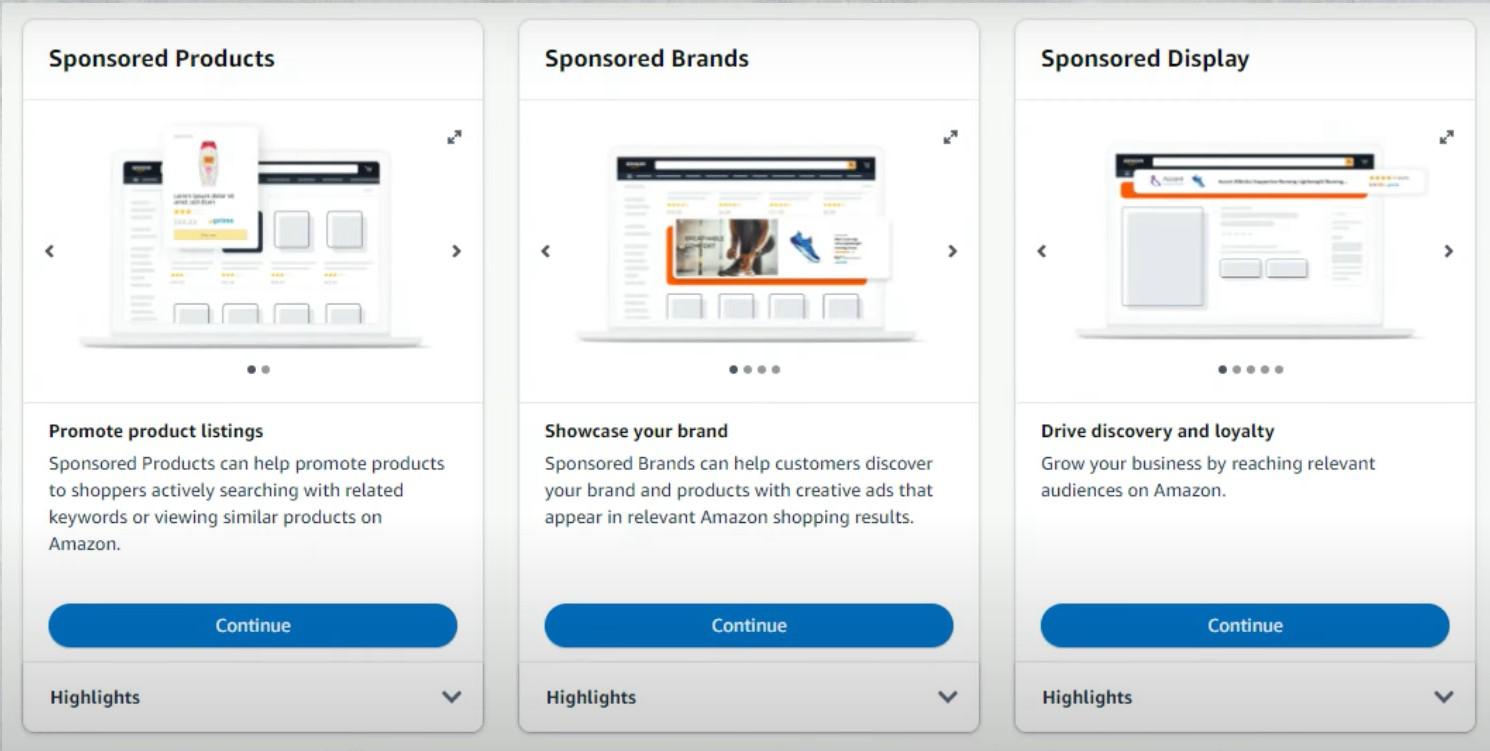
Sponsored Products:
These are targeted ads for individual product listings, appearing in search results and product pages. Sellers bid on keywords, displaying ads when relevant searches occur. They operate on a pay-per-click (PPC) model, where sellers only pay when a customer clicks on the ad.
Sponsored Brands:
These ads feature a custom headline, logo, and multiple products. They are typically displayed at the top of search results, providing brand visibility and allowing for a cohesive brand message. Like Sponsored Products, Sponsored Brands also operate on a PPC model.
Sponsored Display Ads:
These ads reach customers both on and off Amazon. They can appear on product detail pages, customer reviews, and Amazon marketing emails. Sponsored Display Ads enable targeting based on interests and shopping behavior, making them versatile for reaching a broader audience.
How to Choose the Right Channel Based on Product Type and Target Audience
Consider Product Type:
Different products may benefit from different channels. For example, if you have a new product that needs exposure, Sponsored Products may be the right choice. Sponsored Brands might be more suitable if you want to showcase a range of products under your brand.
Understand Target Audience:
Consider the demographics and behavior of your target audience. If your audience is actively searching for specific products, Sponsored Products can capture their attention. If building brand awareness is a priority, Sponsored Brands with a strong visual impact may be more effective.
Budget and Goals:
Assess your advertising budget and overall marketing goals. Sponsored Products can be a cost-effective way to start, as you have control over bid amounts. Sponsored Brands and Display Ads may require a larger budget but offer broader visibility and brand impact.
Evaluate Performance:
Regularly monitor the performance of your ads on different channels. Analyze metrics such as click-through rates(CTR), conversion rates, and return on ad spend. Adjust your strategy based on the channels yielding the best results for your products and goals.
Marketing Mix of Amazon
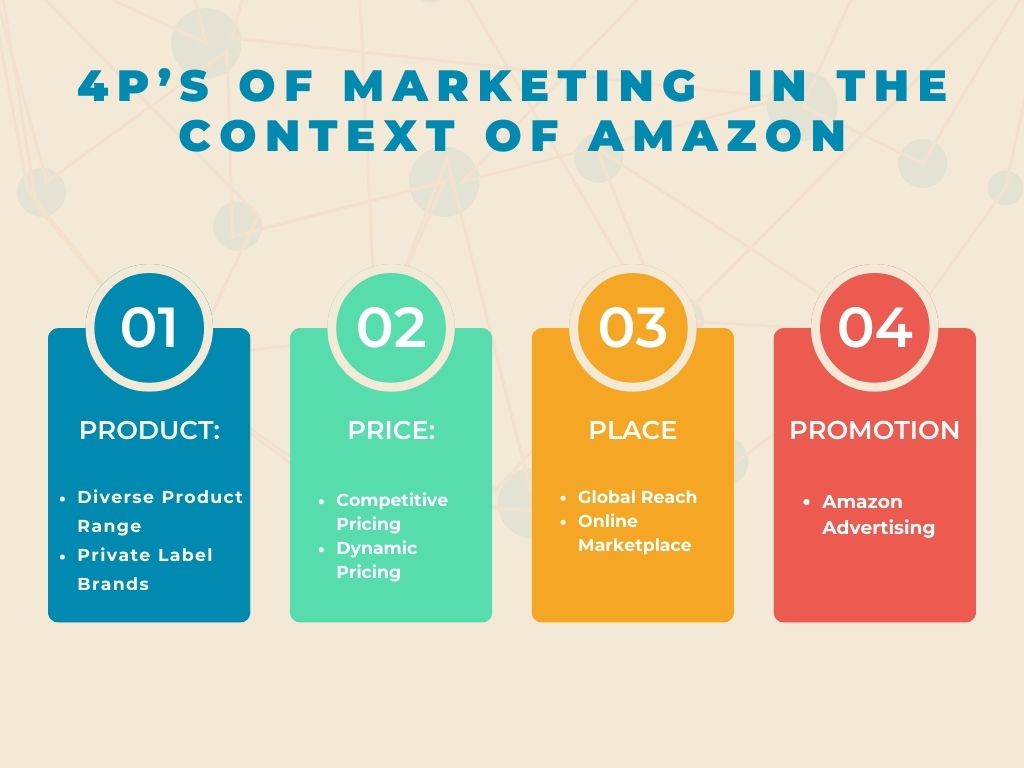
Product:
- Diverse Product Range: Amazon’s product portfolio spans virtually every category imaginable, offering customers an extensive selection.
- Private Label Brands: Besides hosting third-party sellers, Amazon has successfully introduced its private label brands, expanding its product offerings.
Price:
- Competitive Pricing: Amazon is renowned for its competitive pricing strategy, leveraging economies of scale to offer products at attractive price points.
- Dynamic Pricing: The platform dynamically adjusts prices based on demand, competitor pricing, and other factors, optimizing for customers and sellers.
Place:
- Global Reach: Amazon has a vast global presence, with a sophisticated logistics network ensuring efficient product delivery to customers worldwide.
- Online Marketplace: Most of Amazon’s transactions occur through its online marketplace, providing unparalleled convenience to customers.
Promotion:
- Amazon Advertising: The platform utilizes robust advertising tools, including Sponsored Products, Sponsored Brands, and Display Ads, to promote products and enhance visibility.
- Deals and Promotions: Amazon regularly runs Lightning Deals, Coupons, and Prime Day, driving customer engagement and boosting sales.
Insights into How Amazon Effectively Manages Its Marketing Mix
Integration of Technology:
- Data-Driven Decision-Making: Amazon employs advanced data analytics to understand customer behavior, optimize pricing, and make personalized recommendations.
- Innovative Technologies: Integrating AI, machine learning, and voice recognition (Alexa) enhances customer experience.
Customer-Centric Approach:
- Customer Reviews and Ratings: Amazon utilizes content generated by users, including reviews and ratings, to establish trust and assist in making informed purchasing choices.
- Prime Membership: The introduction of Amazon Prime fosters customer loyalty and encourages repeat purchases through benefits like fast shipping and exclusive content.
Operational Excellence:
- Efficient Logistics: Amazon’s logistics and fulfillment capabilities set industry standards, ensuring swift and reliable product deliveries.
- Marketplace Flexibility: The dual structure of Vendor Central and Seller Central provides flexibility for different types of sellers, fostering a diverse and dynamic marketplace.
Lessons for Sellers to Apply in Their Marketing Strategies
Embrace Data-Driven Decision-Making:
Sellers should leverage data analytics to understand customer behavior, optimize pricing, and refine marketing strategies.
Prioritize Customer Trust:
Building and maintaining trust through customer reviews, quality products, and transparent business practices should be a core focus for sellers.
Invest in Innovation:
Sellers should explore innovative technologies and trends to stay ahead. This could involve embracing AI for personalized recommendations or adopting emerging technologies that align with their product offerings.
Offer Value through Membership Programs:
Creating loyalty programs or membership benefits can enhance customer retention. Sellers can explore options like offering exclusive discounts, early access to promotions, or bundled services.
Optimize Logistics and Fulfillment:
Efficient and reliable order fulfillment contributes significantly to customer satisfaction. Sellers should prioritize operational excellence and explore partnerships with fulfillment services if applicable.
Utilize Amazon Advertising Effectively:
Sellers should familiarize themselves with and strategically use Amazon Advertising tools to promote their products. Understanding the nuances of Sponsored Products, Sponsored Brands, and Display Ads can significantly impact visibility.
Platforms and Channels of Amazon Marketing
Overview of Amazon’s Diverse Marketing Platforms (Vendor Central, Seller Central, etc.)
Vendor Central:
- Designed for manufacturers and distributors.
- Involves a wholesale relationship, where brands sell products directly to Amazon.
- Amazon manages pricing, inventory, and promotions.
Seller Central:
- Geared towards individual sellers and small to medium-sized businesses.
- Sellers list and sell products directly to consumers.
- Provides more control over pricing, inventory, and marketing.
Amazon Advertising:
- Encompasses various advertising tools, including Sponsored Products, Sponsored Brands, and Sponsored Display Ads.
- Allows sellers to create targeted advertising campaigns to boost product visibility.
Amazon Stores:
- Enables sellers to create branded storefronts.
- Provides a more immersive shopping experience where sellers can showcase products and build brand identity.
Guidance on Selecting the Most Suitable Platform for Your Business
Consider Your Business Size:
- Small and medium-sized businesses often find Seller Central more suitable, allowing for more control over individual listings.
- Larger manufacturers and distributors may benefit from the features and scale of Vendor Central.
Control and Flexibility:
- Seller Central offers more control over product listings, pricing, and promotions.
- Vendor Central provides less control but may be suitable for a more hands-off approach.
Advertising Goals:
- Sellers looking for more control over their advertising strategy may prefer Seller Central.
- Vendor Central may be suitable for those seeking a more integrated approach where Amazon manages aspects of advertising.
Brand Building:
- Amazon Stores are ideal for brand building. Creating a branded storefront can enhance the customer experience if brand identity is a priority.
Tips for Maximizing Visibility and Reach Across Different Amazon Channels
Utilize Amazon Advertising:
Experiment with different types of ads (Sponsored Products, Sponsored Brands, and Display Ads) to find the most effective combination for your products.
Optimize Product Listings:
Craft compelling product titles, descriptions, and images to maximize organic visibility in search results.
Leverage Amazon Stores:
Create a visually appealing storefront to enhance brand visibility and provide a curated shopping experience for customers.
Monitor Performance Metrics:
Regularly analyze performance metrics across different channels to identify what strategies are working and where adjustments are needed.
Stay Informed about New Features:
Amazon regularly introduces new features and tools. Stay informed and adapt your strategy to take advantage of the latest opportunities.
Amazon’s Marketing Strategies
In-Depth Analysis of Amazon’s Specific Marketing Tactics
Customer-Centric Approach:
Amazon prioritizes customer satisfaction, fostering trust through features like customer reviews and hassle-free returns.
Dynamic Pricing:
The platform dynamically adjusts prices based on various factors, optimizing for competitiveness and profitability.
Amazon Prime:
Amazon Prime membership enhances customer loyalty through benefits like fast shipping, exclusive deals, and access to streaming services.
Highlighting Key Success Stories and Innovative Approaches
Amazon Web Services (AWS):
The success of AWS showcases Amazon’s ability to innovate beyond e-commerce, providing cloud computing services to businesses globally.
Amazon Go Stores:
The cashier-less Amazon Go stores exemplify innovation in brick-and-mortar retail, utilizing advanced technology for a seamless shopping experience.
Lessons that Sellers Can Learn from Amazon’s Marketing Playbook
Prioritize Customer Trust:
Build trust through transparent business practices, quality products, and customer-centric policies.
Embrace Innovation:
Stay abreast of industry trends, leverage innovative technologies to enhance the customer experience, and stay competitive.
Offer Value Through Membership Programs:
Consider loyalty programs or membership benefits to encourage repeat business and enhance customer retention.
Adaptability is Key:
Amazon’s ability to diversify its services and continually adapt to market trends underscores the importance of flexibility and adaptability in business strategies
Tips for Your Amazon Marketing Strategy 2023
Emerging Trends and Best Practices for Amazon Marketing in 2023
Video Content Dominance:
Leverage the increasing popularity of video content on Amazon. Create engaging product videos to showcase features and benefits.
Voice Search Optimization:
With the rise of voice-activated devices, optimize your product listings for voice searches by incorporating natural language and conversational keywords.
Sustainability Marketing:
Highlight eco-friendly practices and sustainable aspects of your products, aligning with the growing consumer interest in environmentally conscious choices.
Influencer Collaborations:
Explore partnerships with influencers within your niche to reach new audiences and build credibility through authentic endorsements.
Practical Tips to Stay Ahead of the Competition
Optimize for Mobile:
Ensure your product listings are mobile-friendly, as many Amazon shoppers use mobile devices.
Utilize Amazon Live:
Use Amazon Live to connect with customers in real-time through live-streamed content, answering questions, and showcasing products.
Diversify Advertising Channels:
Beyond traditional Amazon Advertising, explore external advertising channels to increase traffic to your Amazon listings and expand your reach.
Enhanced Brand Content:
Invest in creating compelling, Enhanced Brand Content (EBC) to enhance your product pages’ visual appeal and informativeness.
Conclusion
As we navigate the evolving landscape of Amazon marketing in 2023, staying informed about emerging trends and embracing innovative strategies is paramount. From the dominance of video content and voice search optimization to the influence of sustainability marketing, sellers have many opportunities to elevate their Amazon presence.
Practical tips, such as mobile optimization, diversified advertising channels, and using Amazon Live, provide actionable steps to maintain a competitive edge, sellers need to stay ahead of the competition. By drawing inspiration from successful case studies, businesses can glean valuable insights into implementing cutting-edge strategies and adapt them to their unique contexts.
In conclusion, the dynamic nature of e-commerce demands continuous adaptation. As sellers embark on their Amazon marketing journey in 2023, a proactive approach, a keen eye on emerging trends, and a willingness to innovate will be the key drivers of success. May your strategies be as dynamic as the marketplace, propelling your brand to new heights on the ever-expansive Amazon platform.
The post Amazon Marketing Strategies – A Comprehensive guide appeared first on Amazon-ASIN Blogs - Latest from Amazon Sellers: News, Advice, and Effective Strategies.
]]>The post Amazon PPC Budget Optimization: Best Practices and Tips appeared first on Amazon-ASIN Blogs - Latest from Amazon Sellers: News, Advice, and Effective Strategies.
]]>Amazon PPC is an advertising strategy that allows sellers and vendors to promote their products on the Amazon platform. It operates on a pay-per-click basis, meaning advertisers only pay when a user clicks on their ad. The ads can appear in various locations on the Amazon website, including search results, product detail pages, and even external websites through the Amazon Advertising network.
Amazon PPC offers different ad types, such as Sponsored Products, Sponsored Brands, and Sponsored Displays. Each type serves distinct purposes, enabling businesses to target their audiences effectively. Sponsored Products, for example, showcase individual products in search results, while Sponsored Brands promote brand awareness with a custom headline, logo, and multiple products displayed.
Quick Guide
- Importance of Budgeting in Amazon PPC
- Why Is It Important To Set An Amazon PPC Daily Budget?
- Amazon PPC Budget Options
- Amazon Ad Spend Allocation
- Applying a Budget Rule within Amazon Ads Campaign Manager
- How to Calculate Amazon PPC Advertising Budget
- Conclusion
Importance of Budgeting in Amazon PPC
Budgeting is a fundamental aspect of any Amazon PPC campaign. It determines how much an advertiser is willing to spend on their advertisements within a specific timeframe, usually on a daily or monthly basis. Effective budgeting in Amazon PPC is crucial for several reasons:
- Cost Control: Setting a budget ensures that advertisers have control over their advertising expenses. This prevents overspending and allows for a better understanding of the return on investment (ROI).
- Ad Positioning: Budget allocation can affect an ad’s position in search results. The higher the budget, the more competitive the ad placement, potentially leading to better visibility and click-through rates.
- Testing and Optimization: A well-defined budget enables advertisers to experiment with different ad campaigns and adjust their strategies based on performance. It allows for testing keywords, ad copy, and landing pages to refine the campaign over time.
- Avoiding Exhaustion: Careful budgeting prevents the depletion of resources too quickly. If an advertiser exhausts their budget early in the day, their ads may not appear during peak shopping hours, potentially missing out on valuable sales opportunities.
- Scaling Up: As campaigns prove successful, businesses can scale up their budgets to reach a larger audience and increase sales, as long as the ROI justifies the expenditure
Why Is It Important To Set An Amazon PPC Daily Budget?
Setting a daily budget in Amazon PPC is a fundamental aspect of managing your advertising campaigns effectively. It provides numerous advantages that are essential for achieving success in the competitive e-commerce landscape. Let’s explore the key reasons why it’s important:
Control over Ad Spending
One of the primary reasons for setting an Amazon PPC daily budget is to exercise control over your advertising expenditure. By specifying the maximum amount you’re willing to spend in a day, you ensure that your advertising costs remain within a manageable range. This control is crucial for businesses with finite advertising budgets, preventing them from overspending and allowing for a clear understanding of their financial commitments.
Avoiding Overspending
Overspending is a common concern in PPC advertising. Without a daily budget limit, it’s easy for campaigns to rapidly deplete your budget, particularly if you have competitive keywords or high-demand periods. Setting a daily budget acts as a safety net, ensuring that your ad spend doesn’t spiral out of control. It helps you strike a balance between aggressive advertising and responsible budget management.
Maximizing ROI (Return on Investment)
An effective daily budget in Amazon PPC is not just about cost control; it’s also about maximizing your ROI. By carefully allocating your budget to campaigns that perform well and generate positive returns, you can ensure that your advertising dollars are being used where they matter most. This strategic budgeting approach enables you to focus your resources on high-impact campaigns, ultimately driving better results and profitability.
Competitive Advantage
In the highly competitive world of e-commerce, a well-planned daily budget can provide a competitive advantage. Advertisers who understand their budgets and can maintain a consistent and compelling presence on Amazon have an edge over competitors who may overspend or lack budget discipline. By staying within budget constraints, you can sustain your campaigns over the long term and continually reach your target audience, thereby outlasting less prepared competitors.
Amazon PPC Budget Options
When it comes to managing your PPC campaigns on Amazon, you have a couple of budgeting options to choose from. Each of these options serves a different purpose and allows for flexible budget management. Let’s explore the two primary Amazon PPC budget options:
Average Daily Budget
The Average Daily Budget is a commonly used budgeting option in Amazon PPC. With this option, you set a daily spending limit for your campaigns, and Amazon will aim to spend this amount evenly throughout the entire month. However, keep in mind that daily spending may vary slightly, but Amazon will ensure that it doesn’t exceed your specified monthly budget. This approach provides a consistent daily presence for your ads, helping you manage your budget effectively.
The Average Daily Budget is an excellent choice for advertisers who want to maintain a steady advertising presence and avoid overspending. It’s beneficial for businesses with limited monthly budgets who need to ensure that their spending is evenly distributed over time.
Fixed Daily Account Budget
The Fixed Daily Account Budget is another budgeting option that provides advertisers with a high degree of control over their spending. With this approach, you set a strict daily budget for your entire Amazon PPC account, and Amazon will not exceed this amount in total daily spending. Unlike the Average Daily Budget, there is no monthly balancing. Once the daily budget is reached, advertising stops for the day.
The Fixed Daily Account Budget is a strategic choice for advertisers who require precise control over their daily ad spend. It is beneficial for businesses that want to ensure that their daily advertising expenses do not exceed a specific threshold, offering a level of financial predictability and constraint.
Choosing between these budget options depends on your advertising goals, budgeting preferences, and the nature of your products or services. Whether you opt for the Average Daily Budget or the Fixed Daily Account Budget, careful budget management is essential for a successful Amazon PPC campaign.
Amazon Ad Spend Allocation
Effectively allocating your Amazon PPC ad spend is a critical aspect of optimizing your advertising campaigns. How you distribute your budget across different campaign types and products can significantly impact your overall success. Here are key considerations for ad spend allocation:
Determining Product Priorities
One of the first steps in ad spend allocation is determining which products or product categories are your priorities. Not all products are created equal, and some may have higher profit margins, greater demand, or strategic importance. By identifying your priorities, consider allocating a larger amount of your budget to these products, ensuring they receive the attention they deserve.
Balancing Budget Across Campaigns
To increase the effectiveness of your Amazon PPC advertising, it’s crucial to allocate your budget strategically across different campaign types. A common approach is to allocate budget percentages to various campaign types based on their objectives:
- Allocate 75% To Sponsored Products: Sponsored Products are often the workhorses of Amazon PPC, promoting individual products. Allocating a significant portion of your budget here can help boost product visibility and sales.
- Allocate 20% To Sponsored Brands: Sponsored Brands are ideal for promoting brand awareness and multiple products. This budget allocation can help reinforce your brand identity and drive more traffic.
- Allocate 5% on Sponsored Display: Sponsored Display is a valuable tool for retargeting and expanding your reach to relevant audiences beyond Amazon. A smaller budget allocation here can still yield meaningful results.
Seasonal Considerations
Seasonality plays a vital role in ad spend allocation. Depending on your products and industry, there may be peak seasons or holidays that demand a more significant ad spend. Adjust your budget allocation to accommodate these seasonal variations. During the peak season, you may want to reallocate more budget to ensure maximum exposure.
Ad Placement Strategies
Careful consideration of ad placement is essential. Different ad placements on Amazon may yield varying results. Monitor the performance of your ads in different placements and allocate your budget to the highest-performing placements. This strategy ensures that your budget is focused where it’s most effective.
Applying a Budget Rule within Amazon Ads Campaign Manager
Applying Amazon PPC budget rules can help automate the process of budget allocation and optimization. Here’s a step-by-step guide to applying a budget rule:
Step-by-Step Guide: Creating a Budget Rule
To create or update a Budget Rule for an existing campaign in Amazon Ads Campaign Manager, follow these steps:
Access Campaign Manager:
- Log in to your Amazon Advertising account.
- Navigate to the Campaign Manager, where you manage your advertising campaigns.
Select the Campaign:
- From the Campaign Manager dashboard, choose the specific campaign for which you want to create or update a Budget Rule.
Access Budget Rules:
- Inside the selected campaign, locate and click on “Budget Rules” in the sidebar.
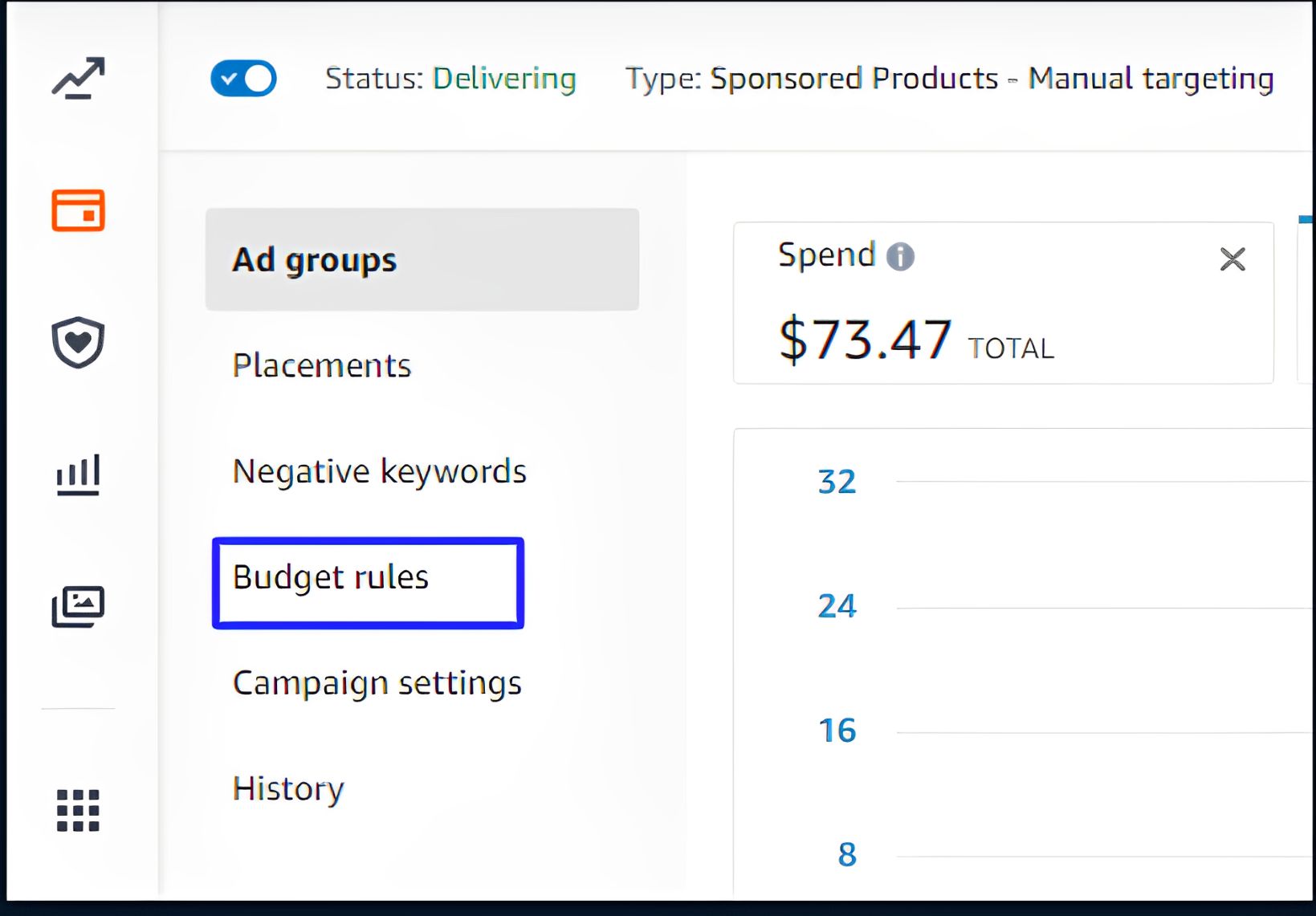
Add a Budget Rule:
- Click the “Add Budget Rule” button to start creating a new rule.
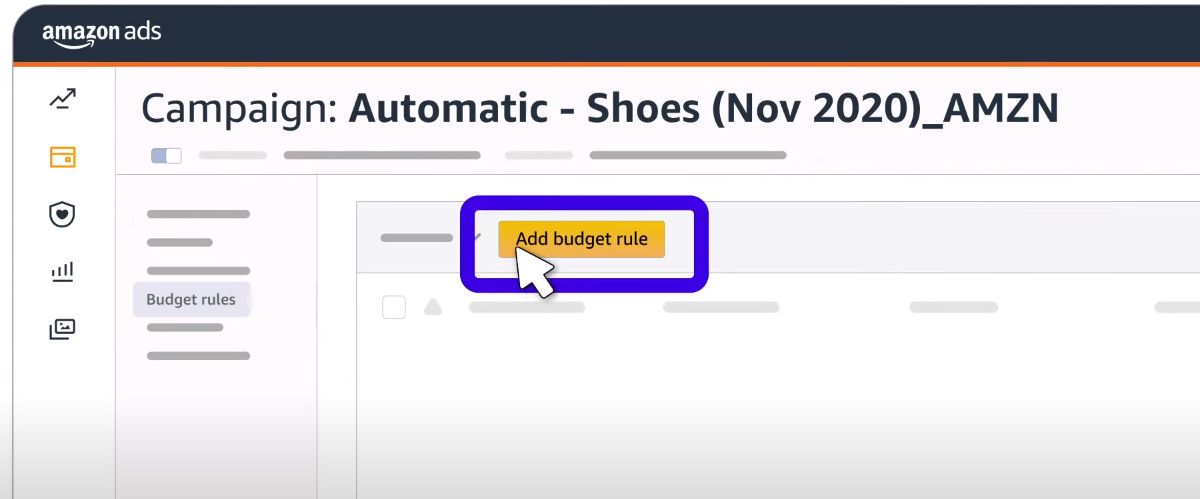
Define Rule Name and Type:
- Give your Budget Rule a descriptive name.
- Choose the type of rule you want to create. Let’s begin with Scheduled Based Rules.
Scheduled Based Rules:
- Select “Scheduled” as the rule type under the “Type” category.
- Choose a “Date Range,” which can be a recommended event or a specific date range.
- Specify the percentage increase you want to apply for the selected event.
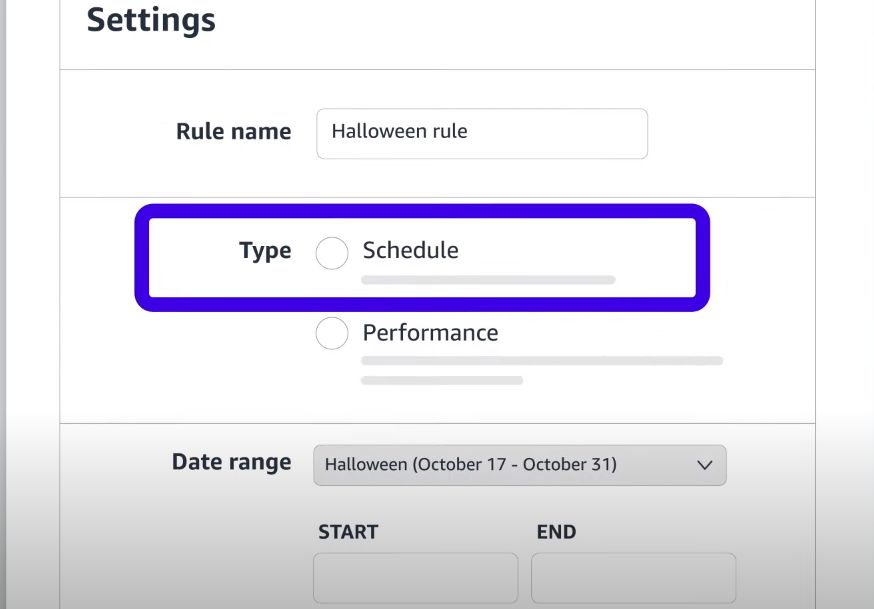
Performance Based Rules:
- If you want to create a Performance Based Rule, select “Performance” as the rule type.
- Choose a “Date Range” (recommended event or specific date range).
- Add your preferred performance metric threshold for this rule.
Apply the Budget Rule:
- After adding the necessary details for your Budget Rule, click “Add Budget Rule.”
- Your selected campaign’s budget will automatically adjust according to the rules you’ve set during the specified date range.
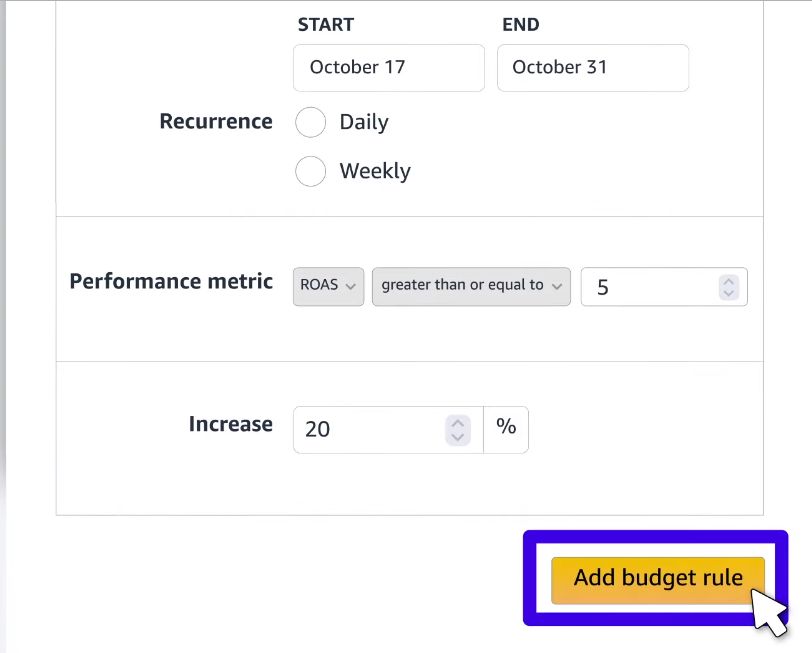
Monitor Campaign Performance:
- It’s essential to keep a close eye on how your campaigns perform under the new budget rules. This allows you to assess the effectiveness of the rules you’ve established.
Advanced budgeting strategies
For those looking to take their budget management to the next level, consider these advanced budgeting strategies:
Dynamic Bidding Options
Amazon offers dynamic bidding options that can automatically adjust your bids in real time based on the likelihood of conversion. These options include:
- Dynamic bids – down only: Amazon lowers your bid to increase cost-efficiency when a conversion is less likely.
- Dynamic bids – up and down: Amazon adjusts bids up or down based on the likelihood of conversion.
- Fixed bids: You set a fixed bid for your keywords. This strategy offers more control but may not be as flexible as dynamic bidding.
Bid+ Feature
The Bid+ feature allows Amazon to increase your bid by up to 50% when your ad is eligible to appear at the top of search results. This can be a valuable tool to enhance visibility for high-priority campaigns and keywords.
Budget Scheduling
Budget scheduling enables you to control when your campaigns are active. This can be particularly valuable for advertisers with specific peak hours or days. You can schedule your budget to be higher during the times when your target audience is most active and decrease it during off-peak hours.
How to Calculate Amazon Advertising Budget
Calculating your Amazon PPC advertising budget is a crucial step in the planning process. By understanding the factors that influence your budget and applying a straightforward formula, you can determine the optimal budget for your advertising campaigns.
Factors Influencing Budget
Several key factors influence your Amazon PPC advertising budget:
Cost Per Click (CPC)
The Cost Per Click is the amount you’re willing to pay each time a user clicks on your ad. The CPC varies based on factors such as keyword competitiveness and the ad type you’re using. Highly competitive keywords often have higher CPCs, so it’s essential to consider this when setting your budget.
Conversion Rate
Your conversion rate is a measure of the proportion of users who click on your ad and then make a purchase. A higher conversion rate means you’re getting more value from each click, which can affect your budget requirements. It’s essential to have a clear understanding of your historical or expected conversion rates.
Profit Margin
Your profit margin is the amount you earn from each sale after deducting all costs, including product costs, advertising expenses, and Amazon fees. Understanding your profit margin is critical in determining how much you can allocate to advertising while remaining profitable.
Budget Calculation Formula
The formula for calculating your Amazon PPC advertising budget is as follows:
Budget = (Sales Goal / Conversion Rate) * (1 – Profit Margin) * CPC
Here’s what each part of the formula means:
- Sales Goal: This is the amount of revenue you want to generate from your Amazon PPC campaign. It’s typically a target you set based on your business objectives.
- Conversion Rate: This is the expected or historical percentage of clicks that result in a sale. It’s expressed as a decimal (e.g., 10% as 0.10).
- Profit Margin: This is the percentage of profit you make on each sale after deducting all expenses. It’s expressed as a decimal (e.g., 30% as 0.30).
- CPC (Cost Per Click): This is the cost you pay for each click on your ad.
Practical Examples
Let’s illustrate the budget calculation with a practical example:
Suppose you have a sales goal of $5,000, an expected conversion rate of 10%, a profit margin of 30%, and a CPC of $1.50.
Budget = ($5,000 / 0.10) * (1 – 0.30) * $1.50
Budget = $50,000 * 0.70 * $1.50
Total = $52,500
In this example, to achieve a $5,000 sales goal with a 10% conversion rate, a 30% profit margin, and a $1.50 CPC, you should allocate a budget of $52,500 to your Amazon PPC campaign.
By considering these factors and using the budget calculation formula, you can set an advertising budget that aligns with your goals and ensures a profitable advertising campaign.
Suggested Read: Amazon PPC Strategy Secrets: Proven Tactics for Boosting Sales and Visibility
Conclusion
Effective budgeting is a cornerstone of success in Amazon PPC advertising. A well-planned and well-executed budget ensures that your advertising campaigns not only reach your target audience but also deliver a positive return on investment.
We’ve explored the various aspects of Amazon PPC budgeting, from setting your daily budget and allocating funds across campaigns to advanced strategies like dynamic bidding and budget scheduling. By understanding the factors that influence your budget, such as Cost Per Click (CPC), conversion rate, and profit margin, you can make data-driven decisions that maximize the impact of your advertising efforts.
With the right budgeting strategy in place, you can leverage the power of Amazon PPC to boost your product visibility, increase sales, and ultimately grow your business on one of the world’s largest e-commerce platforms. As you continue to refine your budgeting techniques and gain insights from your campaigns, you’ll be well on your way to achieving success in the competitive Amazon marketplace.
The post Amazon PPC Budget Optimization: Best Practices and Tips appeared first on Amazon-ASIN Blogs - Latest from Amazon Sellers: News, Advice, and Effective Strategies.
]]>The post The Best Amazon Marketing Agencies for Your E-Commerce Success appeared first on Amazon-ASIN Blogs - Latest from Amazon Sellers: News, Advice, and Effective Strategies.
]]>Quick guide
- What is an Amazon Marketing Agency?
- Why Invest in Amazon Marketing Agencies?
- What to Consider Before Outsourcing Amazon Marketing Services?
- Criteria for Selecting Top Amazon Marketing Agencies
- Top 10 Amazon Marketing Agencies
- Tips for Maximizing Results with Amazon Marketing Agencies
- Conclusion
What is an Amazon Marketing Agency?
An Amazon marketing agency is a team of dedicated experts specializing in optimizing your presence on the world’s largest online marketplace. Leveraging their expertise, Amazon’s top marketing agencies employ a combination of data-driven insights, creative advertising, and product listing optimization techniques to drive sales, visibility, and overall performance on the platform.
Why Invest in Amazon Marketing Agencies?
Investing in the right Amazon marketing agency can lead to a substantial return on investment for your e-commerce business. By tapping into the vast expertise of these marketing experts for Amazon, businesses can achieve top-tier rankings, increased product visibility, and improved sales performance, thereby surpassing their competition.
What to Consider Before Outsourcing Amazon Marketing Services?
Before enlisting the services of an Amazon marketing agency, consider the expertise and track record of the agency in question. It is crucial to choose the best Amazon agency that aligns with your specific business needs and objectives. These marketing experts for Amazon can tailor their services to meet your unique requirements, ensuring a successful collaboration.
Criteria for Selecting Top Amazon Marketing Agencies
The quest to find the best Amazon marketing agency should involve considering the following essential criteria:
Industry Expertise
Look for an Amazon top marketing agency that has a deep understanding of your industry and the specific challenges it faces on the platform. Industry expertise allows the agency to tailor strategies that resonate with your target audience, leading to more effective campaigns and better results.
Customized Strategies
A top Amazon marketing agency will never adopt a one-size-fits-all approach. Instead, they will take the time to understand your unique business goals, target audience, and product offerings to create customized strategies that align with your brand identity and objectives.
Transparent Reporting
Transparent reporting is crucial for maintaining a clear view of the performance of your Amazon marketing campaigns. The agency should provide detailed reports on key metrics, such as click-through rates, conversion rates, and return on ad spend (ROAS), allowing you to assess the effectiveness of their efforts.
Proven Track Record
The best Amazon marketing agencies will readily share their past successes and case studies, demonstrating their ability to deliver tangible results for clients. Look for evidence of increased sales, improved rankings, and successful product launches to gauge their performance.
Holistic Approach
A comprehensive approach to Amazon marketing is vital for maximizing your e-commerce success. The agency should cover all aspects, including Amazon product listing optimization, Amazon PPC advertising, Amazon SEO, content creation, and brand management, to ensure a well-rounded and cohesive strategy.
Proactive and Innovative
The e-commerce landscape is ever-changing, and Amazon’s platform regularly evolves with updates and algorithm changes. The best Amazon marketing agencies stay proactive and innovative, continuously adapting their strategies to stay ahead of the competition.
Responsive Customer Support
Effective communication is critical when working with an agency. Ensure that the agency offers responsive customer support, resolving any questions or issues you may have as soon as possible throughout the collaboration.
Ethical Practices
Choose an agency that follows ethical marketing practices and abides by Amazon’s guidelines. Unethical tactics may lead to negative consequences, including penalties or suspension of your Amazon seller account.
Long-Term Partnership
Consider the potential for a long-term partnership with the marketing agency. Building a strong working relationship over time can lead to even more substantial results as the agency gains a deeper understanding of your business and its market.
Flexibility and Adaptability
The e-commerce landscape is dynamic, and successful agencies possess the flexibility and adaptability to adjust strategies based on market trends, seasonal fluctuations, and changing consumer behaviors.
Top 10 Amazon Marketing Agencies
Let’s explore the top Amazon marketing agencies that have consistently delivered exceptional services and achieved remarkable results for their clients.
SellerApp
SellerApp is a cutting-edge e-commerce analytics and marketing platform that empowers businesses to unleash their full potential in the competitive world of e-commerce. As a comprehensive e-commerce intelligence solution, SellerApp is committed to providing data-driven insights and strategic guidance to help sellers succeed on major e-commerce platforms, including Amazon and Shopify.
The team at SellerApp comprises experienced data analysts, marketing experts, and e-commerce enthusiasts who are passionate about helping businesses thrive in the dynamic online marketplace. With a deep understanding of e-commerce analytics and trends, SellerApp equips sellers with the tools and knowledge they need to make informed decisions, optimize their operations, and drive sustainable growth.
SellerApp takes a customer-centric approach, catering to the needs of sellers of all sizes, from small startups to established brands. If you are looking to start your e-commerce journey or looking to scale your business, SellerApp is committed to being your trusted partner in navigating the complexities of e-commerce and achieving unparalleled success.
Services Offered
- Product Research and Analysis
- Amazon PPC Campaign Management
- Competitor Analysis
- Keyword Research and Optimization
- Listing Optimization
- Amazon Advertising Management
- Amazon Sales Analytics
- Amazon PPC Bid Management
- Amazon Seller Tools
- Shopify Analytics and Insights.
Nuanced Media
Nuanced Media is a renowned Amazon marketing agency with a mission to empower e-commerce businesses to achieve exceptional success in the world’s largest online marketplace.
Founded with a passion for data-driven strategies and innovative marketing solutions, Nuanced Media has garnered a reputation as a reliable and results-oriented partner for businesses seeking to excel on Amazon.
Led by a team of experienced professionals, Nuanced Media combines their extensive expertise in e-commerce marketing, Amazon SEO, and advertising to craft tailored solutions that drive tangible results. Their dedication to staying at the forefront of industry trends and algorithm updates allows them to adapt swiftly to the ever-changing landscape of Amazon, ensuring clients’ brands remain competitive and thriving.
Services Offered
- SEO for Amazon Product Listings
- Amazon Campaigns – Complete Pay-Per-Click Campaign Creation
- Ongoing Amazon Campaign Management and Optimization
- Amazon Campaign Tracking and Reporting
- Dedicated Support for Amazon Seller Management
Disruptive Advertising

Disruptive Advertising is a cutting-edge marketing agency that has gained widespread recognition for its innovative approach to Amazon marketing. Founded on the principle of disrupting the traditional advertising landscape, this agency has quickly become a trailblazer in the e-commerce industry. With a relentless focus on data-driven strategies and creative thinking, Disruptive Advertising empowers businesses to achieve remarkable success on Amazon.
At the core of their philosophy is the belief that successful marketing requires pushing boundaries and challenging the status quo. This mindset drives Disruptive Advertising to continuously explore new techniques, leverage advanced technology, and develop unique solutions tailored to each client’s needs.
Backed by a team of Amazon marketing experts, Disruptive Advertising thrives on delivering unparalleled results for its clients. Their passion for helping businesses thrive in the competitive e-commerce space sets them apart as a top choice for brands seeking exponential growth on Amazon.
Services Offered:
- Amazon PPC Management
- Amazon SEO and Listing Optimization
- Product Research and Launch Strategies
- Amazon Analytics and Reporting
Emplicit
Emplicit is a leading digital marketing agency that is passionate about helping businesses succeed in the digital realm. With a team of seasoned experts, the agency offers innovative and strategic solutions to enhance your online presence, engage your target audience, and drive measurable results. Emplicit firmly believes in the power of data-driven marketing combined with creativity, and they tailor their services to satisfy the particular demands of each client.
Whether you’re a small startup or a well-established enterprise, Emplicit is dedicated to being your partner in success and taking your brand to new heights in the digital space.
Services Offered:
- Amazon Ad Management
- Sponsored Product Ads
- Sponsored Brand Ads
- Sponsored Display Ads
- Off-Amaz on Amazon Channels
- Off-Amazon non-Amazon Channels
Taktical
Tactical is a dynamic and results-oriented digital marketing agency that specializes in crafting tailored strategies to help businesses achieve their goals in the ever-evolving digital landscape. With a team of passionate marketers, data analysts, and creative minds, Taktical empowers brands to navigate the complexities of online marketing with precision and finesse.
Whether you’re a startup striving to make a mark or an established enterprise seeking to modernize your digital presence, Taktical is committed to being your strategic partner in success.
Services Offered:
- Amazon Advertising Management
- Amazon Pay-Per-Click Advertising
- Data Analytics and Performance Insights
- Amazon Account Audit and Optimization
Rank Media Agency

Rank Media Agency is a dynamic and forward-thinking digital marketing agency that champions the success of businesses in the digital landscape. With a passion for innovation and a relentless drive for excellence, Rank Media excels in crafting strategic marketing solutions that empower brands to rise above the competition.
Their team of seasoned experts possesses a deep understanding of the ever-evolving digital world, allowing them to navigate the complexities of online marketing with precision and creativity. From startups to established enterprises, Rank Media is committed to being the catalyst that propels brands to the pinnacle of success.
Services Offered:
- Amazon Listing Optimization
- Amazon PPC Services
- Influencer Marketing
- Boosting Amazon Product Rankings
- Inventory Support
Blue Wheel Media
Blue wheel media is a powerhouse digital marketing agency that thrives on creativity and innovation. With a mission to empower brands and businesses, the agency seamlessly blends data-driven strategies with artistic flair to deliver captivating and impactful marketing solutions.
Blue wheel media takes pride in its team of visionary thinkers, strategists, and digital experts, who work tirelessly to propel brands to new heights of success in the ever-evolving digital landscape. As a driving force behind numerous success stories, Blue Wheel Media continues to be the go-to partner for businesses seeking to captivate their audience and unlock their true potential.
Services Offered:
- Full Management of all Amazon Advertising ad types
- Amazon PPC
- Amazon DSP
- Real-time keyword harvesting and negative keyword harvesting
Rise Interactive

Rise Interactive is a leading digital marketing agency that stands at the forefront of innovation and performance-driven strategies. With a vision to empower brands and drive transformative growth, Rise Interactive has earned a reputation as a trusted partner for businesses seeking to navigate the complexities of the digital landscape.
Their team of skilled marketers, data analysts, and technology experts work collaboratively to deliver personalized and data-centric solutions that propel brands to new heights of success. As a catalyst for numerous success stories, Rise Interactive continues to redefine the boundaries of digital marketing with a focus on measurable outcomes and exceptional results.
Services Offered:
- Sponsored ads
- Organic/PDP strategy
- Store management services
- A+ content
- Amazon DSP
Thrive Internet Marketing Agency

Thrive Internet Marketing Agency is a dynamic and results-oriented digital marketing agency that lives up to its name by empowering businesses to thrive in the online world. With a commitment to excellence and a passion for driving success, Thrive has carved a niche for itself as a trusted partner for brands seeking to make a significant impact in the digital landscape.
From startups to enterprises, their team of digital experts, creatives, and strategists work collaboratively to deliver data-driven solutions that elevate brands and maximize their online presence. With a focus on innovation and measurable outcomes, Thrive Internet Marketing Agency is the catalyst that propels businesses forward on their journey to digital success.
Services Offered
- Amazon Marketing
- Amazon SEO
- Amazon Advertising/PPC
- Amazon Storefront & Branding
- Amazon Seller Consulting
- Amazon Posts Management
- Amazon DSP Advertising Management
Bellavix
Bellavix is a dynamic and innovative digital marketing agency that prides itself on delivering impactful solutions that drive real results. With a mission to help businesses soar to new heights, Bellavix combines creativity, data-driven strategies, and cutting-edge technology to craft personalized marketing campaigns that resonate with audiences.
Their team of skilled marketers, designers, and strategists share a passion for excellence, dedicating themselves to being the driving force behind brands’ success in the digital landscape. Whether it’s increasing brand visibility or increasing conversions, Bellavix is committed to being the partner that brings creativity and results together.
Services Offered
- Amazon Seller Central Management Services
- Vendor Central Management Services
- Amazon Pay-per-Click (PPC) Management
- Amazon Display Advertising (DSP) Management
Tips for Maximizing Results with Amazon Marketing Agencies
To achieve optimal results with your chosen Amazon marketing agency, consider these essential tips:
Clear Communication and Collaboration
Treat your relationship with the Amazon marketing agency as a collaborative partnership. Maintain open and transparent communication to ensure that both parties are on the same page regarding goals, strategies, and expectations. Share valuable insights about your brand, target audience, and product offerings to help the agency tailor their approach effectively.
Set Specific and Measurable Goals
Clearly define your objectives and key performance indicators (KPIs) at the outset of the collaboration. Whether it’s increasing sales by a certain percentage, improving product rankings, or boosting advertising ROI, setting specific and measurable goals provides a benchmark for success and allows you to track progress effectively.
Regular Performance Reviews
Schedule regular performance reviews with the Amazon marketing agency to evaluate the success of their strategies. Frequent check-ins enable you to assess the effectiveness of different campaigns, make data-driven decisions, and implement necessary adjustments promptly.
Data-Driven Decision Making
Successful Amazon marketing agencies rely on data to drive their decisions. Make sure the agency utilizes data analytics and market insights to fine-tune its strategies continuously. Data-driven decision-making leads to more efficient campaigns and better targeting of potential customers.
Test and Iterate
Encourage the agency to conduct A/B tests on various aspects of your Amazon presence, including product titles, images, and advertising copy. Testing and iterating allow you to identify what resonates best with your audience and refine your approach accordingly.
Optimize Product Listings
Product listings are the backbone of your Amazon presence. Work closely with the agency to optimize product titles, bullet points, descriptions, and backend keywords for improved discoverability and ranking in Amazon’s search results.
Leverage Amazon Advertising
Amazon provides several advertising alternatives, including Sponsored Products, Sponsored Brands, and Sponsored Display ads. Collaborate with the agency to determine the most effective advertising strategies based on your products and target audience. Regularly review ad performance and adjust budgets as needed to maximize ROI.
Monitor Competitor Activity
Keep a close eye on your competitors’ activities on Amazon. The agency should conduct competitor analysis to identify potential opportunities and areas where your brand can stand out. Understanding the competitive landscape helps you stay ahead and make informed marketing decisions.
Invest in Product Photography and Visuals
High-quality product images play a significant role in driving conversions. Work with the agency to ensure your product photography is visually appealing, and professional, and highlights the unique selling points of your products.
Utilize Enhanced Brand Content (EBC)
If eligible, take advantage of Amazon’s Enhanced Brand Content feature to showcase your brand story, additional product details, and engaging visuals. EBC enhances the shopping experience for customers and boosts brand credibility.
Amazon SEO and Keyword Research
Collaborate with the agency to conduct thorough Conduct keyword research to learn what terms and phrases your target audience is using to find products like yours. Incorporate these keywords into your product listings and advertising campaigns to improve search visibility.
Leverage Customer Reviews
Positive customer reviews can significantly impact purchasing decisions. Encourage satisfied customers to leave feedback and work with the agency to address any negative reviews constructively.
Stay Compliant with Amazon Policies
Amazon has strict policies and guidelines that sellers must adhere to. Ensure that your marketing strategies comply with Amazon’s terms of service to avoid potential penalties or account suspension.
Conclusion
In a rapidly evolving e-commerce landscape, partnering with the best Amazon marketing agency is crucial for maximizing your success on the platform. These marketing experts for Amazon bring specialized knowledge and strategies to enhance product visibility, increase conversions, and drive sales.
By carefully considering the criteria for choosing an Amazon marketing agency and implementing effective communication and goal-setting practices, businesses can unlock the full potential of their e-commerce endeavors on Amazon. Embrace the power of top Amazon marketing agencies to elevate your brand in the competitive online marketplace and achieve unparalleled success in 2023 and beyond.
The post The Best Amazon Marketing Agencies for Your E-Commerce Success appeared first on Amazon-ASIN Blogs - Latest from Amazon Sellers: News, Advice, and Effective Strategies.
]]>The post Selling on Amazon? These Analytics Tools Will Supercharge your Sales appeared first on Amazon-ASIN Blogs - Latest from Amazon Sellers: News, Advice, and Effective Strategies.
]]>The ever-expanding reach of e-commerce and the unparalleled dominance of Amazon has created an immensely competitive environment for sellers. To thrive in this landscape, sellers must understand their customers, competition, and market trends. Amazon brand analytics tools are designed to provide sellers with the critical information they need to make well-informed decisions and optimize their strategies.
Quick Guide.
- Importance of Analytics for Amazon Sellers
- Growing Popularity of Amazon Analytics Tools
- Top ten Amazon brand analytics tools
- Conclusion
Importance of Analytics Tools for Amazon Sellers
Amazon’s platform presents an immense opportunity for sellers to reach a massive global customer base. However, with such vast potential comes significant complexity. Analyzing customer behavior, identifying product trends, monitoring competitors, and optimizing listings are crucial for success on Amazon.
Analytics tools consolidate large data sets, providing sellers with actionable insights that can significantly impact their business. Understanding customer preferences, search trends, and purchase behavior enables sellers to tailor their product offerings and marketing strategies accordingly. Moreover, staying informed about competitors’ activities allows sellers to adjust their pricing, promotional efforts, and inventory management to stay competitive.
Growing Popularity of Amazon Analytics Tools
As Amazon sellers increasingly recognize the value of data-driven decision-making, the popularity of Amazon brand analytics tools has soared. Sellers understand that these tools streamline their workflow, save time, and provide insights that can significantly impact their bottom line.
Additionally, the number of sellers on the platform creates an environment where staying ahead of the competition is crucial. Analytics tools offer sellers a competitive edge, enabling them to identify opportunities and areas for improvement that may have gone unnoticed otherwise.
Top ten Amazon analytics tools
Their key features, benefits, customer reviews, and pricing options.
SellerApp
SellerApp is a comprehensive Amazon brand analytics tool designed to empower Amazon sellers with data-driven insights to optimize their strategies and achieve success on the platform. Whether you’re a new seller looking to establish a presence on Amazon or an experienced seller aiming to scale your business, SellerApp offers valuable features to streamline your operations and make informed decisions.
Key Features:
PPC Optimization:
The SellerApp PPC optimization feature is a game-changer for sellers aiming to improve the performance of their advertising campaigns. The platform offers data-driven recommendations to help sellers fine-tune their PPC campaigns, optimize bid strategies, and allocate their ad budget effectively. By maximizing the ROI of their ad spend, sellers can attract more qualified traffic to their listings and increase sales.
Amazon DSP Service:
Amazon DSP is typically used by larger advertisers, brands, and agencies to reach and target specific audiences with display and video ads on and off the Amazon platform. It offers more advanced advertising capabilities, such as audience targeting, retargeting, and brand awareness campaigns.
Listing Optimization:
SellerApp offers tools to help sellers optimize their product listings for better conversions. From optimizing product titles and bullet points to improving images and descriptions, sellers can use SellerApp’s insights to enhance their listings and attract more customers.
Product Research:
SellerApp’s product research feature allows sellers to identify high-demand products with low competition. By analyzing historical data, search trends, and customer behavior, sellers can uncover profitable niches and make data-driven decisions about their product offerings.
Sales Tracking:
Monitoring product performance and sales metrics is crucial for sellers to gauge the effectiveness of their strategies. SellerApp provides real-time sales tracking, enabling sellers to analyze revenue trends and understand how their products perform.
Competitor Analysis:
Staying ahead of competitors is essential in Amazon’s competitive marketplace. SellerApp’s competitor analysis feature allows sellers to monitor their competitors’ pricing, promotions, and product strategies. With this information, sellers can adjust their tactics and identify areas for improvement.
Keyword Research:
Effective keyword optimization is vital for improving search visibility and driving traffic to product listings. SellerApp’s keyword research feature helps sellers identify relevant and high-converting keywords, enabling them to optimize their listings for maximum exposure.
Benefits:
Data-Driven Decision Making:
SellerApp’s accurate and real-time data gives sellers valuable insights to make informed decisions. By understanding market trends, customer preferences, and competitor activities, sellers can tailor their strategies for maximum impact.
Amazon FBA (Fulfillment by Amazon) Insights:
For sellers using Amazon’s FBA service, SellerApp provides valuable insights into FBA fees, storage costs, and inventory performance. This information helps sellers assess the profitability of using FBA and make data-driven decisions about fulfillment strategies.
Time and Cost Savings:
SellerApp streamlines various aspects of selling on Amazon, saving sellers time and effort. With SellerApp’s automation features, sellers can efficiently manage their product research, listing optimization, and sales tracking, allowing them to focus on growing their business.
Improved Sales and Revenue:
By leveraging SellerApp’s product research and sales tracking features, sellers can identify profitable products and optimize their listings to increase sales and revenue. Additionally, competitor analysis helps sellers stay competitive and capture more market share.
Enhanced Advertising Strategy:
SellerApp provides valuable insights into the performance of advertising campaigns, including PPC (Pay-Per-Click) campaigns. Sellers can analyze the effectiveness of their ad spend, identify high-performing keywords, and optimize their advertising strategy to achieve a better return on investment (ROI).
Inventory Management:
Efficiently managing inventory is crucial to avoid stockouts or excess inventory, both of which can have adverse effects on sales and profitability. SellerApp’s sales tracking and demand forecasting features help sellers optimize their inventory levels, ensuring they always have the right amount of stock on hand.
International Expansion Support:
For sellers looking to expand to different Amazon marketplaces globally, SellerApp provides valuable data on international market trends, customer behavior, and competition. This data helps sellers make informed decisions when entering new markets and tailoring their strategies for specific regions.
Customer Review and Pricing:
Customer Review

Pricing
SellerApp offers different subscription plans to cater to sellers of various sizes and needs. The pricing options typically include monthly and annual plans, with the latter offering cost savings for sellers who commit to a longer term.
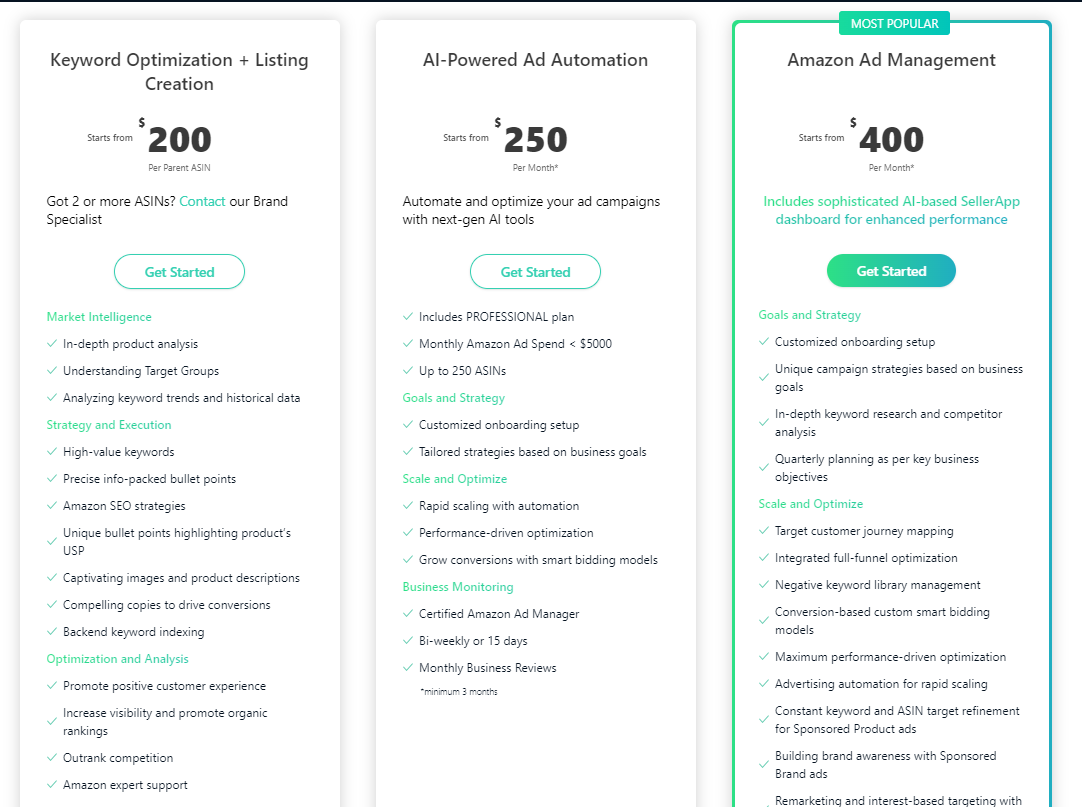
Additionally, SellerApp often offers a free trial period for new users to explore the platform’s features and experience its benefits firsthand. This trial period allows sellers to assess whether SellerApp meets their requirements before committing to a subscription.
To access SellerApp and its features, sellers can visit the official website and sign up for the plan that best suits their business needs. The platform is typically accessible to sellers across different regions, enabling Amazon sellers worldwide to benefit from its powerful analytics and optimization capabilities.
DataHawk
DataHawk is a powerful Amazon brand analytics tool that offers a comprehensive suite of features to cater to sellers’ needs in keyword research, product research, and listing optimization. Its real-time data tracking capabilities enable sellers to stay up-to-date on keyword performance and product rankings, allowing them to make data-driven decisions and optimize their Amazon business for maximum success.
Key Features:
Real-Time Data Tracking:
DataHawk’s real-time data tracking feature provides sellers with up-to-the-minute information on keyword performance, product rankings, and market trends. This timely and accurate data empowers sellers to react quickly to changes in the market, stay ahead of competitors, and capitalize on emerging opportunities.
Keyword Research:
DataHawk’s keyword research feature assists sellers in identifying the most relevant and high-traffic keywords for their products. By understanding the keywords that customers use to search for their products, sellers can optimize their product listings with targeted keywords, improving search visibility and increasing the likelihood of appearing in relevant search results.
Product Research:
With DataHawk’s product research capabilities, sellers can access valuable data on competitor products, market trends, and customer demand. This information helps sellers identify profitable product niches, evaluate product performance, and make informed decisions about expanding their product offerings.
Listing Optimization:
DataHawk’s insights into keyword performance and market trends enable sellers to optimize their product listings effectively. By refining product titles, bullet points, and descriptions based on data-driven insights, sellers can enhance their product pages and attract more potential buyers, leading to increased conversions.
Competitor Analysis:
DataHawk’s competitor analysis feature provides sellers with valuable insights into their competitors’ strategies, pricing, and product performance. By monitoring competitor activities, sellers can identify areas of opportunity, fine-tune their pricing strategies, and adjust their marketing tactics to gain a competitive edge.
Benefits:
Data-Driven Decision Making:
DataHawk’s accurate and comprehensive data tracking capabilities enable sellers to base their decisions on real-time, data-backed insights. This data-driven approach helps sellers make informed choices about their product offerings, pricing, and marketing strategies, increasing the likelihood of success on Amazon.
Improved Search Visibility:
By utilizing DataHawk’s keyword research feature, sellers can optimize their product listings with relevant and high-traffic keywords. This optimization enhances their search visibility, making it easier for potential customers to find their products among the vast array of offerings on Amazon.
Identifying Market Trends:
DataHawk’s ability to identify emerging trends and market dynamics helps sellers stay ahead of the curve. By understanding customer preferences and market shifts, sellers can adapt their strategies and offerings to meet changing demands and capitalize on new opportunities.
Competitive Advantage:
The competitor analysis feature of DataHawk provides sellers with a valuable advantage by allowing them to monitor their competitors’ activities closely. Armed with this information, sellers can adjust their pricing, promotions, and marketing efforts to stay competitive and attract more customer
Customizable Pricing Options:
DataHawk offers various subscription options, allowing sellers to choose the plan that best aligns with their business needs and budget. This flexibility ensures that sellers of all sizes and scales can access the powerful analytics tools offered by DataHawk.
Customer Review
Customer reviews praise DataHawk’s accurate and comprehensive data tracking capabilities. Sellers appreciate the tool’s ability to identify emerging trends and provide valuable insights into market dynamics.
AMZScout
AMZScout is a powerful Amazon brand analytics tool that offers an extensive range of features to support sellers in various aspects of their Amazon business. From market research and product analysis to profit estimation, AMZScout provides valuable insights to help sellers make informed decisions and optimize their strategies.
Key Features:
Market Research:
AMZScout equips sellers with data on market trends, demand, and competition. With this information, sellers can identify lucrative product niches and assess the potential for success in a particular market segment.
Product Analysis:
Analyzing the performance of existing or potential products is crucial for sellers. AMZScout provides comprehensive data on product rankings, sales volume, and customer reviews, allowing sellers to evaluate product viability and popularity.
Profit Estimation:
Understanding the estimated profitability of a product is essential for making sound business decisions. AMZScout’s profit estimation feature factors in product costs, fees, and sales performance to give sellers an accurate estimate of potential profits.
Chrome Extension:
AMZScout’s Chrome extension is a game-changer for sellers as it allows them to access key metrics and data directly from Amazon product pages. This feature streamlines the research process, saving time and effort for sellers.
Competition Analysis:
Staying ahead of competitors is vital in Amazon’s competitive marketplace. AMZScout’s competition analysis feature provides insights into competitor pricing, product performance, and listing strategies. Sellers can use this data to refine their own strategies and gain a competitive edge.
Benefits:
Data-Driven Decision Making:
AMZScout’s comprehensive data and insights enable sellers to make well-informed decisions. From selecting the right products to understanding market dynamics, AMZScout empowers sellers with the information needed to succeed on Amazon.
Time and Effort Savings:
With its Chrome extension and streamlined research process, AMZScout helps sellers save time and effort. Sellers can quickly access essential metrics and data without navigating away from Amazon product pages.
Enhanced Product Selection:
By analyzing market demand, competition, and profitability, sellers can make better product selection decisions. AMZScout’s product analysis and profit estimation features ensure sellers choose products with a higher chance of success.
Competitive Advantage:
With competition analysis, sellers can identify opportunities to outperform competitors. Understanding competitor strategies and pricing allows sellers to adjust their own approach and stay ahead in the marketplace.
Expansion and Growth Opportunities:
AMZScout’s insights into market trends and demand facilitate expansion into new product categories or geographic regions. Armed with data-driven insights, sellers can confidently explore growth opportunities on Amazon.
Customer reviews:
Highlight AMZScout’s effectiveness in uncovering profitable product niches and estimating potential sales. Many sellers credit the tool with helping them make data-driven decisions, resulting in improved product selection and revenue growth.
Pricing
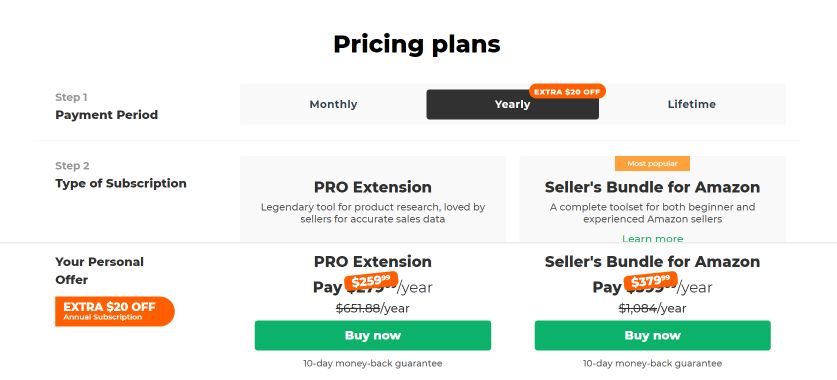
AMZBase
AMZBase is a specialized Amazon brand analytics tool that caters to sellers looking to enhance their Pay-Per-Click (PPC) campaigns, track keyword performance, and efficiently manage their inventory. With a focus on helping sellers achieve optimal results in advertising and visibility, AMZBase provides valuable insights and tools to refine their Amazon selling strategies.
Key Features:
Keyword Tracking:
AMZBase’s keyword tracking capability allows sellers to monitor the performance of their selected keywords over time. Sellers can track keyword rankings, search volume, and changes in keyword trends. Armed with this data, sellers can identify high-performing keywords and uncover opportunities to enhance their product listings’ search visibility and overall performance.
Search Ranking Improvement:
With insights from AMZBase’s keyword tracking, sellers can identify keywords where their products are not ranking as well as desired. Armed with this information, sellers can make targeted optimizations to their listings, such as updating product titles, bullet points, and descriptions, to improve search rankings and increase the chances of appearing in relevant search results.
Competitor Analysis:
AMZBase provides sellers with data on their competitors’ PPC campaigns and keyword strategies. By analyzing competitor data, sellers can gain a competitive edge by identifying successful tactics and adapting their own strategies accordingly. Understanding the landscape of competitors in the market allows sellers to refine their own campaigns and stay ahead in the race for visibility and sales.
Inventory Management:
Effective inventory management is critical for maintaining steady sales and avoiding stockouts. AMZBase assists sellers in understanding inventory performance, sales velocity, and demand fluctuations. This information empowers sellers to optimize their inventory levels, ensuring they have the right amount of stock on hand to meet customer demand without overspending on storage fees.
Benefits:
Increased Advertising ROI:
With AMZ Base’s PPC optimization feature, sellers can make data-driven decisions to maximize the effectiveness of their advertising campaigns. By improving ad performance and reducing wasted ad spend, sellers can achieve a higher return on their investment in advertising, ultimately boosting their overall profitability.
Enhanced Search Visibility:
The keyword tracking capability offered by AMZBase allows sellers to monitor and optimize their product listings for relevant and high-converting keywords. By improving search rankings and visibility, sellers can attract more organic traffic and potential customers, increasing the likelihood of conversions and sales.
Data-Driven Decision Making:
AMZBase provides sellers with actionable insights based on real-time data, empowering them to make informed decisions about their advertising and listing optimization strategies. Sellers can use this data to continually improve their campaigns and stay ahead of market trends and competition.
Competitive Edge:
By analyzing competitor data, sellers can identify successful tactics and opportunities to differentiate their products and brand. This competitive advantage enables sellers to position their products effectively in the market, attract more customers, and achieve sustained growth.
Efficient Inventory Management:
AMZBase’s inventory management insights help sellers avoid overstocking or running out of inventory, which can lead to lost sales and revenue. By optimizing inventory levels, sellers can maintain smooth operations, fulfill customer orders promptly, and improve overall customer satisfaction.
Customer reviews
Appreciate AMZ Base’s simplicity and effectiveness in managing campaigns. The tool’s ability to uncover valuable keywords and manage inventory efficiently has been praised by many sellers.
Pricing
Pricing options and potential discounts can be found on the AMZBase website, making it accessible to sellers of all sizes.
Viral Launch
Viral Launch is a highly regarded Amazon brand analytics tool that stands out for its comprehensive support in product discovery, market intelligence, and listing optimization. Designed specifically for Amazon sellers, Viral Launch offers a suite of tools that equips sellers with invaluable data-driven insights to thrive on the Amazon marketplace.
Key Features:
Product Discovery:
Viral Launch’s product discovery feature is a game-changer for Amazon sellers looking to identify profitable product niches. Through advanced algorithms and data analysis, sellers can uncover products with high demand and low competition. This feature enables sellers to pinpoint lucrative opportunities and launch products that resonate with the target audience.
Market Intelligence:
Understanding competitor activities and market trends is crucial for making informed business decisions. Viral Launch’s market intelligence tools provide sellers with valuable insights into their competitors’ strategies, sales performance, and pricing. Armed with this knowledge, sellers can adjust their own tactics to gain a competitive edge and capitalize on emerging trends.
Listing Optimization:
Optimizing product listings is essential for attracting and converting potential customers. Viral Launch offers tools to enhance listing performance by analyzing keywords, images, titles, and bullet points. By following Viral Launch’s recommendations, sellers can optimize their listings to maximize visibility, improve search rankings, and ultimately increase sales.
Keyword Research:
Keywords play a pivotal role in driving organic traffic to product listings. Viral Launch’s keyword research feature empowers sellers to identify relevant and high-converting keywords. With this data, sellers can strategically incorporate keywords into their listings to reach a broader audience and increase the likelihood of conversions.
Sales Analytics:
Viral Launch’s sales analytics feature provides sellers with real-time data on sales performance and revenue trends. By tracking sales metrics, sellers can gain insights into the effectiveness of their marketing efforts and assess the success of promotional campaigns. This data-driven approach enables sellers to make data-backed decisions for sustained growth.
Benefits:
Uncover Profitable Opportunities:
Viral Launch’s product discovery feature allows sellers to uncover potentially profitable product niches with high demand and low competition. This insight enables sellers to expand their product offerings strategically, minimizing risk while maximizing revenue potential.
Gain Competitive Edge:
By accessing market intelligence on competitors’ strategies, sellers can identify areas of improvement and differentiation. Understanding competitor activities empowers sellers to refine their own tactics and stay ahead in the fiercely competitive Amazon marketplace.
Optimize Listings for Better Conversions:
Viral Launch’s listing optimization tools enable sellers to create highly optimized product listings. By using relevant keywords, attractive images, and compelling content, sellers can enhance their listings’ visibility and conversion rates, leading to increased sales.
Make Informed Business Decisions:
With Viral Launch’s sales analytics, sellers can monitor their sales performance and identify trends in real-time. This data-driven approach empowers sellers to make informed decisions, allocate resources effectively, and focus on strategies that drive results.
Streamlined Workflow:
Viral Launch’s user-friendly interface and automated tools streamline various aspects of selling on Amazon. Sellers can efficiently conduct product research, keyword analysis, and listing optimization within the platform, saving time and effort.
Customer reviews
Customer reviews praise Viral Launch’s ability to accelerate the product research process and improve listing optimization. Sellers appreciate the platform’s impact on driving traffic and increasing sales.
Pricing
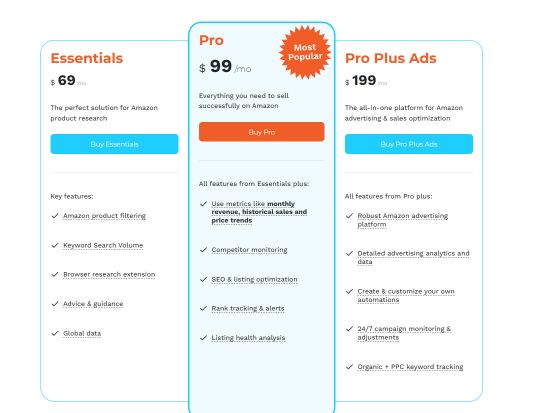
FeedbackWhiz
FeedbackWhiz is a powerful Amazon brand analytics tool designed to provide sellers with comprehensive feedback management and customer communication solutions. As an all-in-one platform, FeedbackWhiz offers a range of features to streamline the process of managing feedback, reviews, and customer interactions, ultimately enhancing the seller’s reputation and customer experience on Amazon.
Key Features:
Feedback Management:
FeedbackWhiz’s feedback management feature simplifies the process of handling customer feedback on Amazon. Sellers can view and respond to customer reviews and feedback directly from the platform, ensuring prompt and personalized responses to address any issues or concerns.
Review Monitoring:
The platform allows sellers to closely monitor and track product reviews, providing insights into customer sentiments and product performance. With this data, sellers can identify areas for improvement, acknowledge positive feedback, and address any negative reviews proactively.
Automated Email Campaigns:
FeedbackWhiz’s automation features enable sellers to create and schedule customized email campaigns. Sellers can send personalized messages to customers at different stages of the buyer’s journey, such as after purchase, delivery, or request for feedback, to enhance customer engagement and encourage reviews.
Order Metrics and Analytics:
FeedbackWhiz provides sellers with detailed order metrics and analytics. This data allows sellers to track various performance metrics, such as order defect rates, feedback ratings, and review conversion rates, helping them identify trends and areas for optimization.
Customer Communication:
The platform facilitates efficient customer communication, allowing sellers to engage with buyers and address queries or concerns promptly. Timely and helpful communication helps build positive relationships with customers and fosters loyalty to the brand.
Benefits:
Improved Seller Reputation:
By offering automated feedback management and prompt responses to customer reviews, FeedbackWhiz helps sellers maintain a positive reputation on Amazon. Positive feedback and prompt customer support contribute to higher seller ratings and improved trust among potential buyers.
Enhanced Customer Experience:
Efficient communication and personalized email campaigns enable sellers to engage with customers effectively. This leads to an enhanced overall customer experience, which, in turn, can result in repeat purchases and positive word-of-mouth referrals.
Proactive Issue Resolution:
FeedbackWhiz’s review monitoring feature allows sellers to quickly identify and address any negative reviews or product issues. The ability to respond proactively helps mitigate potential damage to the seller’s reputation and resolve customer concerns satisfactorily.
Time and Effort Savings:
The platform’s automation features streamline feedback and review management, reducing the manual workload for sellers. Sellers can save time and effort that would otherwise be spent on tracking and responding to reviews, allowing them to focus on other critical aspects of their Amazon business.
Data-Driven Decision Making:
FeedbackWhiz’s order metrics and analytics provide sellers with valuable data insights. Sellers can analyze their performance metrics, identify areas for improvement, and make data-driven decisions to optimize their strategies and achieve better results.
Customer reviews:
Customer reviews comments FeedbackWhiz’s ability to save time and effort in managing customer feedback, which is crucial for maintaining a positive seller rating.
Pricing:
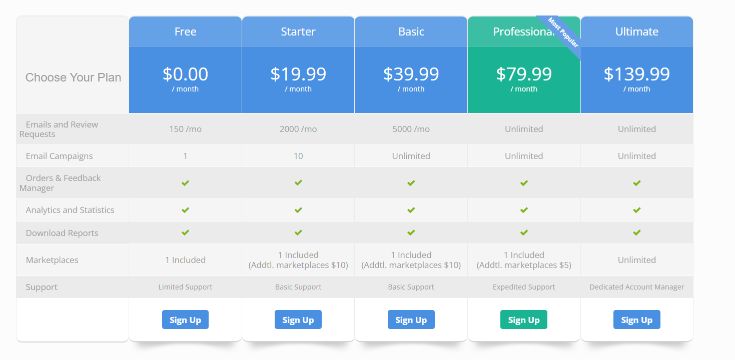
Helium 10
Helium 10 is a powerful and comprehensive Amazon brand analytics tool designed to support sellers in their journey to success in the Amazon marketplace. With a wide range of features, Helium 10 equips sellers with valuable data and insights to optimize their product listings, track keyword performance, and stay ahead of their competitors.
Key Features:
Keyword Tracking:
Helium 10’s keyword tracking feature allows sellers to monitor the performance of their chosen keywords in real time. By identifying high-converting keywords and tracking their rankings, sellers can optimize their product listings to improve search visibility and attract more potential customers.
Product Analytics:
With Helium 10’s product analytics tools, sellers gain valuable insights into the performance of their products. This includes metrics such as sales volume, revenue trends, and customer behavior. Sellers can use this data to refine their offerings, identify top-performing products, and make data-driven decisions to boost sales.
Market Intelligence:
Helium 10 provides sellers with market intelligence to stay ahead of their competition. Through competitor analysis and trend tracking, sellers can identify emerging opportunities, spot gaps in the market, and adjust their strategies to capitalize on changing customer demands.
Listing Optimization:
Helium 10’s suite of tools assists sellers in optimizing their product listings for maximum impact. From refining product titles and bullet points to improving images and descriptions, sellers can utilize Helium 10’s insights to create compelling and high-converting product listings.
Research and Validation:
Helium 10 offers robust research and validation tools to aid sellers in their product selection process. Sellers can find potential winning product ideas, validate their viability, and make informed decisions about which products to invest in.
Benefits:
Improved Search Visibility:
By effectively tracking keywords and optimizing product listings, sellers can improve their search rankings and visibility on Amazon. Higher visibility leads to increased traffic, which translates into higher chances of conversions and sales.
Enhanced Product Performance:
Helium 10’s product analytics tools allow sellers to identify top-performing products and assess the success of marketing strategies. By understanding what works and what doesn’t, sellers can focus their efforts on products with the highest potential for success.
Competitive Edge:
Market intelligence provided by Helium 10 empowers sellers to stay ahead of their competitors. With insights into competitor activities and market trends, sellers can adapt their pricing, marketing, and product strategies to maintain a competitive edge.
Time and Cost Savings:
Helium 10 streamlines various aspects of selling on Amazon, saving sellers valuable time and effort. With automated tools and comprehensive data at their fingertips, sellers can focus on growing their business and building customer relationships.
Informed Decision Making:
Helium 10 equips sellers with data-driven insights to make informed decisions about product selection, pricing, and marketing strategies. By relying on data rather than guesswork, sellers can minimize risks and maximize the potential for success.
Customer reviews
Customer reviews speak highly of Helium 10’s user-friendly interface and accurate data insights. Many sellers credit the tool with significant improvements in keyword rankings and sales.

Pricing
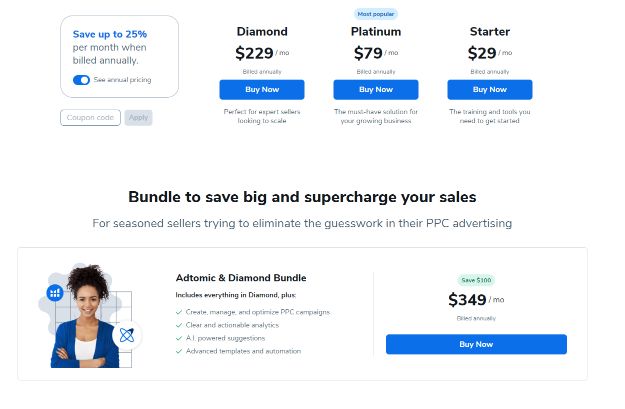
Jungle Scout
Jungle Scout is a reliable and powerful Amazon brand analytics tool that offers a comprehensive suite of features to assist sellers in their product research, sales analytics, and listing optimization efforts. With Jungle Scout, Amazon sellers gain access to valuable insights that enable them to make data-driven decisions and maximize their success on the platform.
Key Features:
Product Research:
Jungle Scout’s product research feature is a standout capability, allowing sellers to uncover high-demand products with low competition. By analyzing historical data, search trends, and customer behavior, sellers can identify profitable niches and products to enter, giving them a competitive edge in the marketplace.
Sales Analytics:
The sales analytics tool in Jungle Scout provides sellers with essential data on their sales performance, revenue trends, and customer behavior. This information allows sellers to track their progress and make informed decisions about pricing, promotions, and inventory management.
Competitor Analysis:
Jungle Scout’s competitor analysis feature enables sellers to monitor their competitors’ activities, such as pricing strategies, promotional efforts, and customer reviews. By understanding their competition, sellers can adjust their own strategies to stay ahead and capitalize on market opportunities.
Listing Optimization:
Jungle Scout assists sellers in optimizing their product listings for maximum visibility and conversions. The tool offers insights into relevant keywords, product titles, bullet points, and images to improve listing quality and attract more potential customers.
Historical Data and Trend Analysis:
Jungle Scout provides access to historical data and trend analysis, helping sellers understand market dynamics and anticipate changes. Sellers can use this information to plan for seasonal fluctuations, adjust inventory levels, and make strategic decisions that align with market trends.
Benefits:
Informed Decision Making:
With Jungle Scout’s comprehensive data and insights, sellers can make well-informed decisions about product selection, pricing, and marketing strategies. By relying on data rather than guesswork, sellers can increase their chances of success on Amazon.
Competitive Edge:
The competitor analysis feature gives sellers a competitive edge by enabling them to stay ahead of their rivals. By tracking competitors’ activities and understanding market trends, sellers can adjust their strategies to capture more market share.
Profitable Product Selection:
Jungle Scout’s product research feature assists sellers in identifying high-demand products with low competition. This knowledge allows sellers to focus on profitable niches and products that have a higher likelihood of success on Amazon.
Improved Sales Performance:
By analyzing sales data and customer behavior, sellers can optimize their listings and pricing to improve conversions and boost overall sales performance. Jungle Scout’s sales analytics tool provides the necessary insights for sellers to fine-tune their strategies for better results.
Time and Resource Savings:
Jungle Scout streamlines various aspects of the selling process, saving sellers time and effort. Instead of manually researching products and market trends, sellers can rely on Jungle Scout’s data-driven insights to make faster and more efficient decisions.
Customer reviews:
Customer reviews commend Jungle Scout’s intuitive interface and actionable insights. Many sellers have reported a substantial boost in sales after using Jungle Scout to identify and optimize their product offerings.
Pricing
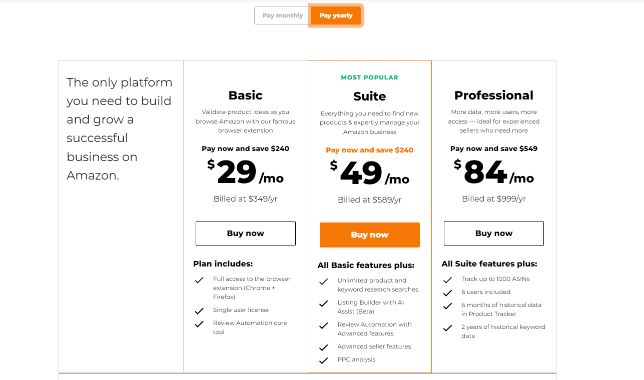
Perpetua
Perpetua is a powerful and all-encompassing Amazon brand analytics tool designed to empower sellers with essential data-driven insights. From product research and keyword analysis to sales estimation and competitor insights, Perpetua equips sellers with the necessary tools to excel in the Amazon marketplace.
Key Features:
Product Research:
Perpetua’s product research feature enables sellers to identify profitable product niches with high demand and low competition. By analyzing historical data and market trends, sellers can discover lucrative opportunities and make well-informed decisions about their product offerings.
Keyword Analysis:
Perpetua keyword analysis feature is crucial for optimizing product listings and improving search visibility. Sellers can identify relevant and high-converting keywords to incorporate into their listings, driving more organic traffic and increasing the likelihood of conversions.
Sales Estimation:
Perpetua offers sales estimation tools that allow sellers to project their potential revenue based on historical data and current market trends. This feature provides valuable insights for setting sales targets and developing revenue forecasts, helping sellers plan their business strategies effectively.
Competitor Insights:
Understanding competitor activities is essential for staying ahead in the competitive Amazon marketplace. Perpetua provides valuable competitor insights, including competitor keyword rankings and pricing strategies, enabling sellers to adjust their own tactics and maintain a competitive edge.
Performance Dashboard:
Perpetua offers a comprehensive performance dashboard that consolidates critical data, such as sales, profits, and advertising metrics. This dashboard provides sellers with a clear overview of their business performance, allowing them to quickly assess the effectiveness of their strategies and identify areas for improvement.
Benefits:
Data-Driven Decision Making:
Perpetua’s accurate and real-time data provides sellers with actionable insights for making data-driven decisions. From product selection to marketing strategies, sellers can leverage Perpetua data to optimize their operations and boost their sales performance.
Improved Listing Optimization:
By using Perpetua keyword analysis, sellers can optimize their product listings with the most relevant and high-performing keywords. This optimization enhances the visibility of their products in Amazon’s search results, driving more organic traffic and increasing the chances of conversions.
Revenue Forecasting:
The sales estimation tools in Perpetua help sellers set realistic revenue targets and plan their inventory and marketing strategies accordingly. This proactive approach enables sellers to meet demand efficiently and maximize their revenue potential.
Competitive Edge:
With access to competitor insights, sellers can keep a close eye on their competitors’ activities, pricing strategies, and keyword rankings. Armed with this knowledge, sellers can make informed decisions to stay competitive and differentiate themselves in the marketplace.
Streamlined Performance Monitoring:
Perpetua performance dashboard consolidates critical data into a single, easy-to-navigate interface. This streamlines the process of monitoring sales, profits, and advertising performance, allowing sellers to stay on top of their business metrics and identify areas for improvement promptly.
Customer reviews
Customer reviews highlight Perpetua’s effectiveness in product research and keyword optimization. The tool’s ability to estimate potential sales helps sellers make informed decisions about product selection and marketing strategies.

Pricing
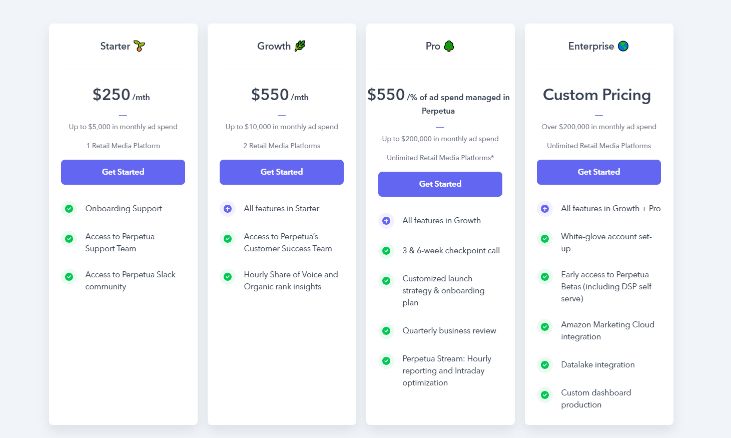
PPC Entourage
PPC Entourage is a powerful and versatile Amazon brand analytics tool designed to provide sellers with a comprehensive understanding of market trends, product performance, and competitor activities. With a focus on product research and sales analytics, PPC Entourage equips sellers with valuable insights to optimize their strategies and boost their Amazon business.
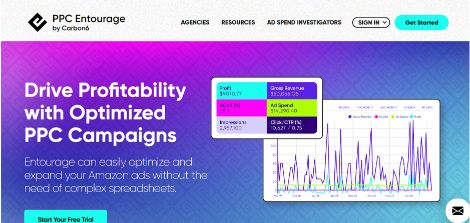
Key Features:
Product Research:
PPC Entourage’s product research feature empowers sellers to discover potentially profitable product niches. By analyzing market trends, search volumes, and competitor data, sellers can identify high-demand products with low competition, enabling them to make informed decisions about product selection.
Sales Analytics:
PPC Entourage’s sales analytics tools offer valuable insights into revenue trends and customer behavior. Sellers can track their sales performance over time, identify peak sales periods, and understand the factors that drive customer purchases.
Competitor Analysis:
Understanding competitor activities is crucial for staying ahead in the competitive Amazon marketplace. PPC Entourage’s competitor analysis feature allows sellers to monitor their competitors’ pricing strategies, promotions, and product performance. This data empowers sellers to adjust their own tactics and identify opportunities for improvement.
Advertising Optimization:
PPC Entourage provides valuable data and analytics for optimizing Amazon PPC campaigns. Sellers can analyze the performance of their advertising campaigns, identify high-performing keywords, and adjust their ad spend to achieve better ROI and increased visibility.
Inventory Management:
Efficiently managing inventory is essential to avoid stockouts and excess inventory, both of which can impact sales and profitability. PPC Entourage’s sales analytics and demand forecasting features help sellers optimize their inventory levels, ensuring they maintain adequate stock levels to meet customer demand.
Benefits:
Data-Driven Decision Making:
PPC Entourage provides sellers with accurate and real-time data, enabling them to make data-driven decisions. By understanding market trends, customer behavior, and competitor activities, sellers can tailor their strategies for maximum impact and increased sales.
Time and Cost Savings:
With its powerful automation features, PPC Entourage streamlines various aspects of Amazon selling, saving sellers time and effort. The platform’s automated data analysis and reporting capabilities enable sellers to focus on core business activities and growth.
Improved Sales Performance:
By leveraging PPC Entourage’s product research and sales analytics features, sellers can identify profitable products and optimize their listings and advertising campaigns. This optimization can lead to increased sales and revenue generation.
Enhanced Competitor Intelligence:
PPC Entourage’s competitor analysis feature provides sellers with valuable insights into their competitors’ strategies. Armed with this knowledge, sellers can adjust their own tactics, pricing, and promotional efforts to stay ahead in the competitive marketplace.
Better Advertising ROI:
PPC Entourage’s advertising optimization tools help sellers refine their Amazon PPC campaigns for improved performance. By identifying high-converting keywords and optimizing ad spend, sellers can achieve better ROI and increase their visibility on the platform.
Customer review
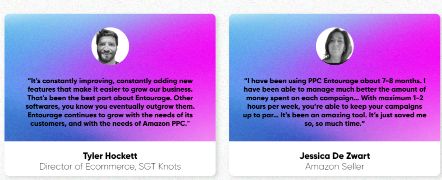
Conclusion
In the fiercely competitive world of Amazon selling, leveraging data-driven insights is essential for success. The top ten Amazon brand analytics tools presented in this article offer valuable solutions for sellers looking to optimize their strategies, boost sales, and outperform competitors.
Each tool provides unique features, benefits, and pricing options to cater to sellers of varying scales and experience levels. By carefully considering the specific needs of their businesses, sellers can choose the right analytics tool to gain a competitive edge, make informed decisions, and achieve long-term success in the Amazon marketplace. Embracing the power of analytics, sellers can confidently navigate the dynamic e-commerce landscape and drive their businesses to new heights.
The post Selling on Amazon? These Analytics Tools Will Supercharge your Sales appeared first on Amazon-ASIN Blogs - Latest from Amazon Sellers: News, Advice, and Effective Strategies.
]]>The post Mastering Amazon ACoS: Boosting Your Advertising ROI with Effective Strategies appeared first on Amazon-ASIN Blogs - Latest from Amazon Sellers: News, Advice, and Effective Strategies.
]]>In this guide, we’ll show you everything you need to know about calculating and improving your Amazon ACoS so that you can reach new customers without breaking the bank!
What is ACoS?
ACoS stands for “advertising cost of sale.” It’s a percentage of your total revenue that you spend on advertising, and it’s an important metric to track when you’re running ads on Amazon.
To calculate ACoS, start by subtracting the total cost per click (CPC) from your total sales revenue. Then divide that number by your total sales revenue:
ACOS = (Total Sales – Total CPC) / Total Sales
As a general rule of thumb, you want to keep your ACoS below 20% to ensure that you’re making money on every sale. If you’re getting higher than 20%, then there’s something wrong with your ads or your product page that needs fixing.
If you’re getting above 20% for a lot of your products, then it’s time to look at your landing page and see what you can do to improve it. You might need more reviews or better copywriting, but whatever the case may be, don’t keep running ads that aren’t profitable.
And if you’re getting lower than 20%, then it’s time to review your ads and see what can be improved. Maybe you need more traffic, or maybe your product page needs some tweaking.
ACoS is a good metric to track because it shows you how well your ads are performing in comparison with the amount of money you’re spending on them. If your ACoS is above 20%, then it’s time to look at why this is happening and what can be done to fix it.
How to calculate Amazon ACoS
ACoS is calculated by dividing your cost of sales by total sales. It’s a measure of how much you are spending on advertising compared to how much money you are making.
If we take a look at an example, let’s say that I sell cell phones on Amazon and my ACoS is 30%. That means that for every $100 worth of cell phones sold through my listing, I spent $30 on advertising costs.
It may seem like this would be easy enough to calculate on your own without having to hire a consultant or accountant; however, there are several things that can make calculating your Amazon ACoS difficult:
- Amazon does not disclose how much you are charged for PPC fees or how much you pay for sponsored products. It’s difficult to figure out what portion of your advertising costs are going towards PPC and sponsored products (i.e. the actual amount that is being spent on ads).
- Amazon does not calculate your ACoS for you. You have to do it manually and it can be a very time-consuming process.
- Amazon does not provide any reports that show you how much you are spending on advertising. You have to manually calculate it yourself and then compare it to your profit margins.
- Amazon doesn’t tell you how much you are spending on advertising because they don’t want to give away their secrets. This makes it difficult for sellers to know when they should stop advertising or what kind of ROI they should expect from their campaigns.
- Amazon’s fees are not the same for every seller. Some sellers pay more than others depending on what category they are in, how many products they sell, and whether or not they have an Amazon Prime account.
Why target a low ACoS when advertising on Amazon?
When you’re looking to boost your advertising ROI, it’s important to make sure you’re targeting a low ACoS. Why? Because the lower your ACoS is, the more money Amazon will spend on advertising and marketing campaigns. This means that they will be able to convert more customers into paying customers than if they were spending more per click.
In addition, having a low ACoS will help increase your conversion rate (the percentage of people who visit your product listing and make a purchase). If this number is higher than average, then that means consumers are visiting more often than usual and if they keep coming back again and again, then Amazon has no choice but to continue promoting your products!
The goal is to have a low ACoS and a high conversion rate, which can be achieved by making sure your product listing is appealing and relevant to consumers. You should also try to reach out to influencers in your niche so that they can help promote your products for free (or at least greatly reduce the cost of advertising).
Amazon is constantly changing its algorithm, and this makes it hard to predict what will happen with your ads. However, one thing that has remained the same throughout the years is that the more money you spend on advertising, the better results you’ll see. If you want to get noticed by customers (and Amazon) then it’s important to invest in your PPC campaigns.
Lastly, it’s important to note that Amazon isn’t just a marketplace for selling products. It’s also a social network where people can share their experiences with products and services. If you want your brand to succeed on Amazon then you need to start building your reputation by creating content that will help consumers learn about the benefits of using your product or service.
How to target a low ACoS on Amazon
To get the most out of your advertising budget, it’s important to find ways to reduce your ACoS. One way to do this is by targeting the right audience with keywords and images that match their interests.
Here are some tips for increasing ROI:
Create a strong brand identity.
You want customers who are interested in buying your product or service as soon as they see it on Amazon’s search results page-and this can only happen if you create an image for your business that resonates with customers’ needs and interests. Make sure that all of your marketing materials reflect this image so people know exactly what they’re getting when they click through from one medium into another.
Create high-quality product listings.
The easiest way to increase ROI on Amazon Ads is by making sure that your landing page and product listing are both optimized for maximum conversions. This means having a strong value proposition, a clear call to action (CTA), relevant keywords in the title, description, and bullets, as well as high-quality images and videos.
Create a strong brand identity.
You want customers who are interested in buying your product or service as soon as they see it on Amazon’s search results page and this can only happen if you create an image for your business that resonates with customers’ needs and interests. Make sure that all of your marketing materials reflect this image so people know exactly what they’re getting when they click through from one medium into another.
Create high-quality product listings.
The easiest way to increase ROI on Amazon Ads is by making sure that your landing page and product listing are both optimized for maximum conversions. This means having a strong value proposition, a clear call to action (CTA), relevant keywords in the title, description, and bullets, as well as high-quality images and videos. -Create a strong brand identity. You want customers who are interested in buying your product or service as soon as they see it on Amazon’s search results page and this can only happen if you create an image for your business that resonates with customers’ needs and interests. Make sure that all of your marketing materials reflect this image so people know exactly what they’re getting when they click
through from one medium into another.
Create high-quality product listings. The easiest way to increase ROI on Amazon Ads is by making sure that your landing page and product listing are both optimized for maximum conversions. This means having a strong value proposition, a clear call to action (CTA), relevant keywords in the title, description, and bullets, as well as high-quality images and videos.
When you learn how to improve your marketing ROI by understanding your cost-of-sale, you’ll be able to successfully connect to new consumers and boost sales.
The formula is simple: ACoS = (cost of an ad campaign) / (gross profit)
For example, if you spent $1,000 on an Amazon ad that generated $5,000 in revenue, then your ACoS would be 20%. In other words, for every dollar spent on advertising, there was a 20% return on investment. This means that if you want to reduce costs and increase profits at the same time, then it’s imperative that you master the art of mastering Amazon ACoS.
How to Reduce Your ACoS on Amazon
There are a number of ways to reduce your ACoS on Amazon. Here are some tips:
- Decrease your cost-per-click bids. This will help you get more clicks for the same amount of money, which can lead to more sales in the long run.
- Use lower cost-per-click keywords in your ads. If you’re not getting enough traffic from a particular keyword, consider changing it so that people searching for products related to yours will see what they’re looking for instead of irrelevant results like “dog toys” when they search “puppies.”
- Create a negative keyword list containing words or phrases that aren’t relevant to your products or services for example, if an ad campaign is targeting shoppers who want new headphones but also include “gaming headset” as one of their interests (and thusly receive higher CPCs), adding this term as part of an exclusion list would prevent those users from seeing ads at all since they won’t match any keyword searches within them anyway.”
Amazon is becoming an increasingly competitive advertising space. It’s important for sellers to understand how to boost their conversion rate and advertising ROI.
As Amazon becomes an increasingly competitive advertising space, it’s important for sellers to understand how to boost their conversion rate and advertising ROI.
One of the best ways you can do this is by understanding your cost-of-sale-the difference between what you sell your product for and what it costs you in order to get that product into customers’ hands. This means taking into account all costs associated with sourcing inventory and shipping it out: from purchasing wholesale goods from manufacturers or distributors, through shipping rates (which vary depending on weight), handling fees, and packaging materials.
It’s important to note that while Amazon offers an FBA (fulfillment by Amazon) option, which takes care of all inventory and shipping costs for you, this is only recommended for sellers who have enough volume that using FBA makes sense. If your margins are low or the product is niche, then it’s more advantageous for you to handle shipping yourself especially if you’re selling in international markets where shipping rates vary widely based on location.
The best way to calculate your cost-of-sale is by using an app that allows you to scan in your product barcodes, which will then pull up all relevant pricing and shipping information. Amazon recently released its own app called Amazon Seller Central for this purpose. It’s available for both Android and iOS devices.
The next step is to determine your profit margin. One easy way to do this is by using a calculator like the Profit Calculator from Amazon Seller Central. This tool allows you to enter various factors including your product price, shipping costs, and any other fees associated with selling on Amazon (such as FBA fees).
The calculator will then tell you how much profit you make on each item sold. Once you have this number, it’s time to determine whether or not FBA makes sense for your business. To do so, simply divide your cost of sale by your profit margin. If the resulting number is less than one, then using FBA is likely to be beneficial for you.
Conclusion
Amazon is a powerful advertising platform that offers sellers the opportunity to reach millions of customers. However, if you’re not careful about how much you spend on Amazon ads and don’t have an effective strategy in place, it can be easy to lose money on these campaigns. The best way to ensure that your advertising efforts are successful is by targeting low ACoS when creating campaigns or managing existing ones.
The post Mastering Amazon ACoS: Boosting Your Advertising ROI with Effective Strategies appeared first on Amazon-ASIN Blogs - Latest from Amazon Sellers: News, Advice, and Effective Strategies.
]]>The post Amazon DSP: The Ultimate Guide to Boosting Your Advertising Success appeared first on Amazon-ASIN Blogs - Latest from Amazon Sellers: News, Advice, and Effective Strategies.
]]>Quick Guide:
- What is Amazon DSP?
- The Benefits of Amazon DSP
- How to Get Started With Amazon DSP
- How to Create Ads With Amazon DSP
- Ad Types and Campaigns on the Amazon DSP
- Create a campaign with the Amazon DSP
- Conclusion
What is Amazon DSP?
The Amazon DSP is a demand-side platform (DSP), which means it allows advertisers to purchase ad space on behalf of their own customers. It’s also known as an “ad exchange,” because it allows advertisers to bid on ads and publishers to sell their inventory in real time.
Demand Side Platform works like other ad exchanges: buyers bid on certain types of traffic, such as brand-new visitors or high-value customers sellers list their available impressions for sale at different prices; the highest bidder wins each impression and pays for it through an automated system that matches buyers with sellers based on criteria like price, location, time of day and device type all without any human intervention!
Demand Side Platform is an ad exchange that allows advertisers to buy and sell ads in real-time, like other digital ad exchanges. However, it also has some unique features that make it stand out from the crowd. All impressions are guaranteed they won’t be wasted by getting filtered out or auto-scraped.
Amazon Demand Side Platform customers can use their own data to create custom audiences. It offers a built-in fraud protection system that prevents ad fraud from occurring on your ads.
The Benefits of Amazon DSP
Amazon DSP is the ad platform that allows you to create and run advertising campaigns on Amazon. It’s an advanced, self-service tool that helps brands leverage their existing data and optimize their performance.
With Demand Side Platform, you can:
- Create ads based on customer interests, demographics, and device type;
- Target customers based on location (including zip code), time of day, and device type;
- Improve ad performance by analyzing historical data from past campaigns;
- Receive real-time reporting so you know exactly how much each campaign costs per click or impression
To get started, you’ll need to connect your Amazon Seller Central account with Amazon Demand Side Platform. Once you’ve done this, Amazon DSP can pull in your existing customer data so that you can start creating campaigns right away.
Here’s how to connect Amazon Demand Side Platform with your Amazon Seller Central account: Go to the ‘Settings’ tab in your Seller Central account. Click on the ‘Advertising’ option under ‘Account Settings.’ Click on the ‘Connect an Amazon Ad Platform’ button. Choose which type of ad platform you want to connect to and click on Continue.
Select the option to connect your DSP account. Enter your DSP credentials and click on Continue.
How to Get Started With the Amazon DSP
- Sign up for an account.
- Create a campaign.
- Create ad sets, which are groups of ads that share similar targeting and bidding strategies.
- Create ads within each ad set, which can be either display or video ads depending on what type you’re creating (more on that later).
Create a budget and set it to “automatic.” This will allow Amazon to automatically optimize for the best possible results based on your campaign goals. You can also set your campaigns to manual optimization if you want more control over how they’re managed. Create one or more audiences. These are groups of people who have expressed interest in what you’re selling by either visiting your website or liking one of your pages.
This is an important step because it allows you to target your ads toward people who are likely to be interested in what you’re offering. For example, if you’re selling a product for cats, it wouldn’t make sense to target dog owners with that ad.
Create an ad set. These are collections of ads that share similar targeting and bidding strategies. For example, if you’re running a campaign for cat toys, you may want to create one ad set for people who have visited your website and another for people who like your Facebook page (or vice versa).
Create one or more ads. These are the actual messages that will appear in people’s News Feeds and on their timelines. You can choose from several different types of ads, including video, carousel, app installs, and mobile website clicks.
How to Create Ads With Amazon DSP
- Select “Ads” from the left menu.
- Click on “Create new ad.”
- Choose the sort of campaign you wish to launch. (e.g., search network), then click “Next step.”
- Select what type of ad you want: text, image, or dynamic display ads (DDA). You can also choose whether or not this is a Demand Side Platform ad by checking off the box next to “Amazon DSP Ads Only” before clicking on “Save & Continue.”
Next, you’ll need to select the ad format. You have the option of running a text ad or a display ad.
If you’re creating a display ad, you’ll need to choose between an image or video. You can also choose whether or not this is an DSP ad by checking off the box next to “Amazon DSP Ads Only” before clicking on “Save & Continue.”Next, you’ll need to select your targeting options.
Next, you’ll need to add a headline and description for your ad. You can write up to 80 characters for the headline and 250 characters for the body of the text.
Geo-Targeting: This allows you to target specific locations or regions within the United States. You can select from a predetermined list of areas, such as New York City or Los Angeles County. Or, if you want more specific control over where your ads show up, you can enter custom coordinates for a location.
Ad Types and Campaigns on the Amazon DSP
There are a variety of different types of ads and campaigns that you can run on the Amazon Demand Side Platform.
- Display Ads: These are banner ads that appear at the top or bottom of your web page. They’re great for catching people’s attention when they’re not actively searching for something on your site, but they can be distracting if used too frequently.
- Video Ads: Video ads are like display ads, except they play video clips instead of images. They’re often used in conjunction with other types of content (like product information), so viewers don’t feel like they’re being sold directly by an advertiser without context or explanation first!
- Mobile Ads: Mobile apps make up more than half of all app downloads worldwide and this number is only going up! If you have an app available through either Google Play Store or Apple App Store, then it makes sense for advertisers like Amazon DSP who want access to as many potential customers as possible through multiple channels including mobile devices like smartphones/tablets which require smaller file sizes than PC browsers do).
Create a campaign with the Amazon DSP
To get started, you’ll first need to create an ad. To do this, go to the DSP dashboard and select “Create New Ad”. You’ll then be presented with options for your campaign settings:
Targeting Type:
This refers to who you want your ads shown to; you can choose between Custom Audiences or Lookalike Audiences (more on these below).
Reach Percentage:
Selecting a percentage will allow you to define how much of the total audience should see your ad. For example, if 1% of shoppers visit websites where they see ads from Amazon partners (including us!), we show them 100% of our impressions (or 1%). If we selected 10% reach instead of 100%, then only 10% will see our ads on those sites 90% go elsewhere!
This is a great way to control your ad spend and make sure you’re getting the most out of every dollar spent on Amazon. We recommend setting this at 10% or less unless you’re specifically trying to build brand awareness.
Show Your Ads On: This refers to what type of websites your ads will appear on. You can choose between “All Websites” (which includes all sites that participate in Amazon’s ad network) or “Sites with Prime Members”. The former allows for more reach, but may also include sites where shoppers are not as likely to purchase from us (e.g. Walmart). The latter will reduce your reach but only show on sites where shoppers are likely to buy from us (e.g. Amazon). You can also choose “Sites with Prime Members” AND “All Websites”, which is what we recommend for first-time advertisers.
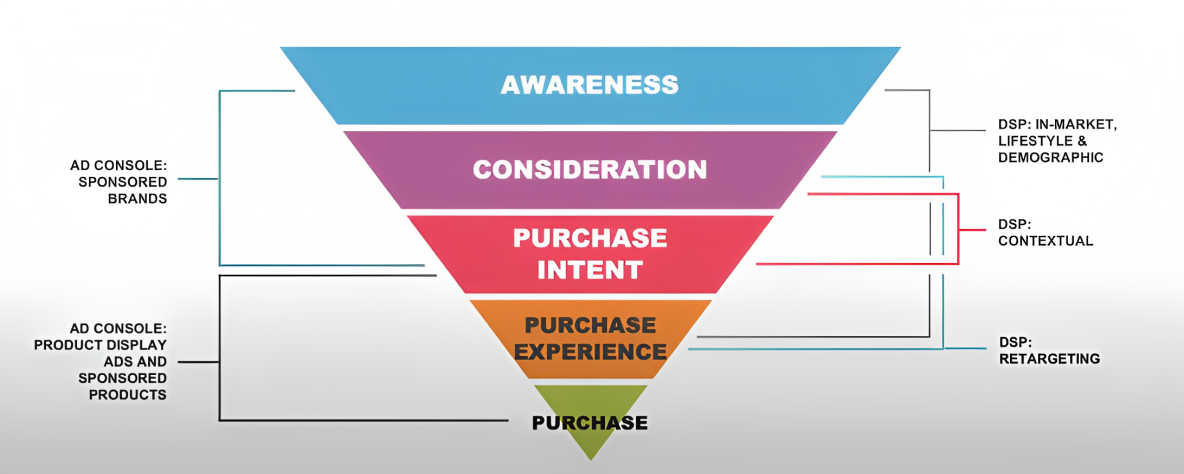
Audience:
- Behavioral
Behavioral audiences leverage past shopping behaviors within relevant categories to deliver ads to potentially interested shoppers.
- Lifestyle:
Lifestyle audiences reflect broad interest groups such as “tech enthusiasts” and “deal seekers.” Advertisers can reach lifestyle audiences to plant their brand in the minds of shoppers who have regularly shopped for related products in the past year.
- In-Market:
in-market audiences can be leveraged to reach customers who are likely to take action or make a purchase based on a recent search, browse, or purchase behavior in the past 30 days.
- Demographic
If advertisers offer products or services that fit a specific, qualified audience, they can choose to reach select demographic audiences to keep campaigns applicable. Although demographic options vary in each locale, some common examples are gender, age range, household income, and the presence of children in the household.
- Remarketing
Advertisers can leverage Amazon remarketing audiences based on views or purchases. To reengage Amazon website audiences that viewed a product specific to that advertiser’s brand, viewed any products under that brand, or viewed any similar products to the promoted product, advertisers can leverage remarketing audiences based on views. To exclude audiences that purchased their products or brand or encourage them to repurchase, advertisers can leverage remarketing audiences based on purchases.
- Contextual
Contextual audiences are actively searching for or viewing products. By leveraging contextual audiences, advertisers can deliver relevant ads based on the detail page shoppers are actively browsing in the contextually targeted product category.
Keywords:
This refers to what people are searching for when they visit a website. For instance, if a person searches for “buy shoes,” you may want them to see your ad. You can also choose from some pre-populated keywords that Amazon automatically associates with your product (e.g., “running shoes”).
Budget:
This refers to how much money you want to spend on advertising. If you are just starting out, we recommend that you set your budget to $5 per day for 10 days (or until Amazon approves it). This will allow you to get a feel for what works and what doesn’t without spending too much money upfront.
Conclusion
We hope that this article has helped you learn more about the Amazon DSP, its benefits, and how to use it to boost your advertising success. The Demand Side Platform is a powerful tool that can help you reach new customers and increase sales on your eCommerce site. If you’re still unsure about whether or not it’s right for your business then we recommend doing some research before committing any time or money into it. However if after reading through this guide there still seems like there might be an opportunity here then go ahead and give it a try!
The post Amazon DSP: The Ultimate Guide to Boosting Your Advertising Success appeared first on Amazon-ASIN Blogs - Latest from Amazon Sellers: News, Advice, and Effective Strategies.
]]>