The post Why Is My Amazon Listing Suppressed and How Do I Fix It? appeared first on Amazon-ASIN Blogs - Latest from Amazon Sellers: News, Advice, and Effective Strategies.
]]>There are many valid reasons why an Amazon listing would be suppressed, but there is only one most common reason for it: violation of policies of Amazon. Some of the most key ones are listed as follows:
- The product listing contains incorrect or misleading information.
- The product sold belongs to those items which are already defined as the restricted items in Amazon.
- Some of the critical information related to product descriptions or customer reviews is not available.
- The listing images fail to meet Amazon’s image guidelines.
- There are numerous customer complaints along with a history of suspensions due to policy violations.
- Another area is that Amazon may also demote a listing for improving the overall shopping experience, particularly if the listing causes confusion or doesn’t match the relevant search queries.
What Does it Mean When an Amazon Listing is Suppressed?
An Amazon-suppressed listing is one that shoppers cannot see-it is completely hidden from search results and completely inaccessible to the public. Amazon suppresses listings it deems do not meet its standards or to otherwise violate its policies. That is to say, listings for best-selling products may be suppressed for whatever reason Amazon has ruled as a reason for doing so.
Suppression is not the same thing as removal, however. Suppressed listings can be reinstated when the problem is fixed. You may have to update the product page or even, in some cases, recreate a listing from scratch.
To determine if some of your listings are suppressed, go to Seller Central, then to the Inventory tab, and click on Manage Inventory. If you have something at the top that says like “Suppressed Listings”, click on that and it will show you which products are flagged. If you do not see this option, you’re good to go!
The Impact of a Suppressed Amazon Listing on Sellers
An Amazon suppression of a listing puts an item out of view in search results due to, among other reasons, selling at very high prices, poor-quality customer reviews, or the wrong product details. Although it might not initially seem so serious, a suppressed listing in Amazon could have a tremendous effect on a seller’s business.
Among other things, suppressed listings hide the item from actual buyers and send sales numbers plummeting.
In addition, suppressed buy box prices usually tend to reduce sales, and also the loss in earnings will be affected.
Lastly, suppressed listings normally tend to damage a seller’s reputation and reduce the overall search visibility. Further, it will affect their IPI score as well, and therefore maintaining a profitable Amazon storefront will be much more challenging.
How can I fix suppressed listings?
Fortunately, suppressed Amazon listing suppression can be easily identified, and solves with a few easy steps. Though, this requires the checking of listings to ensure that everything is up to date and running well.
So here are 5 steps to solve a suppressed Amazon listing:
- Go to ‘Manage Inventory‘ under the Inventory tab in Seller Central.
- If you do have some suppressed listings then you will see a ‘Suppressed’ button appearing. If you don’t see any suppressed listings, then congratulations-things must be going great!
- If the ‘Suppressed’ button is active, click the button and select the listings that you’d like to correct
- Read through and correct any missing information or hit the ‘Manage Images’ button to add missing product images. Every listing comes with an Amazon Product Summary page which usually indicates suppression and quality issues.
- Once corrected, click the ‘Save and Finish’ option to complete the whole process.
How to Prevent Amazon Listing Suppression
The best way to prevent Amazon listing suppression is by closely following all of Amazon’s rules. If you’re finding it difficult to stay on top of what’s permitted, you can use Seller Central to manage product compliance and keep track of any missing documentation. Additionally, the Amazon Listing Quality Dashboard is a valuable tool, as it identifies listings at risk of suppression and provides details on what needs to be updated before issues arise.
What Should I Do if My Listing is Incorrectly Flagged?

At other times, even when you are certain that your listing is within the acceptable standards of Amazon, it will get suppressed because of an unintended prohibited claim. Prohibited claim guidelines maintained by Amazon include the measures that ensure shoppers receive the most honest and accurate information; however, the Amazon algorithm sometimes incorrectly flags certain claims or keywords. Depending on the nature of the problem, there are two basic methods through which suppressed listings that have been flagged incorrectly can be made to alert sellers. These include Stranded Inventory and Performance Notifications.
Stranded Inventory
When a listing is classified as Stranded Inventory, Amazon will delete the ASIN. It can be found on the ‘Manage Inventory’ page as ‘Stranded Inventory’. On the Stranded Inventory page, Amazon will provide a stranded reason, such as a missing characteristic or a wrongly labeled prohibited claim. Sellers can then either dispute or correct the problem.
Often enough, the problem can simply be corrected by editing the copy on the listing. Deleting words such as ‘bugs’, ‘pests’, ‘mildew’, ‘mold’ and ‘insects’ in, for example a pesticide claim usually deletes the ASIN from Stranded Inventory.
Performance Notifications
Performance Notifications are an alert sent to sellers with a specific ASIN flagged for a performance issue. The product detail page could be removed entirely from Amazon, or the seller could just experience an error that must be corrected in order to continue selling. In order to clear Performance Notifications, sellers must provide a Plan of Action consisting of three parts: Root Cause, Corrective Actions, and Preventative Actions.
Sellers can head over to their Voice of the Customer dashboard in Seller Central to see if this ASIN has been flagged and find any recent customer comments concerning this particular performance issue Amazon raised. Upon submission of a proper POA, the performance notification should be removed.
Conclusion
There can also be suppressed listings on Amazon, citing reasons like a violation of the Amazon policy or insufficient critical information; the issues may also be with the product image. Although suppressed listings affect the viewability and sale greatly, it is not completely eliminated from the store as correcting the cause that leads to the suppression might help bring it to life again. With the help of Seller Central tools including Manage Inventory and Amazon Listing Quality Dashboard, sellers are able to identify errors and correct them early. Ongoing monitoring and adherence to policies set by Amazon may help prevent future depressions as well as further the continued success of your business.
The post Why Is My Amazon Listing Suppressed and How Do I Fix It? appeared first on Amazon-ASIN Blogs - Latest from Amazon Sellers: News, Advice, and Effective Strategies.
]]>The post Amazon Bullet Points That Sell: Seller’s Guide for Success appeared first on Amazon-ASIN Blogs - Latest from Amazon Sellers: News, Advice, and Effective Strategies.
]]>Quick Guide:
- What Are Amazon Bullet Points?
- Why Are Bullet Points Crucial for Your Listing?
- Key Elements of Effective Amazon Bullet Points
- Step-by-Step Guide to Writing Compelling Bullet Points
- Optimizing Amazon Bullet Points for SEO
- Advanced Tips for Optimizing Amazon Bullet Points
- Tools and Resources for Amazon Sellers
- Conclusion
What Are Amazon Bullet Points?
Amazon bullet points are short descriptive phrases under the product title on an Amazon product listing page. They provide a quick overview of your product’s key features and benefits. The bullet points and your product images are the first things potential customers see about your product, so they need to be compelling.
What is the ideal length of Amazon bullet points
Amazon bullet points should be concise, around 1 to 2 short sentences. Sellers are allowed up to 500 characters, while vendors have a limit of 250-255 characters. Vendors can use up to 10 bullet points, each with a maximum of 250 characters, requiring them to use their limited space wisely.
Emphasize Key Features and Benefits in your bullet points
Focus on the key features and main benefits of your product. For example, if it’s a kitchen gadget, highlight things like “Saves time chopping and slicing”, “Dishwasher safe components for easy cleaning”, or “Anti-slip base for safety and stability”. Mention innovative or differentiating features.
Make use of power words while writing your bullet points
Use engaging and emotive language to bring your bullet points to life. Words like “premium”, “revolutionary”, “amazing” or “best-in-class” help convey quality and excitement. Mentioning the benefits, like “effortless”, “simplifies” or “enhances” helps the customer understand the product’s usefulness.
Optimize your Amazon bullet points for Search results
Use relevant keywords in your bullet points, especially those matching your product title and listing. Having semantic keywords, synonyms and related terms in your bullet points helps the listing rank better in Amazon search results. But don’t overstuff – bullet points should sound natural.
Why Are Bullet Points Crucial for Your Listing?
Bullet points are essential for creating an eye-catching Amazon product listing. They draw attention and make information easy to digest, which is key when most shoppers only glance at listings for a few seconds.
They Highlight Key Features and Benefits
Bullet points prominently showcase your product’s best features and customer benefits. Focus on things like:
- Innovative or premium materials: For example, “Made of lightweight, durable aluminum alloy” or “100% organic cotton fabric.”
- Key specifications: Such as size, dimensions, battery life, etc. For example, “6-inch full HD display,” “Runs for up to 10 hours on a single charge,” or “BPA-free and dishwasher safe.”
- Standout qualities: Like “4K video recording” or “Noise canceling technology.”
- Valuable extras: Such as accessories, warranties, free returns, etc. For example, “Includes travel case and 3-year warranty” or “30-day free returns.”
They Make Scanning Easy
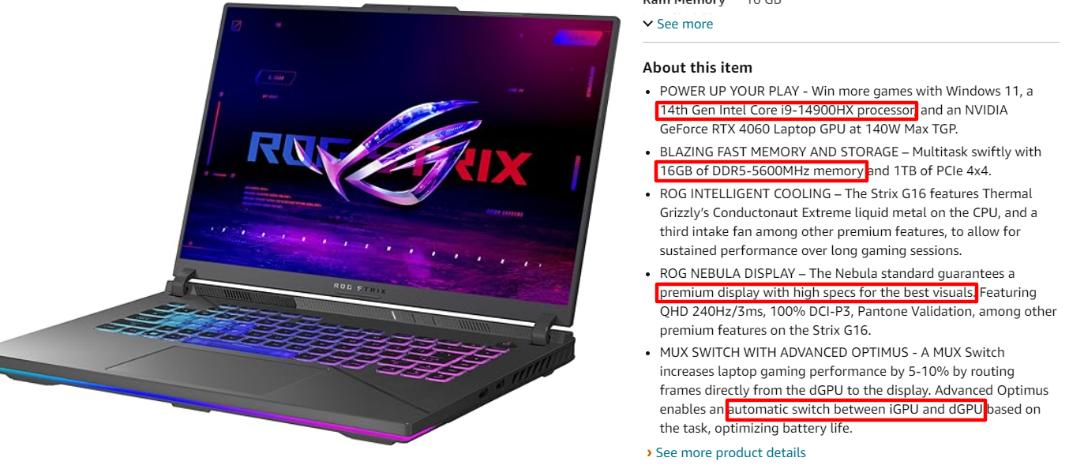
Bullet points make it simple for shoppers to scan your listing and find the most important details at a glance. Keep your bullets concise, starting each with an impactful adjective or verb followed by a compelling benefit. For example:
•14th Gen Intel Core i9-14900HX processor
•16GB of DDR5-5600MHz RAM
•premium display with high specs for the best visuals
•automatic switch between iGPU and dGPU based on the task
They Improve Readability
Bullet points visually break up blocks of text, making your listing easier to read. Use them with short paragraphs, headers, and images for the most readable layout. Keep your bullets around 2 to 3 lines max, and leave an empty line between bullets for the cleanest look.
Well-crafted bullet points are key to optimizing your Amazon product listing. You’ll capture shoppers’ attention and drive more conversions by highlighting key features, benefits, and specifications in an easy-to-scan format.
Key Elements of Effective Amazon Bullet Points
To optimize your product listing and boost sales on Amazon, well-crafted bullet points are essential. Short and Scannable With limited space, keep your bullet points concise and straightforward. Focus on your product’s key features, benefits and specifications. Aim for 3 to 5 bullet points of 1 to 3 short sentences or 1 medium sentence. This makes it easy for customers to quickly scan and comprehend your product’s main selling points.
Keyword-Rich
Strategically include important search keywords and related terms in your bullet points to improve visibility on Amazon. For example, if selling a wireless Bluetooth speaker, you may say “Connect via Bluetooth 5.0 for full wireless streaming from any Bluetooth-enabled device up to 30 feet away.” This incorporates keywords like Bluetooth, wireless, streaming, and device. Just be sure to do so in a natural way.
Solution-Oriented
Rather than just listing the product specifications or attributes, focus on the solutions, benefits and value your product provides customers. For example, instead of “Rechargeable lithium-ion battery provides up to 8 hours of playtime per charge”, say “8 hours of portable power – enjoy your favorite music all day long with a long-lasting rechargeable battery”. This emphasizes the benefit of extended, all-day listening.
Quantifiable and Specific
Use solid facts, numbers and statistics to demonstrate your product’s features and performance. Be as precise as possible. For example, say “360° omni-directional sound from 5 high-performance neodymium drivers” rather than “great sound quality”. Providing concrete details builds credibility and gives customers a better sense of what your product can do.
Consistent Messaging in your bullet points
Ensure your bullet points work together to convey a consistent message and value proposition about your product. Repeat or rephrase key selling points and benefits across the bullet points to reinforce the most important details you want customers to remember. This also creates a cohesive listing that is more compelling and persuasive.
Step-by-Step Guide to Writing Compelling Bullet Points
Focus on benefits, not features
Bullet points should highlight your product’s benefits and key selling points, not just list features. Focus on what your product can do for customers and how it can improve their lives. For example, instead of “12 ounce container” say “Portable size is perfect for travel.”
Keep them scannable
People tend to skim when reading bullet points, so keep them concise and compelling. Aim for 1 to 2 short sentences or 40 characters for each point. Use dynamic and descriptive language to draw the reader in while still being scannable. For example, say “Experience rich, bold flavor” instead of “Dark roast coffee.”
Include numbers and stats
Incorporate numbers, stats, ratings or facts into your bullet points when possible. For example, say “Over 10 million customers worldwide” or “Rated #1 in customer satisfaction.” Numerical figures help to strengthen your key selling points and make the benefits more concrete and believable. However, only include stats and numbers if they are factual and relevant.
End on a high note
Save your most compelling benefit or key selling point for the last bullet point. Readers will remember this the most, so end your list on a persuasive note. For example:
• Award-winning design
• Durable, all-weather construction • Lifetime warranty and total peace of mind
Optimizing Amazon Bullet Points for SEO
Amazon bullet points are one of the most important parts of your product listing page. They determine whether shoppers will click to learn more about your item or scroll past it. Optimizing your bullet points for Amazon search engine optimization (SEO) helps ensure you get noticed.
Include keywords
When crafting your bullet points, be sure to include important keywords that relate to your product. Consider the words customers might search for to find an item like yours. For example, if selling a dog leash, you might mention “dog leash, leash, pet leash, dog walking, dog accessory” and similar terms. Place these keywords or use long tail keywords prominently in your first bullet point.
Write naturally
While keywords are important, your bullet points should sound natural to human readers. Don’t overstuff them with keywords or they’ll seem spammy. Aim for a mix of long and short bullet points with a conversational tone. Keep sentences around 15 to 20 words for the best flow. Read your bullets aloud to make sure they sound genuine.
Focus on benefits
Rather than just listing product features, focus on the key customer benefits. For example, instead of “Made of high-quality nylon material”, say “Durable nylon material provides a comfortable, customizable fit for your dog”. Benefit-focused bullet points are more compelling and help convince customers your product is right for them.
Use numbers and stats
Incorporate numbers, stats, measurements, and quantifiable facts about your product into the bullet points when possible. For example, “Extends up to 6 feet” or “Backed by a lifetime warranty”. Concrete details like these help customers understand exactly what they’re getting and build trust in your listing.
Place most important points first
The first 1-2 bullet points are the most visible, so put your most persuasive selling points there. Mention your premium materials, innovative features, excellent reviews, brand reputation, or product awards. The points you lead with should give customers a reason to choose your item over the competition.
Optimizing your Amazon bullet points with an SEO focus and persuasive messaging helps turn casual viewers into eager customers. Place your product’s keywords, benefits, quantifiable details, and most compelling selling points front and center in your bullets to boost visibility and increase your Amazon conversionson.
Advanced Tips for Optimizing Amazon Bullet Points
Once you have the basics of optimizing your bullet points, it’s time to take it to the next level. The following advanced tips can help boost your product rankings and increase conversions.
Use Dynamic Keywords
Include relevant keywords and phrases in your bullet points, but don’t just repeat the same keywords repeatedly. Use synonyms and related terms as well. For example, if you’re selling a laptop, you might say “powerful processor” in one bullet, “fast Intel i7 chip” in another, and “16GB of quick RAM” in a third. This helps you rank for a wider range of searches.
Write Benefit-Focused Points
Rather than just listing features, focus on the key benefits to the customer. Say how the feature improves their experience or solves a problem. For example, instead of “touchscreen display,” “intuitive 10-point multitouch display lets you navigate with simple finger swipes and taps.” This helps the customer understand the value.
Include Calls to Action
Add urgency and encourage customers to buy now with strong calls to action like “buy now and save 10%” or “only 5 left in stock—order today!” These types of messages motivate shoppers to click the buy button.
Use Eye-Catching Formatting
Make important points stand out using bold text, bullet points, spacing, and numbering. For example:
• Fastest processor in its class: Intel i7 chip and 16GB RAM blaze through tasks • Massive storage: 1TB solid-state drive has plenty of room for photos, movies, music and more
• Stunning graphics: NVIDIA GeForce RTX 2060 graphics card delivers incredibly lifelike visuals for gaming and video editing
The bold text draws attention to each point’s main benefit or feature. The spacing and bullet formatting make each point easy to read.
Check Your Grammar and Spelling in your Amazon bullet points
Careless errors damage your credibility and professionalism. Double check that there are no typos, grammar issues or spelling mistakes in your bullet points before publishing your listing. Even a slight errors can reflect poorly on your business and turn off customers.
With the right techniques, you can create Amazon bullet points that highlight the benefits of your product, motivate customers to buy, and help your listing rank higher in Amazon’s search results. Put these advanced tips into practice and watch your product page become more compelling and conversion-optimized.
Tools and Resources for Amazon Sellers
As an Amazon seller, having the right tools and resources is key to success. Some essentials to have in your toolkit include:
Keyword Research Tool
Choosing the right keywords to optimize your product listings and drive organic traffic. A keyword research tool specifically for Amazon like MerchantWords or Amazon-asin keyword tool allows you to find popular search terms within your niche, see how competitive they are, and get estimates of the search volume. With this data, you can select keywords to drive traffic to your listings.
Product Research Tool
Before launching a new product, you must determine if it will be profitable and in demand. A product research tool such as SellerApp or Profitguru lets you analyze trends, see how competitive a product niche is, find opportunities, and make data-driven decisions about what to sell. They provide monthly sales, revenue, reviews, and seasonality metrics to help you find winning products.
Listing Optimization Tool
Once a product is ready to sell, you must create an optimized listing to drive conversions and sales. A tool like Amazon-Asin listing quality checker can help you write compelling titles, bullet points and descriptions, choose effective images, set competitive prices, and make ongoing improvements to your listings. They analyze what’s working for the top-ranked listings in your category so you can emulate their success.
Feedback and Review Management
Customer feedback and reviews are essential for building social proof and trust in your brand. A tool such as eKomi or Feefo lets you proactively ask buyers to leave reviews and ratings, respond to reviews, report abusive reviews, and gain insights into how to improve your products and services based on customer comments. Monitoring reviews and managing your reputation in one place saves time and helps provide great customer experiences.
Using a combination of tools like these, you’ll have everything you need to research products, optimize listings, drive traffic, get reviews and feedback, and ultimately succeed as an Amazon seller. While the range of options can seem overwhelming, start with the basics and you can always scale up and add more advanced tools as your business grows.
Conclusion
And there you have it – everything you need to know to crush it with Amazon bullet points in 2024. By focusing on the customer, highlighting your product’s benefits, and strategically using power words and formatting, you can write compelling bullet points that convert. Keep testing and optimizing as you learn more about your customers. With practice, you’ll write a bullet point copy that sells itself.
The post Amazon Bullet Points That Sell: Seller’s Guide for Success appeared first on Amazon-ASIN Blogs - Latest from Amazon Sellers: News, Advice, and Effective Strategies.
]]>The post Choosing the Best Amazon SEO Agency: A Step-by-Step Guide appeared first on Amazon-ASIN Blogs - Latest from Amazon Sellers: News, Advice, and Effective Strategies.
]]>Amazon SEO, or Search Engine Optimization, is a specialized field focused on improving product visibility within Amazon’s search results. Like traditional SEO, Amazon SEO involves strategies and tactics that help products rank higher in search listings, increasing organic traffic and, ideally, more sales.
Now, you might be wondering, why not handle Amazon SEO in-house? While some businesses do attempt to manage their Amazon SEO strategies internally, the dynamic and ever-evolving nature of e-commerce, coupled with Amazon’s ever-changing algorithms, often makes it a daunting task. Amazon SEO agencies, on the other hand, are experts in navigating this intricate landscape.
Quick Guide
- The Role of Amazon SEO Agencies in Optimizing Product Listings
- Introduction to the Concept of Amazon SEO Agencies
- How to Choose the Best Amazon SEO Agency
- Top 12 Amazon SEO Agencies
- Conclusion
The Role of Amazon SEO Agencies in Optimizing Product Listings
These agencies are dedicated to understanding Amazon’s algorithms, deciphering consumer behavior, and constantly adapting strategies to ensure their clients’ products get the desired exposure. They possess a deep knowledge of Amazon’s A9 algorithm, which determines product rankings within Amazon’s search results. With this knowledge, Amazon SEO agencies can fine-tune product listings to match the criteria that the algorithm favors.
Introduction to the Concept of Amazon SEO Agencies
Amazon SEO is not a one-size-fits-all solution; successfully navigating this requires specialized knowledge and expertise. This is where Amazon SEO agencies come into the picture.
Amazon SEO agencies are professional service providers optimizing product listings within the Amazon marketplace. They are equipped with a deep understanding of Amazon’s algorithms and guidelines Keep them informed about the most recent developments and shifts in the e-commerce world.
These agencies play a pivotal role in helping businesses and sellers improve their product rankings, boost organic traffic, and ultimately drive more sales on Amazon. They provide a variety of services, which are customized to address the specific requirements of their clients, such as keyword research, product listing enhancement, competitor analysis, and performance tracking.
Benefits of Hiring an Amazon SEO Agency
When it comes to succeeding on Amazon, having a compelling product is just the starting point. To succeed significantly in the highly competitive world of e-commerce, your products need to be easily discoverable by potential customers. This is where Amazon SEO agencies come into play, and they offer a wide range of advantages that can significantly boost your business’s performance on the platform. Here are some of the key benefits of hiring an Amazon SEO agency:
Improved Product Visibility on Amazon
Amazon’s search algorithm, A9, is crucial in determining which products appear at the top of search results. Amazon SEO agencies specialize in understanding how A9 works and can optimize your product listings to match its criteria. This means your products are more likely to appear in relevant search results, ensuring potential customers can find your offerings easily.
Increased Sales and Revenue
Improved visibility translates to more traffic, often increasing sales. By fine-tuning your product listings, Amazon SEO agencies help you attract a broader audience, ultimately leading to higher conversion rates and revenue growth.
Time and Resource Savings
Managing an effective Amazon SEO strategy can be time-consuming and requires specific expertise. Outsourcing this task to a professional agency frees up valuable time and resources within your business. This enables you to concentrate on your primary activities, product development, and customer service while leaving the complexities of Amazon SEO in capable hands.
Expertise and Industry Knowledge
Amazon SEO agencies are specialists in their field. They closely monitor Amazon’s ever-evolving algorithms, trends, and best practices. This means you benefit from their extensive knowledge and experience, which can be challenging to replicate in-house.
Competitive Advantage
In a marketplace as competitive as Amazon, staying ahead is paramount. Amazon SEO agencies optimize your product listings and keep tabs on what your competitors are doing. This enables you to make informed decisions and maintain a competitive edge.
Comprehensive Strategy
Amazon SEO agencies offer a holistic approach to optimizing your listings. They consider keyword research, product content, images, and reviews. This ensures that your products are visible and presented in the best possible light to prospective customers.
Adaptability and Scalability
Your SEO strategy needs to adapt as your business grows and Amazon’s landscape changes. Amazon SEO agencies can scale their efforts according to your business’s needs and quickly respond to shifts in the e-commerce environment.
How to Choose the Best Amazon SEO Agency
Selecting the right Amazon SEO agency for your e-commerce business is a critical decision that can significantly impact your success on the platform. To ensure you choose the best agency to meet your needs, follow these key steps:
Research and Due Diligence
Start your search for an Amazon SEO agency by conducting thorough research. Look for agencies specializing in Amazon SEO with a proven track record. Consider factors such as their reputation, years in business, and the types of clients they have worked with. A reputable agency should be transparent about its services and methodologies. Be cautious of agencies that promise quick fixes or unrealistic results.
Evaluating Past Performance and Client Testimonials
Ask the agency about their past work. Assess their success stories to ensure they have a history of improving product rankings and sales for their clients. Additionally, seek client testimonials and reviews to gain insights into their clients’ experiences. A satisfied client base is a good indicator of a reliable agency.
Understanding Pricing Models and Service Offerings
Amazon SEO agencies offer various service packages and pricing models. Make sure you have a clear grasp of the services that are part of their packages and how pricing is structured. Some agencies charge a fixed fee, while others may work on a commission-based model. Make sure their pricing aligns with your budget and business goals. It’s essential to clearly understand what you’ll receive for the cost.
Communication and Collaboration
Efficient communication plays a pivotal role when collaborating with an Amazon SEO agency. Consider the agency’s communication practices, response times, and the level of transparency they offer. A good agency should keep you informed about the progress of your campaigns, share insights, and promptly address any questions or concerns. Additionally, assess their willingness to collaborate with your in-house team or other service providers to ensure a seamless working relationship.
Expertise and Experience
Pay attention to the expertise and experience of the agency’s team. Amazon’s algorithms and e-commerce landscape constantly evolve, so the agency’s team must be knowledgeable and up-to-date with the latest industry trends. Inquire about the experience and qualifications of their team members, particularly their understanding of Amazon’s A9 algorithm.
Transparency and Reporting
The best Amazon SEO agencies are transparent about their methods and provide regular reports on the performance of your product listings. Ask about their reporting process and the key performance indicators they track. This transparency is crucial for assessing the agency’s impact on your Amazon sales.
Scalability
Consider the agency’s ability to scale its services as your business grows. Your Amazon SEO needs may change, so ensure the agency can adapt to your evolving requirements.
Compatibility with Your Business Goals
Choose an agency that aligns with your business objectives and values. The best Amazon SEO agency should clearly understand your goals and work towards achieving them.
Top 12 Amazon SEO Agencies
SellerApp
SellerApp is a comprehensive Amazon SEO service that offers a wide range of solutions to help businesses optimize their Amazon product listings and drive sales. With SellerApp, you can access a suite of tools and services designed to enhance your visibility on Amazon and maximize your revenue.
SellerApp is a trusted name in the world of Amazon SEO services. They provide businesses and sellers with the tools and expertise to succeed on Amazon’s competitive platform. Whether you have years of experience as a seller, SellerApp offers a holistic approach to Amazon SEO, helping you achieve your e-commerce goals.
SEO Services Offered by SellerApp:
SellerApp offers a comprehensive set of Amazon SEO services tailored to the unique needs of sellers and businesses. Some of the key services provided by SellerApp include:
- Keyword Research: Identifying high-impact keywords relevant to your products and target audience.
- Product Listing Optimization: Crafting compelling product titles, descriptions, and bullet points that incorporate strategic keywords and engage potential customers.
- Competitor Analysis: Analyzing your competitors’ strategies to identify opportunities and gain a competitive edge.
- Performance Monitoring: Continuously tracking and assessing the impact of SEO efforts on your product listings.
- PPC Campaign Management: Managing pay-per-click advertising campaigns to complement your SEO strategy and boost visibility.
- Review and Rating Management: Encouraging positive reviews and managing your product’s reputation on Amazon.
SellerApp’s expertise and tools are designed to help you navigate the complexities of Amazon’s algorithms and achieve higher rankings in search results. Their data-driven approach ensures that your Amazon SEO strategy is based on accurate insights and results, ultimately driving more sales and generating revenue for your business.
Whether you’re looking to improve your product listings, enhance your keyword strategy, or optimize your overall Amazon presence, SellerApp has the resources and expertise to help you succeed in the competitive world of e-commerce. With a focus on data-driven results and a commitment to excellence, SellerApp is a top choice for businesses seeking effective Amazon SEO services.
Thrive Internet Marketing Agency

Thrive Marketing Agency is a prestigious digital marketing firm known for its comprehensive array of services, including top-notch SEO solutions. This has established a strong reputation for helping small startups to large enterprises, improve their online presence and achieve their digital marketing goals.
SEO Services Offered by Thrive Agency
Thrive offers a comprehensive suite of SEO services that address the varied requirements of businesses looking to enhance their online visibility and organic search rankings. Their services include:
- Strategic Keyword Research: In-depth research to identify high-impact Keywords that align with your products and resonate with your target audience.
- Product Content Enhancement: Crafting compelling, keyword-rich product titles, descriptions, and bullet points that drive higher click-through rates and conversions.
- Competitor Analysis: Analyzing competitors’ strategies to uncover opportunities and gain a competitive edge.
- Amazon Advertising Management: Skillfully managing Amazon PPC campaigns to complement organic SEO efforts and enhance product visibility.
- Ongoing Performance Analytics: Continuously monitoring and analyzing the performance of Amazon SEO strategies and making data-driven adjustments as needed.
Wisitech

Wisitech is a leading digital marketing and SEO agency with a solid global presence. With over two decades of experience, they have successfully helped businesses across various industries achieve their online marketing goals through their SEO and digital strategies expertise.
SEO Services Offered by Wisitech
Wisitech offers a diverse range of SEO services tailored to the specific needs of businesses. Their services include:
- Keyword Research: Wisitech conducts thorough keyword research to identify your business’s most relevant and high-traffic keywords.
- On-Page Optimization: They optimize on-page elements such as meta tags, headings, and content to improve website visibility.
- Off-Page SEO: Wisitech focuses on link-building strategies, content marketing, and social media to enhance off-page SEO efforts.
- Local SEO: Businesses targeting local markets optimize their online presence helps to rank well in local search results.
- E-commerce SEO: Wisitech offers specialized SEO services for e-commerce businesses to improve product visibility and sales.
- SEO Audits: Wisitech conducts in-depth SEO audits to identify areas that require enhancement and create tailored strategies.
With their vast experience and a team of experts, Wisitech is equipped to provide businesses with effective SEO solutions, improving their online presence and driving organic traffic and conversions.
Vertical Rail

Vertical Rail is a digital marketing agency that provides e-commerce solutions, including comprehensive SEO services. They have a deep knowledge of the e-commerce landscape and offer strategies that are designed to drive success for online retailers.
SEO Services Provided by Vertical Rail
Vertical Rail provides a variety of SEO services aimed at boosting the online presence and visibility of e-commerce businesses. Their services include:
- Keyword Research: Identifying and targeting the most relevant and high-impact keywords to enhance product visibility.
- Product Listing Optimization: Crafting compelling product titles, descriptions, and content that engages potential customers and encourages conversions.
- Content Marketing: Creating and promoting valuable content to attract and engage target audiences.
- Review and Rating Management: Managing and enhancing product ratings and reviews to build trust and credibility.
- Competitor Analysis: Analyzing competitor strategies and identifying opportunities to gain a competitive edge.
- Performance Monitoring: Continuously tracking and assessing the impact of SEO efforts on product listings.
Orca Pacific
Orca Pacific is a leading digital marketing agency providing top-tier Amazon SEO services. With a proven track record of helping businesses grow on Amazon, Orca Pacific is a trusted partner for those looking to optimize their product listings and boost their presence on the e-commerce giant.
SEO Support Provided by Orca Pacific
Orca Pacific provides a range of Amazon SEO services customized to boost your product visibility, drive sales, and enhance your Amazon presence. Their services include:
- Strategic Keyword Research: Thorough analysis to identify high-impact keywords that are relevant to your products and have the potential to significantly increase traffic and conversions.
- Product Content Enhancement: Crafting compelling product titles, descriptions, and bullet points with strategic keywords, creating content that resonates with potential customers and maximizes click-through rates.
- Amazon Advertising Management: Skillful management of Amazon PPC campaigns to complement organic SEO efforts, boosting product visibility and driving additional traffic and sales.
- Performance Metrics Monitoring: Ongoing tracking and analysis of the performance of your Amazon SEO strategies, facilitating data-driven adjustments and improvements for optimal results.
WebFX
WebFX is a renowned digital marketing agency known for its expertise in a wide range of digital marketing services, including Amazon SEO. With a track record of delivering results, WebFX has earned its place as a trusted partner for businesses seeking to optimize their Amazon product listings and enhance their online presence.
SEO Expertise Offered by WebFX
WebFX provides a wide range of Amazon SEO services tailored to enhance your Amazon store’s performance and increase your product visibility. Their services encompass:
- Marketplace Analysis: In-depth research and analysis to identify emerging market trends and opportunities for your Amazon products.
- Product Content Enhancement: Crafting persuasive and informative product descriptions, images, and A+ content to engage potential customers and boost conversions.
- Advertising Campaign Strategy: Develop customized Amazon advertising campaigns to complement organic SEO efforts and maximize your product’s visibility.
- Brand and Reputation Management: Implementing strategies to build and manage your brand presence on Amazon, ensuring a positive reputation and trust with potential buyers.
SocialSEO

SocialSEO is a prominent digital marketing agency specializing in a wide range of digital services, including Amazon SEO solutions. With a reputation for achieving remarkable results, SocialSEO is a trusted partner for businesses looking to optimize their Amazon product listings and enhance their online presence.
SEO Services by SocialSEO
SocialSEO offers various Amazon SEO services designed to increase your product visibility and drive sales. Their Amazon SEO services include:
- Content Creation and Enhancement: Crafting compelling product titles, descriptions, and bullet points with strategic keywords, creating engaging content that drives click-through rates and conversions.
- Amazon PPC Campaign Management: Skillfully managing Amazon pay-per-click (PPC) campaigns to complement organic SEO efforts, boosting product visibility and revenue.
- Conversion Rate Optimization: Analyzing product listing data to identify opportunities for improving conversion rates and enhancing sales.
- Marketplace Expansion Strategy: Planning and implementing expansion strategies to enter new Amazon marketplaces and reach a broader customer base.
Charles Brian International
Charles Brian International is a digital marketing agency known for its expertise in a wide array of digital services, including Amazon SEO solutions. With a commitment to delivering results, Charles Brian International is a trusted partner for businesses looking to optimize their Amazon product listings and bolster their online presence.
SEO Service Options by Charles Brian International
Charles Brian International delivers a range of Amazon SEO services designed to enhance your product visibility, drive sales, and maximize your ROI. Their Amazon SEO services encompass:
- Keyword Strategy Development: Creating customized keyword strategies to optimize product listings and improve search visibility.
- Product Content Enhancement: Crafting persuasive product titles, descriptions, and bullet points with strategic keywords, creating content that resonates with potential customers and maximizes click-through rates.
- Competitor Analysis and Strategy: Conduct an in-depth competitor analysis to identify opportunities and refine your Amazon strategy.
- Review and Reputation Management: Implementing strategies to encourage positive reviews and maintain your product’s reputation on Amazon, building trust and credibility with potential buyers.
SEO Brand

SEO Brand is a reputable digital marketing agency known for its expertise in various digital services, including Amazon SEO solutions. With a commitment to delivering results, SEO Brand is a trusted partner for businesses looking to optimize their Amazon product listings and bolster their online presence.
SEO Assistance Offered by SEO Brand
SEO Brand offers a range of Amazon-focused services designed to enhance product visibility, drive sales, and maximize your return on investment (ROI). Their Amazon services encompass:
- Marketplace Analysis: In-depth research and analysis to identify emerging market trends, competitive landscapes, and strategic opportunities for your Amazon products.
- Product Listing Optimization: Crafting persuasive product titles, descriptions, and bullet points with strategic keywords and persuasive content to engage potential customers and drive click-through rates.
- Amazon Advertising Management: Developing and managing Amazon advertising campaigns to complement organic SEO efforts, enhance product visibility, and maximize sales.
- Brand Management and Reputation: Implementing strategies to build and manage your brand presence on Amazon, ensuring a positive reputation and fostering trust with potential buyers.
eStore Factory

eStore Factory is a dynamic digital marketing agency specializing in various services to enhance e-commerce businesses, including Amazon SEO solutions. With a commitment to delivering results, eStore Factory is a trusted partner for businesses seeking to optimize their Amazon product listings and enhance their online presence.
Services Offered by eStore Factory
eStore Factory provides various services tailored to boost your Amazon store’s performance and increase product visibility. Their services include:
- Product Content Enhancement: Crafting compelling product titles, descriptions, and bullet points with strategic keywords to engage potential customers and maximize click-through rates and conversions.
- Amazon PPC Campaign Management: Skillfully managing Amazon pay-per-click (PPC) campaigns to complement organic SEO efforts, boosting product visibility and revenue.
- E-commerce Strategy Development: Creating comprehensive e-commerce strategies encompassing marketplace expansion, product portfolio optimization, and competitive analysis.
- Conversion Rate Optimization: Analyzing product listing data to identify opportunities for improving conversion rates and enhancing sales.
Buy Box Experts
Buy Box Experts is a leading digital marketing agency that optimizes e-commerce businesses on platforms like Amazon. With a wealth of experience and expertise, Buy Box Experts has established itself as a go-to partner for businesses aiming to excel on Amazon.
Buy Box Experts Service Offerings
Buy Box Experts offers e-commerce services to help businesses thrive on Amazon and other online marketplaces. Their services include:
- Amazon Product Optimization: Crafting compelling and strategic product listings, including titles, descriptions, bullet points, and images, to maximize conversions and improve product visibility.
- Pricing Strategy: Develop dynamic pricing strategies to remain competitive while maintaining profitability.
- Brand Management: Building and managing your brand’s presence on Amazon to foster trust and recognition among potential buyers.
- Inventory Management: Strategically managing inventory levels and forecasting demand to ensure products are consistently available for customers.
- Amazon Advertising: Creating and managing Amazon PPC campaigns to complement SEO efforts, driving additional traffic and sales.
Ignite Visibility

Ignite Visibility is a renowned digital marketing agency known for its expertise in various digital services, including Amazon SEO and e-commerce solutions. With a focus on delivering results, Ignite Visibility is a trusted partner for businesses looking to optimize their Amazon product listings and enhance their online presence.
Ignite Visibility SEO Service Options
Ignite Visibility offers services tailored to enhance your Amazon store’s performance and increase product visibility. Their services include:
- Keyword Strategy Development: Creating customized keyword strategies to optimize product listings and improve search visibility.
- Product Content Enhancement: Crafting persuasive product titles, descriptions, and bullet points with strategic keywords to engage potential customers and maximize click-through rates and conversions.
- Amazon Advertising Management: Skillfully managing Amazon pay-per-click (PPC) campaigns to complement organic SEO efforts, enhancing product visibility and boosting revenue.
- Conversion Rate Optimization: Analyzing product listing data to identify opportunities for improving conversion rates and enhancing sales.
- Marketplace Expansion Strategy: Planning and implementing expansion strategies to enter new Amazon marketplaces and reach a broader customer base.
Conclusion
The world of Amazon SEO is vast and ever-changing, and navigating it successfully requires expertise, data-driven strategies, and a partner who understands the platform inside and out. The top Amazon SEO agencies discussed in this blog offer diverse services, from keyword optimization to reputation management and marketplace analysis.
Choosing the right Amazon SEO agency is not just a business decision; it’s a strategic investment in your e-commerce success. With the right agency, you can harness the power of Amazon’s vast reach and ever-growing customer base. So, explore the services these top agencies offer, weigh your options, and take a step closer to realizing your business’s full potential on Amazon.
The post Choosing the Best Amazon SEO Agency: A Step-by-Step Guide appeared first on Amazon-ASIN Blogs - Latest from Amazon Sellers: News, Advice, and Effective Strategies.
]]>The post Amazon SEO 2023: A Complete Guide for Ranking your Listings appeared first on Amazon-ASIN Blogs - Latest from Amazon Sellers: News, Advice, and Effective Strategies.
]]>There are several ways to promote your company online, and organic search is one of them. It’s where you connect with buyers by using common search terms. And how is that done? That is where Amazon SEO comes into play. The goal of Amazon SEO is to rank well in Amazon search results by using suitable keywords.
If you are looking for ways to increase your traffic and sales on Amazon through organic search, you are at the right place. We have put together a complete list of action points you need for better product ranking and sales growth.
Since the Amazon algorithm is constantly being updated you can always come back to this article to find all the latest and relevant material that will help boost your sales.
What is Amazon SEO?
Search Engine Optimization is a marketing practice used to optimize the performance of web pages in search results. Amazon SEO works the same way. When a person visits the platform to buy a particular product, Amazon pushes her brand or product on top of the search results page. This action leads to increased visibility, traffic, engagement, conversion, and ultimately more sales.
This unpaid, organic process relies completely on keywords and the algorithm. Millions of merchants are constantly competing for top rankings on Amazon. If you are a seller and want your products to stand out so more people will engage with your brand, you need to make sure your product page is updated and is in an optimum state.
What is A9 and How Does it Work
The Amazon algorithm is called A9. To start selling on Amazon, one must have a basic understanding of how the algorithm works. It is a system that decides which products should rank first. Amazon places the product at the top of search results when users look for items using the specified keyword.
Another point to be noted is how the brand’s sales have been performing. If your products have
- High click-through rate
- Impressions
- Ratings
- Reviews
then it is more favorable. Based on the factors mentioned above, the algorithm determines product ranking on Amazon.
What’s New in A10
Now that you know how A9 works, let us explain what A10 does. A10 is nothing but an upgraded version of the previous algorithm. The only difference between the two is that A10 focuses more on sales. Since Amazon is a business platform, its primary goal is to have a high number of sales.
The new algorithm has an improvised system that reads the intention of the user and directs them towards products that sell more often for the relevant searches. It prioritizes those items that are more likely to sell, especially through organic clicks.
What is Amazon Product Listing
Amazon Product Listing refers to the product detail page for each item you sell on Amazon. It includes the details you enter regarding the product, such as
- Title
- Description
- Backend keywords
- Images
- Videos
- Ratings
- Reviews
A customer will type in a keyword associated with the product they are looking for and then select one or more of the top results. The likelihood of your product having a high-rank increases if your product detail page includes all the required information.
As a seller, you must ensure your product listing is accurate as it plays a big role in influencing shoppers to buy your product. The goal is to show the products on the first page of search results. If your product is not listed on the first or second page, it is improbable for you to make any sales, as it is very rare for shoppers to go beyond these pages.
Major Factors for Amazon SEO Ranking
Various factors affect Amazon’s Search Engine Optimization ranking. You have to take into consideration how well your products are selling, the content you upload, customer queries, etc. The following list consists of all the factors that could determine where your products rank on the search result page.
Sales:
One of the most crucial factors in ranking in sales. Since it is a business platform, increasing sales is the key objective. Amazon examines a user’s prior search history and displays products that are connected to their earlier searches.
Price:
If a product is priced much higher than its competitors, Amazon will not rank that product.
Conversion:
If a listing has a lot of conversions for a certain keyword, Amazon tracks and ranks those products higher since they are more likely to sell.
Inventory:
A seller’s product listing gets affected if they do not have sufficient inventory. If there are no products available, buyers will move on to another listing rather than wait for them to restock.
Relevancy:
Sellers must make sure the product they are offering has relevant information that is similar to search results.
FBA:
If a seller opts for FBA, Amazon will handle storage, packing, shipping, and customer services on their behalf. This is beneficial because the service will be efficient and please customers. There is a good possibility that a satisfied customer will make another purchase in the future.
Although using Amazon FBA won’t have a direct impact on your Amazon SEO, it can help you increase sales. Customers are more likely to click on your listing and buy the product if you have registered on FBA.
How to Optimize Amazon Listing
Before diving into the specifics, we recommend you visit Amazon’s Product Listing Guidelines help page to have a better understanding of how SEO works. If you want your business to succeed, keep the following tips in mind. These measures will help you achieve good results with the product listings.
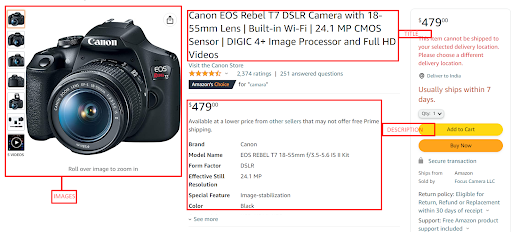
Title:
Making sure the product title includes your brand name, the function of the product, keywords, quantity, and size is the first step in optimizing your listing. Following the character limit will improve your product rank.
- Capitalize the first letter of each word and double-check your grammar.
- Don’t write promotional phrases.
- Do not add special characters like! $ ^ * { } # ~ < >
- Use numbers instead of words.
- Don’t write in all caps.
Description:
Make sure to add all information about the product in the description box. It should include features, benefits, size, color options, uses, material, quantity, ingredients, dimensions, etc.
- Do not add the brand’s email address.
- Try to place your primary or top buyer keywords in the description. (Don’t try to stuff too many keywords
 )
) - Include important keywords
- The images and description must line up.
- Write a clear and understandable copy.
- Make sure it looks orderly by using bullet points.
Bullet points:
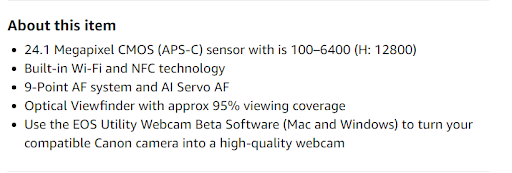
A buyer will pay more attention to your text if it is written in the form of bullet points because they can rapidly scan them and acquire all the required information.
Images:
Images can make or break your sales. A high-quality image can increase traffic to your page even though it has no direct impact on SEO ranking. When adding images, keep these things in mind :
- Use only a plain white background.
- Use high-quality images with a resolution of 1000 pixels. This way, if the users zoom into the image, the quality is not compromised.
- The images must show the exact product you are selling.
- You cannot add GIFs or animation.
- Although adding product videos is optional, they have a better probability of ranking.
- If your product has variations in size or color, add images for those as well
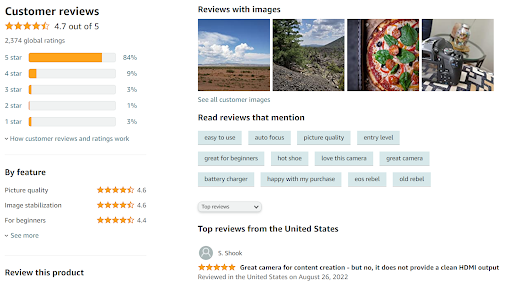
Ratings and Reviews:
The most significant factor in a product listing is the reviews. Before making a final decision, consumers usually look into the ratings. Your sales can skyrocket if customers give your products positive ratings.
Before buying any item, the majority of the customers decide to check the reviews and ratings. If your product page has very few reviews, you could ask customers to offer feedback by sending emails or thank-you cards along with the items. If there are multiple negative reviews, understand the issue and make necessary changes.
You can even make use of the Amazon Vine program. When a customer enrolls in the program, they can request free products and share their reviews with other buyers. This helps others make informed decisions.
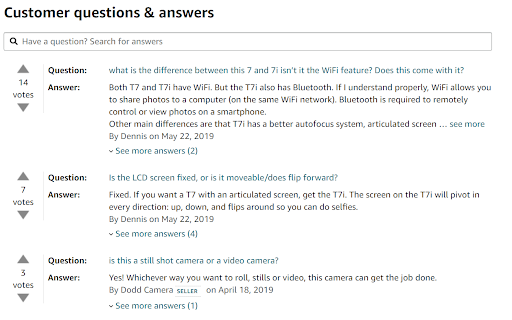
Questions and Queries:
You must answer questions customers ask about your product as soon as possible. Give them useful answers that will persuade them to purchase your merchandise. This demonstrates the seller’s eagerness and interest.
Backend or Hidden Keywords:
A missing keyword can negatively impact the ranking. Your products won’t be indexed if there are no keywords in the listing. For increased traffic, be sure to include all the crucial keywords in the copy.
Visit the SellerApp website if you need assistance with optimizing your product listing.
How to Optimize Keywords
The main method for using Amazon Search Engine Organization to increase traffic to your products is through keywords. Simply said, these keywords are search terms. Search terms are the words a user enters in the search bar when they want to buy a product.
The advantage of using keywords is that you can boost brand awareness, visibility, and conversions. It’s important to choose the right keywords. If you don’t, you’ll lose out on impressions and won’t rank at the top of the search results page.
Your target audience is more likely to find your products if you use relevant keywords. All the information you need regarding keywords in Amazon SEO can be found below.
What is Keyword Indexing?
Keyword Indexing is the process of making Amazon identify the keywords used in your product listings. As a seller, you must ensure that your keywords are indexed if you want to be found on Amazon. To achieve this effectively, include your keywords in the title, product description, and bullet points. When a customer searches for a product, your listing will appear if your keywords are indexed.
Types of Keywords used on Amazon
Primary Keywords also called Buyer Intent Keywords:
Also referred to as volume-based keywords, these terms have a direct impact on your ranking. It uses common, broad phrases and is based on the high search volume. They must be included in the title as they are the main terms that users will search for.
Brand Keywords:
Search terms relating to your brand or products are known as brand keywords. Your listing appears when a user enters your brand name into the search bar. This is important since it allows you to pick keywords that are specific to your brand and, as a result, have no competitors.
Short Tail Keywords:
High-volume search terms known as “short tail keywords” are typically only one to three words long. They also go by the name “head terms.” Due to the length of these keywords, they produce non-specific, broad results. For instance, if a user searches for “Black Marker,” numerous black markers from various manufacturers and for multiple applications will be displayed.
Long Tail Keywords:
In contrast to short-tail keywords, long-tail keywords are very specific and target oriented. They often contain more than three words and provide exact results. For example, if a customer enters “Black permanent marker for whiteboard,” only those products will be displayed to them.
Backend Keywords:
These are terms related to your keywords that are hidden in the backend section of the seller’s account. Its purpose is to tell Amazon’s algorithm that your products are targeting specific keywords.
If you are interested in learning more about Amazon Backend Keywords, here is a detailed article.
Common Amazon SEO Mistakes
Incomplete Keyword Research:
The most important facet of SEO is the use of keywords. Amazon carefully examines each term, and your listing’s relevance is inspected using this data. Knowing what your audience is looking for can help you decide which keywords to include in the description and title if they are related to your products.
Keyword Stuffing:
Considering how crucial keywords are for SEO, it is important to note that they should be added in moderation. Stuffing your content with too many keywords, also known as keyword stuffing, will hurt your brand’s visibility and lower your ranking in search results.
Inaccurate Description:
You will lose customers if you provide misleading and insufficient information. Make sure your descriptions accurately reflect the products you are selling. Additionally, use clear, detailed language when writing so that customers may clearly understand what they are purchasing.
Bad Picture Quality:
This is a no-brainer. High-quality product images taken from a variety of angles must be included in your advertisements. Fewer people will view the pictures if they are of poor quality. For the buyers to make an informed choice, they would prefer to know how exactly your products look.
Fewer Reviews:
One of the most frequent mistakes made by sellers is this one. The majority of consumers decide to read the reviews before taking a look at the product description. They are better able to weigh the benefits and drawbacks as a result. Hence, If your product has few reviews, your page will not appear on top of the search results.
Lack of Information About Competitors:
It is important to know your competitors and their strategies. Analyze your competitors and find out where they are lacking. It is quite beneficial to understand why another competitor is or isn’t ranking. If something is missing in their listing, you can then update your list and perform better.
Mismanaged Inventory:
It is very crucial to keep a track of your inventory. If your products are invariably out of stock, Amazon will stop showing your products to buyers. Customer satisfaction is the number one priority for Amazon, and hence waiting for products to be back in stock results in customers being dissatisfied with your service. Whereas if your products are always available, you will have more people buying your products.
Conclusion:
Whether you are a new seller or are already running your business on Amazon, these tips will help with your ranking. You now have all the knowledge required to use Amazon SEO to optimize your product listings. Follow this guide to have a successful SEO strategy for your business and sell more products.
The post Amazon SEO 2023: A Complete Guide for Ranking your Listings appeared first on Amazon-ASIN Blogs - Latest from Amazon Sellers: News, Advice, and Effective Strategies.
]]>The post 4 Risky Amazon Black Hat SEO Techniques to Avoid appeared first on Amazon-ASIN Blogs - Latest from Amazon Sellers: News, Advice, and Effective Strategies.
]]>Amazon has made it very clear that sellers who use these tactics will not benefit from them as they have complex methods of tracking these artificial rank boosters.
Amazon A9 Algorithm
A9 is how Amazon refers to its search engine algorithm, or its proprietary system that ranks products in a specific order when a consumer enters a word or phrase into the search bar. Did you know that 63% of consumers start their online searches on Amazon?
With that it mind, it is imperative that an A9- specific SEO strategy is developed with a solid understanding of how Amazon’s proprietary search engine works. Unlike Google SEO, A9 is a closely-guarded secret that very few have insider knowledge about.
Due to the limited details shared about A9, it’s difficult to identify what we will call “influential factors”—things similar to what we mentioned above with Google such as keywords and backlinks. This is what makes Amazon SEO challenging.
Unlike Google SEO, A9 doesn’t make their optimization algorithm public, so SEO usually comes down to guesswork. However, based on our tests and knowledge of the Amazon Flywheel, we think we have it figured out. A9 may be difficult to master, but it’s not impossible. Let’s first discuss how Amazon ranks differently than Google.
Amazon’s ranking system doesn’t follow the same rules as most other search engine platforms because it is trying to accomplish a different goal. The best way to understand this is to focus on the conversion funnel, or the path that a consumer takes when making a purchase.
When a consumer goes to Google and searches for something, they are typically at the top of the conversion funnel, “awareness” or “interest.” They are searching for more information about a topic or product. When a consumer searches for something on Amazon, they are specifically searching for products that meet a need. This places users of Amazon lower in the funnel at “desire” or “action.”
Amazon has to account for their user’s unique needs. A9 enables Amazon to realize their user’s full shopping potential during this “desire” and “action” phase of the conversion funnel. To boil this down for simplicity; Google is primarily focused on information while Amazon is focused on conversion.
Amazon Vs Google
Hopefully it is now clear what makes Google and Amazon different and why they both demand a unique SEO strategy. As a quick recap, Google is most widely used for gathering product and brand information, whereas Amazon is where the consumer actually makes a purchase.
Although Google and Amazon share some ranking similarities, their different goals should lead you to develop unique SEO strategies. In order to create a successful Amazon SEO strategy, you must understand Amazon’s fundamental goal, “to be earth’s most customer-centric company; to build a place where people can come to find and discover anything they might want to buy online.”
Amazon’s Fundamental Goal
To be earth’s most customer-centric company; to build a place where people can come to find and discover anything they might want to buy online
Amazon Black Hat SEO Practices Every Amazon Seller Should Avoid
Below are a few of the most common Amazon Black Hat Techniques:
1. Keyword Stuffing
As previously mentioned, there was a time when you could positively influence your page rank by increasing the saturation of keywords in your content. This is no longer the case. Amazon advises sellers to avoid entering redundant information in the keywords fields, suggesting this won’t impact your placement in search results.
You can, however, include words in your product description that are included the product title, as this can still benefit customers when making a purchase decision.Putting Amazon’s style guidelines aside, let’s think about the consumer experience when a product detail page is stuffed with keywords.
Looking at an example of a generic phone charger (above). Would you purchase this product? While it may improve the relationship strength for a variety of search terms in the eyes of A9, the title looks messy and is very difficult for consumers to read. Content that is difficult for consumers to read will negatively impact your listing’s performance. In fact, 98 percent of shoppers are dissuaded from completing a purchase because of incomplete or incorrect content.
This proves how important it is to consider the consumer experience when optimizing your product detail pages. As such, we highly recommend the human-appeal of your listings be carefully considered.
2. Click Farms
You’ve probably heard of click farms. If so, you’re not the only one. Major websites are also aware of their existence and work diligently to reduce their influence. If you’re unfamiliar with the term, click farming is the practice of artificially inflating the number of clicks a link receives.
On Amazon, this can be applied in a few different scenarios such as wasting competitor’s advertising spend or driving artificial traffic to a listing. When artificial traffic is associated with a specific keyword or search term using a Super URL, it can drastically improve the listing’s click-through rate. Why does this work? As previously mentioned, the click-through rate is likely a factor that Amazon analyzes when determining how related each product is to the user’s search term.
By artificially increasing the number of clicks your product receives, you can potentially trick A9 into thinking your product is more related to the specified keyword or search term than it actually is. Here’s where it gets interesting. When this practice was first exposed by David Gaughran, it received a lot of attention. As such, Amazon developed systems for evaluating the quality of traffic to each listing, the conversion rate being one of the more profound.
This is why click farms simply aren’t worth the risk. While they may artificially improve your listing’s page rank in the short-term, the increased traffic without corresponding purchases will ultimately damage your listing’s conversion rate. The net result is simply not worth the risk of falling into the crosshairs of Amazon’s Seller Performance Team.
3. Super URLS
Super URLs are generated links that can be used on external websites to drive traffic to a specific Amazon product based on a keyword. Sounds like a pretty good gig, doesn’t it? Not exactly. Amazon has complex systems that allow them to track how and where individuals (or bots) arrive on their website. Looking at this URL for the Coleman Sundome 4-Person Tent that we found by typing in “tent,” you will notice two very unique identifiers, an “sr” code and “qid” number as shown above.
These two unique identifiers within the URL allow Amazon to track external traffic arriving at any given listing. The “qid” represents the number of seconds since January 1, 1970 and the “sr=” shows the page number and page position number at the time of the search.
This means that Amazon is tracking page position and time for every super URL created and it is rumored that product purchases and reviews left from consumers using these Super URLs are being removed as legitimate conversions in Amazon’s conversion statistics. Gaming the system by driving unnatural traffic to a product detail page through these Super URLs will likely not help your product or page rank, not to mention that you could get on Amazon’s radar. As such, we don’t recommend using Super URLs as a part of your SEO strategy.
4. Fake Reviews
Customers rely heavily on product reviews when they make online purchases. In fact, roughly 84 percent of people trust reviews like they trust their friends’ opinions. That being said, manipulating reviews can be very misleading for customers during the purchasing process.
Amazon is aware of this issue and has been the target of intense criticism for the validity of reviews on its website. Prior to all the publicity around review authenticity, sellers could easily inflate their product reviews by providing product for free, or at a steep discount, in exchange for a review. Amazon is now aggressively cracking down on sellers who attempt to manipulate product reviews in any way.
Recently, there have been reports of hundreds of thousands of product reviews being removed from Amazon after being identified as inauthentic or influenced. You will also notice a “Verified Purchase” tag on most reviews. This is another form of letting customers know the review is authentic.
There are also a host of websites that can be used to detect fake reviews—our personal favorites are fakespot.com/ and reviewmeta.com/.
These sites provide users with an estimate of how authentic a product’s reviews are. While they are only estimates based on data that’s publicly available, they provide a great reference for sellers and consumers alike.
Watch this video to learn about the importance of verified reviews, and how verified reviews help the seller to grow their business on Amazon.
The post 4 Risky Amazon Black Hat SEO Techniques to Avoid appeared first on Amazon-ASIN Blogs - Latest from Amazon Sellers: News, Advice, and Effective Strategies.
]]>The post Create High-Converting Product Listings on Amazon appeared first on Amazon-ASIN Blogs - Latest from Amazon Sellers: News, Advice, and Effective Strategies.
]]>When you look at a few of the best Amazon listing examples and its sales figures, you will realize why listing optimization is important. A well-optimized listing helps improve your product’s visibility, boost your product sales, and increase your business.
Table of Contents:
What is Amazon SEO?
Amazon SEO is the process of optimizing your product listing to rank higher on SERP results for desired targeted keywords.
If you are an Amazon seller, then the ranks on the Amazon search results page are the most crucial success factors for your enterprise.
“The Higher the Position, the More You’ll Sell!“
66% of online buyers hunt for their merchandise by going straight to the Amazon site without Google. Therefore, brands have to be observable in the organic results of the platform to allow Web users to buy their products, and if your products are not rank well, you’re missing out on sales possible!
How Amazon Ranking Algorithm Works?
A9 Algorithm is the platform which Amazon utilizes to choose how products are ranked in SERP. It’s similar to Google search algorithm. But they are some key differences.
A9 is Amazon product algorithm that is made up of direct and indirect facets used to complement users’ search questions to services and products they have been most likely to purchase.
The majority of the components that rely on SEO are on the item page. It’s thus essential to understand what it involves before seeing its details.
The A9 algorithm, consequently, takes the following components into account on the Item page:
- Title
- Bullet-Points
- Description
- Product Pictures
- Keywords
Check this video to get detailed understanding about how amazon algorithm works:
Create High-Converting Product Listing
Title:
Creating quality names is essential to improve the positioning of your products on Amazon and be visible in the marketplace. Unlike Google, names online sales platforms can be up to 200 characters. This allows more data to be included, but not overly much.
According to Amazon, a qualitative product title must have this structure:
- Brand name
- Product name
- Main features
- Color
- Size
- Packaging or volume
The major keywords ought to be put at the beginning of the name and the least important at the end. These should enable you to differentiate your goods from those of the competition.
Description:
This component shouldn’t be neglected if you want to optimize the content and SEO of your brand’s products on Amazon. Inside, you will need to insert the appropriate keyword phrases and synonyms and properly structure the paragraphs with sentences and bullet points.
From the product sheet, there are two types of descriptions:
Bullet Points: there is a short description beside the pictures, which can be in bullets. It is used to temporarily present the product to the user on the product sheet. The purpose is to entice customers to purchase the Item, thus increasing the conversion speed.
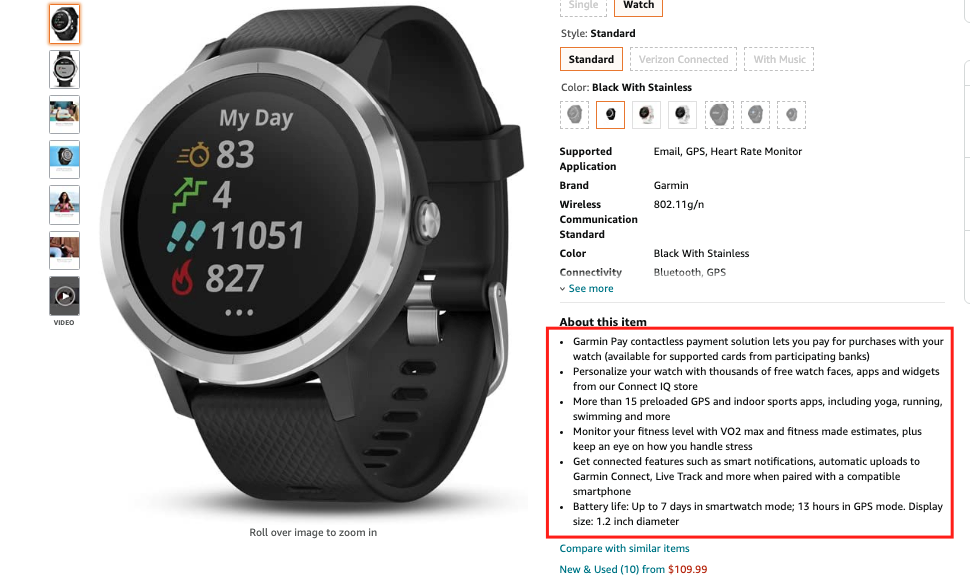
Product Description: Unlike the brief ones, the lengthy description may be further down the item sheet before consumer comments. Additionally, inside, important keywords should appear. It has to be well written and methodical to pull in more people, who are most likely to be interested in the product given that the location where the description is situated.
With that in mind, We have prepared this Free Product Description Editor Tool where you can optimize the description of your Amazon product and make it look attractive and stylized. You can use different styling options and symbols like bold, italic, bullet points, among others.
Product Images:
Pictures added to a product do not have a direct effect on Amazon’s algorithm. On the other hand, the more pictures, the greater the Item will have the ability to be observed by visitors. They are essential to make people wish to look at the item sheet and get it.
Because of this, Amazon has few recommendations:
- The product has to be clearly revealed.
- The image must be at 500 pixels on a single side.
- Have a white background to highlight the Item.
- It is likely to fill five different keywords per Item on Amazon, of 50 characters max per field, which is utilized exclusively for SEO.
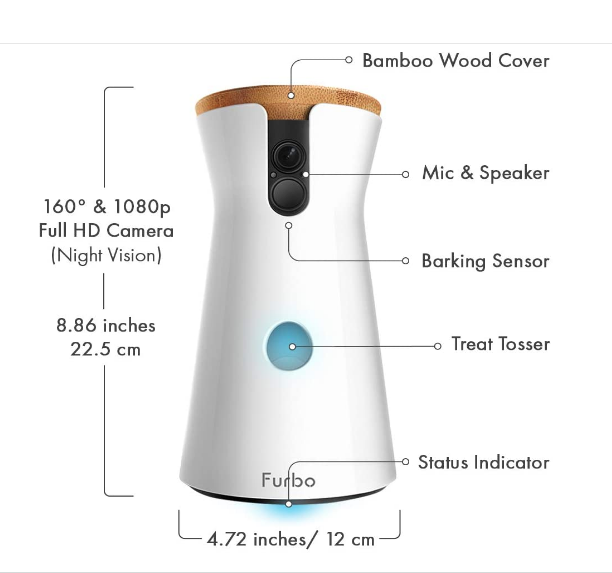
It’s recommended to put in a keyword and synonyms. The first reflex to have a great SEO is to determine the keywords you need to place your merchandise. It is good to know that some generic keywords are not readily available to manufacturers which have just arrived on the platform. To get this, the algorithm should know it.
Keywords:
- Keywords are essential for search engine optimization (SEO) and discoverability. Research and select relevant keywords and phrases that potential customers are likely to use when searching for your product.
- Incorporate these keywords naturally into your title and description. Avoid overstuffing, as it can harm your search rankings.
- Consider long-tail keywords for more specific targeting.
- Regularly monitor your product’s performance and adjust your keywords as needed.
The keywords that Amazon indicates in the search bar can be a fantastic source of inspiration. They could give clues into the keywords that consumers can use to do their study. Visiting the site pages may also be an exciting technique to understand which keywords the opponents use and know the free spaces and their strategy.
Conclusion
To create high-converting product listings on Amazon, focus on crafting a compelling title, informative description, high-quality images, and relevant keywords. Tailor your content to resonate with your target audience and regularly optimize based on performance and customer feedback. By doing so, you can increase the likelihood of driving sales and success on the platform.
The post Create High-Converting Product Listings on Amazon appeared first on Amazon-ASIN Blogs - Latest from Amazon Sellers: News, Advice, and Effective Strategies.
]]>The post How to Create your First Product Listing on Amazon? [STEP-BY-STEP] appeared first on Amazon-ASIN Blogs - Latest from Amazon Sellers: News, Advice, and Effective Strategies.
]]>Creating the perfect product listing is the essential part of success on Amazon. But if you’re a beginner, you may find it a bit challenging. Don’t worry; creating your very first product listing is much easier than you think, and we’ll discuss everything you need to know in this article.
You need to prepare a few things ahead of creating a product listing. Make sure that you have all the required information. I’m going to take you through three critical things.
- Product ID
- Keywords for your Listings
- Product Images
Product ID
If you’re selling a product that’s never been sold before on Amazon, then you need something called product ID. It’s a unique identifier for commercial products. UPC barcodes, EAN are all variations of Global Trade Item Numbers or GTINs.
Many websites sell GTINs for a low price. But, these are not allowed by Amazon. If you do buy it from these sites, there is a risk that your products might get suspended because Amazon might think your products are fraudulent. Amazon suggests a GS1 platform to buy UPCs from, or you can also buy it from legitimate GS1 sellers.
Keywords for your Product Listing
Keywords are one of the important factor that increases your chances of being visible to your potential customers.
Researching keywords can be a bit of a pain. So this is where we come in. With SellerApp’s powerful tools, you can research the right sort of keywords for your product listing based on CPC, search volume, relevancy, etc.
We’ve already created a detailed video on how to research keywords for your listings on Amazon using SellerApp:
You need a unique set of keywords for product title, bullet points, description, and backend search terms.
Product Images
Make sure you have the right set of images for your product. Images can influence the buying decision of shoppers to a large extent.
So you need to make sure that you have the right images that put your product in the best light possible.
- Ensure the images are of High-quality
- Capture product in Different angles
- Portray lifestyle images in different use case scenarios
- Highlight all the USPs.
- Use Infographics to show how your product is unique from your competitors.
How to Create Product Listing on Amazon?
Now you have everything you need, let’s have a look at how to create a product listing on Amazon
- Sign in to Amazon Seller Central
- Add a New Product or Select Existing Product
- Select your product listing Category & Sub-Categories
- Filling out Product Listing Information (Vital-Info)
- Product Listing Information (Variations)
- Select your Fulfillment Channel
- Upload Product Images
- Add Product Description
- Add Keywords
Step 1: Sign in to Amazon Seller Central
Sign in to Amazon Seller Central and select Add a product under the inventory drop-down menu.
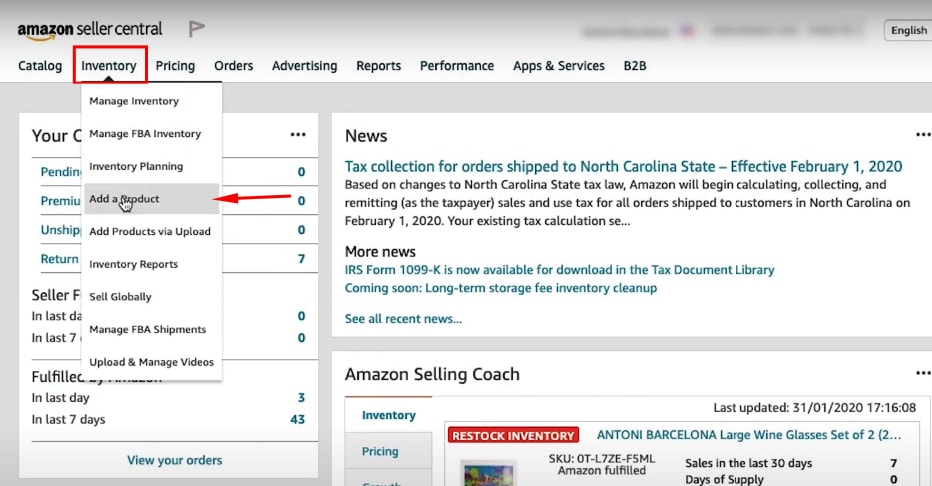
Step 2: Add a new product or Select a product that’s already on Amazon.
Here you see two different options. The first one is if you’re planning to sell a product that already exists on Amazon, then you can choose the first option, which is to find your products in Amazon’s catalog.
If you have any Product ID like EPC or ISBN, or ASIN number, you can type it in the search box.
If you are planning to sell a product that’s not sold on Amazon then click on ‘I’m adding a product not sold on Amazon’
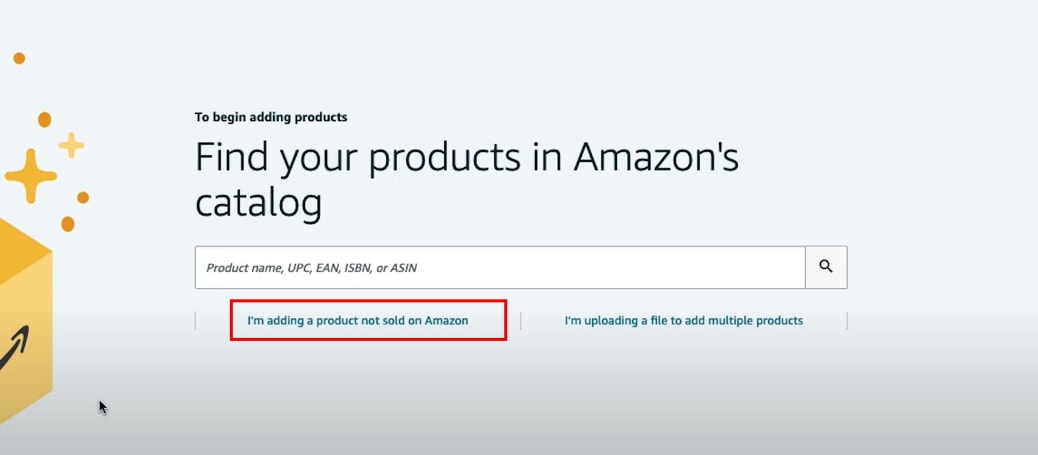
Step 3: Select your Product listing Category and Sub-categories
Once you click on the second option, you’ll be taken to a page with categories to choose from. if you feel like your category might qualify for two different categories, then the wisest thing to do would be to look at where the existing sellers are listed and look at their corresponding daily sales and revenue whatever category is making the most amount of sales, I would say choose that specific category.
You can use the SellerApp Chrome extension to find out the daily amount of product sales and revenue per seller.
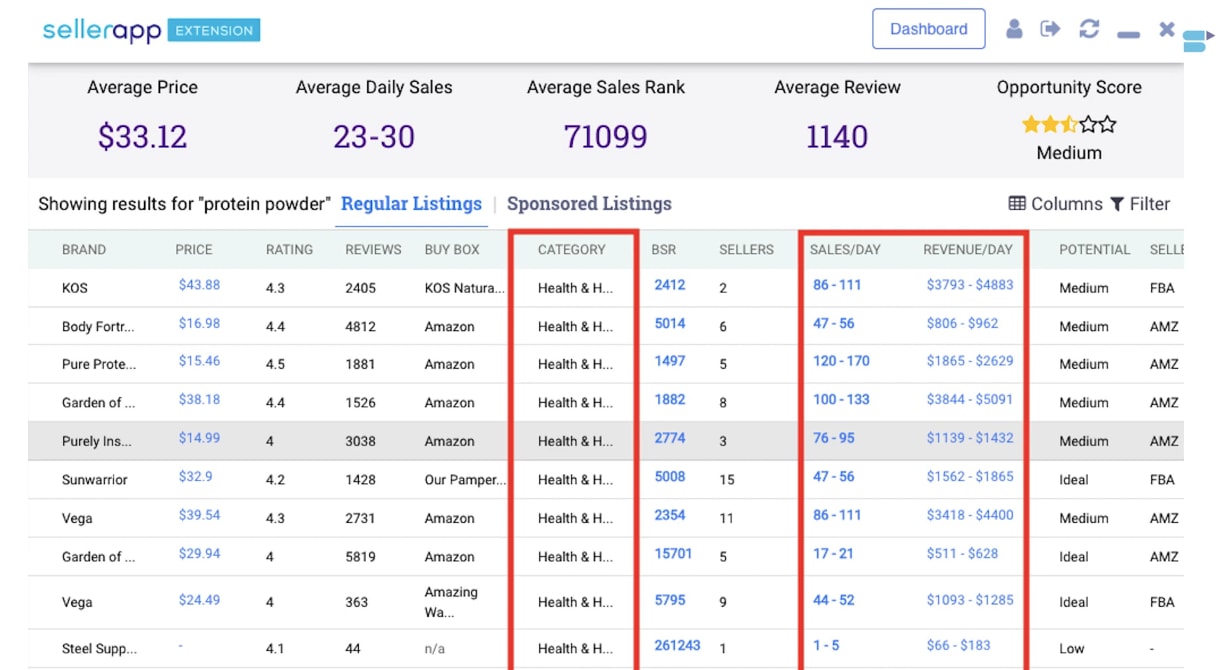
For Example:
I have already chosen the product, which is ‘whey protein powder.’
and it’s the best seller in its niche.
Let’s figure out what category it’s listed under.
Health and Household > Sports & Nutrition > Protein Powders > Whey
Step 4: Filling out your product listing Information (Vital Info)
Once you’ve selected the correct category, you’ll be taken to the most essential part of the process, which is filling out the listing information of your new product.
This section is divided into different tabs, and the first one is vital info.
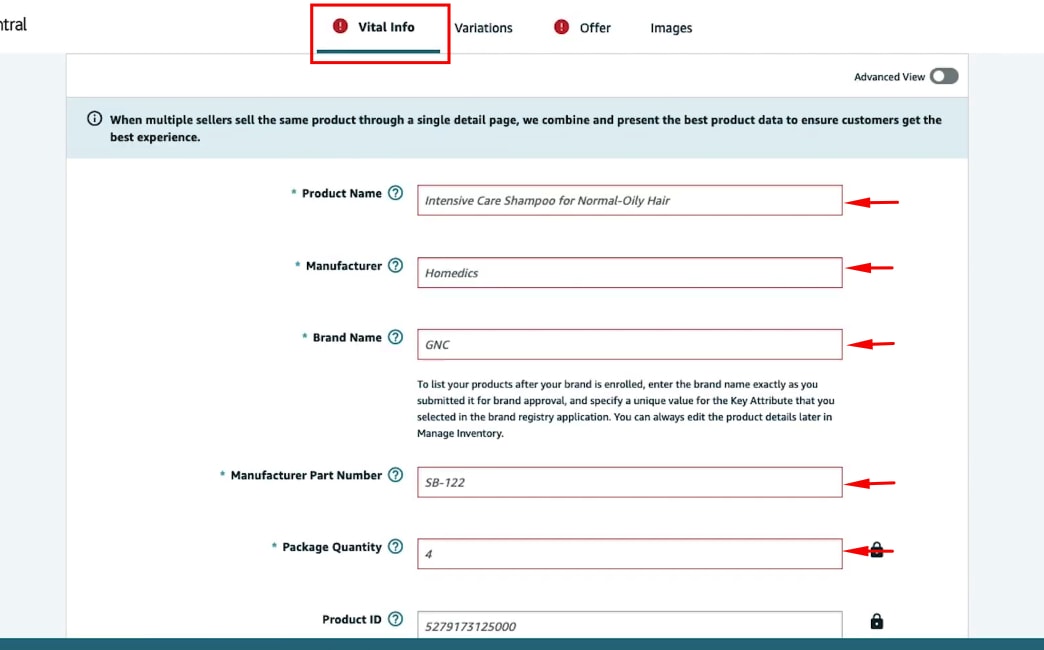
The Vital tab contains one of the essential parts of your product listing. which is your product name, manufacturer, brand name, manufactures part number, package quantity, product id, and more.
Step 5 – Filling out your listing Information (Variations)
If you have different variations for the same product that you’re selling. based on size or color or items, then you can choose variations. You can create a parent ASIN and then list all the child ASINs under it.
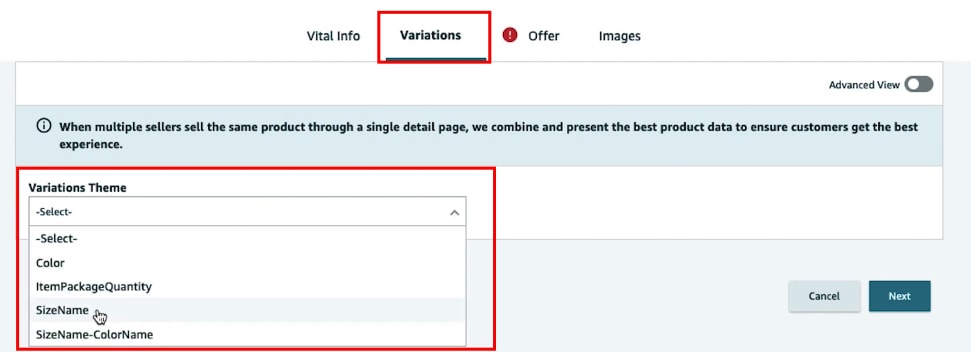
Step 6 – Select Your Fulfillment Channel
There are two options in the fulfillment channel: the first one is motion fulfills, and Amazon fulfills the second one. If the seller is fulfilling the orders, package everything, then it is merchant fulfilled.
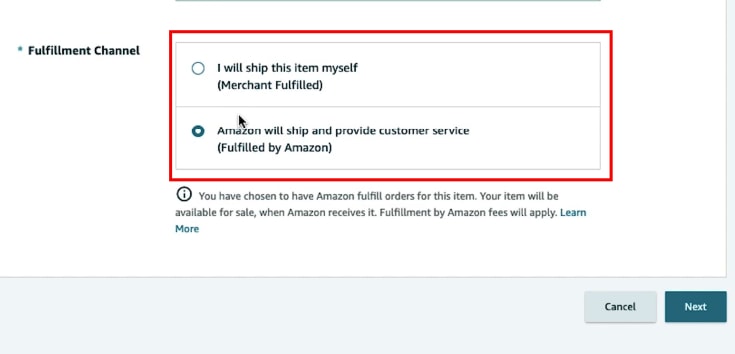
If Amazon is taking care of packaging, shipping, customer service, everything, then it is fulfilled by Amazon.
Step 7 – Upload your Product Images
Move on to the image section. This is where you can upload all of your images. It is recommended to have at least five to six images, and Amazon allows up to ten images. it would help if you made sure that images are of excellent high quality and high resolution.
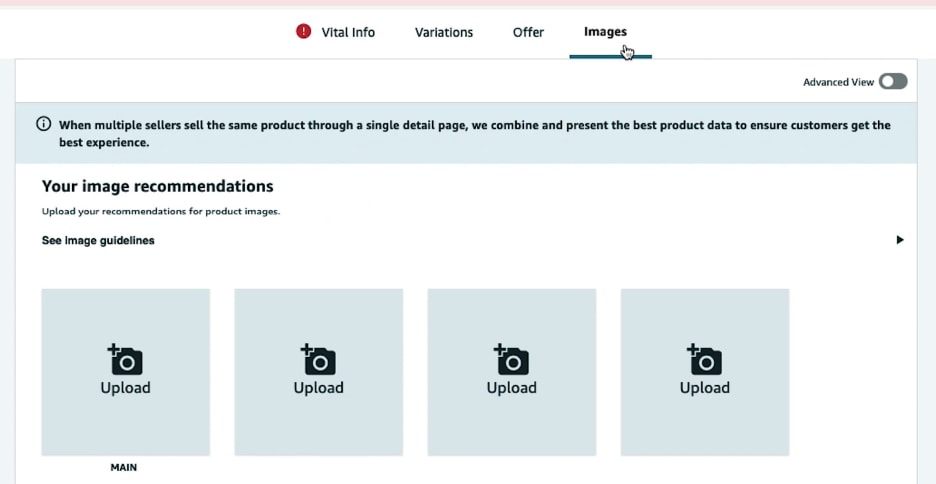
You can have one product image as a thumbnail image, and the rest can be product detail images, infographics, and lifestyle images.
Best Practice
- Images should be at least 1000px on the longes side & 500px on the shorter side
- Ensure your product occupies 85% of the space on the image.
- Don’t add any watermarks or logos on the product images
Once you uploaded all the images, click on advanced view. It will show you multiple different options that were hidden.
Step 8 – Add Product Description
The description is super important as you will be entering your bullet points and product description.
- You’re allowed to have five bullet points to maximize your visibility
- Add your keywords in the description
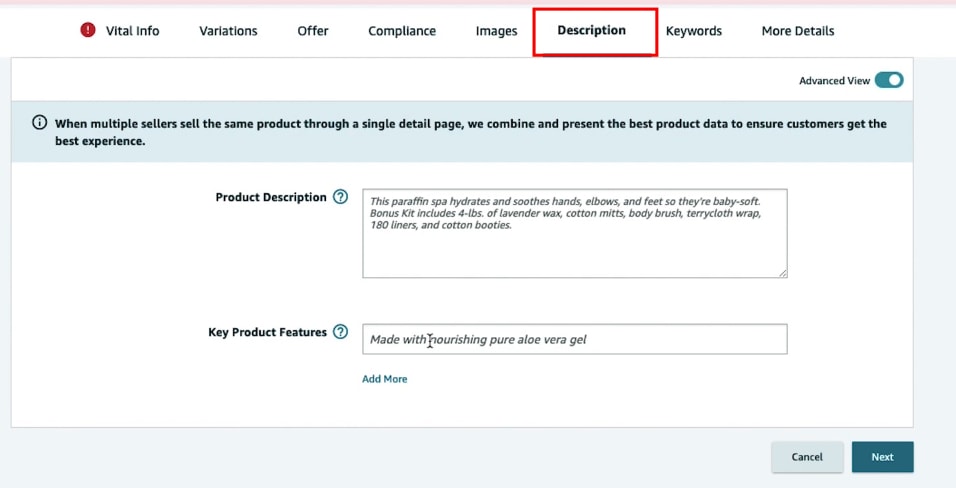
Create an attractive HTML product description for your Amazon product for free with the Amazon Product description editor. No HTML knowledge is needed!
Step 9 – Add Keywords
Keywords are another critical part of creating a successful product listing. Tools like SellerApp can help you find the perfect keywords for your product.
The first one is search terms which are usually referred to as backend keywords. If you have any synonyms or any other keywords that you’d like to put into your listing, you can add those search terms here.
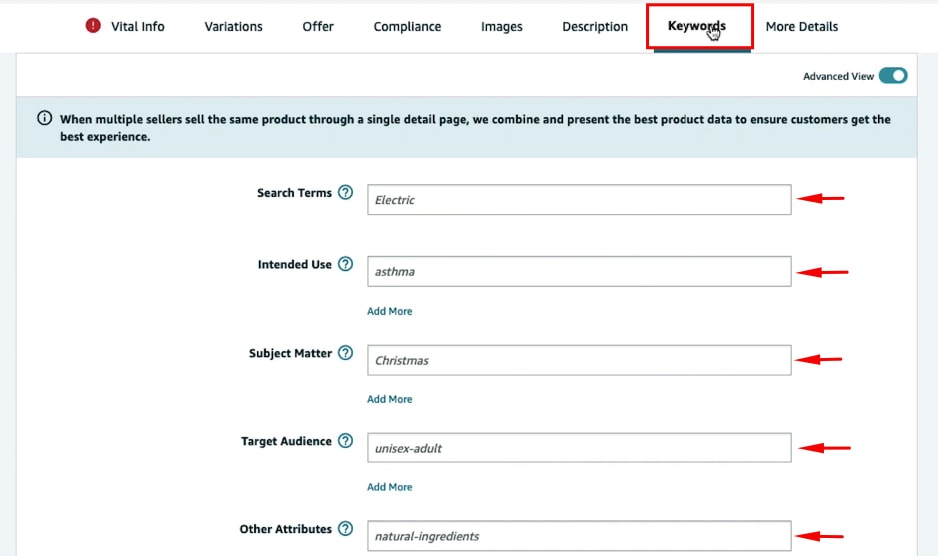
That’s it click Save and finish, and you have created your product listing.
Amazon product listing Restrictions
Now that you’ve created your very first Product listing, make sure you avoid the following
- Don’t use terms like best, free, buy one get one or subjective terms like cute, cool, etc.,
- Stay away from trademark words & Amazon words like special amazon deals.
- Don’t do keyword stuffing because neither amazon, not the shoppers like it
- Incomplete listing will be suppressed, fill out all the information required.
- Don’t use time-sensitive information, like the best product of the year.
- Don’t put shipping details on the description, like free shipping or the shipping duration.
Final Words
Let’s summarize you need to have the following information ahead of creating a product listing on Amazon, like your product ID, keywords, and images. Then you will sign in to your seller central account, choose to add a product on the inventory drop-down menu in the seller central, select the option to add a product that’s not sold on Amazon before, and fill out all your product details and select the appropriate category & subcategories.
You can choose an FBA offer if you want Amazon to fulfill your orders. I hope you found this article helpful.
The post How to Create your First Product Listing on Amazon? [STEP-BY-STEP] appeared first on Amazon-ASIN Blogs - Latest from Amazon Sellers: News, Advice, and Effective Strategies.
]]>The post E-commerce Keyword Research: A Beginners Guide appeared first on Amazon-ASIN Blogs - Latest from Amazon Sellers: News, Advice, and Effective Strategies.
]]>Let us quickly examine some fascinating stats.
- 37.5 percent of traffic to e-commerce websites comes from search engines (SEMrush).
- 23.6 percent of e-commerce orders are directly connected to organic visitors (Company Insider).
Let us dip into the technical approaches in the modern guide.
Importance of Keyword Research
A keyword analysis is the foundation of every e-commerce SEO campaign. Because keyword research informs each other SEO-related activity, you do on your site. Without keywords, it’s not possible to optimize your website.
List of keywords influences your technical SEO too. That is because your site architecture and URLs will need to take keywords into consideration.
Since you can observe, keyword research is a VERY major deal for your eCommerce site.
And here’s exactly how to locate untapped keyword search terms that your customers search for… and also how to choose the best keywords for your website.
Best ways to find keywords for Product and Category Pages
Most keyword research tutorials give attention to “informational keywords”.
Informational keywords are type of search terms that people type into search engines to detect helpful “howto” content.
(Like “How to make coffee beans into powder”)
While informational keywords have their place within e-commerce, the vast majority of your website’s keywords will be customized around product searches.
(Like “Coffee Beans”)
Meaning you will need to tackle keyword search together with product-focused keyword phrases in mind.
Here’s precisely how to take action:
1. Amazon
Yes, Amazon might be your competitor. Nonetheless, it is also the most excellent e-commerce site on the web… helping to make it a items’s keyword gold mine.
Here is the Way to tap into Amazon for keyword study:
First, go over to Amazon and input a keyword that explains one’s merchandise.
Whenever you’re doing this, Amazon will list hints on this keyword.
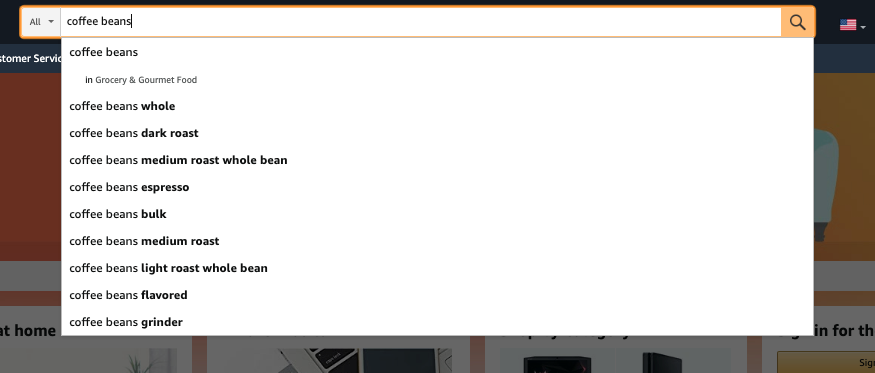
The keywords Amazon suggests are normally quite targeted (also referred to for so long-tail keywords ). Not just do long-tail keywords tend to convert a lot better compared to briefer terms. However, they are usually less competitive too.
Rinse and repeat your primary services and products on your website.
Pro Suggestion: Amazon will sometimes indicate categories over the keyword suggestions. All these create great search phrases to utilize for pages.
2. Wikipedia
Wikipedia is amongst the best regions to find keywords for the category and product pages.
That is why, Much like with category pages on your eCommerce competitor sites, Wikipedia organizes things by keywords and categories. Entirely only: they’ve done the work for you!
Let’s look at an example of ways to use Wikipedia for e-commerce research.
Firstly, Enter a keyword that describes a product or category your site sells:
Then scan the Wikipedia entry to phrases and words that make feel for the products you have on your website:
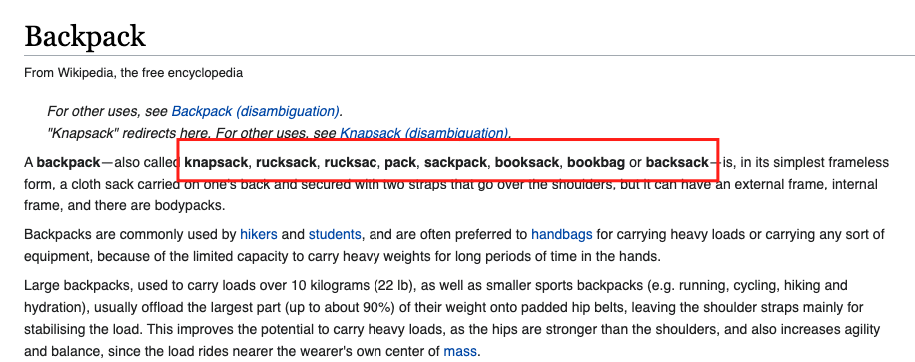
Make sure you have a look at the contents box. These will occasionally reveal excellent category page keywords.
When you’ve drained Wikipedia’s keyword suggestions, it’s time to proceed with one of my favorite tool: SellerApp keyword search tool.
3. SellerApp
SellerApp keyword research provides details about the high search volume of keywords and the purchasing intent of Amazon users. It helps topping up this game, by using the right keywords, you can be at the top organic ranks and get the best positions for your ads.
To use it, Type in the main keyword that describes your product
Click on the Search button to get best keywords list for your product, And it will spit out dozens of keyword suggestions.
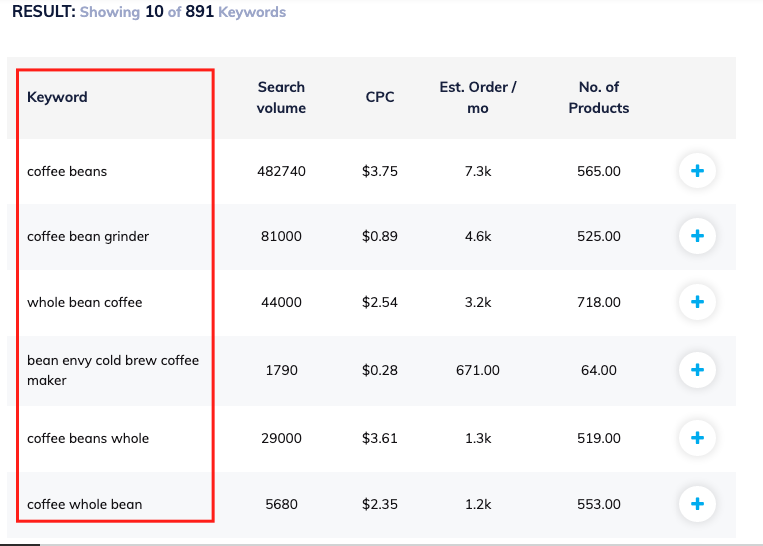
Yup, this tool makes finding longtail keywords from Amazon Suggest significantly faster. However, in my own experience, it gives you more keyword ideas too.
4. Google Keyword Planner
Lastly, we have the excellent Google Keyword Planner.
Even though the GKP can be a halfway good KeywordTool, it’s not very good to generate unique keyword notions.
For Instance, if you enter a category webpage keyword such as “organic pet food” into the GKP, it spits out super-close variations of this term:
That said, if you are doing some digging, you can get some stone which aren’t straight-up variations of this keyword you typed in.
Because the Google Keyword Planner will not generate a Whole Lot of unique keywords, I suggest using it to assess search quantity.
How to choose the best keywords for your eCommerce website?
Since You have a list of Possible keywords In Hand, you Are probably wondering.
Which keywords should you choose?
The clear solution? Make use of this 3-step checklist to recognize the very best keywords for your e-commerce website.
1. Search Volume
All Things Considered, If no one looks for this keyword, it doesn’t matter how hard it converts or the Way competitive Google’s first page happens to be.
There isn’t any way for me personally to give you special search volume tips. In a few industries, 100 searches monthly is A LOT. In others, 10k monthly searches are nothing.
You’ll get an idea of just what a “high volume” and “low volume” keyword is to get the industry through the years.
To locate the search volume for a given keyword, pop it into the GKP. You’ll discover the range of searches in the “Avg. monthly searches” column.
Pro Suggestion: Some keywords have HUGE seasonal variations. You are going to get more searches for “ugly Christmas sweaters” in December than in June. But there are plenty of non-seasonal search phrases which have peaks and valleys all over the world. For example, the keyword “organic pet food brands” has 4x more searches in April than December.
2. Filter keywords related to your product
This is a major one. Let us say you get a keyword that gets tons of searches. Must it be a winner, right?
Well…not really.
That is because the keyword may not be a great fit well in what your site sells.
If the keyword you pick is even a small bit of a stretch in contrast to what you have on the market in your e-commerce site, people that hunt for this term are not going to convert.
Before you move onto the following two stages in this technique, double-check that the keyword you’re considering fits your website, such as a glove.
3. Competition
In the end, it is the right time to understand how hard it’ll be to crack Google’s SERP page.
Here is how:
You’re able to get a keyword’s difficulty score in the SellerApp keyword planner by simply entering a keyword into the search field…
This metric provides you with a good idea of how competitive a keyword is to rank for.
Additional Read:
Amazon SEO: A Complete Guide for Ranking your Listings
The post E-commerce Keyword Research: A Beginners Guide appeared first on Amazon-ASIN Blogs - Latest from Amazon Sellers: News, Advice, and Effective Strategies.
]]>The post Top 7 Amazon Product Listing Tools appeared first on Amazon-ASIN Blogs - Latest from Amazon Sellers: News, Advice, and Effective Strategies.
]]>Developing and maintaining a product catalogue with thorough product descriptions and routinely updated, in addition to appealing vision to present your clients with your merchandise, will lead to greater sales for your business on Amazon
Here are few product listing tools to help kickstart your Amazon Selling business:
1. SellerApp
SellerApp is a tool for Amazon Listing Optimization. The SellerApp’s listing optimizer investigations the visibility of your list for those keywords on your list – verifying the lookup position and the place of the significant key phrases, the condition of the backend key words in addition to the list status for a comprehensive evaluation of the visibility of this list in an investigation. The tool can help to study and examine and to enhance listing conversions listings.
This tool helps you in boosting your product score on Amazon by assigning an objective score to your Amazon product listing that indicates areas of development based on client satisfaction and relevancy. After understanding this score, you can better the Amazon listing level of your merchandise so as to boost your Amazon Listing Quality.
SellerApp can help you in understanding the List score of your merchandise through Amazon Listing Quality check and will also help you in improving Amazon Listing Quality by providing you with personalized suggestions about how it is possible to improve your Amazon Listing Quality of your product.
2. Listtee
Listtee is listing software available for Amazon sellers. Utilizing Listee’s Amazon bulk listing tool, you print labels for transport, restock items in your Amazon stock, and can make custom made SKUs.
Listtee can detect which means you won’t need to worry about listing the identical thing. You gain from team service through their conversation and over the telephone.
It’s a venture package, one for small companies, at $49 per month, and two for entrepreneur companies, at $149/month.
3. EcomDash
EcomDash is a inventory management instrument for many Amazon sellers. The program provides the choice to customize product descriptions and shipping details and to edit merchandise listings and offers quick and reliable upload of graphics and SKU info to both Amazon and stations. They stand out with their pricing program that’s determined and will adjust in line with the seller’s revenue order quantity.
To try it, Ecomdash needs to be aware of the category you’re currently attempting to sell your merchandise under. Its list tool enables you to record your merchandise correctly and fast.
4. Sellbrite
Sellbrite provides a simplified list applications, allowing vendors to market products and list across multiple sales channels that are online. Order fulfillment and the platform enables control over stock in addition to provides a solution that is highly effective for vendors with automation and resources to reduce overselling.
Sellbrite functions with shopping carts, such as Amazon, eBay, Walmart, and Shopify and well known marketplaces. Their pricing is determined according to requests.
Amazon has changed the game for traditional retail. Walmart started to fight back. Take a look at their Amazon Vs Walmart competitive analysis.
Sellbrite functions with shopping carts and marketplaces, such as Walmart, and Shopify Amazon Etsy. Pricing begins low at $49 a month.
5. Channel Grabber
ChannelGrabber provides management options for vendors that brings internet stores and marketplaces . Apart from and command direction, management that allows orchestrating stations using one port upgrades of merchandise upload and lists is featured by the system. Furthermore, ChannelGrabber simplifies operations such as invoicing, postage printing and client emails and aggregates requests.

6. Accelerlist
Accelerlist provides tools specifically designed for Amazon vendors, including a Amazon bulk listing tool that is compatible with any browser. The workflow can be chosen by sellers most appropriate to their list needs: Precision or Speed.
The Speed workflow is designed for sellers who have many items to be listed in bulk. The seller sets default values for each area (e.g., listing price, condition, note), so that many products could be scanned and recorded very fast. The Speed workflow is utilized together with a reprise. As it’s scanned, the Precision workflow allows the seller to optimise every record, grading and pricing each product. To facilitate pricing choices, Accelerlist displays the very competitive offers and supplies Keepa/CamelCamelCamel links.
7. Solid Commerce
Solid Commerce is an incorporated SaaS ecommerce operations platform that provides the ability to list products and also to edit and handle stock listings on Amazon, eBay, essay, and many of other marketplaces as well as the seller’s own web shop. After entering names, descriptions, images, quantities, and prices, that information is automatically pushed into the seller marketplaces. From that point on, any changes made in Earnings Commerce upgrade those listings on the appropriate channels.
Conclusion
Amazon list tools can be a starting point for companies which don’t understand how to deal with inventories or their listings . Consider contacting one and assess for yourself whether or not they could do.
We would like to hear that which tool works best for you personally. Review our listing and leave us a comment below!

The post Top 7 Amazon Product Listing Tools appeared first on Amazon-ASIN Blogs - Latest from Amazon Sellers: News, Advice, and Effective Strategies.
]]>The post Amazon SEO Growth Guide with Strategy, Tips & Examples appeared first on Amazon-ASIN Blogs - Latest from Amazon Sellers: News, Advice, and Effective Strategies.
]]>Are you facing difficulties to increase your rankings on Amazon?
Here, is the mantra to come out from these i.e., Amazon SEO strategy. It will help you to skyrocket your sales by increasing its ranking on Amazon. As we all know the higher the product ranking, the more profitable for the sellers. All we want is your product/ website to appear on the first search engine results page. We will see in this article about the step-by-step guide to Amazon SEO and ranking optimization in 2020.
This comprehensive article is divided into two sections as follows,
Section1: Understanding Amazon SEO
Section2: How to optimize your product listing for Amazon SEO?
Section 1: Understanding Amazon SEO
Once we will move to Amazon SEO, a few questions will be raised in your mind; What is an Amazon SEO? What about its ranking algorithm? Let’s have a basic discussion on these.
What is an Amazon SEO?
Sellers want to appear their products at the top of the Amazon search results which can be possible only by Amazon SEO optimization for the product listings. Amazon SEO means when customers search by entering keywords, they must be able to find your products (which is relevant to that keyword) before they can buy your products. The entered keywords will be matched against the information (title, description, etc.) you provide for a product then your search locates relevant products on Amazon.
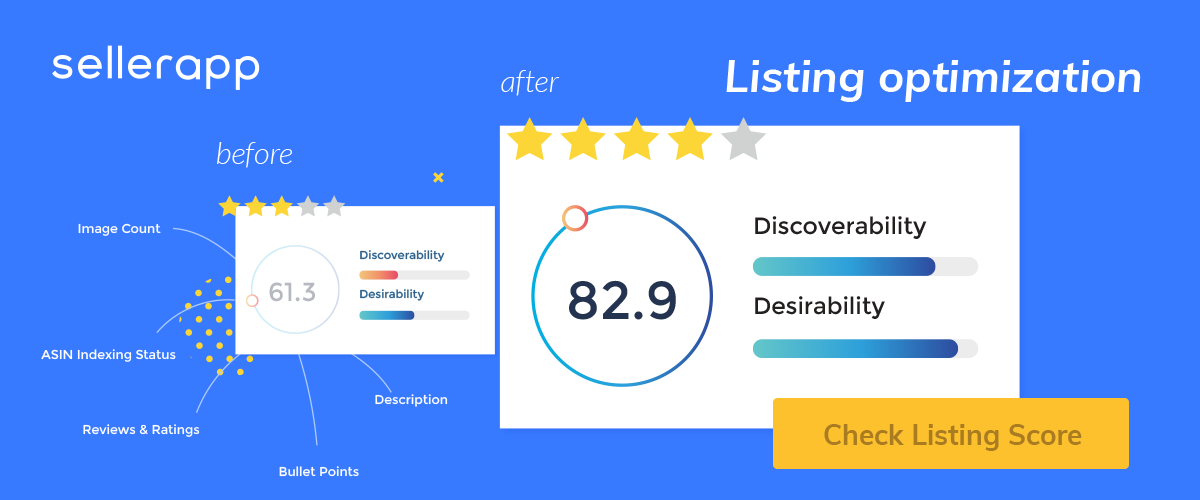
As you know people mainly click on the results which appear on the first few pages in Google search. Similarly, customers will go to the first few products shown in the Amazon search. That clearly means the product rankings on Amazon are the most important success factors for your business and this ranking of a product is decided by an algorithm called “A9 Algorithm”. You can learn more about Amazon Sales Rank.
How Does the Amazon Ranking Algorithm (A9) Work?
There are millions of products available on Amazon and buyers have to choose from them. For which, buyers perform hundreds of millions of search queries on Amazon every month.
And, for every single search query, Amazon has very little time to decide which products will be shown at top position or decide their display sequence among hundreds of millions of products.
Amazon Ranks Products Based on Purchase Likelihood
Amazon sales basically conduct between 3 parties i.e.,
- A buyer
- A seller
- The Amazon.
When a buyer comes to Amazon, ṭhey only want to buy by searching a relevant keyword of the product. The searching mechanism is the same as Google. When a user types a product, say “iPhone” into Google. By seeing only it is not clear what is that user needs. The user might want to buy an iPhone, but he might also just be looking for an image of an iPhone to use in a presentation. There are many probabilities that occur for a search.

But, there are below queries will be occurred by all 3 parties on Amazon i.e.,
- Buyers Query: Only one intent behind every search query is buying the product.
- Sellers Query: Sellers use Amazon for only selling the products.
- Amazon: Amazon wants to generate revenue, but Amazon will only make money if a sale takes place. It will take a 15% commission from Sellers.
Above all three parties have a common aim i.e., they all want a transaction to take place. Furthermore, Amazon wants to increase the number of transactions and for that, it will offer the Amazon Sales Rank concept for every single search query. We can say that Amazon has to rank all products by purchase likelihood.
How does Amazon determine purchase likelihood?
All the search results appear within a second for the user, but behind the scenes, the verification of purchase likelihood is a very complex challenge. Each search query has to go through hundreds of millions of products and hundreds of millions of search queries.
Example: If a search query happens is “iPhone” then an iPhone might have a very high purchase Instead of via search query “smartphone”.
As a consequence, Amazon has to determine the purchase likelihood not just for every product, but for every combination of product and search query.
Amazon follows a two-step process to rank products.
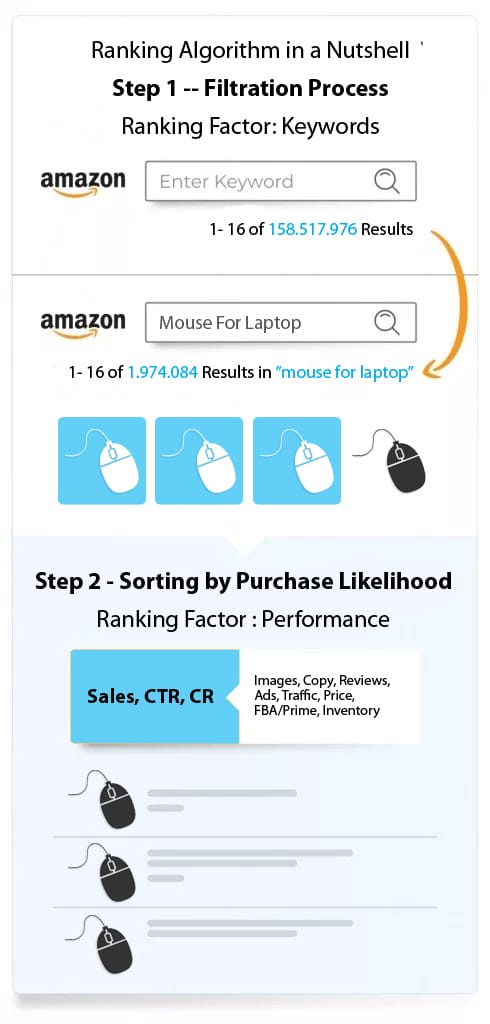
Step 1: Keywords Determine If your Product Ranks on Amazon at All
In the very first step, Amazon filters out all products which are irrelevant to the customer search query. It filters out on the basis of searched keywords. If a product does not contain all keywords of the search query, it cannot appear in the search results.
This step is important because it reduces the number of products that Amazon needs to sort by purchase likelihood.
Step 2: Performance Determines HOW HIGH Your Product Ranks on Amazon (On Which Position)
In this second step, Amazon finds out the purchase likelihood for the remaining products and then ranks them in a specific order i.e., Amazon ranking. For this ranking, Amazon checks the performance of the products.
The measurement of product performance is done by CTR (click-through-rate in search result), CR (conversion rate on the product page), and especially sales. These three parameters are the very significant KPIs for Amazon since they represent the steps that users need to take to buy a product.
These KPIs are measured on the basis of the keyword-specific level. For example, the keywords “iPhone” and “smartphone” have different CTRs, CRs, and sales. That means the better your CTR, CR, and sales are for a specific keyword, the higher your product will rank for this keyword.
There will be a variety of levers that can be used to actively increase CTR, CR, and sales and improve your rankings. Some of the levers are product images, copy, review management, and Amazon PPC.
Amazon SEO Strategy and the Amazon Marketing Flywheel
Once people find your product and if they feel it relevant, they’ll most probably click on it and make a purchase for the same. The more people click and purchase your product, then the A9 algorithm will rank it more generously. The higher your product ranks, it will appear to more people and then more people will buy it. In turn, it will increase your rankings and even enable you to put more resources into marketing initiatives to drive your sales.
This process and strategy can develop a self-perpetuating flywheel between rankings, sales, and marketing initiatives that improves your sales.
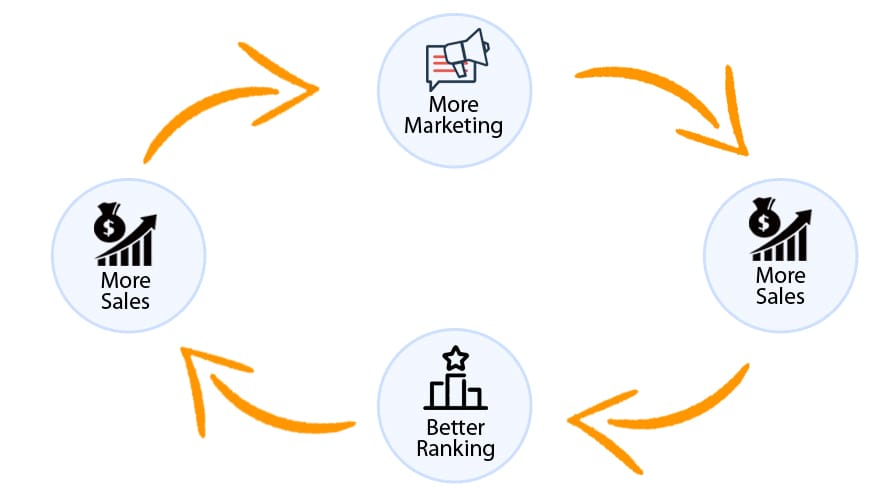
Section 2: Step-By-Step Guide to Optimize Your Amazon Product Listings for Higher Ranking
Now, we have learned about how the Amazon ranking algorithm (A9) works. Let’s get focus on what can be done to optimize your listing.

Here are the steps to optimize your Amazon product listings,
- Content: Creating and enhancing your listing content
- Keywords: Adding and optimizing the keywords of your listing
- Maintenance: Ongoing optimization after the listing is live (e.g. managing reviews and leveraging Amazon PPC to improve your rankings)
Create Optimal Content for Your Amazon Listing
In the very first step, you can create or enhance your content and optimize your product copy and images.
Amazon works like a regular search engine for any of your products. So, it will help to improve the click-rate (CTR) in search results and the conversion rate (CR) on the product page by optimizing your content. Also, it will boost sales and improve your ranking and it will be more successful for any PPC campaigns or other marketing measures that generate traffic to a product page.
So, it can be noticed that optimizing your product listings should always be the first step to improve your ranking on Amazon. Performance and rankings can be improved by optimizing your product copy and images.
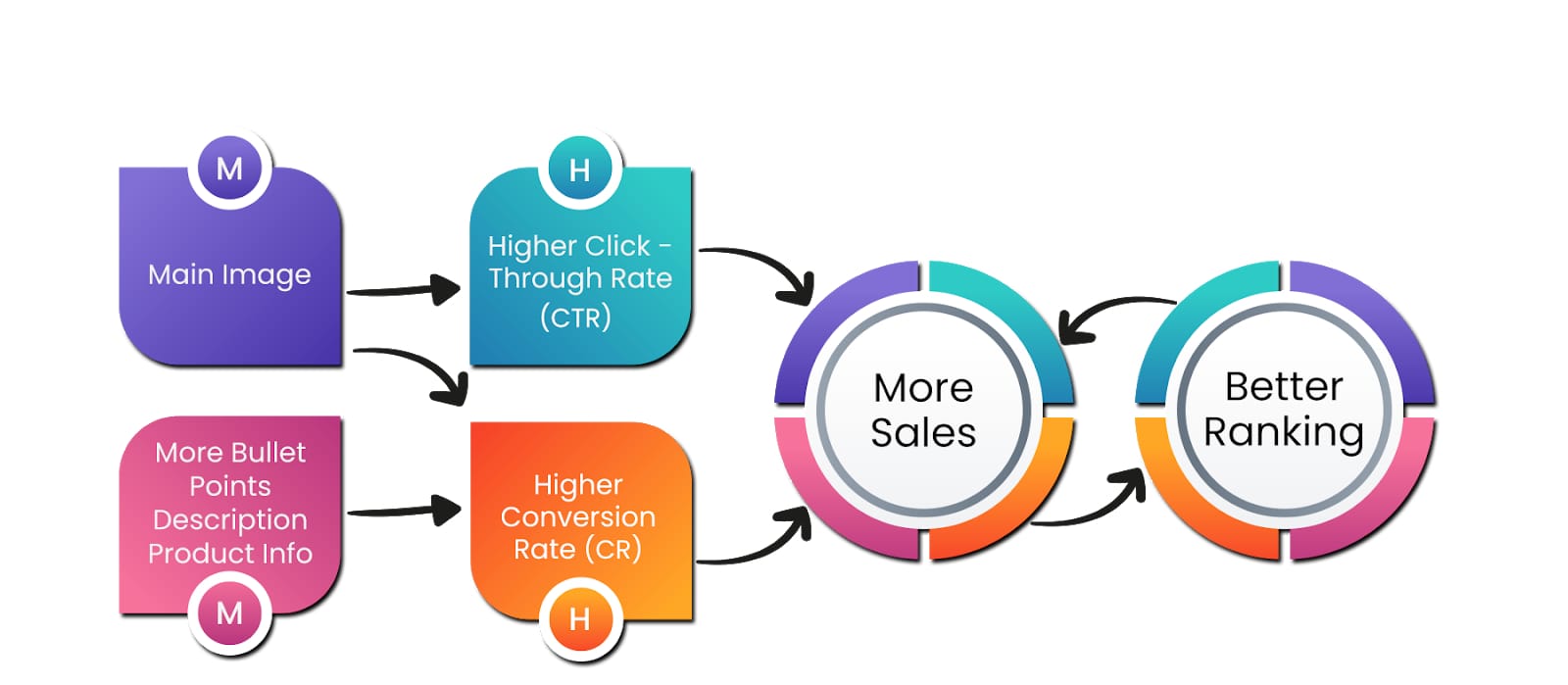
Persuasive Text That Sells — How to Write the Best Amazon Sales Copy
Amazon SEO needs to optimize the following product content,
- Product title
- Bullet points a.k.a. Highlights a.k.a. Attributes
- Product description
- Additional product information
- Enhanced Brand Content (Sellers) & A+ Content (Vendors)
Note: For your product display you should follow the Amazon Style Guides according to your product category otherwise Amazon can put down your product.
Check this article from Amazon which will give you basic information about the ‘Quick Style Guide’ and it can be applied to all categories.
If you want to create convincing product texts then you should follow the below basic rules.
- Inform: Need to provide all necessary information for the purchase decision in the description
- Sell: Need to highlight the benefits and USPs of the product in the description. As well as features should be shown off nicely which will attract customers easily by seeing its benefits, so they will be ready to buy without thinking much.
- Present: Your product should have a formal & simplistic structure for its information which can be easily understandable by a customer.
Product Content and their Optimization Tips

Product Title
- Check the Amazon Style Guides for the length and structure of your title in the relevant product category
- Impacts your CTR and CR
- It should contain important information, benefits, and USPs.
- The mobile view is limited to about 70 visible characters, so stick to the most important information and make sure to place it at the beginning.
Bullet Points a.k.a. Highlights a.k.a. Attributes
- Check the Amazon Style Guides for the relevant product category
- Impacts your CR
- Maximum 200 bytes (equivalent to approximately 200 characters) per bullet point
- Outline the key features and benefits of the product
- Always connect the features with the benefits for the customer (e.g. ‘easy to clean — the glass surface allows the kitchen scales to sparkle with a single wipe’).
- Stick to one benefit per bullet point for better readability and information flow. For example:
- Easy to Clean
- Flexible Use etc.
- Mobile view: Only the first three bullet points are directly visible to mobile users. Place your USPs at the beginning of the list.
Product Description
- Check the Amazon Style Guides for the relevant product category
- Impacts your CR
- Avoid duplicating the bullet points. Provide as much additional information as possible and tell a story about the product.
- Make it easy to read. Maximum three lines per paragraph — you’ll need to use simple html code here:
- Separate paragraphs with <p> text </p> or <br> (line break)
- Use <b> text </b> for bold text and headings.
- For bullet points, use
<ul>
<li>bullet point 1</li>
<li>bullet point 2</li>
</ul> - For numbered lists, use
<ol>
<li>list item 1</li>
<li>list item 2</li>
</ol>
Additional Product Information
- Provide as much information as possible in the respective product information fields.
- Impacts your CR (additional product information appears in the product information section of the product page).
- Amazon’s search filters (page navigation) make use of the additional product information and can increase visibility (e.g., information on color, size, material).
Brand-Only Features: Amazon A+ Content and Enhanced Brand Content
Below are the extended content features for brand-registered Sellers and Vendors, respectively,
- Amazon Enhanced Brand Content and
- A+ Content.
For creating appealing texts and vivid images, you should use various layouts (a.k.a. modules) and an easy-to-use content tool. Then enhancements via these can give your standard product description page a significant visual boost.
Also, through enhanced content, you are able to answer your buyer’s questions conclusively and in a more engaging way and that enhances content can lead to a better conversion rate, more sales, and fewer returns. As per the Amazon point of view, enhanced content has the ability to increase your sales by 3-10 % through a higher conversion rate.
The Advantages of Enhanced Content for Sellers and Vendors
- Product Story: You can tell your product story in the form of more images and elaborate product descriptions. By using it, you can showcase the unique benefits and features of your product.
- Brand Awareness: You can build brand awareness and loyalty by telling your brand’s story and connecting with your buyers. You can stand at a different position among your competition and can encourage repeat purchases.
- Product Range: With the help of a comparison chart, users can discover more of your products and that makes them feel satisfied with their buying decisions. Also, in this way, the probability of distractions for any users will decrease and no need to check again & again for any competitor products.
If your brand is registered with Amazon, and you are using a professional selling plan then, you can use Enhanced Brand Content as free.
For vendors, “Basic A+ Content” is available as a free while “Premium A+ Content” is paid for them. This paid version of A+ content offers more interactive options like video and slider carousels. But, it is an exclusive program that you can get only on your vendor manager’s invitation. It is also available at a high cost.
When should I use Enhanced Content?
As every single branded ASINs are qualified and the essential highlights are allowed to utilize, you can expect to add enhanced content to each of your products. But we need to keep in mind that the formation of Enhanced Brand/Marketing Content will be required more time and exertion into it.
Additionally, Amazon Brand Registration is free, however, you have to authoritatively enlist your product as a trademark to be qualified — which includes some significant pitfalls.
Enhanced content isn’t filed by Amazon and consequently doesn’t legitimately expand perceivability in list products. In any case, enhanced content can improve rankings by implication by improving the conversion rate.
Enhanced content is additionally not a simple fix for the product that isn’t selling admirably. Despite what might be expected, enhanced content is fairly a quickening agent for a product that is as of now indicating a solid exhibition on Amazon.
Pics That Pop — Create Persuasive Amazon Product Images for Amazon SEO
Alluring, great product pictures are colossally significant for a product’s positioning since they can essentially improve the product’s presentation (CTR, CR, and sales).
How would they do that?
- Stage 1-Search Results: The principal product picture in the list items is typically the primary purpose of contact between any product and the client. Customers click on search output all the more every now and again when it relates & are attractive to the principle picture. The fundamental picture is presumably the most significant factor for the Click-Through Rate (CTR)! Moreover, a superior CTR will likewise prompt more deals for your item.
- Stage 2 – Product Page: Alluring product pictures can convince clients to purchase your products, in this manner you can improve your Conversion Rate (CR) and sales. It is more helpful since great product pictures are able to answer client’s inquiries and provide them all the required data which will be needed to settle on an educated purchasing choice — in a configuration that is anything but difficult to expend. Additionally, they leave a decent impression and assemble trust with your purchasers. Clients follow basic buying rationale: if the item picture is terrible, the item can’t be greatly improved.
- The addition of pictures including high-resolution pictures (zoom function to be operated) does not lead directly towards superior ranking. The product will possibly rise to the rankings only if the CTR, CR, and sales really impro
What Are the Technical Requirements for Successful Amazon Product Images?
1. They stick to the base specialized necessities
Amazon has the explicit least necessities for product pictures. In the event that you don’t meet these fundamental necessities, Amazon could put down the pictures or even the whole item.
Permitted positions: JPEG (liked), TIFF, PNG, GIF
Shading model: RGB (CMYK is for print, the hues will appear to be unique)
Resolution: Minimum 72 dpi
Size: Recommended least 1,000 pixels on the longest side (actuates zoom)
Extra prerequisites exist contingent upon the classification, particularly in the categories like ‘Dress’ and ‘Shoes and Handbags’. Review the Amazon Style Guides which will guide you about your relative product categories.
2. They are sufficiently enormous to empower zoom
On the off chance that conceivable, your pictures ought to consistently have an adequately high quality to empower the zoom work (in any event 1000 pixels on the longest side, 500 pixels on the briefest side). Zoomable pictures will build your Conversion Rate (CR).
Extended Options:
360-Degree View: Vendors approach a 360-degree view, which permits clients to see a few items from various edges. Contact Vendor Support to see whether this alternative is accessible to you.
Product Video: Vendors can have the ability to upload product videos. In the US-commercial center, likewise, brand-enlisted vendors can utilize Enhanced Brand Content to upload a product video instead of a product picture. A product video is now easy to create using an online tool like a video editor. These tools save a lot of time and give you the professional quality video that you look for.
The Main Amazon Image
The principle picture shows up in the searched product list (and on the product page). The nature of the fundamental product image is liable for the CTR of your product. Thus, it needs to be in a way that shows the product to the client, features USPs, and makes it simple to perceive the product (the product should fill a huge region of the picture).
To locate the best principle picture for your product, think about A/B testing the CTRs of various fundamental pictures. For this, you can utilize Amazon Sponsored Products campaigns as they permit you to quantify your CTRs correctly, in any event, for explicit keywords.
The following requirements of Amazon need to be satisfied with the main product image:
- The product image should only have the core product and no adornments or props should be present there.
- The background color must be in pure white color (RGB code: 255, 255, 255).
- The product should fill 85% to 100% of the picture zone.
- The product should be always shown without bundling only. (a few exemptions, contingent upon the item)
- The product should be completely obvious.
- The primary picture must not contain content, designs, or outlines (just permitted in other additional pictures).
Additional Images on Your Amazon Product Page
Top-notch pictures on your product page improve your conversion rate (which indirectly improves rankings) essentially. They make up for the absence of direct contact with your product. Along with that, you can showcase extra pictures to give significant data that your client requires to settle on the best purchasing choice and to feature the advantages and USPs of your product.
Get inventive with the extra pictures which show more diversity in the main image. These additional pictures permit you to include some additional profundity with different foundations and props, for instance.
As per the product, you should feature various angles. Here’s the secret:
- Give your product some prospective
- Show your product in various states
- Show off your skills
- Display your product as it is fit for their home
- Show how your products fit in customers lifestyles
- Your product should have perfect size proportions
- Special product features & benefits
- Show more details that enhance the functionality of your product
- Take care of the product’s packaging & its wrapping.
- Show how your product can distinguish them from others
How to Optimize Keywords for Amazon SEO
In the initial step, you’ve composed your posting and made convincing item substance to persuade clients to snap and purchase your product. Your substance will upgrade your product’s presentation and improve its rankings. Our content will boost your product’s performance and ameliorate its rankings so that it gives a positive outcome and there will be tremendous growth in the business.
Weren’t we missing a basic thing? That is — KEYWORDS. The correct keywords will permit your product to show up at the first position in the result lists while searching. Let’s learn about how we can add keywords to your posting and about its optimization.
How to Conduct Amazon Keyword Research
As you all know that whatever is your product on Amazon must have a valid keyword because shoppers generally use these keywords for the identification of products. So basically for the betterment of the product, one must be aware of “all the admissible keywords”. Without any admissible keywords, the product cant be identified. So, here are some techniques to be followed.
Amazon Autocomplete
At the point when you enter a keyword in the Amazon search box, autocomplete proposes search terms that Amazon clients use every now and again for searching.
Autocomplete is an important wellspring of keywords dependent on looks directed by genuine Amazon clients.
For example, entering a keyword followed by the letter A to Z permits you to scan for an entire arrangement of various combinations.
Competitor Listings
This covers the analysis of the competitor’s listings so that an array could be found followed by the combination of appropriate keywords. For this, you need to enter one of the primary keywords for your product in the Amazon search box and break down the top products in the output. And this breakdown will discover a variety of applicable keywords of your competitors.
Customer Reviews
Investigate the survey which customers left on your and comparable products. You will find the specific terms purchasers use to depict your product.
How to Add Keywords to Your Amazon Product Listing
Since you have recognized the applicable keywords, how would you use them to upgrade your product posting?
As it is well known that, a product listing must contain the important keyword for the product to show up at the top in Amazon’s search output, then the most essential principle of keyword optimization is, you need to add every significant keyword into your product listing.
Where should I put my keywords? Amazon product listing fields and their indexation
The following significant inquiry is: Where would it be advisable for me to put the keyword?
Amazon’s A9 calculation takes an overview of the keywords in different fields in your product inclining to decide whether your product can appear for a customer’s pursuit term. In the event that your product can appear in a listed product for a particular keyword, at that point, your product will be fixed for that keyword.
Let’s check how Amazon treats the keywords in every one of those fields in your product listing.
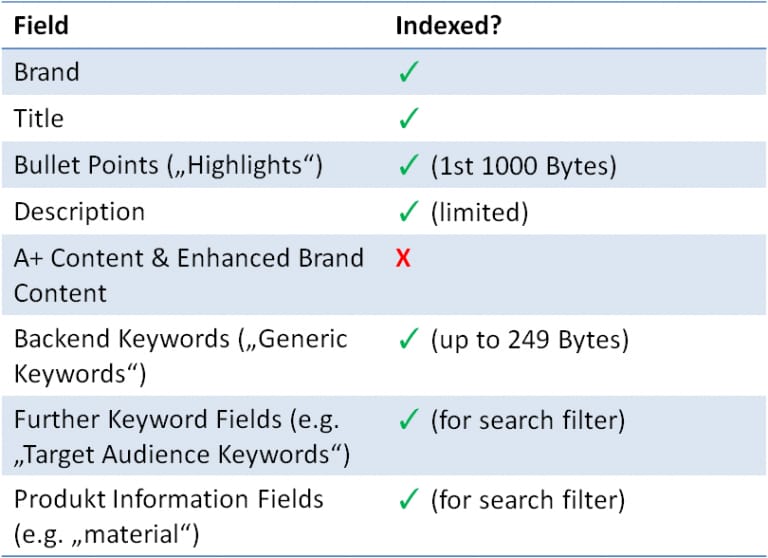
The weighting of the different fields: Does it matter where I put my keywords?
Amazon likes to constantly update and adjust the fields of the product listing (title, visual cues, portrayal, backend keywords, and so forth.) which is used to be weighted distinctively in the Amazon ranking algorithm. Amazon used to quietly introduce some fresh updates in Seller Central every year.
At present, the fields are weighted equally. It doesn’t make a difference where you put your keyword, so far those are indexed in a field.
Brand
Despite the fact that your brand is ordered as a keyword, it doesn’t (and can’t) differ across product postings and, along these lines, offers no open door for enhancement.
Title
The product title is completely listed for search. Utilize the classification explicit Amazon Style Guides to decide the right title length for your product.
Ensure you get this right: Amazon rejects overlong titles and even can put down product listings in specific conditions. Therefore, the product never again shows up in the query items.
Visual cues/ Bullet Points (Highlights)
In certain classes, Amazon just records the initial 1000 bytes as a total overall visual cue and after this edge, it will not list any other keywords.
The content ought to be shorter at any rate — It keeps the visual cues decipherable and stays away from unfriendly impacts on the transformation rate.
Our suggestion: Use 200 bytes greatest per visual cue to ensure full indexation and a decent change rate.
Product Description
Regardless of whether a product depiction is listed relies upon the classification of your product.
In certain classes, products can be found through all the keywords in the product portrayal. In many classes, notwithstanding, the accompanying remains constant:
- The product DOES NOT show up in the indexed lists when clients look for a single keyword from the product depiction
- The product DOES show up in the indexed lists when,
- Clients look for at least two keywords from the product depiction that are found near one another or
- Clients look for a keyword from the product depiction and at any rate two different keywords from at least one recorded fields (i.e., title, visual cues, backend keywords)
- The product portrayal is, in this manner, a fantastic spot to include your long-tail keywords.
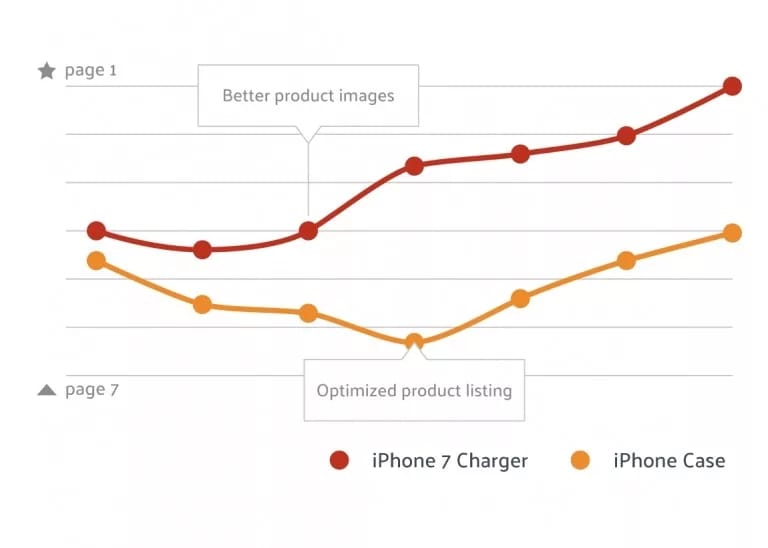
At long last, the product depiction is additionally significant for Google SEO. Because of the restricted indexation, notwithstanding, our suggestion remains:
Enhanced Brand/Marketing A+ Content
Amazon doesn’t record enhanced content (A+ for Vendors and EBC for sellers) for search. In the case, where important keywords only present in enhanced content, then the product won’t show up in the indexed lists.
Enhanced Content vs. Product Description
With regards to indexing and conversion optimization, the standard product portrayal and the enhanced content offer differentiating highlights and advantages.
Enhanced content is outwardly satisfying, while the normal product depiction can be indexed. While A+ Content for vendors is an extra sight to behold, EBC for vendors replaces the standard product portrayal.
Would it be advisable for me to concentrate more on the product descriptions or enhanced content?
In the event that you need to pick between the two, we suggest you center around enhanced content. The product depiction isn’t that significant for your Amazon SEO technique.
One purpose behind this low need is the constrained indexation we referenced, just as the likelihood to cover every important keyword in your backend keywords, title, and visual cues.
When you have your keywords secured, conversion optimization turns into your principal objective. Enhanced content offers better tools for making an attractive and impressive content and is simply like the product description — filed by Google.
Backend Keywords (a.k.a. Search Terms/Generic Keywords)
At present, this backend keywords indexation limit is 249 bytes with spaces and punctuation.
VENDORS – The conventional keywords fields for vendors don’t have a byte counter demonstrating whether you surpass the limit. If the complete byte tally over your nonexclusive keyword fields surpasses 249 bytes, including spaces and punctuation, none of your keywords will be indexed. To avoid this kind of chance, consistently need to check your byte tally by utilizing some of the Content and SEO module tools which helps in keyword optimization.
SELLERS – The hunt terms/conventional keywords field have an incorporated byte counter which doesn’t tally spaces and certain punctuation while these are meant for indexation. In the event that you utilize the absolute character length allowed by the byte counter, along these lines, any of your keywords that surpass 249 bytes (counting spaces and punctuation) may not be listed. Your first keywords inside the cutoff will be that as it may be indexed. To play it safe, consistently check your byte tally which will naturally make an ideal arrangement of search terms/nonexclusive keywords for you.
Additional Product and Keyword Fields
You can include additional data (e.g., about materials) to your product in the extra product fields. For certain products, you can characterize extra keyword types, for example, target crowd keywords (e.g., man, woman, kids).
Make a point to utilize these fields, as the data are given can be utilized to look through channels (sidebar route in the list items) and product discoverers.
Amazon SEO Keyword Rules — How Amazon Treats Keywords
At last, to include your keywords effectively, you ought to stick to some broad keyword rules. Adhere to the accompanying rules to improve the designing of your keywords:
- You don’t need to repeat keywords (for example in your backend keywords, use ‘wallet men leather’ rather than ‘wallet men wallet leather’). Reiteration shows no positive effect on positioning. Rather, utilize the significant space to include progressively applicable keywords.
- Utilize either singular or plural. Including both isn’t fundamental. The special case: Long compound words in German (for example Mehrzweckregal, Fitnessarmbänder)
- Capitalizing letters is not relevant.
- Umlaute (ü, ä, ö) are coordinated to ue, ae, oe. Including the two renditions isn’t fundamental.
- Accents (entrecôte, roségold, mèches) are coordinated to the non-highlight spelling (entrecote, rosegold, meches). Including the two variants isn’t fundamental.
- Minor incorrect spellings (carrier bag, running shoe, leather wallet) are coordinated to equivalent to the right spelling. Including the two variants isn’t fundamental.
- Various spellings of compound words (fitness ball versus wellness ball, flipchart versus flip diagram) are not recorded consequently. You need to incorporate the two forms or use hyphens (see next visual cue).
- You can cover various varieties by joining or isolating words through hyphens, e.g., A-B positions for A, B, AB, AB, A-B (use for max. 2 words, for example, flip-diagram).
Workflow for Your Amazon Keyword Optimization
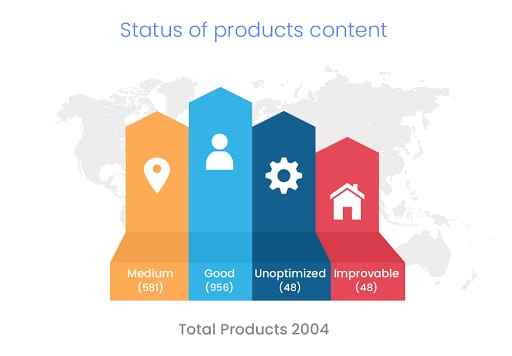
Since we’ve secured all the significant data on keyword improvement, you despite everything may ask yourself.
How do I optimize Keywords on Amazon?
To advance your posting, we suggest the accompanying work process:
Stage 1 — Optimize backend Keywords
Spot however many keywords could be allowed in the backend keyword field (likewise called ‘search terms’, or ‘generic keyword’) before adding a keyword to your substance. This training will keep your substance profoundly intelligible. For vendors and dealers, as referenced previously, to get the entirety of your keywords recorded, don’t utilize in excess of 249 bytes (counting spaces and punctuation). Use spaces (dealers) or comma/semicolon (sellers) to isolate your backend keywords and recall the general keyword rules.
Stage 2 — Place remaining keywords in the item content (i.e., title, visual cues, item portrayal)
It needs to special take care of ease to read and the client experience while including your keywords. You don’t need to include the keywords you previously indexed in the backend to your product content. As far as the Amazon SEO technique, repeating the keywords in various areas has neither a negative nor a beneficial outcome on the ranking.
Stage 3 — Fill in an extra product and keyword fields
We previously referenced that extra product and keyword fields can improve the accessibility and permeability of products through Amazon search channels (page route). You should, in this way, attempt to fill in these fields totally.
FAQ About Amazon Keyword Optimization
Which field ranks best? Where should I place my main keywords?
It’s actual: Amazon keyword fields used to be weighted. There was, for instance, a slight positive ranking impact for products that consist of a keyword in the title. Amazon has, be that as it may, evacuated this weighting.
For whatever length of time that you enter the keyword in an indexed field, it has no effect where you place it in your listing. Rather, Amazon presently depends considerably more on the keyword explicit execution of a product (click rate, conversion rate, deals, and so forth.).
The emphasis presently lies on readability: At the place of stuffing more keywords (particularly in the title), Amazon needs you to concentrate on conversion-optimized content that conforms to their rules.
Should I repeat my keywords to rank higher for them?
No. Keyword redundancy shows no positive effect on the ranking. Utilize the space to include increasingly important keywords.
Can I increase the number of indexed keywords by spreading them across variants?
The fundamental standard despite everything applies: Your posting must contain the pertinent keyword for purchasers to discover it — yet in case you’re squeezed for space, there is a workaround.
A parent listing will consequently refresh all child listings with its visual cues, portrayal, and backend keywords. That implies it can take care of the parent posting a fundamental arrangement of essential keywords, and its child ASINs will rank for them, as well.
In a subsequent advance, you would now be able to include long-tail keywords that are explicit to every child ASIN. Along these lines, you increment the absolute number of potential keywords — and the odds that customers find in any event one of your variations.
When they open it, they will likewise observe different variations that already weren’t shown in the list items.
Ongoing Optimization: How to Keep Improving Your Rankings
So, we have currently learned all about content and keywords optimization for our listing and also now, we can publish it. Rather than simply trusting that the deals will come in, in any case, you ought to take part in continuous streamlining to improve your rankings and expand your prosperity.
All in all, you ought to consistently watch out for your item posting, to ensure it’s forward-thinking, despite everything performing great, and hasn’t been captured.
Furthermore, there are some other significant switches that you can constantly enhance to improve your rankings:
- Reviews
- Amazon PPC
- Price
- External traffic
- Shipping and FBA
- Inventory.
Dealing with Customer Reviews and Questions
How Amazon Reviews Influence Your Ranking
Reviews are basic to the CTR, CR, and deals of a product and, along these lines, to how well it positions. Customers regularly look for the feedback left by past purchasers. The more positive reviews your product has, the better it will perform. In this manner, there are two viewpoints to deal with:
- Number of product reviews
- Product audit score (star rating).
How to increase your number of Amazon reviews
You can expand your number of reviews in different manners. All in all, a client’s readiness to present a review increment with brilliant client assistance. You could likewise utilize package additions to incite clients for reviews or promote on the product testing stages.
Continuously ensure you remain inside the review guidelines of Amazon, particularly with the latter method.
How to increase your product rating
Make sure you have engaged with your reviews consistently to keep up a high product evaluation. Specifically, you should remark on negative client reviews. As a dealer or maker, you can include your point of view and shed a superior light on the review.
This training causes you to keep up your conversion rate for future clients. It likewise shows amazing client care and may convince the client to alter the review or evacuate it inside and out. We should keep a superior perspective on the entirety of your surveys.
Answering Amazon Customer Questions & Answers
The inquiries that clients can pose on the product page are similarly as significant. Customers regularly get some information about explicit subtleties they can’t discover on the product page. Vendors, sellers, and different clients can respond to questions.
Sellers and Vendors should deliver unanswered inquiries consistently to guarantee that clients get the right answers. Doing so will likewise improve the data substance of the product page: Questions regularly point to increasingly critical data holes, which you would now be able to add to the portrayal.
At the point when your items are selling admirably, you will presumably get a staggering measure of client criticism. How would you keep steady over your correspondence with your purchasers?
Boost Amazon SEO with Amazon PPC (and other promotions)
Successful Amazon Advertising Requires an Optimal Amazon SEO Strategy
Amazon advertisements are governed by significance. As a rule, this implies Amazon possibly shows your promotion if your item page additionally contains your focus on keywords. PPC (Pay-Per-Click) battles can, in this manner, possibly work on the off chance that you streamline your item posting for significant keywords first — utilizing Amazon SEO.
Reward: Optimizing your item page for CTR and CR will likewise improve the presentation of your promoting efforts
Amazon PPC Improves the Organic Ranking of Your Product
In any case, presently the significant part for your rankings: The natural positioning of an item relies massively upon its presentation, specifically how well it sells. Not at all like Google AdWords, this additionally applies to deals that get from Amazon PPC battles.
An expansion in deals due to PPC improves the general execution of the product and, thus, the natural positioning.
This criticism instrument is particularly useful to improve the natural perceivability of new items, a procedure that would somehow or another take any longer.
Physically overseeing and enhancing offers, negative keywords, and the various necessities for fruitful PPC battles can be very time-escalated. DCS spares you a ton of time and exertion via computerizing these errands.
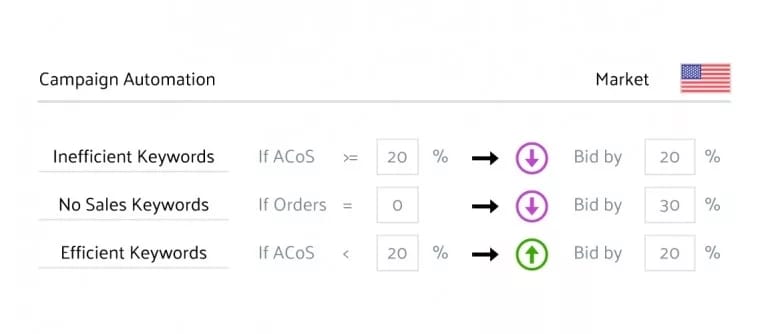
Utilize the PPC supervisor (for Sellers) or the AMS administrator (for Vendors) to set up and deal with your publicizing efforts with Sellics serenely.
PPC battles help new items to rise quickly through the positions, and along these lines accomplish progressively starting deals.
Price — A/B Test Your prices
As past examinations by DCS appeared, modest items are not particularly preferred by Amazon’s positioning calculation. That implies you don’t have to have the least expensive item around to be effective on Amazon.
You despite everything need a serious cost, obviously. Your cost will affect your positioning since it will both impact:
CTR in search results: Clients contrast your cost with different items in the indexed lists.
CR and sales on the product page: Does your value coordinate your intended interest group, item quality, marking, and so forth to accomplish a decent change rate?
Characterizing a decent value utilizing a hypothetical methodology can be exceptionally dubious. This is the reason you should A/B test various costs and think about the outcomes as far as CTR, CR, deals and, obviously, benefit.
External Traffic — Create Additional Traffic and Sales for Your Amazon Listing
Utilizing outer traffic implies guiding clients from outside locales to your product on Amazon to make extra traffic and deals that will likewise improve your rankings.
This impact on rankings can be a valid justification to send traffic to Amazon instead of to your online shop.
Helpful points of arrival are on the product page, on the product selection page, or the Amazon Brand Store.

Here are a few different ways to do that:
- Pay-per-click promoting (Google Adwords, Facebook advertisements, and so on.)
- Newsletter/emails
- Content/influencer advertising (advance your item on web journals, YouTube, gatherings, and so on.)
- Social Media (e.g. brand pages)
- Send traffic from your online shop to Amazon.
Shipping and FBA (Fulfillment by Amazon)
In the event that you don’t utilize FBA yet, you ought to think about it, in light of the fact that just with FBA your item is accessible for Prime transportation (except if you use ‘Seller Fulfilled Prime‘).
Just with Prime delivery, thus, you will have the option to understand a noteworthy number of deals from the continually developing number of Prime individuals.
Except if you have the Prime mark, Prime individuals are probably not going to try and snap on your item in light of the fact that the Prime name as of now shows up in the list items.
Prime individuals can even sift through Non – Prime Items in the indexed list.

Inventory Management — Don’t Run out of Stock
Coming up short on stock may or probably won’t hurt your rankings — relying upon to what extent you are out of stock and how you manage the circumstance. The more you are out of stock, the higher the odds that you will encounter a critical drop in rankings.
In the event that you realize that you will leave stock, here are two points for out-of-stock contextual analysis,
- Try not to raise your costs (essentially): This will hurt your CTR, CR, and deals and will hurt your rankings.
- Use Amazon Advertising to recoup rankings: After restocking, use Amazon Advertising to produce deals and increment your rankings once more.
Amazon SEO: The Bottom Line About How to Rank on Amazon
You simply read the most extensive manual for the Amazon SEO procedure out there. We made a point to incorporate everything there is to know — so you never feel invaded with equivocal data until kingdom comes.
So what’s straightaway?
In our agenda, we came down with all the immense data to the basics of your requirement for upgrading your posting bit by bit.
At that point, check your top of the line postings (and afterward your poor entertainers). Distinguish the components we talked about right now. Would you be able to give them a lift?
In the event that you keep on amplifying your prosperity, you will develop and include more products. You will experience new difficulties — from viable promoting to settling on keen business choices dependent on your business execution and income development.
It’s a smart thought to be readied — The most effortless approach to remain in charge of your whole excursion as a merchant on Amazon is by utilizing DCS.
Conclusion
In this article, we have understood all about the Amazon SEO strategy which will help to enhance your sales rate by appearing your product on the first search. A9 algorithms made easier to rank high for your product among those millions of products are available on Amazon. Also, learned about “How to optimize your product listing for Amazon SEO?”.
Additional Read:
12 Best Amazon PPC Optimization Tools for Sellers
Note: If you’re our Affiliate Partner, please use our Affiliate partner link instead of the link given above.
The post Amazon SEO Growth Guide with Strategy, Tips & Examples appeared first on Amazon-ASIN Blogs - Latest from Amazon Sellers: News, Advice, and Effective Strategies.
]]>