The post Top 10 Amazon DSP Agencies: Top Partners to Scale Your Advertising appeared first on Amazon-ASIN Blogs - Latest from Amazon Sellers: News, Advice, and Effective Strategies.
]]>After all, DSP is a programmatic advertising platform that helps brands reach customers earlier, before they’re even actively searching. You can run display, video, or audio ads not just on Amazon but across other websites and apps where shoppers spend their time. Meaning, you will need the guidance of seasoned professionals.
What makes DSP special is its access to Amazon’s first-party data. That means you can target audiences based on their shopping behaviors, preferences, and browsing patterns.
Whether it’s someone researching a product or casually watching content online, you can reach them with ads that feel personal and timely. It’s a way to build brand awareness, guide potential customers through the buying journey, and retarget them with ads that encourage them closer to a purchase.
Everything has a price tag, and so does Amazon DSP. There’s a minimum spend requirement of $30,000 per month in liquid assets just to get in. The stakes are high, which means this isn’t an area where you can afford trial and error. To make every dollar count, you need to partner with Amazon DSP agencies that know the ins and outs of DSP and can turn that investment into measurable growth.
For brands that want more than just search ads, Amazon DSP agencies open up tons of opportunities.
The Benefits of Partnering with the Best Amazon DSP Agencies
When you are running a DSP campaign, know that it isn’t something you can just set and hope for the best. It’s a more advanced form of advertising that requires a thorough understanding of customer behavior, creative messaging, and constant optimization.
That’s exactly why you need to work with Amazon DSP agencies that really understand Amazon DSP; it can make all the difference.
First, agencies bring the experience needed to make sense of audience targeting. Sure, Amazon offers tons of data, but knowing who to target, how to segment them, and when to retarget them takes skill. Agencies help identify the right audiences and create campaigns that hit the mark without wasting money.
Then there’s the other side of the coin. A well-designed ad is more than a pretty image or catchy line; it speaks to a shopper’s needs and desires at the right time. Agencies can help you craft messaging that resonates while constantly testing and refining creatives for better engagement.
Measurement and tracking are other areas where agencies can help you with. They go beyond basic click or impression counts and help you understand how campaigns can impact your sales, brand awareness, and long-term customer value. This insight allows for smarter budgeting and faster adjustments.
Let’s not forget technology. Managing hundreds of ads, audiences, and placements is overwhelming. Agencies have the right tools to automate bidding, pacing, and optimization while keeping performance on track. They ensure campaigns scale smoothly, without constant micromanagement.
Amazon DSP agencies also safeguard your brand. With rules, privacy standards, and compliance requirements always evolving, working with a trusted partner ensures you’re on the right side of Amazon’s guidelines while protecting your reputation.
Ultimately, Amazon DSP agencies are your partner that helps you build campaigns thoughtfully, avoid costly mistakes, and grow sustainably, whether you’re just getting started or already competing at scale.
Top 10 Amazon DSP Agencies
Finding the right Amazon DSP agencies is about choosing an agency that can translate data into growth, balance automation with human strategy, and navigate Amazon’s evolving ad ecosystem with confidence.
The best Amazon DSP agencies don’t simply push impressions; they help brands build visibility across the entire funnel, from awareness to repeat purchase. Below, we’ve rounded up ten agencies that stand out for their approach, expertise, and results, giving you a clear view of which partner might be the best fit for your brand.
1. Sellerapp
SellerApp is one of the rare agencies that has blended both technology and human expertise together for over a decade.
Where many Amazon DSP agencies stop at plugging campaigns into Amazon’s system, SellerApp goes further. They provide a full-funnel DSP partnership, combining audience science, predictive modeling, and creative strategy with direct access to experts who understand both retail media and consumer psychology.
Their proprietary tech stack integrates seamlessly with Amazon Marketing Cloud (AMC) and even custom API data that allows brands to unlock cross-channel attribution, build custom dashboards, and track granular data points that most Amazon DSP agencies can’t deliver.
The result is better visibility into shopper behavior, from first impression to repeat purchase.
Their clients highlight that SellerApp’s always-on optimization is not just automated bid tweaks but real-time interventions guided by analysts who monitor brand safety, placement quality, and creative fatigue. For example, they’ve reported a lift in campaign by 60-500% a few weeks after launch, depending on objectives and starting baselines.
The team is incredibly proactive, flagging opportunities before they slip through the cracks, which has translated into measurable ROI growth for brands across highly competitive categories.
Unlike many Amazon DSP agencies that treat DSP as a standalone service, SellerApp takes a consultancy-style approach. Beyond managing ads, they refine product pages, coordinate with retail readiness strategies, and ensure creatives align with shopper intent. From contextual targeting to sequential storytelling ads, SellerApp manages campaigns that balance scale with precision.
For enterprise sellers, one of the biggest challenges with DSP is aligning spending with inventory cycles. SellerApp solves this by offering demand forecasting and inventory planning so campaigns never overspend when stock is tight.
Their support even extends into post-conversion engagement, like retargeting lapsed customers and amplifying review generation, ensuring long-term brand lift instead of short-lived spikes.
SellerApp offers the ideal balance of AI efficiency and human expertise, so smaller advertisers are not under the burden of reporting and strategic depth more than they need. In a crowded DSP landscape, they deliver the rare blend of scale, transparency, and strategic storytelling that makes them one of the most compelling Amazon DSP agencies choices today.
2. BTR Media
Similar to SellerApp, Better AMS (Now BTR Media takes a data-first approach to DSP. They help brands unlock audience segments and build strategies around analytics. Their team helps brands scale their ad reach by integrating DSP into their broader Amazon Advertising strategy.
They emphasize flexibility in setting up DSP campaigns that can adjust as needs shift rather than locking you into rigid plans. Better AMS positions DSP not as an isolated service, but as a continuum from sponsored ads all the way through to more advanced display-and-video buying via Amazon DSP.
On their site, they say they will help brands grow by “scaling up everything Amazon Advertising, from Sponsored Products all the way to Amazon DSP and everything in between,” showing that DSP is one of their core offering areas.
Because they already manage campaigns like Sponsored Products, Better AMS is able to fold in DSP with audience segmentation, targeting, and campaign structure that benefit from the rest of the Amazon ads they run. Their DSP work is about expanding reach and getting into placements and impressions that go beyond just search or standard display.
While they lean on proven techniques and industry insight, their public material is careful to frame their DSP work as part of a full Amazon Advertising stack rather than a separate, experimental add-on.
3. My Amazon Guy
My Amazon Guy helps brands scale with Amazon DSP by bringing in advanced targeting and ad formats that go beyond standard PPC. They run display, video, audio, and static ads both on and off Amazon in order to lift awareness, increase product visibility, and then drive more sales.
They make use of Amazon’s first-party data to build custom audience segments, such as shoppers by location, browsing behavior, or past purchase history, and use those for retargeting and reach campaigns.
Creatively, they integrate different ad formats (video, image banners, and audio) so that the ad messaging can reach customers at different touchpoints on mobile, desktop, streaming, or devices like Alexa or Fire TV.
They also emphasize optimization and campaign management. That means adjusting creative, tweaking targeting or budget, refining which placements work best, and doing frequent testing.
My Amazon Guy positions their DSP offering as a growth step for brands that have already seen decent performance with Amazon PPC and are ready to expand reach.
4. Tinuiti
Tinuiti’s Amazon services cover the full spectrum from Sponsored Ads to DSP and Amazon Marketing Cloud. Much like SellerApp, their team helps brands leverage Amazon’s first-party audience data and custom targeting features to run upper-funnel awareness campaigns, mid-funnel engagement, and lower-funnel retargeting, all with measurement and optimization built in.
One of Tinuiti’s strengths is their mastery of Amazon’s audience tools. They use Amazon Marketing Cloud to pull together organic and paid shopper signals, discover new audiences, and feed those insights back into DSP targeting to improve performance.
They’ve worked with brands to build full-funnel campaigns. For example, Tinuiti helped their client Blueair reduce acquisition costs, raise return on ad spend significantly, and use Custom AMC Audiences to guide shoppers through the funnel using Amazon DSP plus related creative and content work.
Because of their advanced partner status with Amazon, they can access tools and beta programs others might not. Their reporting, analytics, and creative support are fairly sophisticated, making them a strong choice when you need visibility, control, and scale.
Their services are especially well matched with brands that have sizable ad budgets and want to do more than just run display ads. They’re built to help with strategy, analytics, full-funnel campaign execution, and continuous improvement.
For brands that are more experimental with DSP or smaller in budget, Tinuiti’s depth of service is extremely attractive, though the scope and cost can be higher.
5. Perpetua
Perpetua offers its Amazon DSP service with a strong emphasis on self-serve tools that simplify how brands build, launch, and optimize full DSP orders.
Their platform lets you create audiences, generate creatives, and attach line items in a single, streamlined workflow instead of juggling multiple steps.
They’ve built out “Target Markets” audience templates, pre-built segments based on best practices that can be customized further, so advertisers get started faster while still being able to refine targeting precisely.
Budget behavior and optimization are central to their DSP product. Perpetua’s ad engine automatically shifts budgets between line items to improve performance and ensure pacing. According to their data, this outperforms Amazon’s native optimization tools by around 20%.
They provide consolidated analytics, including ASIN-level reporting across both DSP and Sponsored Ads, so you see how different ad types are performing together, not in silos.
Always-on campaign optimization is part of their offering: as campaigns run, the platform continuously monitors performance and makes adjustments, including when it comes to placement, audience segments, and budget allocation.
Because of how automated many of the optimizations are, some advertisers may find the trade-off is less granular manual control over every lever, though Perpetua does allow for customization where needed.
6. BellaVix
BellaVix handles Amazon DSP with a data-driven, full-funnel mindset. Their team manages awareness, consideration, purchase, and loyalty stages with tailored DSP campaigns that use precise targeting and performance analytics.
They use Amazon’s first-party data plus their own audience insights to reach customers across devices and ad formats: video, display, audio, and more. Their strategies are built to meet brands where their audience already is, both on and off Amazon.
Performance measurement is central to their DSP services. BellaVix provides regular reporting and audience insights so brands can see what’s driving results. Impressions, conversions, and reach are all part of the picture.
They also integrate DSP into a broader advertising strategy. Alongside Sponsored Products, Sponsored Brands, display ads, and content optimization, BellaVix ensures that DSP campaigns complement other Amazon ad types and strengthen the overall brand presence.
Their approach works very well for brands that want their ads to support not just immediate sales but sustained growth brands that care about awareness, loyalty, and holistic signals, not just click-throughs.
7. Bluewheel
BlueWheel brings together automation and strategic consultation in their Amazon DSP work. Their Amazon DSP service is designed to help brands reach audiences both on and off Amazon with display, video, and streaming placements, supported by tools like Amazon Marketing Cloud to analyze and refine who sees the ads.
They don’t require massive spending minimums to get started, making their DSP services accessible to smaller brands, though they also scale up for larger advertisers. Their team emphasizes daily tracking and optimization monitoring to see which audience segments and placements are delivering results and adjusting bids, creative, and targeting accordingly.
Creative support is part of their DSP service: BlueWheel develops both auto-generated ads and custom creatives, including video and display tailored to audience, device, or placement.
Their approach tends to balance transparency and flexibility. Clients see dashboards, frequent reporting, and campaign insights while having room to scale spending and tweak strategies.
Some clients may miss the boutique agency feel in terms of ultra-hands-on creative direction, since BlueWheel handles many of its processes via tech and optimized flows, but for many brands the trade-off is a smoother, more predictable experience.
8. Incrementum Digital
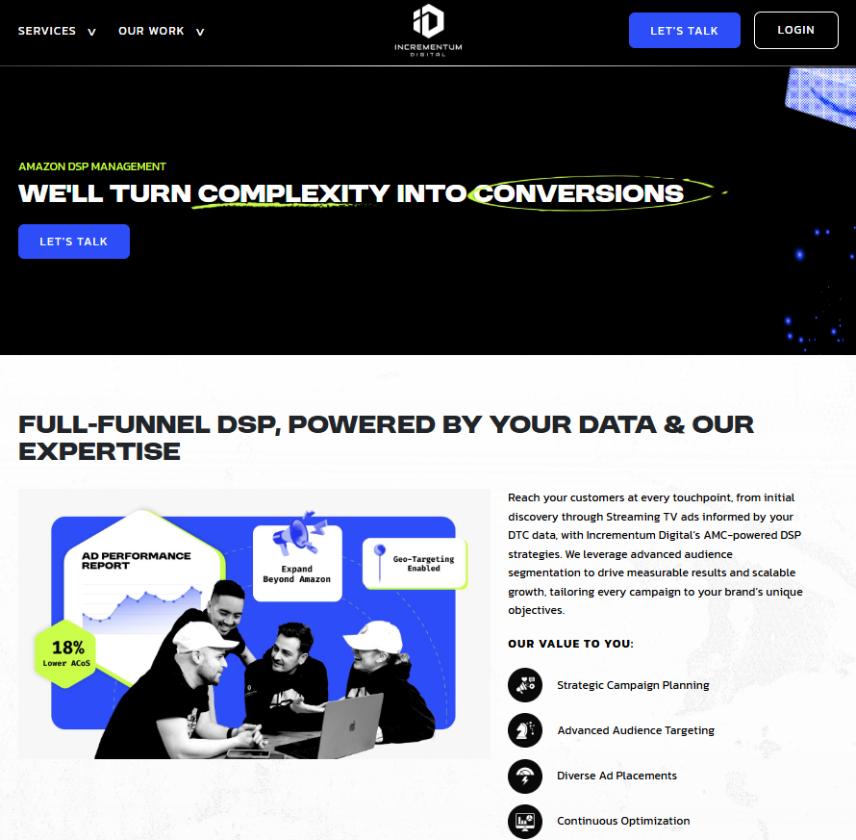
Incrementum Digital runs Amazon DSP with a full-funnel, data-driven mindset. They begin by doing deep onboarding that includes market, competitive, and audience analysis. From there, they build annual or seasonal media plans, setting budgets and custom audiences in line with product launches and promotional windows.
They use both Amazon’s first-party and third-party data, plus insights from Amazon Marketing Cloud (AMC), to target audiences more precisely. Their placements include display ads, video, and streaming TV, so brands can reach people across Amazon and off-Amazon touchpoints.
Once campaigns are live, they don’t just let them run. Incrementum continuously optimizes shifting budget based on performance, refining audience segments, running A/B creative tests, and using dashboard reporting to identify what’s working and what’s not.
Their value to clients lies in transparency and strategy. With their DSP work, clients get custom dashboards and deep reporting so they can see metrics that matter, not just generic impressions. They aim for scalable growth, helping brands improve visibility and awareness while keeping ROI front and center.
For brands ready to take DSP seriously those who want predictable plans, frequent optimization, and reliable measurement. Incrementum Digital is a strong fit. Their approach demands enough budget and clarity of goals, but for those that have both, it offers a pathway to consistent growth.
9. Acadia
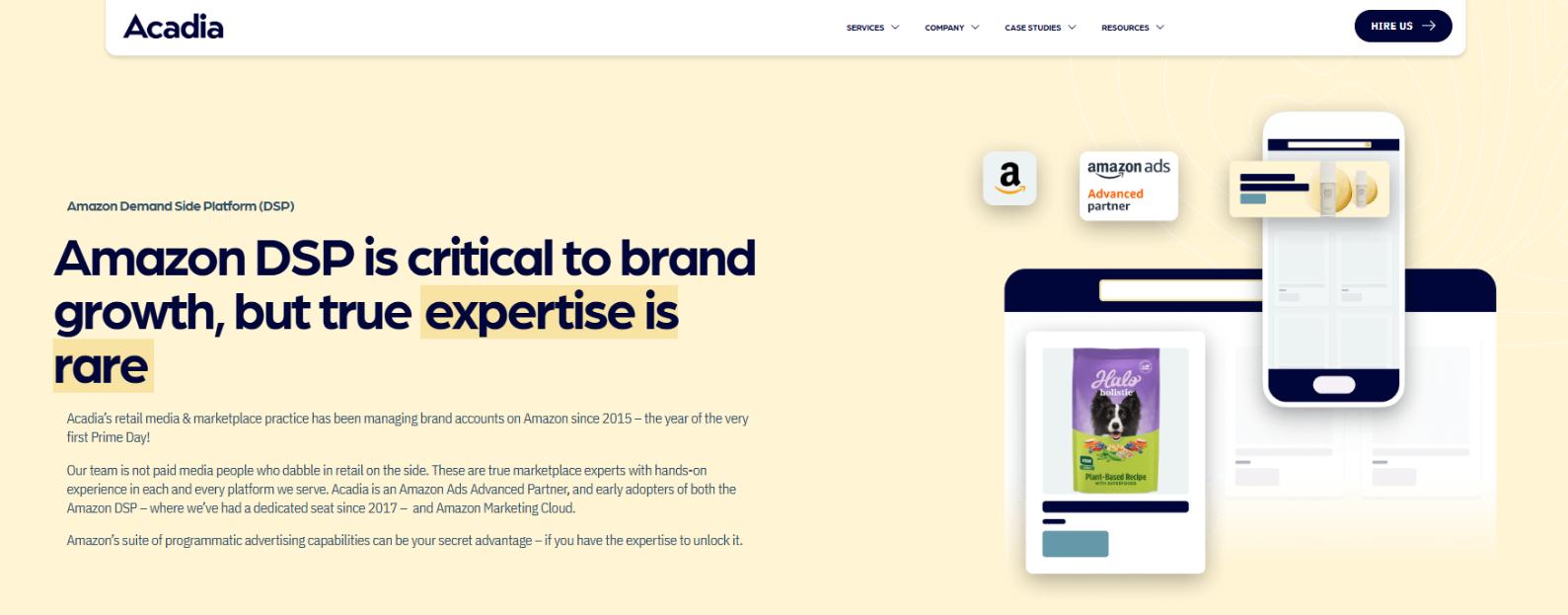
Acadia is an DSP agency with deep roots in Amazon ecosystems (they’ve been managing brand accounts since 2015) and are one of the earlier adopters of Amazon DSP; in fact, they’ve held a dedicated DSP seat since 2017.
When brands work with Acadia, they gain access to expert audience targeting. Acadia uses Amazon’s first-party data, sophisticated segmentation, and creative message testing. They also lean on Amazon Marketing Cloud (AMC) to understand how upper-funnel awareness and consideration efforts feed into actual purchase behavior.
One of Acadia’s differentiators is that they can resell DSP seats, which allows brands to access more inventory or reach, often with reduced platform fees.
They stress strategy over short-term metrics. For example, they created a “Fit for Purpose” ADSP metric framework in 2023, defining next-generation metrics beyond just click-throughs and ROAS to better measure awareness, remarketing performance, and longer-term brand lift.
They also offer full-funnel campaign design. They integrate DSP with sponsored ads, content optimization, product content, and inventory & operations support, making Amazon DSP part of a comprehensive strategy rather than a standalone tool.
A useful case study is with Kenra Professional, where Acadia used Amazon Streaming TV (STV) through Amazon DSP along with AMC to reach new audiences. They excluded existing customers to focus on new buyers, tested homeowners’ creatives, used STV in the upper funnel, and then applied full-funnel tactics. The outcomes were a major lift in brand searches, huge growth in new-to-brand purchases, and increased revenue.
10. Kepler Group
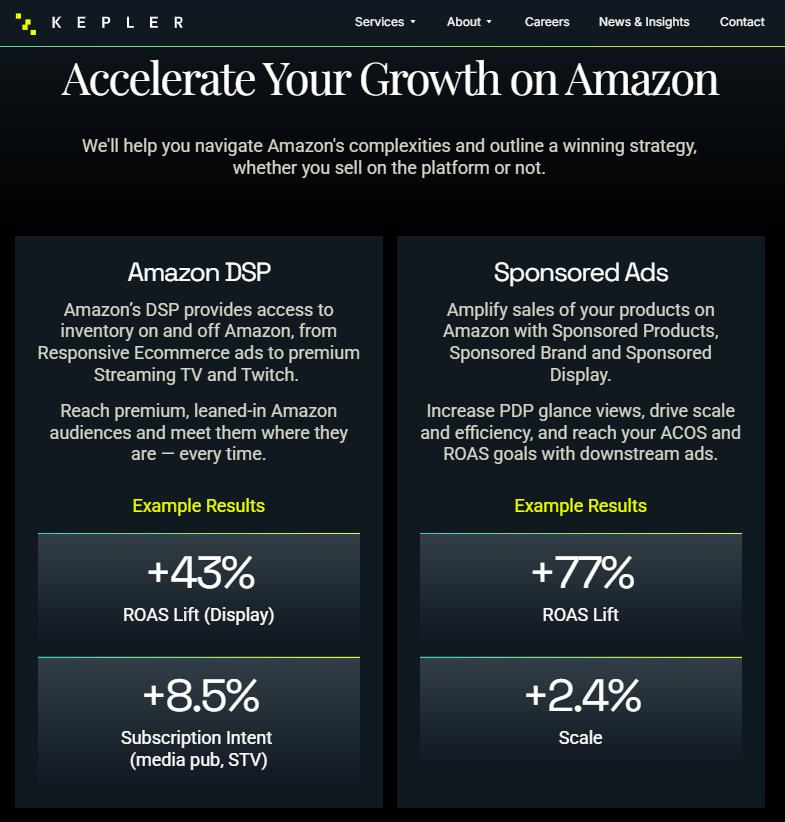
Kepler Group is one of the more mature experts when it comes to Amazon DSP. They aren’t just another ad agency; they’ve earned Amazon Advanced Partner status (including for Amazon Marketing Cloud), which means they’ve been vetted for deeper technical ability and access.
When working with Kepler, brands get flexible service models: you can go fully managed or shift toward more in-house/self-service over time. Their Amazon DSP work covers not just display but premium placements like streaming TV, Twitch, video + audio, and Amazon’s off-Amazon inventory.
They also lean heavily on measurement. Through Amazon Marketing Cloud, Kepler helps clients analyze overlap, audience behavior, and purchase journeys so DSP isn’t just about reach or impressions but understanding what drives new-to-brand acquisition or lifts in ROAS.
Brands that work with Kepler tend to see quick improvements. For example, they’ve reported campaign lifts of 40-400% a few weeks after launch, depending on objectives and starting baselines.
Because of their scale, tools, and experience, Kepler is especially well suited for mid-sized to enterprise brands that want serious Amazon DSP work: premium inventory, cross-format placements, and deep analytics.
That said, brands just getting started with DSP and limited budgets might find their services and requirements more advanced (and possibly more expensive) than boutique providers.
How to Choose the Best Amazon DSP Agencies?
Choosing the right Amazon DSP agencies isn’t just about picking the one with tools that shine from a distance or the lowest rates. It’s about finding a partner that understands your brand’s goals, challenges, and growth trajectory.
Experience is critical. Amazon DSP agencies with a proven track record on Amazon DSP and ideally other retail platforms will bring insights that help you avoid common pitfalls and take advantage of new opportunities.
Equally important is the balance between technology and human insight. While automation is crucial for scaling, campaigns still require strategists who understand customer psychology, creative storytelling, and timing. The best agencies pair smart tools with seasoned experts who know when to intervene.
You also want a profit-first mindset. It’s easy to get lost chasing clicks and impressions, but campaigns should always be aligned with measurable business outcomes. A good agency will help you connect advertising spend with revenue, margins, and customer loyalty.
Creative support is another factor to look for. More than visual ads, they need context and messaging that your audience will find relatable. The right agency helps craft creatives that feel authentic, relevant, and persuasive.
Transparency in reporting is non-negotiable. Look for agencies that offer access to dashboards and detailed reports where you can see how every decision is made, from targeting to bidding to pacing.
Scalability matters as well. Whether you’re managing a handful of products or hundreds, you need Amazon DSP agencies that can scale campaigns smoothly without compromising on strategy or support.
Communication is extremely important. Direct access to account managers and open channels for feedback guarantees that issues are identified early and campaigns remain in sync with changing requirements.
Pricing should be equitable and flexible. Hidden fees or strict contracts should be avoided. The best agencies will provide straightforward price models that help you scale with your company rather than tying you to rigid terms.
At the end, client fit is essential. Every agency has its own sweet spot, whether it’s for startups, mid-market sellers, or major corporations. Choosing an agency whose capabilities coincide with your specific goals ensures that you have the right assistance you need to grow.
Final Thoughts
Amazon DSP is an extremely useful tool, but it needs a mindful strategy and thoughtful approach to truly unlock its potential. Partnering with right Amazon DSP agencies like SellerApp or Bellavix will ensure that your campaigns perform. Whether you’re just beginning in programmatic advertising or managing a complex, data-driven operation, a good agency helps you make informed decisions, scale effectively, and build lasting customer relationships.
Brands benefit greatly from agencies that provide organized support and clear guidance. Analytics-driven strategies, cross-channel insights, and experienced strategists make a significant difference for businesses. At the end of the day, the finest agency is one that blends technology and human knowledge, adjusts to your demands, and helps in focusing on growth, leaving you with no second thoughts.
With the right Amazon DSP agencies you can become not just another marketing channel but a strategic advantage that propels your brand forward with purpose and precision.
Related post:
15 Walmart Advertising Agencies to Scale Profitably in 2025
Top Amazon Automation Software Tools for Sellers
Best Amazon Marketing Agencies for Your E-Commerce Success
Top Analytics and Optimization Tool for Amazon Sellers
The post Top 10 Amazon DSP Agencies: Top Partners to Scale Your Advertising appeared first on Amazon-ASIN Blogs - Latest from Amazon Sellers: News, Advice, and Effective Strategies.
]]>The post 15 Walmart Advertising Agencies to Scale Profitably in 2025 appeared first on Amazon-ASIN Blogs - Latest from Amazon Sellers: News, Advice, and Effective Strategies.
]]>Walmart is no longer just a retail giant; it’s a fast-growing ecommerce marketplace (that comes right after Amazon) where competition intensifies daily.
Running ads here isn’t just about switching on campaigns; it requires a blend of creativity, data, and strategy to outpace competitors. A strong Walmart ad agency brings that mix to the table, combining automation, marketplace expertise, and human oversight.
Below, we’ve broken down the 15 best Walmart advertising agency options out there, their strengths, drawbacks, and the sellers they’re best suited for.
15 Top Walmart Advertising Agency Options & their Quick Comparison
Below, we deep dive into 15 of the best Walmart advertising agencies, what they offer, their standout strengths, drawbacks to note, and which type of seller they’re best suited for.
1.SellerApp
SellerApp wins by combining AI-powered advertising with something technology alone can’t replace: individual attention from seasoned ad managers (10+ years’ experience).
While many agencies lean on automation, SellerApp ensures sellers get full‑service Walmart advertising agency partnership with strategic oversight, custom campaign logic, and direct communication with experts who’ve managed millions in retail ad spend.
Additionally, their standout Walmart API integration allows brands to build custom dashboards, offering granular visibility and cross-marketplace reporting that most Walmart ppc agency partners can’t match. The blend of AI efficiency and human expertise sets SellerApp apart in a crowded space.
SellerApp’s clients praise their proactive account monitoring, with clients noting measurable ROI improvements in competitive niches. The Walmart advertising agency offers multi‑channel Walmart marketplace services that reflect a consultancy-style well rounded approach rather than just campaign management. From optimizing your Walmart product listings, to offering brand/IP protection services, SellerApp does it all.
Though smaller sellers may find the depth of reporting more than they need, it is ideal for mid-market to enterprise sellers for the control and granularity. If you’re an enterprise seller, inventory management can be a headache. SellerApp can do the inventory planning on your behalf and help you with demand forecasting.
What sets SellerApp apart is that these strengths extend to post-sale engagement, like review management and customer feedback optimization, which ensures growth that’s both sustainable and swift.
For mid-to-enterprise brands determined to grow their market share, SellerApp delivers the best of both worlds, i.e, scalable AI insights with expert-driven strategy, making it arguably the strongest option among Walmart PPC agency options.
2. Tinuiti

Tinuiti is a top Walmart advertising agency with an employee strength of 1000+ staff. Being an official Walmart Connect partner, it offers Walmart PPC, listing optimization, inventory planning, and demand forecasting.
For instance, if Walmart ads drive sales but your stock isn’t aligned, Tinuiti will adjust your campaigns accordingly, toning the budget down to match the inventory movement pace. It is a rare operational link between ads and the supply chain.
Tinuiti’s GAMMA analytics framework (proprietary tech) helps you optimize strategies and budget with custom reporting services across Walmart Ads.
Its strengths include full-funnel strategy creation and collaboration experience with big brands such as Converse and Nestlé. They can run multi‑channel campaigns alongside Amazon, Target, Instacart, etc.
Being a very large agency, it’s expensive for small-scale sellers, and their ideal clients are large retailers/brands that need broad marketing integration along with complex Walmart strategies. But here’s a fair trade-off. You pay a premium but get a holistic commerce partner that goes beyond just a PPC manager-client partnership.
3. Emplicit
Among the Walmart advertising agency offerings, Emplicit includes Sponsored Products or Brands ads, marketplace listing optimization, strategic consulting, and brand/IP protection services. Emplicit’s team uses competitor/keyword analysis techniques to improve PPC campaigns and overall visibility.
People have often praised its structured campaign planning. Few public criticisms have emerged regarding custom pricing, which can be hard on emerging sellers with limited budgets.
It is due to the lack of published rates, giving less clarity. So, it primarily serves bigger accounts. Ideal clients for Emplicit are larger, multi‑channel brands seeking a Walmart strategy with a healthy budget for the services (mid-market to enterprise). Smaller sellers often call them “too corporate.”
4. Vertical Rail
Vertical Rail identifies as a boutique agency that is hyper-focused on their clients, which means it thrives in niches. This Minnesota‑based digital marketing boutique provides Walmart PPC/ad management (search & display), listing creation, brand registry support, and even fulfillment.
Their Walmart PPC agency approach leans on geographic or demographic targeting, which is ideal for products with region-specific demand. Clients often laud their quick responsiveness, but being a niche Walmart advertising agency, it has limited capacity so, it isn’t the best fit for larger brands needing high-volume campaign execution.
It brings immense value for sellers who seek personalized relationship-driven strategies, rather than a cookie-cutter automation tool. Vertical Rail is made to serve the SMEs who want close attention from a team well-versed with their catalog.
5. WebFX
WebFX is the enterprise juggernaut of Walmart PPC. With 500+ staff, it uses sophisticated tools like MarketingCloudFX, and multi-channel attribution. It handles Sponsored Products, Native Banner, Site Search Ads, plus listing/content support and for enterprise clients, they offer granular ROI tracking.
However, their services may feel impersonal for a big Walmart ppc agency as communication can be slower. But the best part is, WebFX allows you to consolidate all your digital marketing strategies under one roof like SEO, PPC, CRO, Walmart, Amazon etc, almost like SellerApp.
WebFX is best suited for mid-to-large sellers who are in need of robust, sorted data backup as they may require data for cross-channel synergy.
Its key strengths are a transparent, uncomplicated dashboard UI and comprehensive campaign management. Even entry-level Walmart sellers can opt for it because their plans start from around $1,000/month after.
6. AiHello
AiHello is a Walmart Marketplace partner offering listing optimization, catalog/inventory management, rich content creation, and end‑to‑end PPC campaign management.
This stands out as a Walmart advertising agency with automation as its leading force. Its proprietary “AutoPilot” tool adjusts your ad bids, targeting, and budget deployment completely based on market status and its signals.
This makes AiHello Walmart advertising agency ideal for sellers who are overwhelmed by manual campaign management and looking for a solution close to an agency experience. Users often criticize their UI, calling it an engineer’s tool more than an ad manager’s.
If you’re a seller operating ads by yourself, prioritizing the automation that helps you free your time, so you can focus on product sourcing or branding, while AiHello optimizes ad efficiency in the background. It is ideal for budding sellers who want AI to do the heavy lifting without hiring a Walmart ppc agency or a separate team.
7. Urtasker
Founded in 2015, Urtasker specializes in holistic marketplace growth (including Amazon, Walmart, eBay). Its Walmart services include Sponsored Products ad campaigns, listing and keyword optimization, SEO, and inventory management.
Urtasker’s edge is accessibility to support and its hands‑on, data-driven approach. Unlike a high-ticket Walmart ppc agency, they cater to startups and mid-sellers.
Their packages are flexible, covering PPC, SEO, inventory, and agile support.
Clients use Urtasker for custom Sponsored Ads (Products and Brands) and ongoing bid management. They market themselves as “fastest growing Walmart advertising agency” with personal account service. Urtasker acts as an outsourced growth team, letting smaller sellers punch above their weight at an affordable non-enterprise rate.
8. BellaVix
BellaVix is a full-service ecommerce agency with 20+ years of experience that positions itself as more than just a Walmart advertising agency because their Walmart services go beyond Sponsored Products/Brands. They include content optimization services (titles, bullets, images), along with inventory and customer service management, and counterfeit monitoring/brand registry support.
This holistic approach ensures ad spend isn’t undermined by poor catalog protection or hijackers.
Clients consistently praise BellaVix’s swift communication, regular updates, and proactive monitoring and flagging approach. They’re praised for category expertise, strategic bidding practice and long-term brand-building focus, with strengths that stretch into post-sale engagement like review management.
But their excellent services aren’t without limitations. Being a smaller agency of less than 20 employees, their bandwidth can be tight for enterprise-level sellers keeping a high-volume product catalog.
For DTC brands entering Walmart or SMEs worried about knock-offs, BellaVix delivers immense value. It protects brand equity, offering growth and marketplace defense in one package.
9. JungleTopp Media

JungleTopp has been in operation for 6 years now, specializing in Amazon and Walmart.
What seller may like the most about JungleTopp is their performance-first approach, offering zero setup fees. They won’t push you to sign long-term contracts, which makes it perfect for new Walmart sellers. Even if you’re a seasoned seller, testing paid growth for the first time, you can give Jungle Topp a shot without any upfront payment.
Clients often praise their technical expertise, transparency in communication, and granular data offerings, which many agencies still under-deliver on. Where they are lagging as a new-to-market firm is in their processes, which are still maturing compared to legacy players like SellerApp.
So the enterprise sellers might recognize the infrastructure as less complex compared to what their requirements are.
For small to mid-sized brands or ambitious SMEs, JungleTopp offers enterprise-level tools without over-the-top expenses.
10. Commerce Rev
Commerce Rev is a full-service marketplace agency. As a Walmart advertising agency in particular, it focuses on achieving “Pro Seller” status, acknowledging that ads only convert if trust signals are strong. Their services include PPC campaign management, listing optimization, inventory forecasting, review program and brand strategy.
Their strengths are integrated marketing services as a part of comprehensive brand alignment and managing product review programs. Ideal for new-to-Walmart sellers aiming to legitimize their storefront fast.
11. Search Nurture
Search Nurture brings a data-science angle to Walmart advertising agency services and specializes in retail and CPG. Their custom dashboards integrate SEO, PPC, and retail media, giving brands unified visibility. Clients praise their creative out-of-the-box ad angles, while some report that the pace of their work is relatively slower for certain projects. But the team has 10+ years in ecommerce, which pushes them into creating a holistic digital funnel for sellers. Search nature can be great for mid-sized sellers that don’t just want their PPC ads managed but insights that connect advertising to broader digital KPIs.
12. IG PPC
IG PPC is one of the niche PPC Walmart advertising agencies that emphasizes white-glove service and transparency. With 10+ years’ experience, the team provides hands-on campaign setup, keyword research, bid optimization, and regular reporting. What really sets them apart is their direct access to senior strategists and every client gets a dedicated account manager, ensuring no cookie-cutter campaigns and full visibility into keyword and bid-level decisions.
Clients credit IG PPC with driving $1.5B+ in annual sales under management, and highlight their clarity, control, and human-first approach, which turns out to be a refreshing contrast to an AI-heavy Walmart ad agency that prioritizes scale.
Their absence of long-term contracts and commitment to no hidden fees further reduces risk for sellers. But the lack of AI-powered automation may limit ultra-fast scaling, at least that’s what a tech-forward Walmart advertising agency would feel. But for small-to-mid sellers seeking steady growth and expert PPC guidance IG PPC delivers confidence, accountability, and expertise.
13. Areto

Areto is a full-service ecommerce accelerator that stands out by directly linking Walmart PPC performance to profitability metrics. The agency deploys AI-powered bid algorithms that factor in margin, COGS, and commissions, which makes profit more predictable. This profit-first methodology is balanced with human oversight, giving clients both automation at scale and strategic account management.
Their Walmart services cover Sponsored Products/Brands campaigns and account management, with strengths in advanced tracking, ROI-focused bid pacing, and in-house expertise. While reviews are scarce, their positioning is clear: they’re for brands that prioritize financial discipline over storytelling-heavy creative approaches.
The main trade-off is a lighter emphasis on brand-building compared to other Walmart ads agency options that invest in content and creative. But for mid-size to enterprise sellers who obsess over unit economics and demand ad dollars tied to real profit outcomes, Areto offers a sophisticated, finance-driven approach to Walmart PPC.
14. SellWix

Like most other Walmart advertising agencies, SellWix positions itself as an all-in-one marketplace growth partner. Along with Walmart PPC it also offers SEO, branding, and account optimization.
What keeps SellWix apart from any other Walmart advertising agency is them providing bundled services under one roof which allows small brands and startups to streamline PPC, content, and branding without juggling multiple vendors.
Their cross-channel expertise and affordability, makes it an accessible option for sellers to explore advanced features staying under budget. But as a smaller firm, due to resource constraints, execution consistency may vary, so sellers must set their KPIs and expectations from early on.
15. SalesDuo
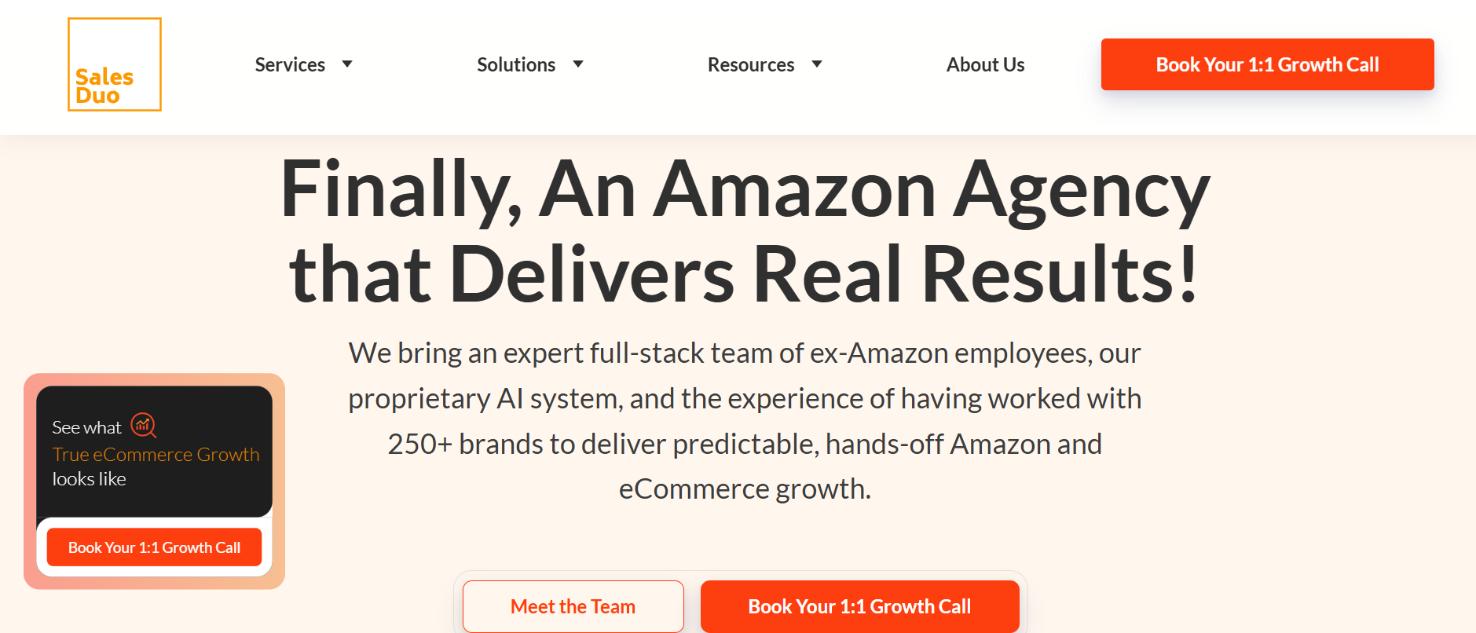
SalesDuo is a performance-driven Walmart advertising agency offering end‑to‑end Walmart ad management (Sponsored Products/Brands, Video, Display) with a proprietary AI‑driven platform.
What sets them apart is direct access clients get to BI dashboards with granular insights, and the Walmart advertising agency’s creative ad copywriting services to improve ad response. It’s an agency model that blends tech with hands-on listing expertise, giving brands both measurable optimization and excellent storytelling.
It’s best for brands ready to invest ~$5k+ min who want measurable scaling from Walmart ads.
Quick Comparison
| Agency | What They Offer | Best For |
| SellerApp | Full-funnel Walmart PPC, AI-powered dashboards via Walmart API, listing optimization, brand/IP protection, review management | Mid-to-enterprise sellers seeking scalable AI insights with expert-driven strategy |
| Tinuiti | Walmart Connect partner services: PPC, listings, inventory planning, multi-channel campaigns | Enterprise brands needing broad omnichannel strategy |
| Emplicit | Walmart ads, listing optimization, IP protection, competitor analysis | Mid-to-enterprise sellers with strong budgets |
| Vertical Rail | PPC/ad management, listing creation, brand registry, fulfillment | SMEs wanting niche focus & close attention |
| WebFX | PPC, site ads, native banners, listing/content support, ROI tracking | Mid-to-large sellers seeking robust cross-channel data alignment |
| AiHello | Automation-first Walmart PPC, AutoPilot bid/targeting tool, listing optimization | New sellers wanting automation without hiring a team |
| Urtasker | Sponsored ads, SEO, listings, inventory management | Startups & mid-sellers needing flexible PPC + SEO |
| BellaVix | PPC, content optimization, inventory, brand registry & hijacker defense | DTC brands & SMEs needing protection + growth |
| JungleTopp | Walmart + Amazon ads, performance-first PPC, zero setup fees | New sellers or SMEs testing paid growth |
| Commerce Rev | PPC, listing optimization, inventory forecasting, review programs | New-to-Walmart sellers wanting quick legitimacy |
| Search Nurture | PPC, SEO, retail media dashboards | Mid-sized brands wanting PPC tied to broader digital funnel |
| IG PPC | PPC-only, hands-on campaign mgmt, keyword research, optimization | Sellers wanting steady growth with personal strategist support |
| Areto | Profit-focused Walmart PPC with AI + human oversight | Mid-to-enterprise brands prioritizing ROI and unit economics |
| SellWix | PPC, SEO, branding, account optimization | Startups/small sellers needing bundled affordable services |
| SalesDuo | End-to-end Walmart ads (PPC, Display, Video), AI-driven platform, BI dashboards | Mid-to-enterprise brands ready to invest for measurable scaling |
Do I Need a Walmart Advertising Agency?
If you’re serious about growth on Walmart, a specialized Walmart advertising agency isis mandatory. Walmart’s ad ecosystem is growing fast, but it’s also competitive and increasingly complex, which requires expertise to break into. Just “running ads” won’t cut it.
Success lies in aligning campaigns with business goals, optimizing continuously, and protecting margins in real time. This is what the best Walmart advertising agency for you will always aim for.
Here’s why a Walmart advertising agency makes all the difference:
Expertise beyond DIY tools
Walmart Connect gives you access, but a Walmart ad agency brings battle-tested strategies that translate impressions into conversions. These insights are built from managing millions in spend across categories, which helps you avoid costly trial-and-error.
Advanced tech + human insight
The best Walmart ads agency will pair AI automation (rule-based bidding, dayparting, keyword harvesting) with senior ad managers who understand the nuances that algorithms miss. A top ppc Walmart agency like SellerApp combines AI automation (rule-based bidding, dayparting, keyword harvesting) with senior ad managers who have a decade or more of hands-on experience. This ensures your campaigns benefit from both speed and precision. Imagine machines optimize your ad campaigns at a large scale, while humans fine-tune strategy when algorithms fall short.
End-to-end optimization
Success on Walmart doesn’t stop at the ad click. A Walmart ad agency will align ad campaigns with listing quality by improving titles, bullets, Product images, and A+ content. When you polish up the content and double it down with ads, it ensures that the traffic you’re paying for converts at the highest possible rate, protecting your ad budget.
Profit-first approach
The best Walmart PPC advertising agency will not just chase impressions or clicks. They aim to build strategies that tie spend to profit, accounting for COGS, Walmart commissions, and margin goals.
Scalability
Whether you’re just testing Walmart as a new channel or managing thousands of SKUs, a Walmart advertising agency adapts strategy to your stage of growth. They know how to scale your products with a proven track record and make sure it’s done responsibly, identify winning products, and keep budgets lean in underperforming areas.
Data visibility
With Walmart API integrations that SellerApp provides, agencies can build custom dashboards that give you actionable insights, going far beyond what standard reporting shows. This kind of visibility helps enterprise sellers understand which campaigns are truly moving the needle.
Focus and time leverage
Instead of drowning in dashboards and spreadsheets, you focus on your brand while experts push campaigns forward.
A Walmart advertising agency is about running ads and gaining a competitive edge in a marketplace, where the smallest advantage compounds into outsized growth. For brands that want to scale profitably, the right Walmart advertising agency is the element that pushes them to succeed.
How to choose the right Walmart Advertising Agency?
Use this checklist to evaluate a top ppc Walmart agency with precision and avoid costly missteps.
Choosing the right Walmart advertising agency is about finding a partner that not only runs your ads but also aligns with your growth and profitability goals. Here’s what you should evaluate before signing on:
- Experience across Marketplace
We suggest sellers to look for agencies with a solid track record on Walmart and consider experience in managing ads across other marketplaces like Amazon as another strong indicator of quality services. This shows they understand both Walmart’s advertising tactics and how to implement those strategies across channels for maximum results. - Human Expertise with a fair share of Tech Balance
The top ppc Walmart agency doesn’t rely solely on automation, even if they offer such solutions. Check if senior strategists actively oversee campaigns, because nothing replaces human judgment and experience. - Profit-first Approach
A serious Walmart PPC agency partner ties ad spend back to profitability, so ensure they consider key profit indicators such as COGS, commissions, and margins instead of optimizing only for vanity metrics like clicks or impressions. - Creative Support is a Plus
Ads are only as effective as the product pages behind them. A top ppc walmart agency will optimize listings, images, and A+ content, while also offering support for long term branding, review management, or counterfeit protection, just like SellerApp does. - Transparency in Reporting
A trustworthy agency will offer clients full visibility into campaign logic, keywords, bids, pacing decisions with customizable reporting through Walmart’s API or BI dashboards, if their solutions are advanced enough. - Scalability
Ask whether they can manage campaigns from a small SKU count to a full enterprise catalog. The right agency will use automation for keyword harvesting, dayparting, and bid pacing to scale efficiently. - Strong Communication & Agile Support
Direct access to senior account managers matters is a must present aspect. Your agency partner should proactively flag issues and recommend improvements. - Fair Pricing & Flexibility
Watch out for hidden fees, setup costs, or rigid contracts that some Walmart advertising agencies are known for charging. The right agency offers pricing that scales fairly with your ad spend. - Right Client Fit
Every Walmart advertising agency has a sweet spot. Make sure they specialize in working with brands of your size or they have a balanced portfolio of startup, SME, or enterprise experience.
Final Thoughts
The best ppc agency for Walmart is one that adapts to your stage of growth, ties spend directly to ROI, and balances automation with senior-level human expertise. For startups, cost-efficiency and bundled services may be the right path.
For enterprise brands, advanced API dashboards, cross-channel reporting, and ad managers with a decade of experience make all the difference. So choose your Walmart advertising agency wisely, or if you want the best of them, you can schedule a demo right away and see for yourself why SellerApp brings you the best.
Additional Read:
Selling on Walmart – Why you Should and Where to Start?
Top Amazon Automation Software Tools for Sellers
Best Amazon Marketing Agencies for Your E-Commerce Success
Top Analytics and Optimization Tool for Amazon Sellers
The post 15 Walmart Advertising Agencies to Scale Profitably in 2025 appeared first on Amazon-ASIN Blogs - Latest from Amazon Sellers: News, Advice, and Effective Strategies.
]]>The post Best Amazon PPC Software: 10 SaaS Tools to Help You Improve Your Campaign Performance appeared first on Amazon-ASIN Blogs - Latest from Amazon Sellers: News, Advice, and Effective Strategies.
]]>As a campaign manager, you don’t need another dashboard, you need absolute precision and optimization features. Tools that pinpoint the stuff that matters and help you automate related tasks. Most importantly, give you control when it counts.
An excellent Amazon PPC optimization tool will help you drastically limit waste in ad spend and ensure that your budget is being used to its highest potential.
This breakdown goes beyond marketing fluff. We’ve reviewed the top 10 Amazon PPC software tools for 2025 through the lens of seasoned campaign execution: automation logic, AMC integration, cross-marketplace performance, SKU-level profitability, and how well they actually reduce time-to-decision across accounts.
What is Amazon PPC?
Amazon PPC, or Pay-Per-Click, is essentially Amazon’s internal advertising system. It’s an advertising system that enables Amazon sellers and brands to promote their products more effectively.
Specifically, you pay to have your products appear in front of high-visibility placements across the marketplace. For example, the search results, the product details pages, and even external sites that have partnered with Amazon.
With Amazon PPC, you essentially bid on specific keywords, target products, and even choose audience segments. Unlike other advertising models, with Amazon PPC, you only pay when someone clicks your ad.
That’s the technical definition.
In practice, PPC is the most direct lever you have to drive traffic. After all, paying for visibility can help you effectively scale your brand rather than solely depending on slow organic growth.
Additionally, you can quickly gauge product market fit, test market demand, and generate much-needed sales on Amazon. It’s where you compete for attention in a marketplace that isn’t always fair, isn’t always transparent, but is very much performance-driven.
It’s important to note that you’re always paying for more than just clicks; you’re also paying for signals and data. Every search term that gets a click or doesn’t, or every ASIN that doesn’t get any orders, or every shift in CPC is telling you something about buyer behavior. Not to mention deep insights into competition, seasonality, and much more.
And when you’re managing spend across dozens or hundreds of SKUs, your decisions tend to compound. Are you defending your brand or bleeding on broad match terms? Are your auto campaigns actually harvesting useful data, or just burning through budget? Are you balancing impressions with conversions, or simply chasing ACOS without considering TACOS?
For seasoned campaign managers or brand owners, Amazon PPC isn’t just about advertising. It’s about control. When organic rankings fluctuate, when reviews lag, when listings stall, PPC is the one channel where you can push and get immediate feedback. That speed, when managed well, is a growth advantage. When mismanaged, it can be a significantly expensive lesson.
Different Types of Amazon PPC Ads
If you’re running Amazon Ads day in and day out, you already know that not all campaign types are the same.
Each campaign gives you a different level of control, reach, and risk. Therefore, it’s always important to know when and how to use these campaigns and how they fit into your brand’s overall strategy.
Here are the different types of Amazon PPC Ads:
1. Sponsored Products – Your Workhorse
Sponsored Products are the most common type of ad used on Amazon. You’ll find these ads on the Amazon search results page and on product pages. Typically, blending it with regular product listings. Most campaign managers spend most of their budget on this type of Ad.
Fundamentally, Sponsored Products help increase visibility for individual items, making them ideal for sellers who want to promote specific products and drive direct sales.
Moreover, they’re incredibly versatile. You can run them for branded terms, new launches, bestsellers, or even defense/brand loop plays.
But their simplicity can be a bit deceptive. Auto campaigns can leak spend fast if you’re not refining them. However, Manual campaigns can scale, but only if you’re feeding them clean, high-intent terms and segmenting match types smartly. Of course, it’s always a question of constant optimization. This is where margin is made or lost.
2. Sponsored Brands – Your Brand Story on Display
Sponsored Brands ads effectively let you run headline ads that showcase your brand logo, a custom message, and up to three products.
Most importantly, they sit at the top of search results, which is essentially prime real estate. Of course, you can also find these in the middle. However, they’re still quite effective as they break the monotony.
SB brands tend to do more than just help with conversions. When leveraged properly, these ads can significantly boost awareness and credibility. Especially when someone’s in consideration mode.
If you’re pushing a product line or even trying to own your branded terms, SB brands can help a lot, as they give you a lot more freedom to control the narrative. Honestly, we’d recommend that more sellers use this format to shape their brand. Of course, if you’re only looking at pure ROI, you can always use it to sell your premium products or even cross-sell the rest of your products.
3. Sponsored Display – Retargeting with a Caveat
Sponsored Display is where things get a bit more nuanced. We also wouldn’t recommend you use this until you’ve gained significant experience running Amazon ads. Especially, as these campaigns are incredibly more volatile. You’ll need to monitor CPCs closely and constantly to effectively decide your bid increments. If you don’t, you could either run up your ACoS (Advertising Cost of Sale) or potentially cannibalize what could have been an organic or brand conversion.
When taken advantage of, SD brands can be absolutely brilliant.
You can essentially target your audience based on Amazon or beyond, making it perfect for any retargeting campaigns. SD ads are also incredibly effective when trying to capture market share.
Ultimately, each campaign type has its place. The real skill is in knowing when to dial each one up, how to layer them, and where to pull back. We recommend you think of them less as formats and more as levers, with each one playing a different role in your flywheel.
Challenges of Managing Amazon PPC Campaigns?
If you throw a rock and hit any Amazon PPC Campaign Manager on this brilliant blue planet, all of them will say that Amazon PPC isn’t hard because it’s technical. It’s primarily hard because it’s constant. Meaning you will have to make your peace with constant optimization.
You’ll have no choice but to turn managing your campaigns into a full-time job because you’re always going to be a keyword or a target away from wasting your ad spend or a breakout win!
Now, to ensure sustainability, you will have to understand the challenges. Here are some of the most common challenges of managing Amazon PPC campaigns:
1. Too Much Data, Not Enough Signal
Campaign reports are endless. You’ve got your impressions, CTR, CVR, RoAS, TACoS, NTB%, and that’s just before you grab your morning coffee.
Unfortunately, the real problem? Making sense of it all.
What looks good in isolation might be a bleeding margin at the overall account level. So, you’ll have to constantly toggle between high-level metrics and line-item actions, trying to find clarity.
And unless you’re layering insights from Search Query Performance reports, brand analytics, and Seller Central, you won’t be able to see the full picture.
However, we’re being a bit diplomatic here. Honestly, you’ll need a third-party tool that can consolidate all performance metrics in one unified dashboard. This will help you understand everything as opposed to flitting between several tabs or reports.
2. Bid Adjustments Are a Daily Grind
When it comes to bid adjustments, which is essentially the most important task of a campaign manager, the worst thing you can do is only “increase bids on top performers.”
That’s day-one logic.
To stabilize your performance and, more importantly, scale, you will have to understand performance metrics holistically and consider margins.
After all, there will always be the possibility of inventory risk and other issues.
Manually doing this can sound simple. However, it’ll get challenging when you’re managing 100+ campaigns across several ASINs with different lifecycles. Especially, as this will require you to be precise under pressure.
3. Keyword Management Becomes Chaos Fast
Every keyword you target will have a cost. That obvious. However, there’s also a consequence to adding several keywords. Not only will you have to balance high volume terms that bring traffic but destroy RoAS alongside long tail terms that convert but barely scale.
However, you also have to consider campaign structuring. For example, if you set a low budget but target 100 keywords in one ad group, the ad will only be served to the first couple of keywords before the budget runs out, leading to a cannibalization of potential.
Additionally, you will also need to run auto campaigns to harvest keywords that you can target in manual campaigns. Of course, you will also need to block irrelevant queries and audit match types regularly. All of this becomes challenging if you don’t have a dedicated campaign manager or a performance marketing manager.
4. Budgeting Isn’t Just About Caps
Anyone can set daily budgets. The hard part is allocating those budgets strategically. Do you push more into branded to stabilize RoAS? Or do you shift to defense/brand looping to protect your market share?
You’ll need to understand if you’re burning cash on retargeting that offers no lift. When it comes to budgeting, you’ll need to recognize that each dollar has to do its job, and teams will more often than not work with finite budgets. Meaning, one bad allocation = one missed sales window.
5. Campaign Structure Needs Constant Cleanup
You start out with a neat build. Then a new product launch comes in. Then Prime Day. Then a change in seasonality. Before you know it, you’ve got duplicate targeting, bloated campaigns, and no clear ownership between branded, competitor, and category terms.
Campaigns aren’t “set-and-forget.” They always degrade and require constant optimization. If you’re not actively cleaning and restructuring, performance slowly dies without you noticing.
6. Marketplace Shifts Outpace Reaction Time
Unfortunately, Amazon’s A10 Algorithm is constantly updated and improved. So, much so that there are new ad types, new rules, and new competitors.
And if you’re not reacting in real time, you’re reacting late. That’s the hard truth. What worked last quarter may not hold today, and if you’re stuck waiting on weekly reporting cycles, you’re already behind.
Ultimately, it’s because of all of these challenges that brands tend to hire a dedicated Amazon professional. However, even the dedicated performance marketer will need accurate data, optimization, and automation tools.
Why Using an Amazon PPC Software Important?
Fundamentally, as a brand owner or a campaign manager, you’ll find it significantly challenging to manage and scale campaigns.
Especially, as Amazon Ads have become incredibly competitive and complex. Without optimization or automation tools, you’re not only leaving money on the table but also burning through your budget on irrelevant targets.
Moreover, you’ll need a consolidated hub as running PPC ads involves juggling hundreds, sometimes thousands, of keywords, bids, and budgets across multiple campaigns. Trying to keep up with changes in real-time, analyze performance, and adjust bids manually. Not only is this exhausting, but it’s inefficient and prone to errors.
A good optimization tool will cut through the noise.
With automation features, it can also speed up routine tasks and repetitive tasks like bid adjustments and keyword management, surface insights you might miss when staring at spreadsheets, and give you more precise control over your ad spend.
This means you can focus on the overall strategy instead of grunt work.
More importantly, the tool helps protect your margin by keeping bids aligned with profitability goals, spotting wasted spend, and making sure your budget goes to campaigns that actually drive sales. In a competitive marketplace like Amazon, small mistakes add up fast, and the right tool helps you avoid them.
Ultimately, using a PPC optimization tool lets you manage your ads smarter, move faster, and grow your business without burning out.
Top 10 Amazon PPC Software Tools for 2025
When you’re scaling ad budgets past $100K/month, managing hundreds of SKUs, and balancing TACoS with a really good margin, you need more than a basic campaign manager.
The right PPC optimization platform should not only automate execution but also drive strategic decisions across marketplaces, product lines, and sales cycles.
Below, we evaluate the top 10 Amazon PPC software for 2025 based on what really matters to advanced sellers and agencies: rule-based + AI automation, campaign structuring, data integration, and profitability visibility.
1. SellerApp – End-to-End PPC Intelligence & Profitability Engine
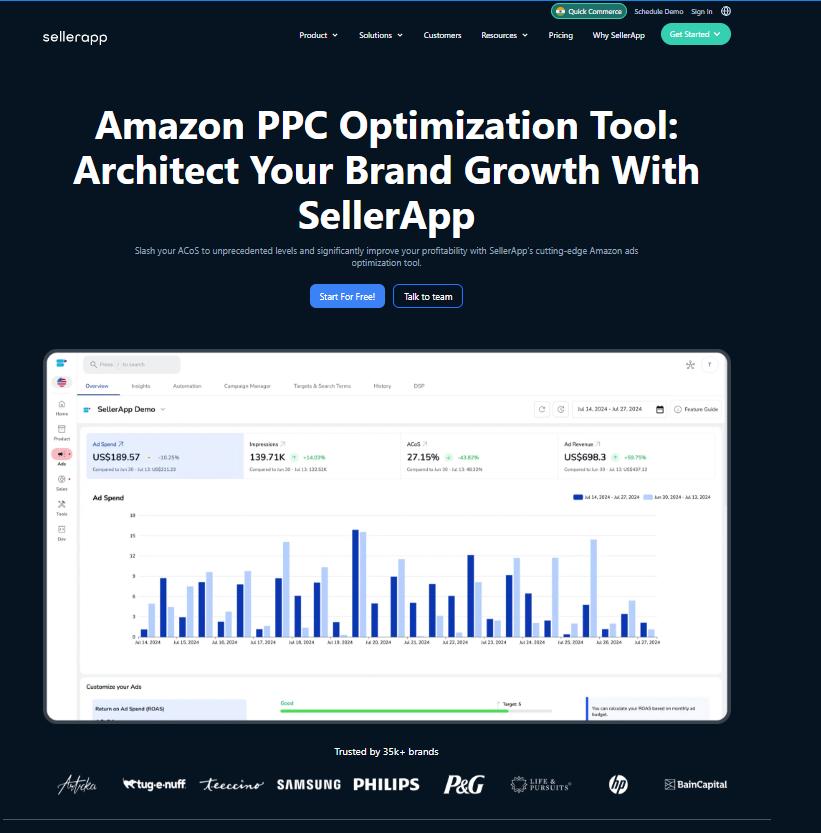
SellerApp isn’t just an Amazon PPC software, it’s an AI-powered PPC command center designed to align advertising, pricing, inventory, and product strategy across global Amazon marketplaces. With its multi-marketplace capabilities, it’s more of an ecommerce business accelerator.
SellerApp combines proprietary data, technology, human expertise, marketplace-specific signals, and real-time automation to help 7–9 figure brands scale profitably. Here’s why it’s one of the most powerful choices in 2025:
Unified PPC Operations Across Marketplaces
- Manage Sponsored Products, Brands, and Display campaigns across Amazon US, UK, DE, IN, CA, and more. All within one interface. We were able to access advanced filtering that allows campaign views by ASIN, portfolio, ACoS, and so much more.
Full-Funnel Data Visibility
- Track every campaign and ad group metric. You have complete access to several performance metrics that can actually help you move the needle. In addition to key metrics like ACoS, TACoS, ROAS, you’ll also be able to understand your campaign performance by new-to-brand sales, wasted spend, impression share, conversion rate, and much more.
- This essentially eliminates the need to toggle between the Amazon Ads console, Excel sheets, and third-party dashboards.
Rule-Based + AI Optimization
- Both SellerApp’s Advanced Rule-based automation and AI automation can help you streamline repetitive tasks, bid adjustments, budget reallocations, keyword pausing, harvesting, and campaign goal tracking.
- There are even features that adapt to the daily data changes, margin inputs, and marketplace seasonality.
- Or, you can define custom rule-based workflows to execute changes based on granular thresholds (e.g., auto-pause non-converting terms after 30 clicks + CTR < 0.25%).
Negative Search Term Management
- This tool enables you to automatically identify and suppress non-converting, high-cost, or irrelevant terms using customizable thresholds and historical patterns. SellerApp’s engine flags negative keywords and applies them at the ad group or campaign level to cut wasted spend as quickly as possible.
Advanced Dayparting + Budget Control
- Like most tools, SellerApp offers Dayparting as well. However, we recognize that it’s significantly more advanced, which can help you control campaign run times based on historical conversion windows.
- Pause low-performing hours, boost peak ROAS slots, or set spend caps by hour/day. Pair this with rules for automatic budget increases during seasonal surges or low ACOS periods.
Amazon Marketing Cloud (AMC) Integration
- SellerApp goes way beyond what Seller Central reports offer. Specifically, this Amazon PPC Optimization tool integrates with AMC to analyze path-to-purchase, audience overlap, branded vs. non-branded impact, and repeat purchase behavior. So, you can tie campaign spend to customer lifetime value. Most importantly, it’s visual in the form of a heatmap, helping you quickly execute your tasks.
Search Term Intelligence Beyond SQP
- SellerApp will dissect all of the converting and non-converting search terms at the match-type level, tied to SKU and margin data. This will enable you to view ASIN-level intent scores, match type volatility, and lifetime revenue per search term, not just clicks or ACoS.
SKU-Level Margin & Promo-Aware Optimization
- Track actual SKU profitability post ads with ease. You’ll be able to adjust for returns, coupons, inventory holding cost, and cross-selling lift. No more optimizing to ACoS in isolation. You get true net margin awareness at the keyword and campaign level.
Trusted by Enterprise + Agency Teams
- Used by brands like Coca-Cola, SellerApp supports agency workflows with account grouping, white-labeled reporting, bulk edits, API integrations, and cross-account benchmarking dashboards.
Best For: Enterprise brands, aggressive private-label sellers, and performance agencies managing complex, multi-geo accounts who need deep intelligence, automation, and real profitability control.
2. Sellozo – Streamlined PPC for Sellers Focused on Growth
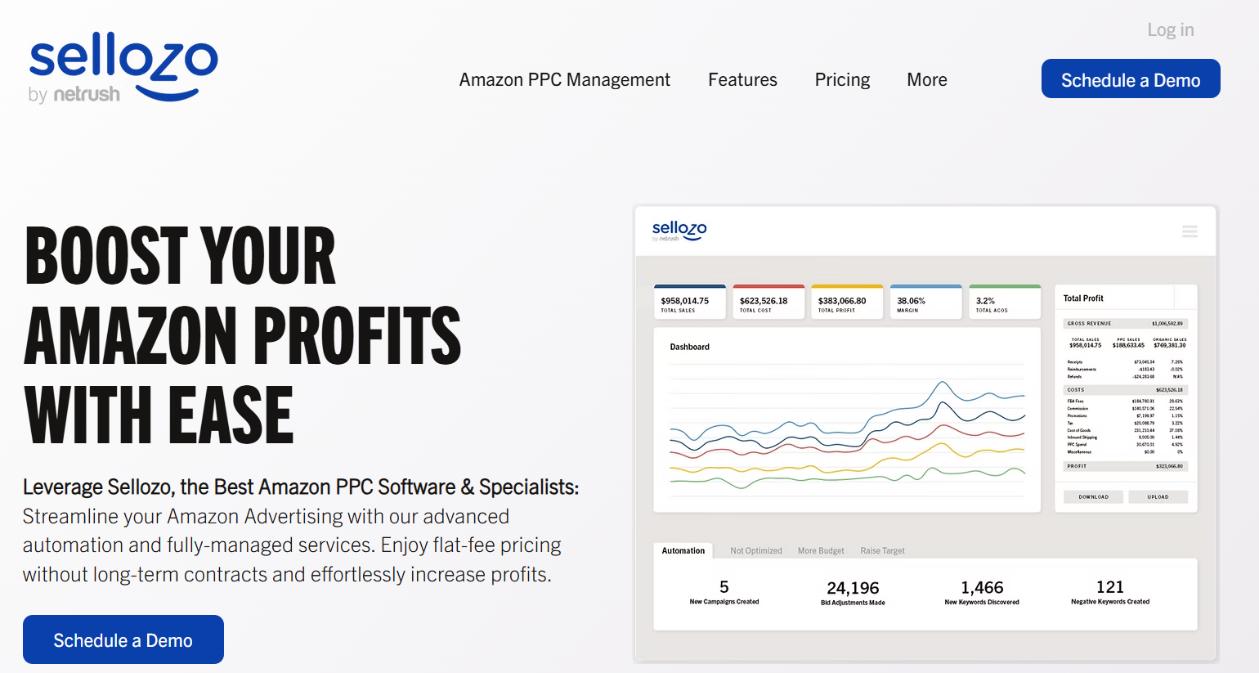
Sellozo simplifies daily campaign optimization with a predictive bidding engine and smart structuring tools. Sellozo is ideal for brands growing past $25K/month in ad spend who want automation without a steep learning curve. Here’s what stands out:
- There’s a brilliant campaign studio that enables a drag-and-drop campaign structuring for funnel builds (Auto > Broad > Exact), keyword transfers, and match-type mirroring.
- This tool runs every 24 hours, adjusting bids based on ACoS targets, historical CVR, and keyword elasticity.
- Similar to SellerApp, Sellozo also offers Dayparting capabilities. Easily set up hourly/day-based schedules to pause campaigns during low conversion windows.
- This tool offers a clean dashboard showing PPC spend vs. gross profit and ad-driven vs. organic sales.
However, there are significant limitations. For example, there’s no Amazon Marketing Cloud integration, it lacks SKU-level profitability adjustments, and doesn’t support custom automation rules, making it less suitable for agencies or enterprise sellers.
Best For: Growing sellers and smaller agencies looking for automation without complexity.
3. PPC Entourage – Profit-Driven Campaign Structuring & Search Term Mining
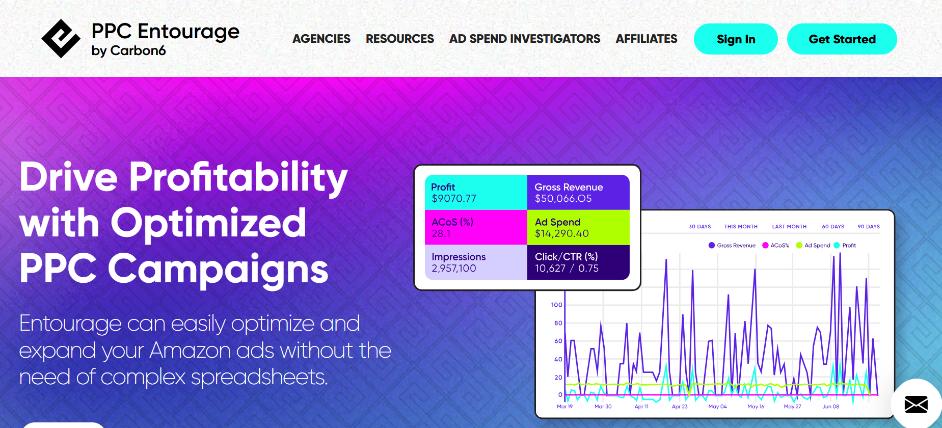
PPC Entourage is an excellent tool that excels with tactical keyword management and excels at tactical keyword management and building clean, margin-aware campaign structures. It’s ideal for private-label brands refining campaign efficiency.
Here are some of the key highlights of PPC Entourage:
- This tool has pretty effective search term expansion and negative marking capabilities. You can easily mine by converting search terms and even auto-flag unprofitable or irrelevant ones.
- PPC Entourage comes with a blueprint campaign builder. Specifically, templates for Sponsored Product campaign architecture from scratch.
- One of the features we absolutely loved was the ability to set threshold-based rules. We managed to set limits to auto-pause wasteful terms after X clicks or high ACoS.
- Another aspect that stood out was the consolidation of PPC cost with product COGS to surface true ROI.
What are the limitations of PPC Entourage?
- Lacks AMC data, real-time AI optimization, and deep automation capabilities.
Best For: Smaller private-label sellers aiming to clean up campaign waste and structure accounts for long-term scale.
4. BidX – AI-Led PPC With Budget-Centric Campaign Control
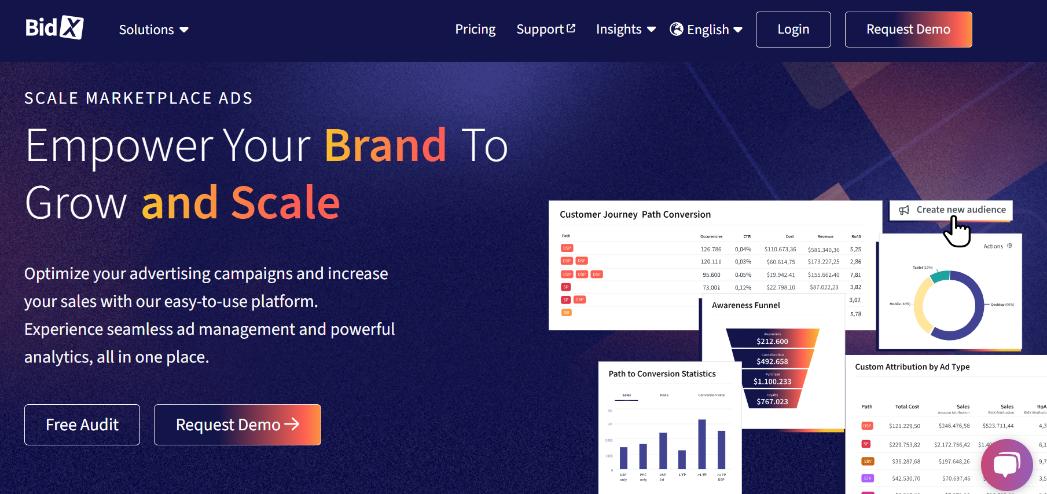
BidX combines full automation with optional manual controls. It’s strong for sellers managing strict budgets or operating across EU marketplaces. Here are some of the top features:
- Trained on conversion and marketplace data, BidX comes with a built-in AI engine that adjusts bids daily based on your goals.
- Allows optional custom rules on CTR, CVR, ACoS, or impressions.
- Useful for EU sellers operating across Germany, France, Italy, UK, which includes currency-adjusted performance tracking.
- Additionally, automatically promotes or demotes keyword & ASIN harvesting.
- BidX offers an incredibly unique advantage. This tool empowers you to plan campaigns around budget ceilings rather than bidding alone. This feature makes it great for sellers who tend to execute controlled ad spend strategies.
Best For: International sellers or agencies needing smart automation without needing to micro-manage campaigns.
5. Helium 10 Adtomic – PPC Inside the Helium 10 Ecosystem
Adtomic is the PPC module inside Helium 10’s suite. While it lacks the depth of standalone tools, it’s powerful if you’re already using Helium 10 for research, tracking, and listing optimization. Here are some of the key strengths of Helium 10’s Adtomic:
- You gain access to campaign templates. Specifically, you can launch Sponsored Products and Brands from keyword clusters found via Cerebro or Magnet.
- Based on profitability targets and conversion data, you get access to smart bid recommendations.
- Assist you in converting high-performing terms from auto to manual campaigns. Like SellerApp, Helium 10 offers search term harvesting capabilities.
- Ultimately, Helium 10 is known for its Keyword research prowess. You can use magnet + Cerebro data inside the PPC interface for better targeting.
Watch-Outs: No advanced rule-based workflows, negative keyword automation, AMC integration, or margin-level insights.
Best For: Helium 10 users adding PPC as part of their broader listing and keyword strategy. Especially in early growth stages.
6. Teikametrics Flywheel 2.0 – Multi-Channel AI Optimization With Retail-Aware Signals
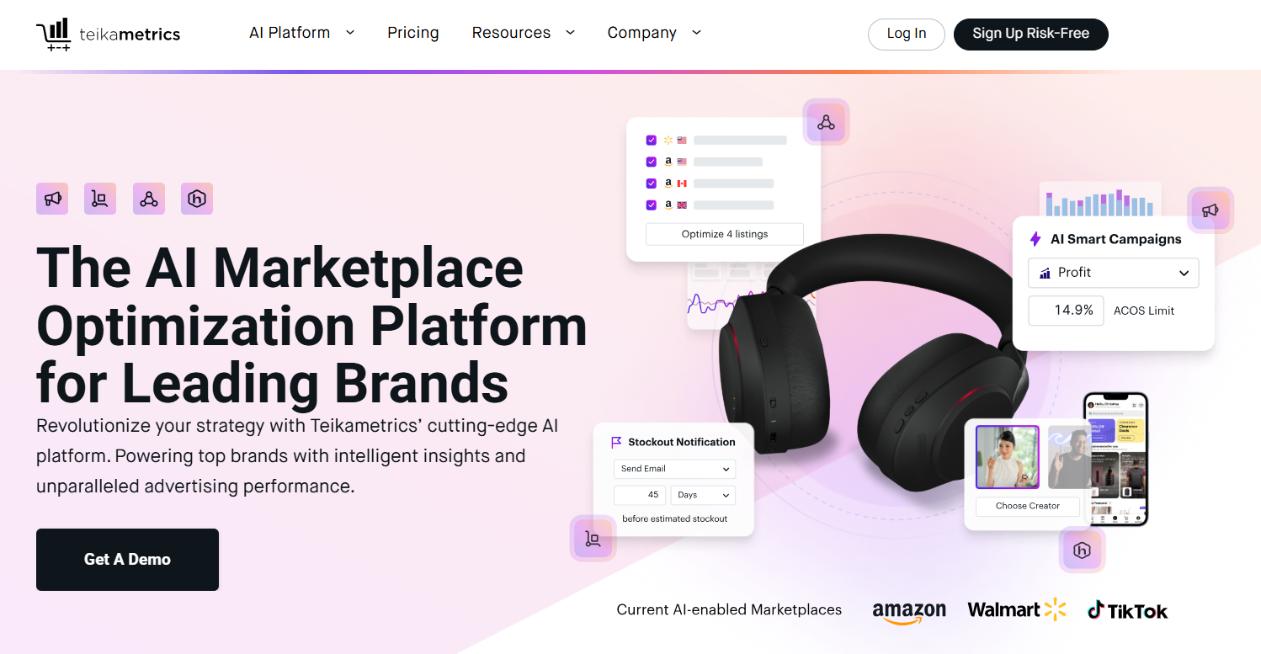
Teikametrics is a strong contender for brands selling across both Amazon and Walmart, especially those looking to tie their advertising to real-time inventory, Buy Box metrics, and profitability thresholds. Here’s what stands out when it comes to Teikametrics:
- You gain access to a pretty powerful AI. Flywheel’s algorithm factors in inventory levels, pricing changes, and Buy Box ownership, ensuring you don’t waste spend on SKUs that are out-of-stock or underperforming on price.
- Supports Amazon, Walmart, and Target, making marketplace expansion incredibly effective. In fact, the process is made significantly easier with a unified dashboard that gives a clean view across platforms without switching UIs.
- You can easily move terms between Auto, Broad, Phrase, and Exact campaigns based on conversion signals, without setting up rules..
- Tracks gross margin impact, ad spend vs. organic lift, and even competitive pricing influence on campaign performance.
Although we loved using the tool, we felt that the rule-based automation was minimal. Most of the system was algorithmically driven, which isn’t great for sellers who want to define their own keyword or bid logic.
Best For: Mid to large brands selling across Amazon and Walmart who want automation that adapts to inventory and Buy Box changes.
7. Perpetua – Goal-Based Advertising With DSP and Video Access
Perpetua is built for performance marketers focused on scaling Sponsored Brands Video, DSP, and core campaigns without getting into the weeds of bid-level tuning. In fact, it’s quite the beast when it comes to DSP. Here are some of the key advantages of Perpetua:
- You can set your ACoS, ROAS, or visibility goals, and Perpetua allocates budget across campaign types accordingly. The AI engine runs continuous bid adjustments.
- Amazingly, you can get native support for SBV and DSP placements. Useful for brand-first campaigns or remarketing.
- What we loved the most was the performance visualizations. Strong visual dashboards showing top-performing creatives, keyword trends, and sales attribution.
- Perpetua gives you real-time performance alerts and snapshots on the go, which is significantly helpful for fast-moving teams.
Now, what we absolutely loved was the creative support. There’s an Integrated creative marketplace if you need help producing SBV assets or optimizing visuals. However, on the PPC side of things, there was a lack of rule-building or deep campaign structuring flexibility.
Best For: DTC brands scaling fast and looking to combine creative campaigns (SBV/DSP) with performance goals under a clean, centralized dashboard.
8. Quartile – Managed AI Advertising for High-Volume Sellers
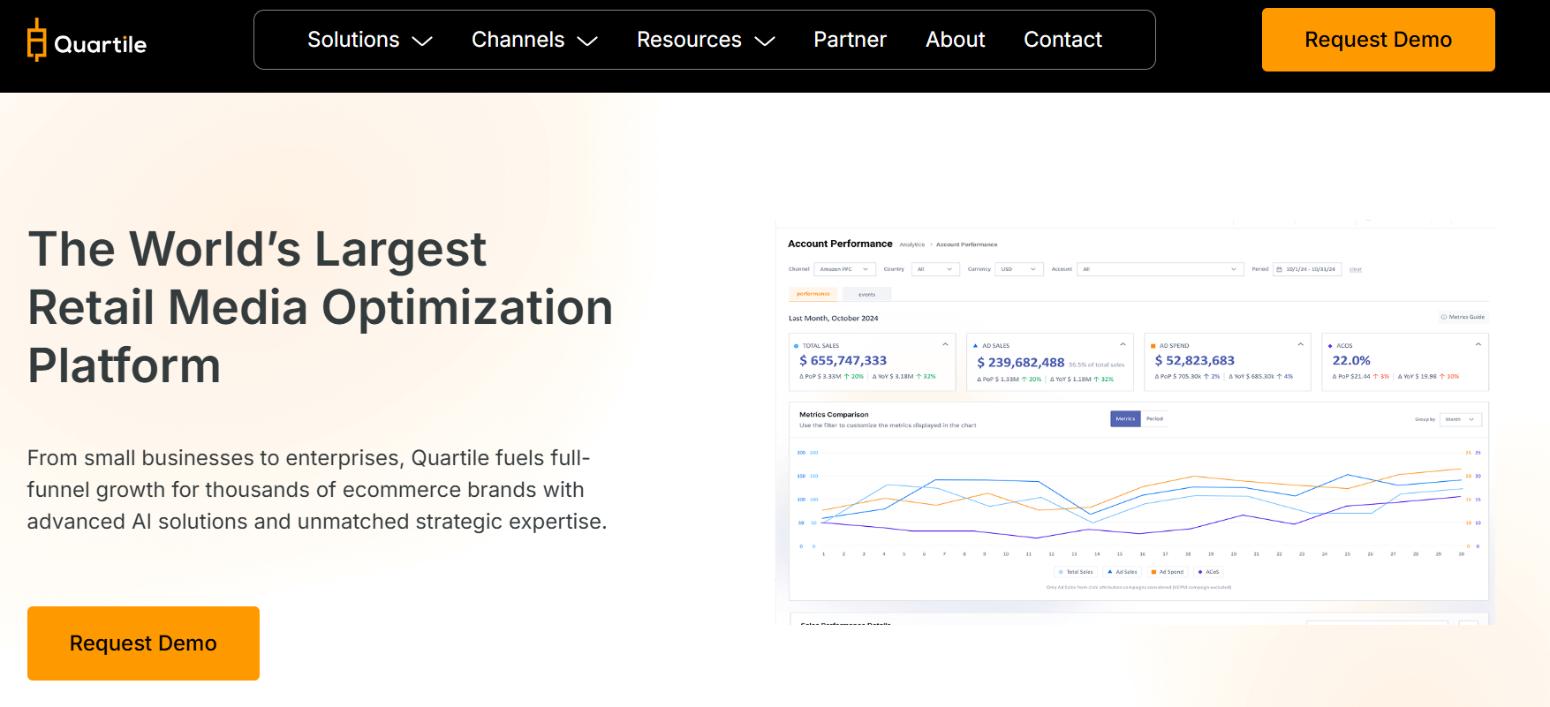
Quartile combines machine learning and account management to offload end-to-end optimization, ideal for sellers spending $ 50 K+ on ads monthly. Here’s what’s included:
- Automatically shifts search terms across match types, manages budgets, and sets negatives, learning over time from performance trends.
- You can segment campaigns by ASIN groupings, goal types (launch vs. scale), and intent tiers.
- Dedicated account managers support strategy, campaign audits, and optimization tracking.
- The tool empowers you to scale Amazon globally and includes built-in localization strategies for expansion.
- Loved the organic rank tracking. You can essentially measure the PPC influence on organic rank changes over time for core products.
However, surprisingly, you don’t get control over workflows, rules, or daily actions. Most of the logic is managed on their end, making transparency a challenge.
Best For: High-volume brands or aggregators who want advertising offloaded but still expect growth tied to efficiency.
9. Zon.Tools – Precision Rule Builder for Advanced PPC Managers
Zon.Tools is built different. It’s a no-frills, high-control automation engine tailored for seasoned managers who want to scale existing strategies. However, it’s still quite niche in execution as there’s no AI to rely on. Here are some interesting capabilities:
- You can create detailed performance rules based on any metric: ACoS, ROAS, CTR, orders, CVR, even hourly time blocks.
- Easily manage bulk campaigns. You can also execute mass edit campaigns, ad groups, and bids across large catalogs with granular filters, which is cool. But we’ve seen it in other tools as well.
- We could also set automated rules for pausing, negating, or quarantining non-converting terms at the keyword or ASIN level.
There’s a pretty effective dayparting feature that can help you schedule campaigns to start/stop by hour or day. Great for brands with data showing peak conversion windows.
Best For: Experienced PPC managers or agencies with strong internal playbooks looking for pure automation flexibility without black-box AI.
10. Downstream by Jungle Scout – Retail Media Analytics With Strategic Visibility
Well, Jungle Scout was bound to make this list. However, it’s important to note that Downstream isn’t a bid management tool; it’s more of a retail media analytics platform that connects advertising to business-level outcomes.
This is Ideal for in-house brand teams reporting to leadership. Here’s what you can do with Downstream:
- Share of Voice & Shelf Metrics. You get to track branded vs. competitor visibility across search placements and page positions.
- You can effectively access Buy Box monitoring features and track the impact of ad spend. See how your campaigns influence Buy Box win rates and price competitiveness.
- Downstream breaks down performance by Sponsored Products, Brands, Display, and retail readiness.
- One of the most amazing features we’ve come across is that this tool has the ability to customize the dashboard for teams. You can tailor reports for execs, marketers, or finance—great for internal storytelling.
Since it’s a part of Jungle Scout, you’ll also find that this tool integrates with the rest of the Jungle Scout Stack, making it useful if you are already using it for product research, tracking, and competitive analysis.
Unfortunately, there’s no campaign or bid automation, and it can’t completely replace a PPC platform. It made this list as it’s incredibly helpful as a secondary tool that sits on top of your PPC tool, as it helps with strategy-level optimization.
Best For: Brand managers, retail media teams, or finance leaders who need to track how ad dollars influence market share and category performance.
How to Choose the Best Amazon PPC Software for Your Business?
Not all PPC tools are built the same. Some offer full automation that’s further split into rule-based automation and AI automation, while others give you too much data without any intuitive features, making it incredibly difficult to use. And, of course, there are several tools that are simply reskinned dashboards that offer zero functionality.
Now, if you need assistance in optimizing your campaigns effectively and not a simple overglorified report dashboard, here’s what you’ll need to look for when you choose your optimization software:
1) Fast, Clean UI (Because You’re In It Every Day)
Ultimately, you’re going to be spending hours inside the tool, and the UI will matter. After all, you don’t want to get fatigued. This is why the best Amazon PPC software out there use fast, intuitive dashboards that have a breakdown of all critical metrics. Bonus points if it’s broken down by inline edits and annotations so your team stays in sync.
2) Built for Both Analysts and Advertisers
It’s important to note that you don’t need to simply have a bunch of raw data. You need answers. The best tools will surface actual insights, not just CTRs and CPCs. Look for software that tells you why a campaign is not performing. Moreover, you also need to understand what’s eating into your margin, if you’re bidding is effective, or how you’re not making the most of your ad budget.
3) Customizability That Doesn’t Break Workflow
A certain level of customization is incredibly important. For example, you should be able to access automation or set rules to stabilize your TACoS at 15% and systematically scale. Or the platform should be capable of effectively helping you achieve specific goals. For example, doubling down on acquiring NTB customers during a product launch.
The tool should be, ultimately, capable of supporting your logic and not just force you into your predefined templates.
3. Search Term-Level Precision
Really good PPC tools will let you manage campaigns at the most granular level: the search terms. Meaning, you’ll be able to find not only insights that drive your business forward by moving high-performing search terms from broad match to exact match. You’ll also be able to effectively understand how each term impacts your overall keyword strategy.
4. Cross-Campaign Budget Intelligence
Seasoned campaign managers will know that budgeting isn’t just about setting daily limits. It’s about knowing which campaigns deserve more fuel and which ones need to be terminated immediately. Now, to pull this off effectively across several campaigns, campaign types, and ASINs without needing several spreadsheets, you’ll need an Amazon PPC software.
5. Data You Can Trust
You’re bid strategy, logic, campaign insights, and overall performance decisions will only be as effective as the data. This is why you’ll need an effective tool that offers direct integration with the Amazon Ads API to avoid delays or sampling errors. These tools are critical as they help maintain high data fidelity as well.
6. Support That Actually Knows Amazon Ads
Now, support is something that you will absolutely need. After all, keeping abreast with the latest Amazon PPC best practices, Algorithm changes, and simultaneously running split testing will result in you running into several roadblocks.
So, when it comes to troubleshooting, you can’t just rely on chatbots. You will need to reach out to a seasoned Amazon ads specialist who can not only guide you but also help you understand how the dashboard ties into solving that specific pain point.
Only an actual human who’s optimized accounts, ad lifecycles, and understands how to solve issues like search suppression, buy boxes, and poor ad relevance scores will be able to help you navigate the PPC Tool and even help you understand its use cases.
Final Thoughts
Amazon advertising in 2025 is way different than than the early 2020s. Now, it’s about who optimizes smarter, faster, and with better data fidelity. To pull this off, you’ll absolutely need to take advantage of one of the PPC tools on this list. Especially, as these tools have been engineered to deliver incredible systems of insights.
With a good Amazon PPC software such as SellerApp, you’ll be able to easily spot a $10,000 leak hiding behind a bloated Sponsored Brands campaign, or a high-converting ASIN buried in an auto campaign.
Moreover, these tools will come in handy if you’re managing multi-geo accounts, integrating AMC workflows, or tracking TACoS across product lifecycles that require a command center of sorts.
The absolute bottom line is to choose the tool that aligns with how you think. Whether you’re a data-heavy operator or a rules-based strategist, or if you’re thrown into the deep end and have been asked to manage 200+ SKUs with thin margins. The tech’s mature enough now to stop settling.
The post Best Amazon PPC Software: 10 SaaS Tools to Help You Improve Your Campaign Performance appeared first on Amazon-ASIN Blogs - Latest from Amazon Sellers: News, Advice, and Effective Strategies.
]]>The post Optimizing Your Amazon Product Detail Page: A Seller’s Guide to Success appeared first on Amazon-ASIN Blogs - Latest from Amazon Sellers: News, Advice, and Effective Strategies.
]]>But what does it mean to make something better? This guide explores the key ways to turn a normal product listing into a sales powerhouse. From writing catchy titles to using top-notch pictures and smart keywords, each part has a big impact on getting seen and making sales. If you’ve been selling for years or you’re just starting out in online shopping, getting good at these methods will help you deal with Amazon’s tricky parts and reach new levels of success on this worldwide platform. Let’s start this journey to improve your listings and make them stand out from the crowd!
A Quick Peek into the Content:
- What is an Amazon product detail page?
- Key Parts of an Amazon Product Detail Page
- Which elements of an Amazon product detail page can you optimize?
- A+ Content on Amazon detail pages
- What to Add to Amazon Product Pages
- The Role of Amazon Launchpad in Enhancing Product Detail Pages
- Conclusion
What is an Amazon product detail page?
An Amazon product detail page is essentially the online amazon storefront for your product, where potential customers can learn everything they need to know before making a purchase. This page is crucial because it showcases your product through various elements like the title, bullet points, description, and images.
How to Create a Standout Amazon Product Detail Page
If you really want to stand out on Amazon, pay attention to crafting a great title with rich content in keywords, optimize bullet points to reflect key features and benefits, and high-quality images that can show what you’re selling from different angles. Ensure the description is clear and engaging to point out what exactly will differentiate your product and strategically choose keywords to increase search visibility.
Key Parts of an Amazon Product Detail Page
- Product Title: Here, you’ll see the product name and brand. Keep it simple and clear using keywords to boost search visibility.
- Images and Videos: The main picture comes with extra photos and videos showing the product from different views or in everyday use. Top-notch visuals play a key role in giving customers a clear idea of what they’re buying.
- Brand Information: This part displays the brand name and might have a link to the brand’s Amazon store helping buyers recognize and trust the brand.
- Ratings and Reviews: Customers can check out the average rating and total review count here. This gives them proof from other buyers about how good the product is.
- Product Details: This part lists specs like size, what it’s made of, and main features. It helps shoppers get a clearer picture of what they’re buying.
- Bullet Points: Key features show up in a short easy-to-read format. This lets customers scan through the most important info.
- Product Description: This section dives deeper into explaining the product. It covers its benefits and what makes it stand out to help convince potential buyers.
- Variations: This area gives customers the option to pick different sizes, colors, or packs of the same item, if available.
- Pricing Information: Customers can easily see the price, any discounts, and Prime eligibility. This helps them understand their options .
- Customer Questions & Answers: Potential buyers can ask questions about the product in this section. Previous customers or sellers can provide answers, which builds trust and gets people involved.
- Related Products: This part shows suggestions for similar items or products often bought together. It aims to encourage customers to buy more.
Rules and guidelines for Amazon detail page
Avoid Duplicate Listings:
Do not place duplicate products that already exist in the Amazon catalog.
Accurate Categorization:
Better Cataloging facilitates better discoverability.
Prohibited Content:
Avoid inappropriate material, personal contact information, pricing details, or promotional links.
Character Limits:
Products should have the title brief to up to 200 characters and ensure it is a relevant and clear title.
Use Clear Language:
Ensure that titles, descriptions, and bullet points are in plain language so that customers understand what they will buy.
Image Standards:
Use Amazon’s image standards when uploading your product images so they are in and out of compliance.
Location Language:
Include all the information for sale on a marketplace in the local language of the location, eg: German for Amazon.de
Which elements of an Amazon product detail page can you optimize?
To optimize for profit, you have to focus on both getting potential customers to find your product and encouraging them to make a purchase. Here’s how to enhance your product detail page and attract buyers that may eventually convert their interest into sales.
Do Your Keyword Research
Start by researching keywords that consumers would use in search for your product. Think of how they might actually type in the search bar and be sure to organically include those words within your listing.
Create a Compelling Title
Your product title is the most critical text in determining visibility in search. Use a clear, exciting title that holds important keywords but contains also your product details, though not over 200 characters. An improved title can dramatically increase your click-through rates.
Use High-Quality Images
Invest in good clear pictures from all angles for your product. Easily meet the requirements set by Amazon, and of course, make sure that the first picture can have a white background. Try for at least five images so customers have an idea of what exactly they are getting.
Optimize Bullet Points
Summarize the importance of your product’s attributes and benefits in as few words as possible in bullet points, yet carry the pertinent keywords.
Stretch Your Product Description
In addition to containing the bare essentials, your product description should say more than that. Talk about the benefits, specifications, and possible applications of your product in an interesting manner to make the customer want to purchase it.
A+ Content Optimization
Ensure you are an Amazon registered brand and utilize the facility of A+ Content. It supports the addition of rich media, lifestyle images, and comparison charts that may help make your product more recognizable in the market.
Use Competitive Pricing
Monitor the prices of similar products so that your price is at par without being too low it devours profit margins. Apply such psychological pricing practices like, for instance, $19.99 instead of $20 to really attract more buyers.
Customer Review Management
Satisfied customers should be motivated to provide good reviews, which may play a crucial role in the purchasing decisions of other buyers. The best answer to a customer’s questions or negative comments is a positive one.
Keywords in the Backend
Do not forget your hidden keywords! These amazon backend keywords help the algorithm on Amazon understand what your product is about without cluttering up your visible content. You have up to 250 bytes for these keywords—avoid duplicates and special characters.
Keep an Eye on Performance and Revise
Check constantly how your listings are performing using Amazon’s analytics tools. Be ready to revise things based on keyword trends, customer feedback, and shifts in the market.
A+ Content on Amazon detail pages
If you are an Amazon Brand Registry seller, then you get the great opportunity of adding A+ Content to your product detail pages. This feature allows you to expand your product descriptions, providing you with extra space to add text and lifestyle images, brand stories, and other engaging elements.
Why is A+ Content Important?
Creative freedom is one of the major advantages with A+ Content. Other than making your listings look pretty, it can also express a better representation of the story of your brand. According to Amazon, up to 10% increases in sales are seen when you make use of A+ Content.
What to Add to Amazon Product Pages
Detailed Descriptions: Proffer beyond the surface information. They help to give in-depth information about your product.
Lifestyle Images: This is the images of your product put out in everyday living. To this end, such images will help the customers see a real-life picture with the product.
Brand Story: This describes who you are. It creates a relationship between you and the potential buyer. So, create good comparisons of charts that help the customer decide.
Integrating these factors makes your listing more attractive and enhances customer engagement and confidence. Aimed at giving customers the complete sense of a product, you will be able to substantially improve the chances of conversion.
Common Mistakes to Avoid on Amazon Product Detail Pages
Avoiding Keyword Research
Failure to base your content based on relevant keywords may lead to poor search visibility. Identify keywords that a potential customer will likely use when searching for your product.
Keyword Stuffing
Loading your title, bullet points, or description with overuse of keywords will make it unreadable and unprofessional. Amazon algorithms will also slap penalties on listings that seem spammy. Focus on natural language that offers value to the customer.
Neglecting Available Space
Failure to use the entire space available for description, bullet points, and other content can limit the effectiveness of your listing. Use these sections to give out key information about the benefits and features of your product.
Avoid Using A+ Content
When you are a Brand Registry seller, if you want to have more images with detailed descriptions of your product, you can use A+ Content to engage customers to improve conversion rates.
Poor Quality Images
Providing low-quality images or not enough images about the products would not attract the attention of the customers. Always make sure you include high-resolution images of your product from different angles with lifestyle shots that even show how the product is used.
Wrong Category
Selecting the wrong category can lead to confusion among customers and lessen the discoverability. Be sure you get the right category for your product.
Setting a New Listing for a Product Already Listed
Setting a new listing can declassify your listing if Amazon had the same product listed within its catalog. Before creating a new listing for your product, make sure there is no similar product listed on Amazon already.
Missing Out on Customer Reviews
Ignoring customer reviews, be it a negative or positive one, may influence your reputation. It shows you care about your customers’ opinions and builds trust.
Incorrect Formatting
Titles and descriptions that are not formatted correctly make your listing look messy and unreadable. Your content needs to be concise, logical, and according to Amazon’s style guideline.
The Role of Amazon Launchpad in Enhancing Product Detail Pages
Amazon Launchpad is an important avenue through which there exists enhancement of the product detail pages. This feature greatly touches on products that are new and innovative. It helps startup companies and emerging brands, making it easy for them to showcase their products on Amazon. How Amazon Launchpad Enhances Product Detail Pages
More Visibility: Amazon Launchpad provides more visibility to the products. This section features distinctive and innovative products that can be easily browsed on this part.
A+ Access for Contents: Brands participating in the services offered by Amazon Launchpad may make use of A+ Content, enriching the product descriptions with more text, lifestyle images, and even a company story which will all be helpful in creating an interesting shopping experience.
Custom Branding: Brands can narrate their story on product detail pages through customized branding elements offered by Launchpad. Brands are able to develop a bond with potential customers and increase recognition of the brand name.
Promotional Support: Amazon generally launches marketing campaigns for the products listed under Launchpad through email campaigns, social media, and other marketing channels. These increased traffic and sales are the result of promotional support.
Customer Trust: Joining Launchpad with Amazon can help a new brand attain some good reputational badges. Customers will be assured of buying from a brand that Amazon endorses if they are assured it meets some form of acceptable quality standards.
Access Analytics: Sellers in the program have analytics that will enhance listings and enable a seller to understand better what’s going on with the customers.
Conclusion
An optimized Amazon product detail page will include many high-quality images, rich and clear product descriptions, strategically placed keywords related to buyer search intent, compelling bullet points as enhanced brand content highlighting the key features and benefits of the product. Critical support for the trust that’s required comes from positive customer reviews and ratings. Periodic revision and refreshing with performance metrics would help sustain a competitive advantage. Finally, A+ Content can make the story better; hence, it may impact the overall attractiveness of the product.
The post Optimizing Your Amazon Product Detail Page: A Seller’s Guide to Success appeared first on Amazon-ASIN Blogs - Latest from Amazon Sellers: News, Advice, and Effective Strategies.
]]>The post Step-by-Step Guide to Selling Used Books on Amazon appeared first on Amazon-ASIN Blogs - Latest from Amazon Sellers: News, Advice, and Effective Strategies.
]]>One big plus of selling old books on Amazon is the chance to earn extra money. Whether you want to add to your current income or start an online shop, the used book market is a good place to begin without much risk. You can find books to sell at thrift shops, yard sales, or even from your shelves, letting you build a steady cash flow without spending much to start.
What’s more, Amazon’s used book market is huge and varied, meeting the needs of readers with all sorts of tastes and interests. You can find everything from old valuable copies to textbooks and bestsellers. There’s a need for every kind of book you can think of. This variety lets sellers focus on specific types of books or offer a wide range, giving them a better shot at catching buyers’ eyes and making more money.
Why Sell Used Books on Amazon?
Amazon gives sellers an unmatched place to sell used books, with many perks to help them do well. With its massive customer base and easy-to-use site, Amazon has become the place to go for book buyers worldwide.
Selling used books on Amazon has a big advantage: the platform’s huge reach. Amazon, one of the biggest online markets in the world, gets millions of visitors every day. This gives sellers access to loads of possible customers. With so many people browsing, your books have a better chance of being found and bought, boosting your sales.
Also, Amazon makes it easy for sellers to list and manage what they sell. The platform has simple tools and features that make tasks like creating listings, keeping track of orders, and talking to buyers a breeze. This lets sellers spend more time growing their business instead of getting stuck with complicated steps.
Moreover, Amazon’s track record for dependable customer service and safe transactions gives buyers peace of mind, making them more inclined to buy from sellers on the site. This element of trust can be a big plus, as it can boost sales and keep customers returning.
Types of Books You Can Sell
When you’re looking to sell books on Amazon, you’ve got plenty of choices. The site lets you sell new and used books to meet different customer needs and price ranges.
New Books
Selling new books on Amazon can bring in good money if you know publishers or distributors. People often want new books, and buyers like getting a book in perfect shape and being its first owner. But you’ll face tough competition in the new book market, and you might need to set your prices low to catch buyers’ eyes.
Used Books
Secondhand books often have a higher profit margin for individual Amazon sellers. You can find these books in thrift stores, garage sales, or even on your bookshelf. People who want to save money often buy used books, as they don’t mind if the book isn’t in perfect shape if it costs less. Selling books you own can also help you clear out space and make some cash.
Textbooks
Textbooks are a hot item for Amazon’s used booksellers. College kids always need cheap textbooks, which makes this market very profitable. But you need to keep track of which editions are current and make sure the books you’re selling are still useful for today’s classes. This way, you can avoid selling outdated versions students can’t use.
Rare Books
Amazon offers a great platform to show off and sell rare and collectable books if you can spot them. These books can fetch high prices because they’re scarce and appeal to book lovers and collectors. But you must check the book’s condition and worth to price it right and avoid arguments.
Niche Topics
Selling books on specific topics can help you reach a particular market and serve a devoted readership. Books about unusual hobbies, specialized areas of study, or unique interests often sell for more because they’re hard to find and appeal to a specific group.
Mass-Market Paperbacks
Mass-market paperbacks play a key role in the used book market. These cheap and common books can help new sellers or others grow their stock fast. The profits might be smaller, but high sales and quick turnover make mass-market paperbacks a steady income source.
Knowing the types of used books selling on Amazon helps you shape your stock to meet buyer needs and boost your profits. You might focus on one area or offer many kinds of books. The main thing is to pick your books carefully and give clear details and fair prices to keep buyers happy.
Getting Started: Setting Up Your Amazon Seller Account
Head to Amazon Seller Central:
- Open the Amazon Seller Central site.
- Click “Start selling.”
Sign In or Set Up an Account:
- Use your Amazon account to sign in.
- Create a new account if you don’t have one.
Pick Your Selling Plan:
- Choose between two options:
- Individual Plan: Good for selling up to 39 items a month. No upfront fee, but Amazon takes $0.99 per item sold, plus other charges.
- Professional Plan: Costs $39.99 per month with no per-item fee. Great for high-volume sellers.
Give Your Business Details:
- Enter your official business name and address.
- Add your contact info.
- Include a working credit card for charges and invoicing.
Build Your Seller Profile:
- Choose a seller name.
- Optionally, add a logo and write a brief intro about your business.
Get to Your Seller Central Dashboard:
- Use the dashboard to manage listings, monitor orders, and track sales results.
Finding Books to Sell
Getting a constant supply of used books is key to building a thriving bookselling business on Amazon. The main goal is to find books at low prices, which ensures you make a good profit when you sell them. Here are some great spots to source used books:
Thrift Stores
These stores are goldmines from which to source used books at very low prices. Check them often for new stock, and don’t miss the hidden treasures on the shelves.
Library Book Sales
Libraries sometimes hold book sales to clear out their extra or donated books. You can find many titles cheaply, from popular fiction to rare and out-of-print books.
Garage Sales and Estate Sales
Keep watch for garage sales and estate sales near you. These can be great places to find books that people want to sell.
Online Marketplaces
Sites like eBay, Craigslist, and Facebook Marketplace offer good options to find secondhand books that individuals or small vendors are selling. You might have a chance to haggle for better deals when you buy large quantities.
When looking for books, you must know how to spot valuable titles that will do well on Amazon. Here are some pointers:
- Look for Textbooks: College textbooks, especially new editions, can make you good money. Check Amazon to see if people want them and what they sell for.
- Rare and Collectible Books: First-edition signed copies and books in great shape can be valuable to collectors. Look up how rare and valuable a book is before you buy it.
- Niche Topics: Books about specific subjects like hobbies, crafts, or specialized jobs can have dedicated fans and sell for higher prices.
- Popular Fiction: While single mass-market paperbacks might not be worth much, you can group them and sell them as sets, which appeals to book lovers.
- Check for Damage: Look over the books for any signs of harm. Watch out for ripped pages, water stains, or books that are worn out. These issues can significantly affect how much the books are worth.
Listing Your Books on Amazon
Making a good listing greatly impacts getting buyers and boosting your sales on Amazon. A solid listing should give many details about the book, like its shape, version, and cool features. Also, clear pictures and a catchy description can help you sell more books.
Photographs
Add clear and accurate pictures when you put your books up for sale on Amazon. People who want to buy books rely heavily on what they see to check their condition, so your photos should show what you’re selling. Take several pictures from different angles. Show the front cover, back cover, spine, and any noticeable wear or damage. Use good lighting and a plain background to ensure the photos are easy to see and understand.
Descriptions
Photos are great, but a good description can boost your book listings. Start with the basics: title, author, publisher, and when it came out. Then, get into the nitty-gritty of the book’s shape. Mention any scratches, marks, or wear and tear. If it’s a special or rare edition, highlight what makes it cool and why it’s worth more.
When you’re writing these descriptions, keep it short and sweet, but don’t skimp on the details. Use words that clearly depict the book’s condition and catch buyers’ eyes. Don’t oversell it or use wishy-washy language – that’ll just lead to unhappy customers and bad reviews.
Pricing
Choosing the right price for your used books is key in drawing in buyers and boosting earnings. Look at similar listings on Amazon to understand what people are paying for the book you want to sell. Think about things like how good the book’s shape is, how rare it is, and how many people want it when determining your price.
Most experts say it’s a good idea to price your books a bit lower than other sellers if you’re new to selling or if many people offer the same book. This can help you catch more buyers’ eyes and build a good name on the site.
But watch out – don’t price your books too low. This can make your inventory less valuable and cut into your profits. Try to find a sweet spot between prices that’ll attract buyers and ones that’ll make you money.
Keep in mind that listings that work well – with great photos, lots of details, and fair prices – can boost your chances of doing well when you sell used books on Amazon.
Fulfillment Options: FBA vs. FBM
When you sell books on Amazon, you have two main ways to handle orders: Fulfillment by Amazon (FBA) or Fulfillment by Merchant (FBM). Each way has its good and bad points, and picking the right one can make a big difference in how well your business does.
Fulfillment by Amazon (FBA)
FBA allows you to send your inventory to Amazon’s fulfillment centers. Amazon then manages the entire order fulfillment process. This includes storage, picking, packing, and shipping. When a customer buys your book, Amazon takes care of everything. They pick up the item from their warehouse and ship it to the customer.
Pros of FBA:
- Your products become eligible for Amazon Prime shipping. This boosts their visibility and sales potential.
- Amazon handles customer service and returns. This saves you time and energy.
- Your products can join other Amazon programs. These include Subscribe & Save and Multi-Channel Fulfillment.
- You gain access to Amazon’s huge logistics network and infrastructure.
Cons of FBA:
- Amazon’s FBA fees will cut into your profits.
- You have less say in how your products are handled and packaged.
- Your inventory might mix with other sellers’ items, a process known as commingling.
Fulfillment by Merchant (FBM)
FBM means you take care of the whole fulfillment process. Amazon tells you that when a customer orders something, it’s up to you to pick, pack, and ship the order straight to the customer.
Pros of FBM:
- You can control the entire process of fulfillment and packaging.
- Amazon charges no extra fees beyond the usual selling costs.
- You can offer customized packaging or add inserts to your orders.
Cons of FBM:
- You need to handle customer service and return yourself.
- Shipping might cost more, as you can’t access Amazon’s negotiated rates.
- Your items don’t qualify for Amazon Prime shipping, which could limit your sales potential.
Marketing and Promoting Your Books
Make Your Listings Better: Make sure your book listings have the right keywords, great descriptions, and clear pictures. This helps buyers find your books and gives them the info they need to decide if they want to buy.
Use Amazon Ads: Amazon has different ads, like Sponsored Product and Sponsored Brand ads, that can make your book more visible and reach people who want to buy it. These ads appear at the top of Amazon’s search results and on product pages, meaning more people are likely to see your books.
Use Amazon Marketing Services: Amazon Marketing Services (AMS) offers tools and features to help sellers boost their product promotion. These include Amazon Stores, which lets you build a custom storefront to display your book collection, and Amazon Posts, which allows you to share engaging content and updates with your followers.
Put Pricing Strategies into Action: Offering competitive prices and running smart promotions can attract buyers and boost sales. Consider giving discounts, package deals, or time-limited offers to encourage purchases and spark interest in your books.
Use Social Media: Social media platforms like Facebook, Twitter, and Instagram can help you promote your book listings and connect with potential customers. Post updates, give sneak peeks, and hold social media contests or giveaways to create excitement and bring people to your Amazon listings.
Create an Email List: Get email addresses from interested buyers and start an email list. This lets you keep your readers updated about new book listings, sales, and news, which builds customer loyalty and leads to more sales.
Ask for Reviews: Good reviews can greatly impact whether someone buys your book. Ask happy customers to leave reviews for your books, which can help build trust and make potential buyers more likely to purchase.
Tips to Maximize Profit by Selling Used Books on Amazon
Pricing Plans
One way to boost your profits when selling used books on Amazon is to use smart pricing tactics. While it’s tempting to undercut rivals, you must balance competitive prices and good profit margins. When you set your prices, consider the book’s shape, scarcity, and how much people want it.
Also, monitor your sales rank and change prices as needed. If a book is doing well, you might be able to bump up the price a bit. On the flip side, a short-term price cut could help clear stock if sales are sluggish. Using Amazon’s repricing tools can make this job easier.
Managing Inventory and Avoiding Storage Fees
Amazon hits sellers with long-term storage fees when books sit in their warehouses too long. To dodge these charges, you need a solid inventory system. Keep an eye on your sales numbers and restock hot sellers while clearing out slow movers through sales or price cuts.
Consider using inventory software or methods like just-in-time ordering to keep things lean and efficient. Also, Amazon’s removal and disposal options should be used when needed to avoid racking up huge storage fees.
Handling Customer Service and Returns
Great customer service is key to success in selling books on Amazon. Answered customer questions, handled concerns like a pro, and worked to solve problems quickly and to the customer’s satisfaction.
Regarding returns, get to know Amazon’s rules and steps. Give easy returns and refunds when needed, as this can help create trust and good reviews from buyers. Think about setting up a way to check quality to cut down on returns in the first place.
Is Selling Books on Amazon Profitable?
Selling used books on Amazon can make you money, but you must keep your hopes in check. How much you earn depends on things like the book’s shape, how popular it is, and what price you set. But if you play it smart and put in the work, you can create a steady cash flow from selling old books on Amazon.
One big plus of hawking used books on Amazon is that it doesn’t cost much to start. You don’t have to pay for a store, power bills, or employees like you would with a real bookshop. Plus, Amazon has tons of customers and is easy to use, so you can get your books in front of more people and sell them faster.
While profits can fluctuate, many Amazon booksellers who do well report making $500 to $2,000 a month. Some even turn this into their main job, pulling in over $5,000. Remember, though, that these numbers aren’t set in stone. What you earn depends on things like how many books you sell, what prices you choose, and how good you are at finding cheap books to resell.
These success stories excite you, but remember that selling books on Amazon takes hard work, commitment, and a readiness to keep learning and changing. But if you think the right way and use good plans, you can turn your passion for books into a money-making business on Amazon.
Conclusion
Selling used books on Amazon can make you money and be fun if you love books or want to start a business. This guide shows you how to find books, list them, and sell them in one of the biggest online stores in the world.
To do well, you need to pick the right books, write good descriptions, and use Amazon’s tools to reach more buyers and sell more. Whether you want to earn some extra cash or build a big online book business, you’ll need to stick with it, pay attention to small things, and keep learning and changing as you go.
Don’t let competition or challenges scare you off. If you approach it right and plan well, you can find your own space and do well-selling books online. Enjoy the process, keep loving books, and feel good about turning your passion for reading into a money-making venture.
Start today by opening an Amazon seller account and putting up your first set of books for sale. The online book market is ready for you, and if you work hard and stay committed, you can turn what you love into a business that pays off and lasts.
The post Step-by-Step Guide to Selling Used Books on Amazon appeared first on Amazon-ASIN Blogs - Latest from Amazon Sellers: News, Advice, and Effective Strategies.
]]>The post What Sellers Need to Know About Amazon Fresh: Strategies for Success appeared first on Amazon-ASIN Blogs - Latest from Amazon Sellers: News, Advice, and Effective Strategies.
]]>This guide will walk you through everything you need to know to get your products into Amazon Fresh stores in 2024. You’ll learn all about the requirements, how to apply, tips for getting accepted, and what to expect once your items are available for 1-2 hour delivery to customers. Whether you sell packaged foods, beverages, supplements, or grocery items, you’ll get the inside scoop on these exciting opportunities to expand your reach and boost revenue. So read on to get the full rundown of selling on Amazon Fresh.
Quick Guide:
- What is Amazon Fresh and how does it work?
- The benefits of using Amazon Fresh for grocery shopping
- Requirements to Selling on Amazon Fresh
- How to sell on Amazon Fresh: A step-by-step guide
- How to become an Amazon Fresh supplier
- Amazon Fresh marketing strategy: Tips for success
- Amazon Fresh Fees, Pricing and Payments for Sellers
- Maximizing sales on Amazon Fresh: Best practices for sellers
- Amazon Fresh store locations and availability
- Conclusion
What is Amazon Fresh and how does it work?
Amazon Fresh is Amazon’s grocery delivery and pickup service. It allows you to shop for groceries and household items on Amazon.com and have them delivered to your doorstep or pick them up from an Amazon Fresh location.
Selection and pricing
Amazon Fresh offers a variety of products including vegetables and fresh fruits , meat and seafood, dairy, bakery items, packaged groceries, beauty and household essentials. Prices are competitive with most supermarkets.
Ordering and delivery
You can place an Amazon Fresh order on Amazon.com or using the Amazon Fresh app. Delivery is available in select cities and zip codes. You can choose a delivery window for the same day or schedule up to 7 days in advance.
Pickup
If you prefer picking up your order, select an Amazon Fresh Pickup location near you. Your order will be ready within 2 hours. You just drive to the location, check in using the app and an associate will load your groceries into your car.
Returns and refunds
Amazon Fresh offers free returns on most items. Simply initiate a return on Amazon.com and drop off the items at an Amazon return center or Whole Foods Market store. Returns must be initiated within 30 days of delivery. Perishable goods can only be returned if unopened. You will receive an automatic refund once the return is processed.
With competitive prices, a wide selection, convenient delivery and pickup options, and easy returns, Amazon Fresh is a great option for your grocery needs.
The benefits of using Amazon Fresh for grocery shopping
Amazon Fresh is Amazon’s grocery delivery and pickup service, available for Prime members in select locations. As an Amazon seller, using Amazon Fresh for your grocery shopping offers several advantages.
Convenience and time savings
With Amazon Fresh, you can shop for groceries from anywhere using the Amazon website. No more trips to crowded grocery stores. Your fresh groceries will be delivered straight to your door or available for pickup at an Amazon pickup location near you. This can save you hours each week that you’d normally spend shopping and waiting in checkout lines.
Competitive prices
Amazon Fresh offers competitive prices on grocery staples as well as gourmet and specialty items. Amazon is able to keep costs low due to their massive purchasing power and efficient supply chain. These savings are passed onto customers. You’ll often find lower prices with Amazon Fresh compared to traditional grocery stores.
High quality fresh produce and ingredients
Despite the convenience, Amazon Fresh doesn’t skimp on freshness or quality. You’ll find high-quality fresh produce, meats, dairy and other perishables. Many items are locally sourced from farms and producers in your area. Strict temperature controls are used during delivery to ensure freshness.
Using Amazon Fresh for your grocery shopping provides an easy, affordable and high-quality solution. With prices and selection rivaling traditional stores and the convenience of delivery or pickup, Amazon Fresh aims to take the hassle out of your grocery routine. For Amazon sellers and customers alike, that’s an opportunity worth exploring.
Requirements to Selling on Amazon Fresh
To sell your products on Amazon Fresh, there are a few requirements you’ll need to meet first. Amazon wants to ensure that only the highest quality perishable goods make it onto their virtual shelves.
Product Freshness
Since Amazon Fresh specializes in delivering fresh groceries and perishable goods, your products need to have a decent shelf life. In general, Amazon looks for products with at least 7 to 14 days of shelf life remaining upon delivery to customers. Some categories like baked goods, dairy, and produce may require even shorter timeframes. Make sure you understand the requirements for your specific product category.
Food Safety Certification
To sell food on Amazon Fresh, your company must have a certification for safe food handling practices. The most common certifications are SQF, BRC, and FSSC22000. These audits ensure your company follows proper sanitation, employee hygiene, and hazard control procedures. If you’re just getting started, SQF Level 2 certification is typically sufficient for small food producers.
Product Labeling
All products sold on Amazon Fresh must have proper labeling that complies with FDA regulations. This includes an ingredients list, net quantity statement, name and address of the manufacturer or distributor, and nutritional information. Perishable products also require “use by” date coding to ensure freshness. Amazon may reject products that do not meet labeling requirements.
Shipping Capabilities
To qualify for Amazon Fresh, you must be able to properly pack and ship perishable goods. This means using insulated packaging, cold packs, and expedited shipping to keep products chilled during transit. Amazon Fresh deliveries also require adult signatures to ensure someone is available to properly receive the shipment. Make sure you understand how to ship perishable goods before applying to the program.
Meeting these requirements may seem daunting, but with some preparation you can position your company to take advantage of the huge opportunity Amazon Fresh offers. Focus on building a quality, food safety-focused operation and you’ll be selling fresh on Amazon in no time.
How to sell on Amazon Fresh: A step-by-step guide
The key to selling successfully on Amazon Fresh is making sure your products meet their strict criteria. Once approved, attracting customers comes down to competitive pricing, high quality, and strong customer service. Here’s how to get started:
Ensure your products qualify
Amazon Fresh only accepts perishable goods with a minimum shelf life of 7 days. They must be properly packaged and labeled for individual sale. Check that your products meet all FDA requirements for food. If you’re producing prepared foods or meals, you’ll need proper permits and licenses.
Create an Amazon seller account
Create an Amazon seller account and sign up for a Professional Selling Plan account to sell on Amazon Fresh. You’ll provide business details, tax information, and product listings. There is a $39.99 monthly subscription fee.
List your products
Enter details like product name, images, price, quantity, and expiration date for each item. Amazon uses this info to determine if your product qualifies for Amazon Fresh and how to properly store and ship it. Competitive pricing is key.
Ship inventory to Amazon
Once your products are listed, ship inventory to Amazon’s warehouses, clearly labeled for “Amazon Fresh”. They handle storing and shipping to customers. Replenish stock as needed to avoid running out of popular products.
Provide great customer service
Even though Amazon handles fulfillment, you’re still responsible for customer service. Respond quickly to questions and concerns and issue refunds or replacements if needed. Build a loyal customer base through high quality products and service.
Optimize and advertise
Run promotions and sales, update listings with enticing product images and descriptions, and bid on advertising to increase visibility. Look for ways to optimize the customer experience.
How to become an Amazon Fresh supplier
Meet the requirements
To become an approved supplier for Amazon Fresh, you’ll need to meet some basic criteria. Your company must have been in business for at least one year and have all proper licenses and permits to sell food products. You’ll also need to pass an initial food safety evaluation. Many suppliers start by selling pre-made meals, snacks, or shelf-stable grocery items.
Apply and get approved
To apply, visit Seller Central and select “Apply to sell in Amazon Fresh”. You’ll have to provide details about your business, products, and food safety practices. The review process takes around 4 to 6 weeks. If approved, you’ll gain access to the Amazon Fresh portal where you can list your products, check sales reports, and manage orders.
Prepare and ship inventory
Make sure you understand Amazon’s labeling, packing, and shipping requirements before sending your first shipment. All products must have scannable UPC codes and proper expiration/use-by dates. Perishable items require temperature-controlled shipping and must be delivered within 1-2 days. It’s best to start with a small shipment in case any issues need to be addressed.
Amazon handles the customer ordering and delivery process. They will purchase your products upfront and handle returns/refunds. You are still responsible for high quality and food safety standards. Continually optimizing your product listings, managing inventory, and providing great customer service will help boost your sales over time.
With some patience and persistence, selling on Amazon Fresh can open your products up to millions of customers across the U.S. and Canada. Pay close attention to trends in grocery ecommerce and make sure your business is well positioned to take advantage of new opportunities.
Amazon Fresh marketing strategy: Tips for success
With Amazon Fresh, you have the opportunity to reach many new customers. However, the competition is fierce. To stand out, focus on these key parts of your marketing strategy:
Optimise your product listings
Create high quality product images. Write detailed but scannable product descriptions highlighting your product’s key benefits and features. Include keywords that your target customers are searching for to rank higher in search results. Offer competitive pricing and discounts to drive more traffic to your listings.
Run sponsored ads
Amazon PPC ads, like Sponsored Products and Sponsored Brands, are a great way to promote your products at the top of Amazon search results and product pages. They boost visibility and traffic to your listings. Set up automatic targeting to reach customers searching for products like yours, or choose specific keywords and products to target for the best results.
Leverage Amazon Vine
The Amazon Vine program gives top products to trusted reviewers in exchange for their honest opinions. Having a high number of positive Vine reviews builds social proof and credibility for your products. If selected to join, take advantage of this opportunity to gain more reviews and increase trust in your brand.
Cross-promote on and off Amazon
Promote your products across all of Amazon’s sites, including AmazonFresh. Also advertise on social media, your own website, email marketing, and anywhere else your audience spends time. Use retargeting to reconnect with people who viewed your products but didn’t buy. Offer promotions and discounts to encourage them to come back and make a purchase.
Provide great customer service
Customer service is key to getting loyal, repeat customers. Respond to questions and concerns quickly and helpfully. Offer fast, free shipping and hassle-free returns. Follow up with customers to make sure they’re satisfied with their purchase. Build personal connections and your customers will keep coming back to buy from you again.
With a strong marketing strategy leveraging all of Amazon’s tools and resources, you’ll gain more visibility, drive more traffic, increase sales and build a loyal customer base for your products on AmazonFresh. Focus on optimizing your product listings, running effective ads, getting more reviews, cross-promoting everywhere, and providing amazing customer service.
Amazon Fresh Fees, Pricing and Payments for Sellers
As an Amazon Fresh seller, you’ll pay fees for various services to sell your products. The good news is that fees for the this program are quite reasonable. Amazon aims to keep fees low so you can focus on growing your business.
Referral Fees
For each item sold, you’ll pay a referral fee, which is a percentage of the total sales price. The exact referral fee depends on the product category. Grocery and gourmet foods typically range from 6-15%. These fees go towards operating Amazon Fresh and compensating Amazon for referring customers to your products.
Pick & Pack Fees
Amazon will handle picking, packing and shipping your orders to customers through the Amazon Fresh service. The pick & pack fee for a typical grocery item is around $0.75-$2 per unit. The exact fee depends on the size and weight of your product. These fees cover the costs of Amazon employees picking and packing your items.
Storage Fees
If you choose to use Fulfillment by Amazon (FBA) to store your inventory in Amazon’s fulfillment centers, you’ll pay monthly storage fees. For standard-size grocery and gourmet food items, you can expect to pay between $0.30 to $2 per cubic foot. The storage fees cover the space your items take up in the fulfillment centers. You’re only charged for the space you actually use.
Shipping Credits
One of the benefits of the Amazon Fresh program is that Amazon handles the shipping for all your orders. However, you will need to pay shipping charges to send your inventory to Amazon’s fulfillment centers. Once your items arrive at the fulfillment centers, Amazon will ship them for free when customers place orders. You’ll receive shipping credits to offset most of the costs of sending your inventory to Amazon.
The key is to factor all these fees into your product pricing to ensure you still make a good profit margin. While the fees may seem complicated, Amazon provides tools to easily calculate what your total fees will be for any product. By keeping fees low and volume high, you’ll find success selling grocery and gourmet foods through Amazon Fresh.
Maximizing sales on Amazon Fresh: Best practices for sellers
Now that Amazon Fresh has expanded to more areas, it’s an ideal time for sellers to tap into this market. Customers tend to buy more groceries and household essentials, so products in these categories typically sell very well. Here are some tips to boost your sales:
Focus on eligible products
Double check that your items qualify for Amazon Fresh before listing them. Grocery, household and pet supply products are good bets. Also, be sure your items have a longer shelf life, as Fresh customers expect items to last.
Optimize your product detail page
Select eye-catching images and write enticing product descriptions to capture customers’ interest. Call out key attributes like organic, natural or eco-friendly. Highlight your brand story and any certifications. These details resonate strongly with Fresh shoppers.
Run promotions and coupons
Offering deals and discounts is key to standing out. Run temporary price reductions, coupons or multi-buy promotions to drive more sales. Time your promotions around holidays for the biggest impact.
Build a loyal customer base
Provide great quality and service to cultivate repeat Fresh customers. Run loyalty programs offering perks for return shoppers. Strong word-of-mouth and reviews from satisfied shoppers will also help you gain more new customers over time.
Analyze your metrics
Closely track your sales, traffic and conversion rates on Fresh to see what’s working and make improvements. Look for opportunities to boost sales during seasonal peaks or expand into new product categories that your customers want. Make data-driven decisions to optimize your Fresh storefront.
Amazon Fresh store locations and availability
Amazon Freshstores are popping up across the U.S. and Canada to provide customers with a physical place to shop for groceries, packaged goods and prepared foods. As an Amazon seller, it’s important to understand where these stores are located and how you can get your products on their shelves.
Currently, there are over 500 stores open for business in major cities across North America, with many more planned to open in the coming years. The stores tend to be concentrated in large metro areas, especially on the West Coast. Some of the cities with the highest number of stores include Seattle, San Francisco, Los Angeles, Chicago and New York.
The good news is, as an Amazon seller, you already have a foot in the door to get your products into these stores. Amazon prioritizes products that are already selling well on their website to feature in stores.
To be considered for, make sure your products meet some basic criteria. They should have professional packaging, be ready for retail display, and have a proven sales record on Amazon.com. Grocery and gourmet food items in particular should have at least 6-12 months of shelf life remaining. You should also be able to ship full case packs for in-store replenishment.
Once in stores, Amazon uses their Just Walk Out technology so customers can grab items and go without waiting in checkout lines. Your products are tracked through cameras and sensors as customers shop, then charged to their Amazon account when they leave the store. This convenience is a big draw for customers, so being featured in-store can significantly boost your sales and visibility.
Conclusion
Well there you have it everything you need to know to get started selling on Amazon Fresh in 2024. By now you should have a solid understanding of the opportunities and challenges of this exciting new sales channel. Just remember that staying informed and flexible will be key as things continue to evolve. Don’t let the rapid changes intimidate you. With the right preparation and persistence, selling on Amazon Freshstore could take your ecommerce business to the next level this year.
The post What Sellers Need to Know About Amazon Fresh: Strategies for Success appeared first on Amazon-ASIN Blogs - Latest from Amazon Sellers: News, Advice, and Effective Strategies.
]]>The post Amazon Private Label: Your Gateway to Profitable Branding appeared first on Amazon-ASIN Blogs - Latest from Amazon Sellers: News, Advice, and Effective Strategies.
]]>In this guide, we will go in-depth into the realm of Amazon Private Label, exploring its definition, the surge in its popularity, and the myriad reasons why it’s a golden opportunity for aspiring business owners.
Quick Guide.
- What is Amazon Private Label?
- Why Should You Sell Private Label Products on Amazon?
- Understanding Amazon Private Label
- Benefits of Amazon Private Label
- Disadvantages of Amazon Private Label
- Steps to Launching a Private Label Product on Amazon
- Overcoming Challenges in Amazon Private Label Business
- Tips for Sustaining and Growing Your Private Label Brand
- The Future of Amazon Private Label
- Conclusion
What is Amazon Private Label?
Amazon Private Label refers to creating your brand and selling products under that brand on Amazon’s platform. Instead of simply reselling existing products, the private Label allows you to customize and brand products according to your vision, offering unique solutions to customers. This approach gives you control over pricing, product quality, and branding, allowing you to differentiate your offerings in the competitive marketplace. By leveraging Amazon’s vast customer base and infrastructure, private label sellers can build their brands, maximize profit margins, and establish long-term customer relationships.
Private Label in the Context of Amazon FBA
Private Label, within the realm of Amazon FBA, involves creating your brand and selling products under that brand on Amazon’s platform. Instead of simply reselling products from established brands, private label sellers design, brand, and market their unique products. This can include customizing the product’s design, quality, and packaging to cater to specific target audiences.
The Synergy Between Amazon FBA and Private Label
Combining Amazon FBA with a private label offers a powerful synergy that enhances the potential for success. Here’s how they complement each other:
Efficient Fulfillment
With Amazon FBA, you can leverage Amazon’s robust fulfillment infrastructure, ensuring your products are stored, handled, and shipped efficiently. This seamless process eliminates many sellers’ logistical challenges, enabling you to concentrate on other crucial aspects of your business.
Global Reach
Amazon’s expansive customer base provides a global reach that would take more work to achieve through traditional selling methods. Private label products, tailored to specific customer preferences, can gain traction on a global scale.
Brand Control
Private Label empowers you to build a unique brand identity, and FBA ensures consistent and professional delivery of your products. This combination fosters customer trust and loyalty, driving repeat purchases.
Time and Resource Optimization
By outsourcing fulfillment to Amazon, you free up valuable time and resources that can be directed toward product development, marketing, and scaling your business.
Prime Eligibility
FBA products are often eligible for Amazon Prime, which grants customers access to expedited shipping and a premium shopping experience. This can give your private-label products a competitive edge in the marketplace.
Customer Service
Amazon’s customer service handles inquiries, returns, and other customer-related issues, ensuring a positive shopping experience and further strengthening your brand’s reputation.
Scale with Ease
As your private label brand gains traction, FBA accommodates scaling without significant logistical challenges. Without a complicated infrastructure for warehousing and shipping, you may increase your product line and reach more customers.
The Surge in Popularity and Growth of Private Label Products
The digital age has democratized entrepreneurship, and Amazon FBA Private Label is at the forefront of this revolution. The ease of access to global suppliers, advanced manufacturing techniques, and the vast reach of e-commerce platforms like Amazon have fueled the explosive growth of private-label products.
As more entrepreneurs realize the potential for higher profits, greater brand control, and reduced competition, the private label landscape expands exponentially. Printed lanyards are among the diverse products that entrepreneurs can develop under this model. This allows sellers to offer unique and customized items, catering to specific market needs.
Why Should You Sell Private Label Products on Amazon?
Selling private-label products on Amazon offers entrepreneurs a unique and lucrative opportunity in the e-commerce landscape. This business model has gained immense popularity due to its potential for profitability and brand ownership. Here’s a closer look at the compelling reasons to venture into Amazon’s private label:
Higher Profit Margins and Control Over Pricing
Private label products generally have higher profit margins compared to reselling branded items. With your brand, you have control over pricing, allowing you to set competitive prices while maintaining healthy margins.
Brand Ownership and Recognition
Creating your brand identity gives you control over how your products are perceived in the market. Over time, a recognizable brand can lead to customer loyalty and repeat business.
Flexibility in Product Design and Quality
As the brand owner, you can dictate product specifications, design, and quality standards. This control ensures that your products meet the expectations of your target audience.
Streamlined Fulfillment through Amazon FBA
Amazon FBA (Fulfillment by Amazon) simplifies order fulfillment, storage, and customer service. This allows you to focus on business growth rather than logistical challenges.
Understanding Amazon Private Label
To embark on this journey, it’s essential to grasp the essence of Amazon Private Label, how it differs from other models like retail arbitrage and wholesale, and why Amazon is the ideal platform for private label endeavors.
Concept of Private Label in E-commerce
Private Label isn’t just about putting your logo on a product; it’s about creating a brand experience that resonates with customers. You’re not merely selling a product; you’re selling a story, a promise, and a solution to your customers’ needs.
Differentiating Private Label from Other Selling Models
Unlike retail arbitrage, where you resell existing products, or wholesale, where you buy products in bulk from manufacturers, Private Label involves creating a unique product line tailored to your brand’s vision and your audience’s desires.
Why Amazon is a Fertile Ground for Private Label Sellers
Amazon’s immense reach, customer trust, and seller-friendly ecosystem provide a fertile ground for private-label endeavors. The platform’s vast infrastructure handles logistics, customer service, and payment processing, freeing you to focus on building your brand.
Discovering the Best Private Label Products to Thrive on Amazon
Selecting the best private label products to sell on Amazon requires a strategic approach considering market demand, competition, and your brand’s unique value proposition. While the ideal products can vary based on trends and niches, specific categories tend to perform well due to their evergreen nature and consumer preferences. Here are some top contenders for the best private-label products to sell on Amazon:
Health and Wellness Products
With growing interest in personal health, items like vitamins, supplements, fitness equipment, and eco-friendly wellness products appeal to health-conscious consumers.
Beauty and Skincare
Cosmetics, skincare products, and accessories cater to a vast audience seeking self-care and grooming solutions.
Home and Kitchen Essentials
From innovative kitchen gadgets to eco-friendly home organization products, this category caters to daily needs.
Electronics Accessories
Phone cases, screen protectors, and intelligent device accessories are sought-after items.
Pet Supplies
Pet owners are willing to invest in high-quality pet products, making this a lucrative niche for private labels.
Baby Products
Items like baby gear, clothing, and organic baby care products resonate with parents seeking safe and convenient solutions.
Apparel and Accessories
Offering unique clothing items, fashion accessories, and customized apparel can tap into consumers’ desire for self-expression.
Outdoor and Adventure Gear
Camping equipment, outdoor accessories, and eco-friendly travel essentials appeal to adventure enthusiasts and eco-conscious consumers.
Home Decor
Decorative items, wall art, and customized home accents cater to individuals looking to personalize their living spaces.
Personalized Gifts
Customized gifts like engraved jewelry, personalized mugs, and unique home decor offer a special touch for special occasions.
When choosing private label products for Amazon, conducting thorough market research is crucial. Look for products with steady demand, reasonable competition, and differentiation potential. Utilize tools like Amazon’s Best Sellers Rank, Google Trends, and keyword research to gauge market trends and customer preferences.
Benefits of Amazon Private Label
Private Label comes with a plethora of benefits that set it apart from other selling models:
Higher Profit Margins and Control Over Pricing
With the ability to set your prices, you can strategically position your products for optimal profitability.
Brand Ownership and Building
Private Label empowers you to craft a unique brand identity, fostering customer loyalty and enabling long-term growth.
Reduced Competition Through Product Differentiation
By creating unique, tailored products, you reduce direct competition, giving your brand a distinct edge.
Flexibility in Product Design, Quality, and Packaging
Private Label allows you to customize products to meet your target audience’s precise needs and preferences.
Disadvantages of Amazon Private Label
Initial Investment and Risk
Launching a private label product requires upfront investment in product development, branding, and inventory. There’s a risk that your investment might not yield the desired returns, especially if the product doesn’t resonate with the target audience.
Competition and Saturation
As private label gains popularity, competition within specific niches can intensify. Saturated markets make it challenging to stand out, requiring innovative differentiation strategies.
Brand Building
Building a brand from scratch demands time and effort. Establishing brand recognition, loyalty, and trust among consumers takes time, especially in a competitive marketplace.
Marketing and Promotion
Success in private Labels depends on effective marketing and promotion. Generating visibility and sales may require substantial investment in advertising and promotional activities.
Quality Control and Supplier Relations
Maintaining consistent product quality can be challenging when working with suppliers. Poor-quality products can damage your brand’s reputation and lead to negative reviews.
Intellectual Property Concerns
Protecting your brand from intellectual property infringement, counterfeit products, and copycats requires vigilance and enrollment in Amazon’s Brand Registry.
Dependence on Amazon
Relying solely on Amazon for sales can make your business vulnerable to changes in Amazon’s policies, algorithms, or competition from Amazon-owned brands.
Limited Customer Data Access
Amazon controls customer data, limiting your ability to build a direct relationship with customers. This can hinder your ability to personalize marketing efforts.
Risk of Imitation
Once your private-label product gains popularity, other sellers might attempt to replicate your success by offering similar products. This further intensifies competition.
Lack of Control
While you control branding and listing optimization, you need full control over the entire sales process, including factors like shipping speed and customer service.
Steps to Launching a Private Label Product on Amazon
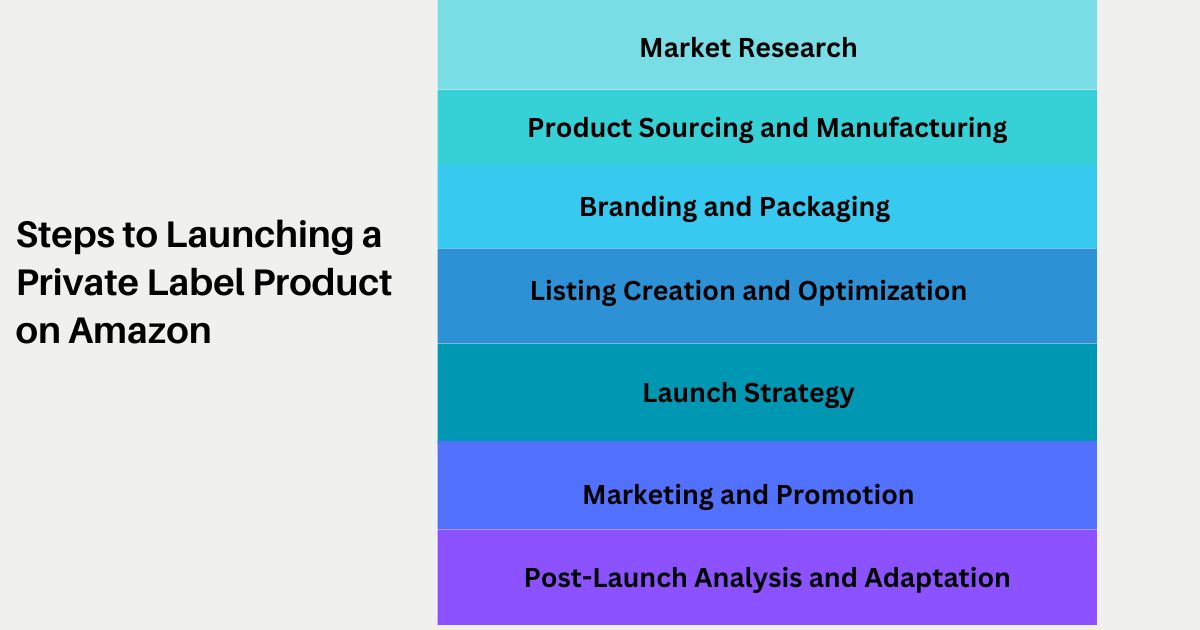
Launching a private label product on Amazon involves a series of strategic steps laying the foundation for a successful product launch. Here’s an expanded and comprehensive breakdown of the essential stages to effectively introduce your private-label product to the Amazon marketplace:
Market Research: Identifying Your Path to Success
Identify Profitable Niches
Explore various Amazon categories to identify niches that align with your expertise and offer growth potential. Look for products with steady demand and manageable competition.
Analyze Demand, Competition, and Trends
Dive into sales data, customer reviews, and trends using SellerApp or AMZScout tools. Gain insights into peak selling seasons and market gaps.
Understand Target Audience
Develop detailed customer personas to understand their demographics, preferences, and pain points. Tailor your product offering to address their specific needs.
Product Sourcing and Manufacturing: Crafting Quality and Consistency
Vet Suppliers
Thoroughly vet potential suppliers based on their track record, production capacity, and communication skills—request samples to assess product quality.
Negotiate Terms
Negotiate pricing, minimum order quantities, and delivery times with your chosen supplier. Ensure clear terms to prevent misunderstandings.
Customization and Prototyping
Collaborate closely with manufacturers to customize your product’s design, features, and packaging. Create prototypes to test and refine your vision.
Branding and Packaging
Creating a Lasting Impression
Develop a Strong Brand Identity: Craft a compelling brand name, logo, and mission statement that resonate with your target audience. Ensure consistency across all branding elements.
Design Eye-Catching Packaging
Your packaging is an extension of your brand. Design packaging that aligns with your brand’s aesthetics and effectively communicates product information.
Include Value-Added Materials
Consider including inserts, user guides, or generating QR codes that enhance the customer experience and provide value.
Listing Creation and Optimization
Craft Engaging Product Listings
Write persuasive product titles, feature-rich bullet points, and informative descriptions that showcase the benefits of your product.
Leverage High-Quality Images and Videos
Include high-resolution images and videos that highlight your product’s different angles and use cases.
Optimize for SEO
Conduct thorough keyword research and incorporate relevant keywords organically into your listing content for improved search visibility.
With SellerApp’s Listing Quality Checker feature, you can quickly check the listing quality of any product.
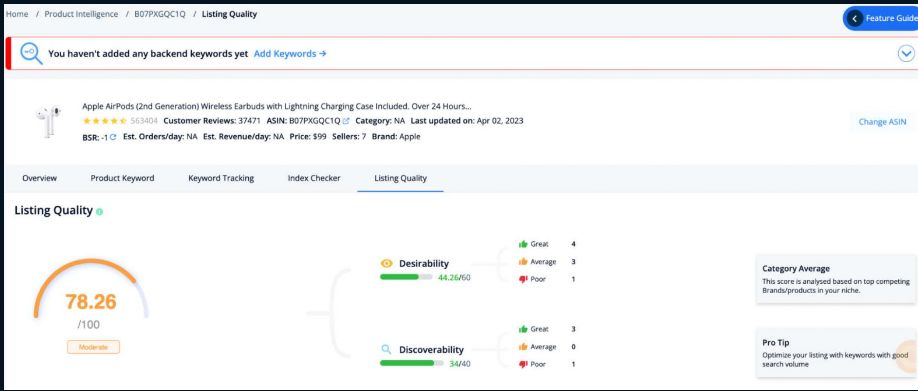
Launch Strategy
Pre-launch Teasers
Generate excitement by teasing your upcoming product launch through social media, email newsletters, and blog posts.
Early Bird Promotions
Offer exclusive discounts or limited-time offers to reward early adopters and encourage initial purchases.
Influencer Partnerships
Collaborate with social media influencers or bloggers in your niche to create buzz and reach a wider audience.
Marketing and Promotion: Amplifying Visibility
Amazon PPC Advertising
Invest in Pay-Per-Click (PPC) advertising on Amazon to attract relevant traffic to your product listings. For the best results, keep an eye on and tweak your campaigns.
Social Media Engagement
Engage with your audience on social media platforms by sharing valuable content, responding to comments, and running contests.
Email Marketing
Build an email list and create engaging email campaigns to inform customers about new products, promotions, and updates.
Post-Launch Analysis and Adaptation: Continuous Improvement
Analyze Performance Metrics
Monitor sales data, customer feedback, and reviews to assess the product’s performance and identify areas for improvement.
Iterative Enhancement
Based on customer feedback and sales data, continuously iterate on your product, listing, and branding to enhance customer satisfaction.
Expand and Diversify
Once your initial product gains traction, consider expanding your product line within the same niche or venturing into related niches.
Overcoming Challenges in Amazon Private Label Business
Launching and growing an Amazon private label business has its share of challenges. Addressing these challenges strategically is key to building a successful venture. Here’s a concise overview of the common challenges and how to tackle them:
Initial Investment and Risk Management
Starting a private label business requires initial product development, branding, and inventory investment. To manage risk, conduct thorough market research to validate demand before committing significant resources. Start with a lean inventory and reinvest profits as your sales grow.
Dealing with Counterfeits and Hijackers
Protect your brand by enrolling in Amazon’s Brand Registry program. This helps you proactively address counterfeit products and unauthorized sellers. Regularly monitor your product listings and take prompt action against any unauthorized activity.
Managing Inventory and Stock Levels Effectively
Balancing inventory levels is crucial to avoid stockouts or overstocking. Utilize inventory management tools and forecasts based on historical data and sales trends. Maintain a close relationship with your suppliers to adjust production based on demand.
Adapting to Changing Amazon Algorithms and Policies
Amazon’s algorithms and policies can change, affecting your product’s visibility and ranking. Stay updated by following Amazon’s seller news and forums. Adapt your optimization and advertising strategies to align with these changes to maintain your competitive edge.
Tips for Sustaining and Growing Your Private Label Brand
Sustaining and expanding a private label brand on Amazon requires ongoing effort and strategic approaches. Here are vital tips to ensure the growth and longevity of your brand:
Continuous Product Improvement
Actively seek customer feedback and reviews to identify areas for improvement. Regularly update and enhance your products based on customer suggestions to meet evolving needs.
Product Line Expansion
Introduce complementary products within the same niche. Offer variations, accessories, or related items to increase customer options and encourage repeat purchases.
Geographic Expansion
Explore opportunities to expand your brand’s reach beyond your current market. Consider selling in different Amazon marketplaces or opening up to international customers.
Seasonal and Trend Integration
Capitalize on seasonal trends and events by introducing limited-time products or special editions. Align your brand with trending topics to capture consumer interest.
Invest in Professional Imagery
High-quality images and videos are crucial for showcasing your products effectively. For the best pictures of your products, think about hiring a professional photographer.
Partnerships and Collaborations
Collaborate with other brands, influencers, or complementary products for joint promotions. Partnerships can expand your brand’s reach and introduce it to new audiences.
Optimize Listing Content
Optimize your product listings with relevant keywords, compelling images, and clear, concise descriptions. Regular updates can improve search visibility and conversion rates.
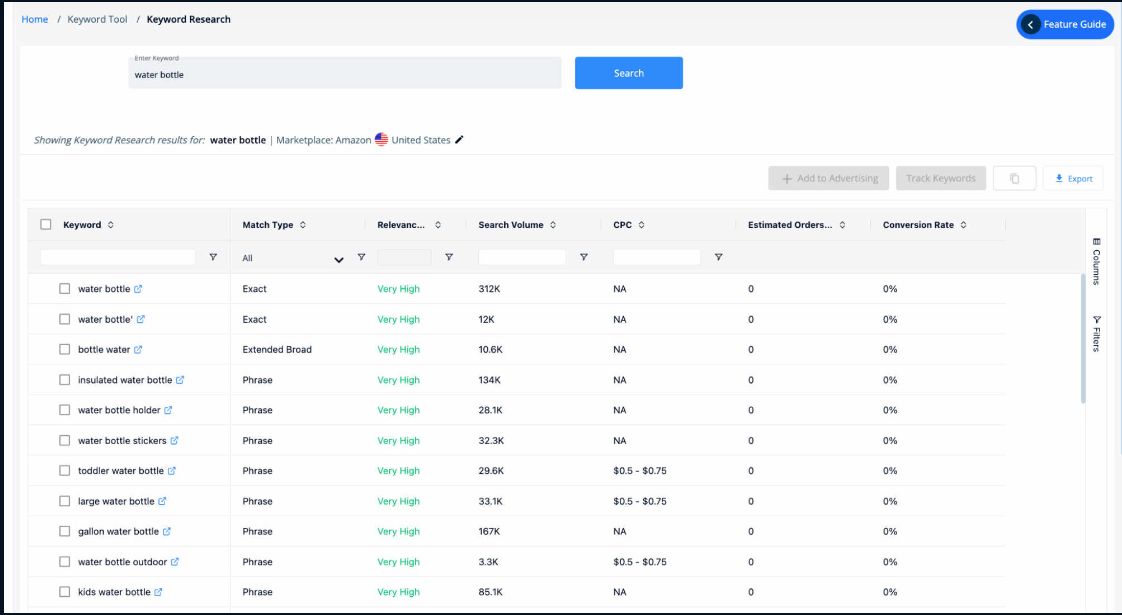
The Future of Amazon Private Label
Emphasis on Brand Differentiation
As more private-label brands emerge, the importance of differentiation will intensify. Brands that effectively communicate their unique value propositions, build strong brand identities, and establish emotional connections with customers will stand out in the competitive marketplace.
Data-Driven Decision Making
Data analytics will play a major role in shaping business strategies. Brands that harness customer data to personalize offerings, optimize marketing campaigns, and refine product development will have a competitive edge.
Expansion to International Markets
Access to global markets will continue to expand for private-label brands. Amazon’s growing international presence will allow brands to tap into new customer bases and adapt to diverse cultural preferences.
Cross-Channel Marketing Integration
Brands will increasingly integrate their Amazon presence with other marketing channels. Effective cross-channel marketing, including social media, email marketing, and influencer collaborations, will be essential for reaching customers throughout their buyer journey.
Technological Integration
Augmented reality (AR) and virtual reality (VR) will provide immersive shopping experiences. Customers can visualize products in their spaces before purchasing, enhancing confidence in online buying.
Voice Commerce and AI Assistants
Voice-activated devices and AI-powered assistants like Amazon’s Alexa will reshape how consumers interact with brands. Private label businesses must optimize their product listings for voice search and provide seamless voice-driven shopping experiences.
Evolution of Fulfillment Models
Amazon’s fulfillment services, including Amazon FBA private label, will evolve to accommodate changing customer expectations. Brands may explore innovative fulfillment methods to provide faster, more efficient shipping.
Regulation and Compliance
Regulatory scrutiny on e-commerce and private labels will likely increase. Brands must stay informed about changing regulations, ensuring product safety, labeling accuracy, and compliance.
Conclusion
The world of Amazon Private Label is brimming with potential, offering aspiring entrepreneurs the chance to build their brands, control their destinies, and tap into a global audience. With the knowledge and techniques described in this comprehensive guide, you’re equipped to embark on your journey into the exciting realm of Amazon Private Label. Remember, success in this venture requires diligence, creativity, and a deep commitment to delivering value to your customers. So, go forth confidently, and may your private label brand thrive in the vibrant e-commerce marketplace.
The post Amazon Private Label: Your Gateway to Profitable Branding appeared first on Amazon-ASIN Blogs - Latest from Amazon Sellers: News, Advice, and Effective Strategies.
]]>