The post The Complete Guide to E-Commerce Email Marketing appeared first on Amazon-ASIN Blogs - Latest from Amazon Sellers: News, Advice, and Effective Strategies.
]]>What Is E-Commerce Email Marketing?
E-commerce email marketing is an attempt to avail or sell a product over the internet through email correspondence, or improve customer relations for increased sales. This may comprise emails, newsletters, promotional emails, random product recommendations, and abandoned cart reminders. The purpose is to maintain customers’ interest in the brand and encourage repeated purchases.
You can also improve your marketing efforts further with tools such as the Snov.io email finder to locate the right contacts for your list and hence make improvements on the results of your marketing campaign.
If the e-commerce store is able to segment audiences and provide personalized content to the recipients, then it can help the customers receive relevant and timely information that may satisfy their needs and result in sales.
Tips for Crafting the Perfect E-Commerce Marketing Email
To maximize the impact of your email marketing campaigns, it’s important to focus on several key elements. Here are some tips for crafting the perfect e-commerce email.
Subject Lines Matter
The creation of the email’s subject line is the first thing that your customers will be able to see. A good subject line can really boost the level of open rates by a huge margin. Short and to the point, simple yet informative and leave a taste of the topic telling more in the context. Do not use the language that readers would find you intrusive, and try to stimulate the interest and interest of the readers. Another way of increasing interest is by using the customer’s name in the subject line.
Balance Copy and Design in the Body
The content and design of your email should complement each other or at least should be in a very consistent harmony. Always make sure that your message and information is as straightforward as it is possible. Subdivide your text with pictures, lists, and most importantly, CTA buttons. Keep a good and appropriate layout of brochure that matches brand or company image but ensure that there is too much information} that fills up the mail. Make the design mobile friendly because the majority of the users access their emails through their mobile devices.
Treat Customers As Individuals
Yet, e-commerce branded e-mailing is a very personalized way of consumer approach. Add value to your e-mailing recipients by directly addressing them, including their first name, suggesting which products they might like based on previous purchases or sending them a birthday discount. This contributes towards development of a loyal customer base since the company establishment is able to grant individual attention to each particular customer.
Refresh and Update Older Emails
Thus it is optimal to consider updating your email templates frequently to help keep your marketing campaign unique. Review the performance of the email campaigns – some emails would have resulted in high response while others would have yielded little or no results at all, so change your content, design or call to action to reflect this. By keeping your content well updated, there would always be renewed interest from your customers.
Get Feedback
Customers should be encouraged to provide feedback on their experience of your given email campaigns. Regardless of whether the collected data comes from the surveys or the questions posed in the email, customer insights will help you make the necessary adjustments in your further campaigns. Engaging your audience also improves your relationship with them, and they will know you appreciate their opinion.
How to Develop an E-Commerce Email Campaign
The complete process behind creating a great e-commerce email marketing campaign is complex. Here’s a step-by-step approach to developing your next campaign:
- Define Your Goals: Who is the target audience? What do you want to achieve with the help of your email campaign? Do you want to create demand, introduce a new product, and sell, or does your client want to sell more to his existing customers?
- Segment Your Audience: Like in most forms of marketing, you should strategically split your fan base into categories according to demographic information, previous actions, or inclinations. This will mean you send more relevant and targeted emails. The first is that the emails that you will receive will be varied depending on which ones people sign up for.
- Create Compelling Content: Be sure to use language that will be understood by your target consumers. Tell your subscribers what they can expect to get out of your email – in terms of a benefit such as a discount code, a piece of content, or tailored product suggestions.
- Design for Mobile: Make sure your email treats mobile as a relative of desktop and is easy to interact with on all platforms. Mobile responsiveness is also important, as more and more users use their handheld devices to access email.
- Use Automation: Send certain emails fully automatically, for instance, welcome emails, abandoned cart reminders or follow-up after purchase. They let you remain connected with your customers without having to personally email them every time.
- Track and Analyze: To track the effectiveness of the results of your campaign you need to regularly track such parameters as the open rates, click-through rates and conversion rates. Employ the strategies and recommendations for you during the future campaigns.
Examples of E-Commerce Email Marketing with Emarsys
For you to have a clear view of what some of the best practices of email marketing are, we are going to illustrate some basic real-life examples of the brands that use Emarsys – the omnichannel marketing platform.
Welcome Email for Crabtree & Evelyn
The example of Crabtree & Evelyn, welcome email is one way to create that first good impression. Their email’s content starts with a greeting, then an introduction to the brand, and ends with a 10% first-time use discount. Such an email is very important in establishing a good working relationship with subscribers who are newly subscribed to a particular website.
Abandoned Cart Email (Bamboo Clothing)
Bamboo Clothing has incorporated abandoned cart emails where once certain items are left in the cart, the company or store sends an email to the customer. Their emailed reminder is a simple picture of the forgotten product along with a gentle prod, reminding the buyer what it was and urging him to go through with the purchase. This serves the purpose of recovering possibly lost sales.
Order Confirmation Email (ROMAN)
The post purchase communication from ROMAN is quite good and is the order confirmation email sent to the consumer. It can contain Order summary, Shipping and tracking details and a Thank You message to the customer to let him/her know that their order was received. It also goes a long way in making the customer trust the brand as they are using the product as meant by the manufacturer.
Conclusion
One of the most successful types of email marketing is still e-commerce promotional campaigns. The key here is to work on creating really compelling mailing and building matched campaigns. It helps to keep clients engaged and ready to purchase again.
Read more:
7 Smart Productivity Tips for Ecommerce Business Owners
E-commerce Keyword Research: A Beginners Guide
The Ultimate Security Checklist for Your E-commerce Business Startup
The post The Complete Guide to E-Commerce Email Marketing appeared first on Amazon-ASIN Blogs - Latest from Amazon Sellers: News, Advice, and Effective Strategies.
]]>The post Why Is My Amazon Listing Suppressed and How Do I Fix It? appeared first on Amazon-ASIN Blogs - Latest from Amazon Sellers: News, Advice, and Effective Strategies.
]]>There are many valid reasons why an Amazon listing would be suppressed, but there is only one most common reason for it: violation of policies of Amazon. Some of the most key ones are listed as follows:
- The product listing contains incorrect or misleading information.
- The product sold belongs to those items which are already defined as the restricted items in Amazon.
- Some of the critical information related to product descriptions or customer reviews is not available.
- The listing images fail to meet Amazon’s image guidelines.
- There are numerous customer complaints along with a history of suspensions due to policy violations.
- Another area is that Amazon may also demote a listing for improving the overall shopping experience, particularly if the listing causes confusion or doesn’t match the relevant search queries.
What Does it Mean When an Amazon Listing is Suppressed?
An Amazon-suppressed listing is one that shoppers cannot see-it is completely hidden from search results and completely inaccessible to the public. Amazon suppresses listings it deems do not meet its standards or to otherwise violate its policies. That is to say, listings for best-selling products may be suppressed for whatever reason Amazon has ruled as a reason for doing so.
Suppression is not the same thing as removal, however. Suppressed listings can be reinstated when the problem is fixed. You may have to update the product page or even, in some cases, recreate a listing from scratch.
To determine if some of your listings are suppressed, go to Seller Central, then to the Inventory tab, and click on Manage Inventory. If you have something at the top that says like “Suppressed Listings”, click on that and it will show you which products are flagged. If you do not see this option, you’re good to go!
The Impact of a Suppressed Amazon Listing on Sellers
An Amazon suppression of a listing puts an item out of view in search results due to, among other reasons, selling at very high prices, poor-quality customer reviews, or the wrong product details. Although it might not initially seem so serious, a suppressed listing in Amazon could have a tremendous effect on a seller’s business.
Among other things, suppressed listings hide the item from actual buyers and send sales numbers plummeting.
In addition, suppressed buy box prices usually tend to reduce sales, and also the loss in earnings will be affected.
Lastly, suppressed listings normally tend to damage a seller’s reputation and reduce the overall search visibility. Further, it will affect their IPI score as well, and therefore maintaining a profitable Amazon storefront will be much more challenging.
How can I fix suppressed listings?
Fortunately, suppressed Amazon listing suppression can be easily identified, and solves with a few easy steps. Though, this requires the checking of listings to ensure that everything is up to date and running well.
So here are 5 steps to solve a suppressed Amazon listing:
- Go to ‘Manage Inventory‘ under the Inventory tab in Seller Central.
- If you do have some suppressed listings then you will see a ‘Suppressed’ button appearing. If you don’t see any suppressed listings, then congratulations-things must be going great!
- If the ‘Suppressed’ button is active, click the button and select the listings that you’d like to correct
- Read through and correct any missing information or hit the ‘Manage Images’ button to add missing product images. Every listing comes with an Amazon Product Summary page which usually indicates suppression and quality issues.
- Once corrected, click the ‘Save and Finish’ option to complete the whole process.
How to Prevent Amazon Listing Suppression
The best way to prevent Amazon listing suppression is by closely following all of Amazon’s rules. If you’re finding it difficult to stay on top of what’s permitted, you can use Seller Central to manage product compliance and keep track of any missing documentation. Additionally, the Amazon Listing Quality Dashboard is a valuable tool, as it identifies listings at risk of suppression and provides details on what needs to be updated before issues arise.
What Should I Do if My Listing is Incorrectly Flagged?

At other times, even when you are certain that your listing is within the acceptable standards of Amazon, it will get suppressed because of an unintended prohibited claim. Prohibited claim guidelines maintained by Amazon include the measures that ensure shoppers receive the most honest and accurate information; however, the Amazon algorithm sometimes incorrectly flags certain claims or keywords. Depending on the nature of the problem, there are two basic methods through which suppressed listings that have been flagged incorrectly can be made to alert sellers. These include Stranded Inventory and Performance Notifications.
Stranded Inventory
When a listing is classified as Stranded Inventory, Amazon will delete the ASIN. It can be found on the ‘Manage Inventory’ page as ‘Stranded Inventory’. On the Stranded Inventory page, Amazon will provide a stranded reason, such as a missing characteristic or a wrongly labeled prohibited claim. Sellers can then either dispute or correct the problem.
Often enough, the problem can simply be corrected by editing the copy on the listing. Deleting words such as ‘bugs’, ‘pests’, ‘mildew’, ‘mold’ and ‘insects’ in, for example a pesticide claim usually deletes the ASIN from Stranded Inventory.
Performance Notifications
Performance Notifications are an alert sent to sellers with a specific ASIN flagged for a performance issue. The product detail page could be removed entirely from Amazon, or the seller could just experience an error that must be corrected in order to continue selling. In order to clear Performance Notifications, sellers must provide a Plan of Action consisting of three parts: Root Cause, Corrective Actions, and Preventative Actions.
Sellers can head over to their Voice of the Customer dashboard in Seller Central to see if this ASIN has been flagged and find any recent customer comments concerning this particular performance issue Amazon raised. Upon submission of a proper POA, the performance notification should be removed.
Conclusion
There can also be suppressed listings on Amazon, citing reasons like a violation of the Amazon policy or insufficient critical information; the issues may also be with the product image. Although suppressed listings affect the viewability and sale greatly, it is not completely eliminated from the store as correcting the cause that leads to the suppression might help bring it to life again. With the help of Seller Central tools including Manage Inventory and Amazon Listing Quality Dashboard, sellers are able to identify errors and correct them early. Ongoing monitoring and adherence to policies set by Amazon may help prevent future depressions as well as further the continued success of your business.
The post Why Is My Amazon Listing Suppressed and How Do I Fix It? appeared first on Amazon-ASIN Blogs - Latest from Amazon Sellers: News, Advice, and Effective Strategies.
]]>The post How to Create an Amazon Product Video That Converts appeared first on Amazon-ASIN Blogs - Latest from Amazon Sellers: News, Advice, and Effective Strategies.
]]>Unsurprisingly, due to the variety of benefits it offers, Amazon has already attracted 9.7 million sellers worldwide, including 1.9 million vendors who are actively selling. Looking at these numbers, we’ve got to be frank – the competition isn’t easy.
But are there any practical ways to stand out from the crowd? – Luckily, there are.
Apart from quality product descriptions, appealing photos, and reviews, there is one more element of success – video content. According to experts, sellers who add an Amazon product video to their listings can enjoy a better SEO ranking, more customer engagement, fewer negative reviews, better brand awareness, and enhanced conversions.
Read on, and we’ll give you a step-by-step guide on how to create videos for Amazon products that sell!
Amazon Product Video Requirements: Understanding the Basics
Before we move on to practical advice on how to create a product video, you need to grasp the basics.
Here’s a brief outlook on the key requirements the platform asks you to stick to:
- Dimensions: 16:9 (1920 x 1080 px) recommended
- Frame rate: At least 15 FPS
- Bit rate: No less than 1 MBps (recommended 2 MBps)
- Codec: H.264, MPEG-2, or MPEG-4 preferred for video and MP3 or AAC for audio
- File size: 500 MB or less
- Duration: From 6 to 45 seconds (recommended 30 secs or less)
- File type: MP4 or MOV
Be sure to ensure full compliance with these recommendations to verify that your content won’t be rejected.
Conducting Keyword Research to Prepare for Content Creation
Though it might not be the first thing you think of when creating your Amazon listing video, thorough keyword research is an important preparatory stage to help you promote your product and boost sales later. Just like in search engines, in Amazon, keywords help you get your product easy to find for potential buyers.
In short, using the right keywords in your listing can give you multiple benefits, including:
- Enhanced visibility and searchability for your product;
- Improved targeting (as you leverage queries your potential buyers are searching for);
- Better conversion rates;
- Competitive advantage.
In case you’re wondering what this has to do with your video creation, the answer is simple – adding target keywords into the file name, title, and descriptions of your content, you can boost the overall optimization of your listing and obtain all the benefits mentioned above. So how do you find target queries? Though you can explore them manually through Amazon search, a much faster and easier way to do this is to leverage specialized tools.
If you don’t know which software to use, one of the popular options is Ahrefs. The platform has a special keyword tool designed to help you learn what users are searching for on Amazon and target winning queries in no time. You can read an unbiased Ahrefs review to see if it’s right for you and get started with your research. Once ready, make a list of your target queries and keep it until later.
Crafting a Compelling Script for Your Product Video for Amazon
Once you are done with preparation, you can start working on your content. The work begins with crafting a perfect script.
In case you don’t have much experience in scriptwriting, here is a brief overview of the key elements you want to include in your script:
- A hook – You need to come up with a strong opening that would capture viewers’ attention.
- Features – Detail in your script all the most important features of your product that you’ll demonstrate.
- Benefits – Outline the primary benefits buyers will receive from using your product.
- Use cases – To give your prospects a better understanding of how your item works, you can provide a short tour and guide that demonstrates real-life use cases.
Once you briefly outline the abovementioned elements, you can pick a suitable framework. For example, it can be a compare and contrast framework that shows buyers how your item is different from others in the market or a problem-solution framework that shows them the real benefits they can gain in terms of solving their problem.
Now since your content should be under 45 seconds (or only 30 seconds as recommended), you might want to keep your script as clear and concise as possible. Here are several tips that might help:
- Understand your primary goal (e.g., provide additional instructions, emphasize the benefits, etc.);
- Don’t use too complex, technical terms;
- Use simple language;
- Cut the fluff, such as unnecessary jargon or long descriptions;
- Detect the most prominent features and benefits to focus on, ideally, limit them to 1-3 unique selling points that make you stand out;
- Show, don’t tell – minimize the amount of unnecessary chit-chat in your video to focus on demonstrating your item.
Adhering to High-Quality Production Techniques
Without any doubt, videos for Amazon products can be a powerful tool for attracting sales. First, such visual content drives attention much more than static marketing materials. Most importantly, the message conveyed through such content is retained by 95%, which means that users will be more likely to remember you, your item, and its features, which boosts the likelihood of purchase.
However, do all videos have the same impact? Of course not.
Low-quality videos can actually result in bad conversions simply because people won’t enjoy watching them. Due to this reason, we have to stress the importance of high-quality production with quality lighting, sound, and editing.
So here’s what you’ll need to ensure the best outcomes:
- Top-end recording equipment to ensure clear visuals and impeccable sound;
- The right location that offers low or no background noise;
- Sound equipment (and its setup) to create the right, soft lighting (unless you want your item to get lost in the shot or be surrounded by overly dramatic shadows;
- A simple backdrop that doesn’t steal away the attention;
- Professional footage;
- High-quality recording and editing software that won’t hinder your visuals or audio;
- Expert editing.
All these things, together with well-planned visuals and demonstrations that showcase your item at its best, can help you create a product video that converts. So don’t hesitate to invest enough money, time, and effort into it.
Adding a Clear and Strong Call to Action (CTA)
When it comes to selling, a call to action is necessary to convert regular viewers into leads who can then turn into paying customers. In a nutshell, a CTA is a phrase that motivates your visitors to act in a desired way. The action could be pretty much anything, including signing up for a newsletter, visiting a site, leaving a comment, etc. However, since we’re speaking about shoppable videos for Amazon, your call to action must encourage viewers to take the only desired action – to buy from you.
Pick a short but strong CTA like “Buy now,” “Get [item name] now,” “Order now,” or similar, and integrate this call to action at the end of your video. This is
Optimizing for SEO to Boost Visibility
Finally, when all the actual shooting and editing stages are over, you can do one more thing to outshine the competition – optimize your video for search engines.
Basically, to ensure that your Amazon listing video ranks in search engines, you need to perform two actions:
- Integrate the keywords you researched earlier into content titles.
- Integrate them into descriptions.
This is pretty much it, simply take your target query and use it in your video’s title and description. Most importantly, make it sound natural and organic.
Now how do you ensure better visibility within Amazon itself? There are multiple tactics to make sure your listings are easy to find:
- Only use relevant keywords;
- Find Amazon-specific keywords using Amazon’s Auto-Complete feature or search term report;
- Steer clear of subjective keywords, such as “great,” “best,” and similar;
- Take advantage of the platform’s hidden backend keywords to integrate additional related phrases into your titles and descriptions;
- Research your direct competitors’ stores to see which keywords work for them.
Conclusion
One of the primary reasons why Amazon is so trending among e-commerce vendors is because of how easy it is to get started with this platform. Thanks to intuitive navigation and a wealth of handy, user-friendly tools, pretty much anyone can launch their listings and start selling. However, the truth is that outshining the competition might be pretty challenging.
But not anymore! With the help of a high-quality and well-optimized Amazon product video, you can make your listing stand out from the crowd and be easier to notice for potential buyers. Use the tips we shared here and invest in the production of outstanding product content to boost conversions and thrive!
Related posts:
The post How to Create an Amazon Product Video That Converts appeared first on Amazon-ASIN Blogs - Latest from Amazon Sellers: News, Advice, and Effective Strategies.
]]>The post The Amazon Effect: How the Retail Giant is Shaping Global Commerce appeared first on Amazon-ASIN Blogs - Latest from Amazon Sellers: News, Advice, and Effective Strategies.
]]>This blog will be a step-by-step guide to the entire Amazon marketplace all over the world. About the importance of Amazon for setting up and growing a business, you will also learn about the effects of the platform, discover new novelties and difficulties, and even take a look at what might be coming next for this retail colossus.
Navigating Amazon’s Global Marketplace
If you’re an e-commerce entrepreneur, the first step to tapping into Amazon’s vast audience is setting up your business on their platform. Amazon provides an extensive guide, but here are some key points to help you get started.
Setting Up Your Amazon Store
Creating an Amazon store begins with registering for an Amazon Seller account. Choose between an Individual seller account or Professional account based on your expected sales volume. Once registered, you’ll need to list your products. Be sure to provide detailed descriptions, high-quality images, and competitive pricing to attract potential buyers.
Expanding Your Reach
Once your store is set up, the next goal is to expand your reach. Utilize Amazon’s Fulfillment by Amazon Services to handle storage, packing, and shipping. Supply Chain can be one of the biggest roadblocks for e-commerce businesses, but FBA alleviates those challenges and opens up your business to Amazon’s global audience. This can drastically improve delivery times and customer satisfaction. Additionally, consider using Amazon’s advertising tools, such as Sponsored Products, to boost visibility.
Leveraging Data and Analytics
Amazon provides a wealth of data through its Seller Central platform. Use these analytics to track sales, monitor inventory, and understand customer behavior. By leveraging this information, you can make informed decisions to optimize your listings and marketing strategies.
The Impact of Amazon on Global Consumers
Amazon constantly impacts global consumers in the capacity of changing how people shop and their expectations towards online shops. Below are details of the aforementioned shifts in trends.
Convenience and Speed
Thus, one of the major driving forces of the market is the ability to expedite the whole process of purchasing something through the Amazon site. With attributes such as one-click orders and same-day delivery plus many others, society has gotten used to fast and convenient ways of shopping. This trend has compelled other retailers to work hard and ensure that they produce the best results thus increasing the competition in the market.
Consumer Behavior Insights
The online giant amasses lots of information about the purchasing habits of its customers. These data can help them offer specific shops, and particular products or even anticipate the main purchases of consumers. About the general public’s requirements, this indicates that consumers will enjoy a more customized shopping experience but it also brings in issues of privacy and use of data.
Getting A Grip On Newer Trends of e-Shopping
Amazon has also shifted the shopping paradigms online in the selected context. People, particularly consumers, are more knowledgeable when it comes to the price since the wave of the comparison tool has swept the market. This transparency makes retailers compete on price, but this also makes them compete on price, quality, and service.

Innovations and Challenges
Amazon is at the forefront of retail innovation, but it also presents challenges to traditional businesses. Let’s explore both sides.
Technological Innovations
Amazon’s innovations extend beyond retail. Their use of artificial intelligence, such as the Amazon Echo and Alexa, has revolutionized home automation. In logistics, their drone delivery service, Prime Air, promises to make shipping even faster.
Challenges to Traditional Retail
While Amazon’s innovations are groundbreaking, they present significant challenges to traditional retailers. The need for rapid adaptation can be daunting, and smaller businesses often struggle to keep up. The convenience of Chrome shopping has also led to declining foot traffic in physical stores.
Sustainability and Ethical Concerns
Amazon’s rapid growth has raised sustainability and ethical concerns. From labor practices in fulfillment centers to the environmental impact of their vast delivery network, these issues are increasingly under scrutiny. Businesses must consider these factors as they develop their strategies.
Future Outlook
What does the future hold for Amazon and its influence on global commerce? Here are some predictions and possibilities.
Continued Technological Advancements
Amazon is likely to continue its push into technology. Advances in machine learning, robotics, and possibly even augmented reality could further enhance their service offerings. Expect more integration with smart home devices and even smarter shopping algorithms.
Expansion into New Markets
Amazon has already made significant inroads into international markets, but there’s still room for growth. Emerging economies present new opportunities, and Amazon’s global footprint is likely to expand even further. This will bring a new question – how to change location on Amazon for entrepreneurs looking to tap into these markets? Normally Amazon location settings for sellers such as the UK or US have different rules and regulations which might be different in a new market. Balancing Growth and Regulation
As Amazon’s influence grows, so does the call for increased regulation. In recent years, there have been concerns about antitrust issues, data privacy, and fair treatment of third-party sellers on their platforms. Finding a balance between growth and compliance will be crucial for Amazon’s future success.
Conclusion
Amazon occupies a huge niche in the global market and can hardly be overestimated. For online merchants, it provides a window that is hard to come by in the current business world. Consumers, on the other hand, gain convenience
and a personalized shopping experience. For retail innovators, it provides a perfect example of the current state of technological development and the level of customer care.
Thus, by knowing what Amazon is and following its evolution, you can be prepared for changes and ready to succeed if your company enters the market for goods in a highly competitive environment.
If you would like to take it to the next level of selling, there are more options available on Amazon or you can observe Seller Central. There are indeed good opportunities and with them, the possibilities are enormous.
Take your business to the next level with Amazon. Begin now and become one of those successful business people who are employed by Amazon’s world market.
The post The Amazon Effect: How the Retail Giant is Shaping Global Commerce appeared first on Amazon-ASIN Blogs - Latest from Amazon Sellers: News, Advice, and Effective Strategies.
]]>The post How Sellers Can Protect Themselves from Amazon Scams appeared first on Amazon-ASIN Blogs - Latest from Amazon Sellers: News, Advice, and Effective Strategies.
]]>Indeed, Amazon scams are more common than you might think, and they can have a huge negative impact on e-commerce sellers. Thankfully, there are a number of smart steps sellers can take to keep themselves safe and secure.
Be Aware of Common Amazon Scams
The first and most important step is simple awareness. By knowing the different forms that Amazon scams can take, sellers can be more vigilant and defensive.
There are too many types of Amazon scams to summarize here, but consider a few of the most common examples.
- Phishing scams. Phishing might look like sending fake emails or messages pretending to be from Amazon, asking e-commerce sellers to provide sensitive information like login credentials or tax details.
- Account takeovers. Additionally, hackers may gain access to a Amazon seller’s account through phishing or other types of data breach. This allows them to make unauthorized changes, including changing bank account information or altering passwords.
- Fake claims and chargebacks. Duplicitous buyers might falsely claim that the items they ordered were not received or arrived in a damaged state, all in an attempt to get a refund while keeping the product.
- False reviews. Online reviews can be make-or-break for e-commerce merchants. Scammers (or unethical competitors) may post negative reviews or feedback to damage a seller’s reputation.
These are just a few examples of the kinds of Amazon scams e-commerce sellers should be aware of.
Ensure Personal Liability Protections
Amazon scams can often lead to significant financial peril or reputational damage. This makes it essential for e-commerce sellers to enact protections against litigation and creditors. One of the best ways to limit personal liability exposure is by registering your e-commerce business as a Limited Liability Company, or LLC.
What is an LLC, exactly? It’s actually one of the most popular business structures in the country, providing the kinds of personal liability protections you’d get with a Corporation, but with much less regulatory overhead. An LLC allows you to establish your ecommerce business as its own distinct legal entity, which in turn means you can keep personal assets and liabilities totally distinct from your business affairs.
The steps for registering an LLC can vary from state to state, but the typical process involves:
- Choosing the state where you will register (likely just wherever you’re based).
- Naming an individual or an organization to serve as your Registered Agent.
- Filing Articles of Organization with your state; check sites like LegalZoom for template documents.
- Creating an Operating Agreement, which serves as a charter for your business.
- Claiming an Employer Identification Number (EIN) from the IRS.
Registering your e-commerce business as an LLC can significantly reduce the level of risk you’re exposed to at the hands of Amazon scammers.
Practice Cybersecurity Basics
A lot of the most common Amazon scams boil down to simple cybersecurity breaches. As such, attending to some IT basics can go a long way toward keeping your e-commerce business safe and sound. Here are a few best practices for Amazon sellers to keep in mind.
Verify Any Communications Claiming to Be from Amazon
Remember, one of the most common types of scams is fraudulent communications, sent by scammers purporting to represent Amazon. Always verify the authenticity of emails, phone calls, or messages claiming to be from Amazon, and remember that reputable companies will never ask for sensitive information via email or phone. Any credible communications from Amazon should come via the Seller Central website or app.
Implement Strong Passwords and Two-Factor Authentication (2FA)
Speaking of your Amazon Seller account, ensure that it’s secured with a strong, unique password and enable two-factor authentication (2FA). This adds an extra layer of security and helps protect your account from unauthorized access. Some other password essentials include:
- Make sure you change passwords fairly regularly.
- Avoid using the same password for multiple accounts.
- Don’t use anything that might be easy for hackers to guess; randomized words, letters, or numbers work best.
Keep an Eye on Your Amazon Account
It’s good practice to regularly review your account settings, transactions, and product listings. Monitor for any unauthorized changes or suspicious activity. Set up alerts for significant account changes, including changes to your banking information. This simple practice of vigilance can help you identify any signs of fraudulent behavior early, allowing for a more rapid intervention.
Show Caution Regarding Invoices or Payments
Another important practice is to verify the legitimacy of any invoices or requests for payment. If you receive an invoice for services or products, confirm it through official channels before you authorize any payments. And always avoid paying for services or products that you didn’t request or you don’t recognize.
Educate Yourself About Scams and Security
A final tip for avoiding Amazon scams: Stay in the loop about common scams and fraud tactics targeting Amazon sellers. Educate yourself and your e-commerce team members on how to recognize phishing attempts, account takeovers, and other types of cyberattack. Familiarize yourself with Amazon’s policies and best practices for safeguarding account security.
Keep Your Ecommerce Business Safe from Scammers
The bottom line: E-commerce sellers can’t afford to ignore Amazon’s massive marketplace… but neither can they afford to turn a blind eye to scams and other fraudulent activity.
While Amazon scams are quite common and potentially quite costly, there are a number of simple steps you can take to protect your business. From ongoing awareness to LLC formation, the steps mentioned here can go a long way toward keeping Amazon scammers at bay.
The post How Sellers Can Protect Themselves from Amazon Scams appeared first on Amazon-ASIN Blogs - Latest from Amazon Sellers: News, Advice, and Effective Strategies.
]]>The post The Ultimate Security Checklist for Your E-commerce Business Startup appeared first on Amazon-ASIN Blogs - Latest from Amazon Sellers: News, Advice, and Effective Strategies.
]]>With the e-commerce sector expected to grow 8.8% in 2024 most of the new e-commerce store owners would be at risk of hackers’ attack.
One of the main requirements to help your e-commerce startup project succeed is to safeguard it from any potential risks.
Let’s look at how you can do exactly that.
The main risks of not having a security system
Before starting our checklist, you should read about the two main risks of not investing in security for your e-commerce.
The Cost of Cyberattacks
Did you know that small businesses are a prime target for cybercriminals?
Only in the United States, 73% of US small business owners reported a cyber attack last year. What is the main reason why hackers often attack small businesses?
They usually don’t have strong security like more prominent companies could and it’s easier for criminals to corrupt their data. This is why implementing a malware breach alert system is crucial it helps detect threats early and minimizes potential damage.
A cyberattack could cost your startup a lot of money and all your assets. Damages can be lethal without a contingency plan.
Trust and Reputation
Let’s suppose you suffer a data breach in a very unfortunate event.
Even if you get to solve it all and go through it without major destruction, your customers’ trust will be seriously damaged.
Remember that at the startup stage of every business, your clients will be your best allies.
Basic Security Practices
1. Bullet-Proof Passwords
Yes, we know, this sounds kind of obvious, but is it though?
If you use the same password for different accounts, if your employees share similar passwords, if you use any personal references for them, spoiler alert: That’s not safe!
If you struggle to remember several passwords, just install a trustworthy password manager and you should be ready to go.
2. Two-Factor Authentication
Many people already are using 2FA (abbreviation for Two-Factor Authentication). This tool gives you extra security and is really easy to use. There are two ways in which you can use 2FA:
● Directly from the apps, most platforms offer this service in 2024.
● Download an authenticator app and link it with your accounts.
3. Newer Software
It might be cheap, but old software doesn’t have the security needed for the 2024 landscape in terms of the new digital threats, every small business should be paying attention to this.
Always run the latest version of your software and accept all the security measures suggested by the experts.
E-commerce Specific Security Measures
1. Secure Your Website with HTTPS
Every online e-commerce platform needs a secure HTTP protocol, but you shouldn’t think this could be all.
Using an HTTP is not a guarantee of not having a breach, but it’s a good place to start. You can ask a professional IT team if you don’t know how to do this.
2. Conduct Regular Security Audits and Vulnerability Scanning
Conduct regular security audits to identify and fix vulnerabilities. Use tools like vulnerability scanners to detect weak points before hackers do.
These audits can help you stay one step ahead of potential threats.
3. Implement a Web Application Firewall (WAF)
WAF or a Web Application Firewall, is a security tool created to protect websites and applications from malicious attacks.
They are mostly prepared to prevent the most common threats, such as SQL injection, DDoS attacks, clickjacking, and many others.
4. Be Minimalist With the Data
When requesting information from your clients, think carefully about the exact data you need to ask to function.
Don’t ask for any extra data just because you believe it could be useful.
That might be problematic in the future. Stick to the minimum and only ask for essential information.
5. Conduct Regular Backups
You can use external memories or cloud services to store your data. The best option is to use both, but we know this might take a little extra time.
Assure you use at least one of these mechanisms to back your sensitive data.
This will be useful, not only in cases of hackers’ attacks but also if your hardware gets physically damaged.
6. Use a VPN for Data Protection
A Virtual Private Network (VPN) encrypts your internet connection, making it harder for hackers to intercept your data.
It’s especially useful if you or your employees work remotely or use public Wi-Fi networks.
VPNs allow your team to hide their IP address and encrypt your data. Encourage everyone within your business to use virtual private networks (VPNs) when accessing sensitive information.
It does not matter what type of system or software you are using. VPN can be used with all types of operating systems, so don’t worry if your team is using Apple for example, you can also get a VPN for Safari and all iOS devices.
7. Get an Antivirus Software
Hackers attacks can’t be stopped by regular antivirus software anymore.
These software programs act as protectors, neutralizing malicious attempts before they can get into your e-commerce platform.
Luckily, nowadays, many antivirus companies provide tailored programs for eCommerce businesses, offering real-time protection against modern threats.
When buying antivirus solutions, especially if your business is small, you should consider creating a private contract with them and asking for a representative to discuss the particular situation of your startup.
8. Secure Payment Gateways
PCI DSS (Payment Card Industry Data Security Standard) is a set of security standards to ensure safety while handling credit card information during transactions.
If your startup uses, processes, stores, or transmits cardholder data, you will need PCI DSS. It helps prevent data breaches and protect their clients’ financial information.
While we agree that any information leak could be lethal to any company, the worst attacks usually involve payment methods. Unfortunately, global payments fraud has tripled in the past years, and it is expected to reach $40 billion by 2027.
9. Run Regular Training and Awareness Programs
Your business should develop a comprehensive risk management strategy. It’s a good idea to create a formal company guideline for security, outlining acceptable and prohibited online activities for employees.
You can rely on professional IT services when educating your staff.
Hosting regular cybersecurity workshops or participating in webinars is an effective way to ensure they all stay informed.
Keeping up with all the rends yourself a lot of work, but luckily many IT companies specialize in businesses and have training programs you can access too.
10. Have a Response Plan
The first hours after a data breach or a hacker attack are the most important to mitigate damage. It’s no one’s dream to prepare for the worst, but unfortunately, you should. Having a response plan could be the difference between experiencing the loss of your dreams or saving your e-commerce.
Conclusion
Running an e-commerce startup is challenging enough even if we forget about the online threats. If you follow these security checklists, you can protect your startup to focus on growth.
Remember, security is not a one-time task but an ongoing process and it takes a lot of patience.
Every entrepreneur trying to make their way into the e-commerce world should be concerned about the security of its clients and staff.
This shouldn’t be stressful, but staying active and informed is essential. Follow professional advice, get involved in your startup security and your information should be safe.
Additional Read: 7 Smart Productivity Tips for Ecommerce Business Owners
The post The Ultimate Security Checklist for Your E-commerce Business Startup appeared first on Amazon-ASIN Blogs - Latest from Amazon Sellers: News, Advice, and Effective Strategies.
]]>The post Amazon Bullet Points That Sell: Seller’s Guide for Success appeared first on Amazon-ASIN Blogs - Latest from Amazon Sellers: News, Advice, and Effective Strategies.
]]>Quick Guide:
- What Are Amazon Bullet Points?
- Why Are Bullet Points Crucial for Your Listing?
- Key Elements of Effective Amazon Bullet Points
- Step-by-Step Guide to Writing Compelling Bullet Points
- Optimizing Amazon Bullet Points for SEO
- Advanced Tips for Optimizing Amazon Bullet Points
- Tools and Resources for Amazon Sellers
- Conclusion
What Are Amazon Bullet Points?
Amazon bullet points are short descriptive phrases under the product title on an Amazon product listing page. They provide a quick overview of your product’s key features and benefits. The bullet points and your product images are the first things potential customers see about your product, so they need to be compelling.
What is the ideal length of Amazon bullet points
Amazon bullet points should be concise, around 1 to 2 short sentences. Sellers are allowed up to 500 characters, while vendors have a limit of 250-255 characters. Vendors can use up to 10 bullet points, each with a maximum of 250 characters, requiring them to use their limited space wisely.
Emphasize Key Features and Benefits in your bullet points
Focus on the key features and main benefits of your product. For example, if it’s a kitchen gadget, highlight things like “Saves time chopping and slicing”, “Dishwasher safe components for easy cleaning”, or “Anti-slip base for safety and stability”. Mention innovative or differentiating features.
Make use of power words while writing your bullet points
Use engaging and emotive language to bring your bullet points to life. Words like “premium”, “revolutionary”, “amazing” or “best-in-class” help convey quality and excitement. Mentioning the benefits, like “effortless”, “simplifies” or “enhances” helps the customer understand the product’s usefulness.
Optimize your Amazon bullet points for Search results
Use relevant keywords in your bullet points, especially those matching your product title and listing. Having semantic keywords, synonyms and related terms in your bullet points helps the listing rank better in Amazon search results. But don’t overstuff – bullet points should sound natural.
Why Are Bullet Points Crucial for Your Listing?
Bullet points are essential for creating an eye-catching Amazon product listing. They draw attention and make information easy to digest, which is key when most shoppers only glance at listings for a few seconds.
They Highlight Key Features and Benefits
Bullet points prominently showcase your product’s best features and customer benefits. Focus on things like:
- Innovative or premium materials: For example, “Made of lightweight, durable aluminum alloy” or “100% organic cotton fabric.”
- Key specifications: Such as size, dimensions, battery life, etc. For example, “6-inch full HD display,” “Runs for up to 10 hours on a single charge,” or “BPA-free and dishwasher safe.”
- Standout qualities: Like “4K video recording” or “Noise canceling technology.”
- Valuable extras: Such as accessories, warranties, free returns, etc. For example, “Includes travel case and 3-year warranty” or “30-day free returns.”
They Make Scanning Easy
Bullet points make it simple for shoppers to scan your listing and find the most important details at a glance. Keep your bullets concise, starting each with an impactful adjective or verb followed by a compelling benefit. For example:
•14th Gen Intel Core i9-14900HX processor
•16GB of DDR5-5600MHz RAM
•premium display with high specs for the best visuals
•automatic switch between iGPU and dGPU based on the task

They Improve Readability
Bullet points visually break up blocks of text, making your listing easier to read. Use them with short paragraphs, headers, and images for the most readable layout. Keep your bullets around 2 to 3 lines max, and leave an empty line between bullets for the cleanest look.
Well-crafted bullet points are key to optimizing your Amazon product listing. You’ll capture shoppers’ attention and drive more conversions by highlighting key features, benefits, and specifications in an easy-to-scan format.
Key Elements of Effective Amazon Bullet Points
To optimize your product listing and boost sales on Amazon, well-crafted bullet points are essential. Short and Scannable With limited space, keep your bullet points concise and straightforward. Focus on your product’s key features, benefits and specifications. Aim for 3 to 5 bullet points of 1 to 3 short sentences or 1 medium sentence. This makes it easy for customers to quickly scan and comprehend your product’s main selling points.
Keyword-Rich
Strategically include important search keywords and related terms in your bullet points to improve visibility on Amazon. For example, if selling a wireless Bluetooth speaker, you may say “Connect via Bluetooth 5.0 for full wireless streaming from any Bluetooth-enabled device up to 30 feet away.” This incorporates keywords like Bluetooth, wireless, streaming, and device. Just be sure to do so in a natural way.
Solution-Oriented
Rather than just listing the product specifications or attributes, focus on the solutions, benefits and value your product provides customers. For example, instead of “Rechargeable lithium-ion battery provides up to 8 hours of playtime per charge”, say “8 hours of portable power – enjoy your favorite music all day long with a long-lasting rechargeable battery”. This emphasizes the benefit of extended, all-day listening.
Quantifiable and Specific
Use solid facts, numbers and statistics to demonstrate your product’s features and performance. Be as precise as possible. For example, say “360° omni-directional sound from 5 high-performance neodymium drivers” rather than “great sound quality”. Providing concrete details builds credibility and gives customers a better sense of what your product can do.
Consistent Messaging in your bullet points
Ensure your bullet points work together to convey a consistent message and value proposition about your product. Repeat or rephrase key selling points and benefits across the bullet points to reinforce the most important details you want customers to remember. This also creates a cohesive listing that is more compelling and persuasive.
Step-by-Step Guide to Writing Compelling Bullet Points
Focus on benefits, not features
Bullet points should highlight your product’s benefits and key selling points, not just list features. Focus on what your product can do for customers and how it can improve their lives. For example, instead of “12 ounce container” say “Portable size is perfect for travel.”
Keep them scannable
People tend to skim when reading bullet points, so keep them concise and compelling. Aim for 1 to 2 short sentences or 40 characters for each point. Use dynamic and descriptive language to draw the reader in while still being scannable. For example, say “Experience rich, bold flavor” instead of “Dark roast coffee.”
Include numbers and stats
Incorporate numbers, stats, ratings or facts into your bullet points when possible. For example, say “Over 10 million customers worldwide” or “Rated #1 in customer satisfaction.” Numerical figures help to strengthen your key selling points and make the benefits more concrete and believable. However, only include stats and numbers if they are factual and relevant.
End on a high note
Save your most compelling benefit or key selling point for the last bullet point. Readers will remember this the most, so end your list on a persuasive note. For example:
• Award-winning design
• Durable, all-weather construction • Lifetime warranty and total peace of mind
Optimizing Amazon Bullet Points for SEO
Amazon bullet points are one of the most important parts of your product listing page. They determine whether shoppers will click to learn more about your item or scroll past it. Optimizing your bullet points for Amazon search engine optimization (SEO) helps ensure you get noticed.
Include keywords
When crafting your bullet points, be sure to include important keywords that relate to your product. Consider the words customers might search for to find an item like yours. For example, if selling a dog leash, you might mention “dog leash, leash, pet leash, dog walking, dog accessory” and similar terms. Place these keywords or use long tail keywords prominently in your first bullet point.
Write naturally
While keywords are important, your bullet points should sound natural to human readers. Don’t overstuff them with keywords or they’ll seem spammy. Aim for a mix of long and short bullet points with a conversational tone. Keep sentences around 15 to 20 words for the best flow. Read your bullets aloud to make sure they sound genuine.
Focus on benefits
Rather than just listing product features, focus on the key customer benefits. For example, instead of “Made of high-quality nylon material”, say “Durable nylon material provides a comfortable, customizable fit for your dog”. Benefit-focused bullet points are more compelling and help convince customers your product is right for them.
Use numbers and stats
Incorporate numbers, stats, measurements, and quantifiable facts about your product into the bullet points when possible. For example, “Extends up to 6 feet” or “Backed by a lifetime warranty”. Concrete details like these help customers understand exactly what they’re getting and build trust in your listing.
Place most important points first
The first 1-2 bullet points are the most visible, so put your most persuasive selling points there. Mention your premium materials, innovative features, excellent reviews, brand reputation, or product awards. The points you lead with should give customers a reason to choose your item over the competition.
Optimizing your Amazon bullet points with an SEO focus and persuasive messaging helps turn casual viewers into eager customers. Place your product’s keywords, benefits, quantifiable details, and most compelling selling points front and center in your bullets to boost visibility and increase your Amazon conversionson.
Advanced Tips for Optimizing Amazon Bullet Points
Once you have the basics of optimizing your bullet points, it’s time to take it to the next level. The following advanced tips can help boost your product rankings and increase conversions.
Use Dynamic Keywords
Include relevant keywords and phrases in your bullet points, but don’t just repeat the same keywords repeatedly. Use synonyms and related terms as well. For example, if you’re selling a laptop, you might say “powerful processor” in one bullet, “fast Intel i7 chip” in another, and “16GB of quick RAM” in a third. This helps you rank for a wider range of searches.
Write Benefit-Focused Points
Rather than just listing features, focus on the key benefits to the customer. Say how the feature improves their experience or solves a problem. For example, instead of “touchscreen display,” “intuitive 10-point multitouch display lets you navigate with simple finger swipes and taps.” This helps the customer understand the value.
Include Calls to Action
Add urgency and encourage customers to buy now with strong calls to action like “buy now and save 10%” or “only 5 left in stock—order today!” These types of messages motivate shoppers to click the buy button.
Use Eye-Catching Formatting
Make important points stand out using bold text, bullet points, spacing, and numbering. For example:
• Fastest processor in its class: Intel i7 chip and 16GB RAM blaze through tasks • Massive storage: 1TB solid-state drive has plenty of room for photos, movies, music and more
• Stunning graphics: NVIDIA GeForce RTX 2060 graphics card delivers incredibly lifelike visuals for gaming and video editing
The bold text draws attention to each point’s main benefit or feature. The spacing and bullet formatting make each point easy to read.
Check Your Grammar and Spelling in your Amazon bullet points
Careless errors damage your credibility and professionalism. Double check that there are no typos, grammar issues or spelling mistakes in your bullet points before publishing your listing. Even a slight errors can reflect poorly on your business and turn off customers.
With the right techniques, you can create Amazon bullet points that highlight the benefits of your product, motivate customers to buy, and help your listing rank higher in Amazon’s search results. Put these advanced tips into practice and watch your product page become more compelling and conversion-optimized.
Tools and Resources for Amazon Sellers
As an Amazon seller, having the right tools and resources is key to success. Some essentials to have in your toolkit include:
Keyword Research Tool
Choosing the right keywords to optimize your product listings and drive organic traffic. A keyword research tool specifically for Amazon like MerchantWords or Amazon-asin keyword tool allows you to find popular search terms within your niche, see how competitive they are, and get estimates of the search volume. With this data, you can select keywords to drive traffic to your listings.
Product Research Tool
Before launching a new product, you must determine if it will be profitable and in demand. A product research tool such as SellerApp or Profitguru lets you analyze trends, see how competitive a product niche is, find opportunities, and make data-driven decisions about what to sell. They provide monthly sales, revenue, reviews, and seasonality metrics to help you find winning products.
Listing Optimization Tool
Once a product is ready to sell, you must create an optimized listing to drive conversions and sales. A tool like Amazon-Asin listing quality checker can help you write compelling titles, bullet points and descriptions, choose effective images, set competitive prices, and make ongoing improvements to your listings. They analyze what’s working for the top-ranked listings in your category so you can emulate their success.
Feedback and Review Management
Customer feedback and reviews are essential for building social proof and trust in your brand. A tool such as eKomi or Feefo lets you proactively ask buyers to leave reviews and ratings, respond to reviews, report abusive reviews, and gain insights into how to improve your products and services based on customer comments. Monitoring reviews and managing your reputation in one place saves time and helps provide great customer experiences.
Using a combination of tools like these, you’ll have everything you need to research products, optimize listings, drive traffic, get reviews and feedback, and ultimately succeed as an Amazon seller. While the range of options can seem overwhelming, start with the basics and you can always scale up and add more advanced tools as your business grows.
Conclusion
And there you have it – everything you need to know to crush it with Amazon bullet points in 2024. By focusing on the customer, highlighting your product’s benefits, and strategically using power words and formatting, you can write compelling bullet points that convert. Keep testing and optimizing as you learn more about your customers. With practice, you’ll write a bullet point copy that sells itself.
The post Amazon Bullet Points That Sell: Seller’s Guide for Success appeared first on Amazon-ASIN Blogs - Latest from Amazon Sellers: News, Advice, and Effective Strategies.
]]>The post 7 Smart Productivity Tips for Ecommerce Business Owners appeared first on Amazon-ASIN Blogs - Latest from Amazon Sellers: News, Advice, and Effective Strategies.
]]>Use online ecommerce tools and apps
With automated tools and AI to help you in every process, it would not be a wise idea to ignore them. From shipping orders to payment processing and social media campaigns to inventory management, there’s an online tool. This makes every part of the process smooth and efficient. These processes mentioned here are just some of the many. Once you start exploring deeply, you will find there’s a tool or an app to help you at every step to make you highly productive.
There are outstanding Mac tools and ideas that simplify your tasks and streamline your workflow. Mac productivity tools and shortcuts make you work smartly. One of the top ideas when using multiple software and apps is to try the split screen feature, which is basically two app windows side by side. It helps to use two applications together by dividing the screen into two. Using this feature, you can compare data analytics in spreadsheets. You can also use multiple design social media marketing apps without swiping into another app. To make it even better, use Command-S (Save file), Command-W (Close Window), Command-N (New file), and Command +/- to zoom in and zoom out. These shortcut keys make work quick. You won’t have to navigate through screens or waste time with the trackpad and mouse. Mac screen real estate is for real so learn to make full use of it.
Set clear goals
Goal setting is one of the top business productivity strategies to meet targets. Measuring progress is possible only if you have set relevant goals and work consistently towards them. With too many tasks to handle, you might struggle to prioritize the tasks or manage the team well. Set smart goals while keeping in mind the time and effort you can put in to achieve them. Having clear, achievable targets helps you to accomplish more in less time, making you more productive.
Plan your ecommerce business workflows
Streamlining workflows is also a smart way to run an ecommerce business successfully. You can do so by analyzing the current workflow and eliminating the unnecessary tasks that make your work repetitive and unproductive. Find easy ways to perform a task by allocating tasks and analyzing their progress regularly. As a business owner, you must focus on important business tasks rather than those that your team can handle easily.

Collaborate and communicate
Ecommerce businesses can be managed well when all the team members work in collaboration, whether remotely or in-office. It is a business productivity strategy that the best entrepreneurs use. You should encourage team members and keep things transparent to see them motivated and positive. Use tools to collaborate and provide all possible support to remote teams. A better level of communication and collaboration creates an atmosphere where everyone becomes more productive than before.
Look for quality sourcing channels
With China being a manufacturing hub, most online retailers including Amazon outsource their goods manufacturing there. If you lack that kind of capital, place bulk orders from popular Chinese online wholesale retailers. Sourcing goods from the best places at the best prices means you will save time and money. This plenty of extra time saved in sourcing can be used in many other business activities that need your regular intervention.
Prioritize work-life balance
Ecommerce business is stressful but being at work all day and all night might get you ideal results in the short run but in the long run, you will face burnout. You will feel exhausted and have a drop in your motivation level. To stay productive, learn to take time off, spend quality time with family and friends, or maybe go for a vacation. A balance in this regard does wonders for your productivity levels.
Find reliable partners
Just as for sourcing, find partners for your online business store for other processes. From delivery to packaging and branding to payments, use an outside partner. Offload as much work as you can through reliable outside partners. It’s their core work so it’s natural that they will provide better results there. With no burden on your shoulders on some of these key aspects, you will see yourself being productive every day and contributing more towards ecommerce business growth.
Conclusion
Like every business, ecommerce is also a lot of hard work. Being productive becomes a key element for every business owner. To make an online ecommerce business flourish, you must value productivity and try these seven best ways to improve it.
The post 7 Smart Productivity Tips for Ecommerce Business Owners appeared first on Amazon-ASIN Blogs - Latest from Amazon Sellers: News, Advice, and Effective Strategies.
]]>The post Amazon Attribution Decoded: Supercharge Your Marketing Efforts appeared first on Amazon-ASIN Blogs - Latest from Amazon Sellers: News, Advice, and Effective Strategies.
]]>As Sellers strive to create impactful campaigns on Amazon, the significance of advanced analytics and insights, including Amazon attribution ads, cannot be overstated. Traditional marketing models often fail to comprehensively understand the customer journey on such platforms. This is where Amazon steps in as a revolutionary tool, offering Amazon sellers an unparalleled opportunity to gain enhanced campaign insights, including those derived from Amazon Attribution ads, and optimize their strategies effectively.
A Quick Peek Into The Article:
- What is Amazon Attribution?
- Key Features and Capabilities of Amazon Attribution
- Benefits of Using Amazon Attribution for Marketers
- Eligibility Criteria for Using Amazon Attribution
- Step-by-Step Guide on Setting Up Amazon Attribution
- Understanding Attribution Metrics
- Integrating Amazon Attribution into Your Marketing Mix
- Conclusion
What is Amazon Attribution?
Amazon Attribution is a cutting-edge program that empowers marketers to understand how their non-Amazon marketing efforts are contributing to their Amazon sales. This means that brands and sellers can gain a more comprehensive understanding of their customer journey, from initial touchpoints to the final purchase on Amazon. By leveraging unique tracking codes, sellers can link off-Amazon marketing activities such as social media ads, influencer partnerships, and email campaigns to eventual sales on Amazon.
The Amazon Attribution program not only provides valuable information about how successful different marketing channels are but also enables marketers to optimize their strategies for better performance. Armed with this data, businesses can make informed decisions about allocating their marketing budget for maximum impact and return on investment. Ultimately, by leveraging this attribution, Amazon sellers are better positioned to drive sales growth and achieve a higher ROI by fine-tuning their multi-channel marketing approach.
Overview of its Role in Marketing Strategies
Amazon Attribution is pivotal in enhancing marketing strategies in the complex e-commerce landscape, where customer journeys often span multiple platforms and touchpoints. It serves as a bridge between advertising efforts and actual sales on Amazon, offering insights that allow advertisers to improve the optimization of their campaign performance.
The tool is particularly beneficial for brands selling on Amazon, allowing them to measure the impact of external marketing efforts, such as social media, search, or display advertising, on their Amazon sales. Amazon Attribution connects the dots between pre-purchase interactions and the final transaction, providing a comprehensive understanding of the customer’s path to conversion.
Amazon Attribution vs. Traditional Attribution Models:
While traditional attribution models often struggle to capture the nuances of e-commerce, Amazon Attribution is tailored to the unique dynamics of the platform. Unlike models that attribute success solely to the last click or a single touchpoint, Amazon Attribution recognizes the multifaceted nature of the customer journey on Amazon.
Traditional models may fall short in attributing value to various touchpoints contributing to a sale on Amazon. On the other hand, Amazon Attribution excels in attributing sales and conversions accurately across different channels, offering a more nuanced and realistic representation of a customer’s path to purchase.
Key Features and Capabilities Amazon Attribution
Multi-channel Tracking:
Amazon Attribution sets itself apart with its robust multi-channel tracking capabilities. Sellers can gain valuable insights into the customer journey across various touchpoints, including social media, display advertising, and search platforms. This feature enables a comprehensive view of how different channels contribute to conversions on Amazon, empowering Amazon seller to allocate resources strategically and optimize their campaigns effectively.
Cross-device Attribution:
In an era where consumers seamlessly switch between devices during their online journey, cross-device attribution is crucial for understanding the full customer picture. Amazon Attribution excels in attributing conversions across devices, ensuring they can track the impact of Amazon attribution campaigns as users transition from mobile to desktop or tablet. This feature provides a holistic understanding of user behaviour and allows for targeted marketing efforts across different devices.
Granular Performance Insights:
Amazon Attribution goes beyond surface-level metrics, offering granular performance insights that delve into the specifics of campaign success. Amazon sellers can access detailed data on clicks, views, and other engagement metrics, allowing for a nuanced analysis of what resonates with their audience. This granular approach enables fine-tuning the campaigns, helping them to make data-driven decisions to enhance performance and ROI.
Comprehensive Reporting Features:
The reporting features of Amazon Attribution are designed to provide sellers with clear and actionable data. Customizable reports allow for a tailored view of campaign performance, making extracting the most relevant information easy. Whether analyzing the success of a particular ad creative’s success or evaluating a specific channel’s effectiveness, comprehensive reporting features empower sellers to make informed decisions that drive results.
Benefits of Using Amazon Attribution for Marketers
Enhanced Visibility into Customer Journeys:
One of the standout advantages of leveraging Amazon Attribution is its unparalleled visibility into customer journeys. Sellers gain a holistic view of how consumers interact with their brand across multiple touchpoints before purchasing on Amazon. This comprehensive insight allows for a more informed understanding of the customer’s decision-making process, enabling them to tailor their strategies to align with customer behaviour effectively.
Improved ROI Tracking and Optimization:
By attributing sales and conversions to specific advertising touchpoints, Amazon sellers can precisely measure the impact of their campaigns on Amazon. This granular data facilitates the strategic allocation of resources, ensuring that the marketing budgets are optimized for maximum effectiveness. The result is improved ROI as marketers can identify and prioritize the most impactful channels and strategies.
Holistic Understanding of Campaign Performance:
Amazon Attribution equips sellers to connect the dots between pre-purchase interactions on external channels and actual sales on Amazon. This holistic understanding enables them to refine their strategies, identify successful channels, and address pain points in the customer journey, leading to a more impactful and successful campaign.
Strengthening Brand-Consumer Relationships:
Building strong and lasting relationships with consumers is a cornerstone of successful marketing. This contributes to this goal by providing insights beyond simple transactional data. By understanding the entire customer journey, they can tailor their messaging and engagement strategies to resonate with their audience. With a better connection between the brand and the customer, this personalized approach improves the overall customer experience and eventually increases loyalty and repeat business.
Eligibility Criteria for Using Amazon Attribution
Requirements for Participation:
Before they can harness the power of Amazon Attribution, certain criteria must be met to ensure eligibility and seamless integration. The requirements for participation typically include:
- Active Amazon Advertising Account: Amazon Sellers must have an active Amazon Advertising account to access and utilize Amazon Attribution.
- Product Listings on Amazon: The products being promoted or advertised should have active product listings on Amazon, as the attribution primarily focuses on tracking sales and conversions on the platform.
- Compliance with Amazon Policies: Adherence to Amazon’s advertising policies and guidelines is crucial for participation. sellers must ensure their campaigns align with Amazon’s standards to be eligible for Amazon Attribution.
Categories and Products Eligible for Attribution:
While this is a versatile tool, not all product categories and types are immediately eligible for attribution. Eligibility may vary based on product types and categories, and they must be aware of these distinctions. Certain restricted or prohibited categories may have limitations on using Amazon product attributes, and they should review Amazon’s guidelines to understand the specific eligibility criteria for their products.
Geographical Restrictions and Considerations:
Availability may vary across different geographical regions. They should verify whether the tool is accessible in their target markets and be mindful of any regional restrictions that could impact its functionality. Understanding these geographical considerations ensures that marketers can plan and execute their attribution strategies effectively, considering the availability and scope of Amazon Attribution in specific regions.
Step-by-Step Guide on Setting Up Amazon Attribution
Step 1: Set Up an Amazon Attribution Account
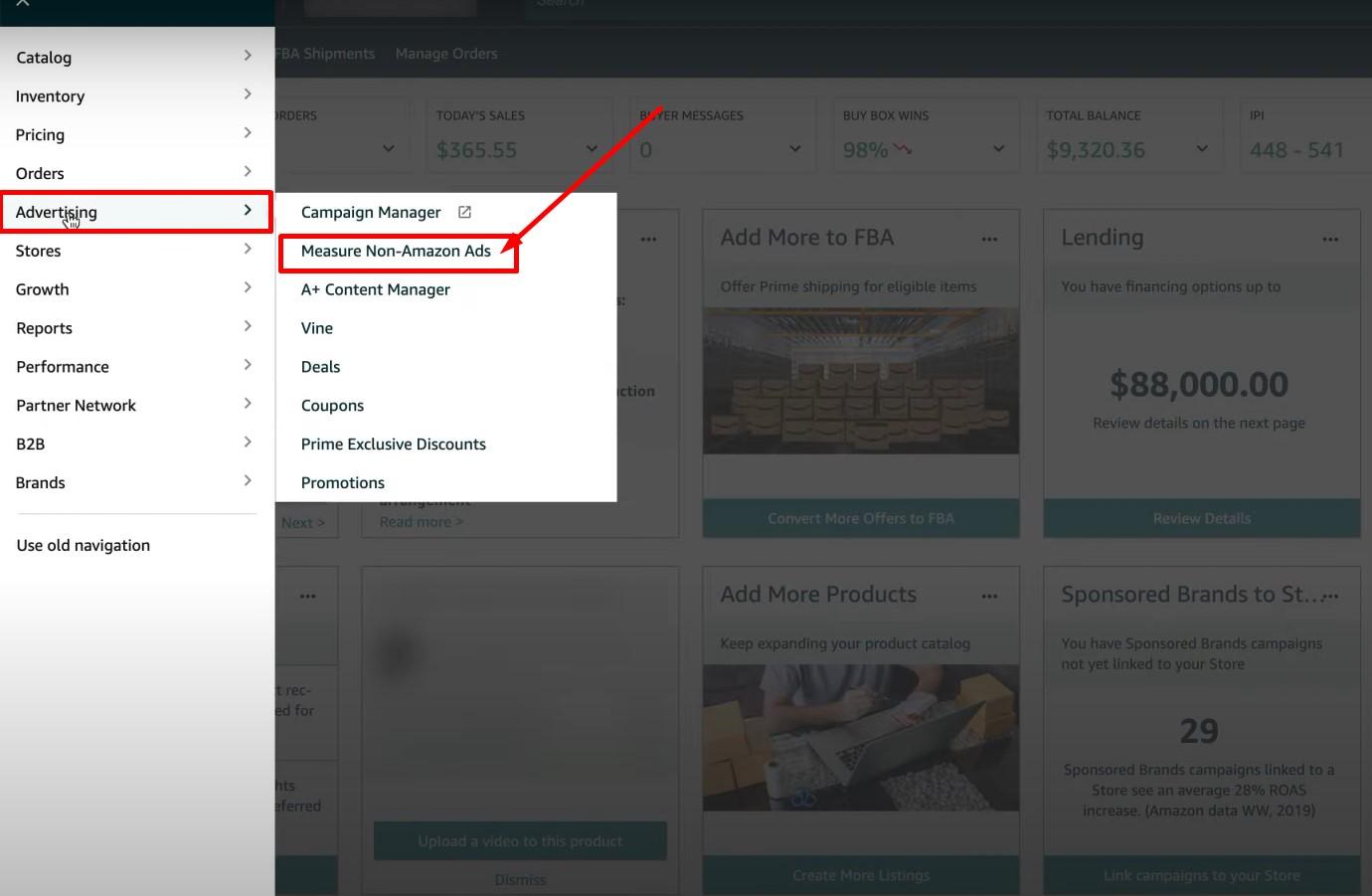
- Visit the Amazon Attribution homepage or sign in to your Amazon Advertising account.
Create an Attribution Account:

- If you don’t have an Amazon Attribution account, follow the prompts to create one.
Step 2: Create a New Attribution Program
Navigate to the Attribution Dashboard:
- Once logged in, go to the Attribution dashboard.
Click on “Create Attribution”:
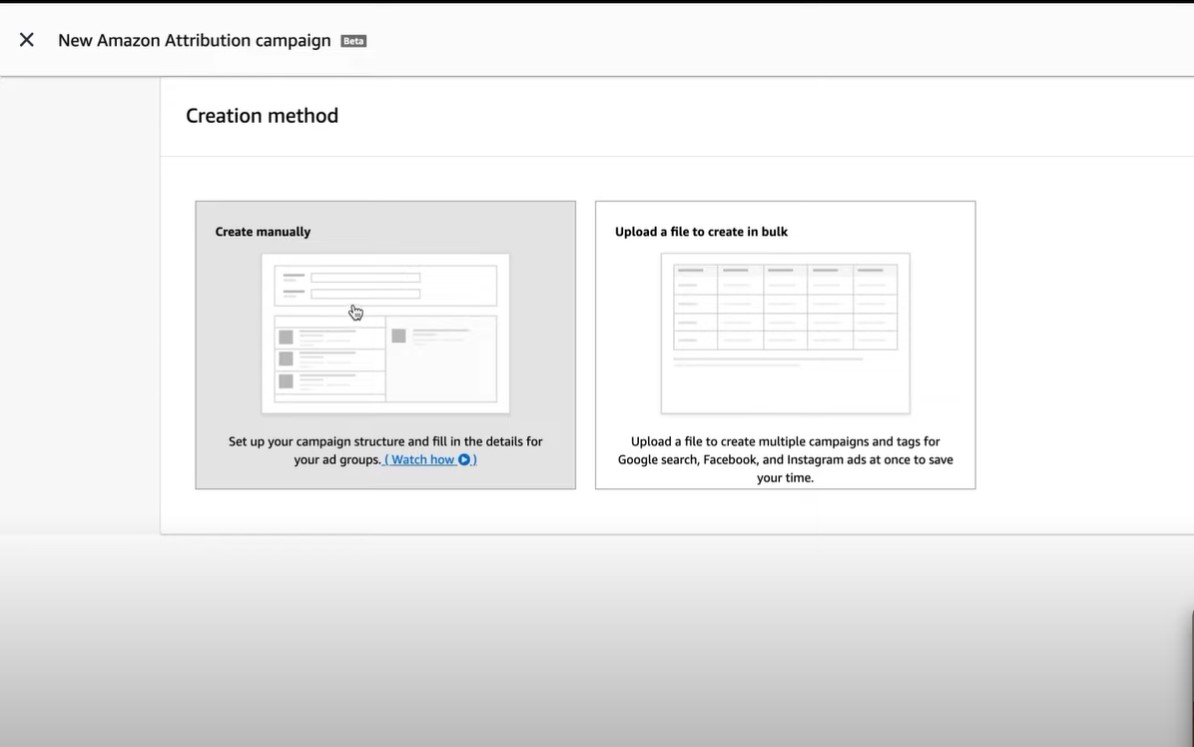
- Look for an option to create a new attribution program or campaign.
Step 3: Define Attribution Settings
Set Add Group:
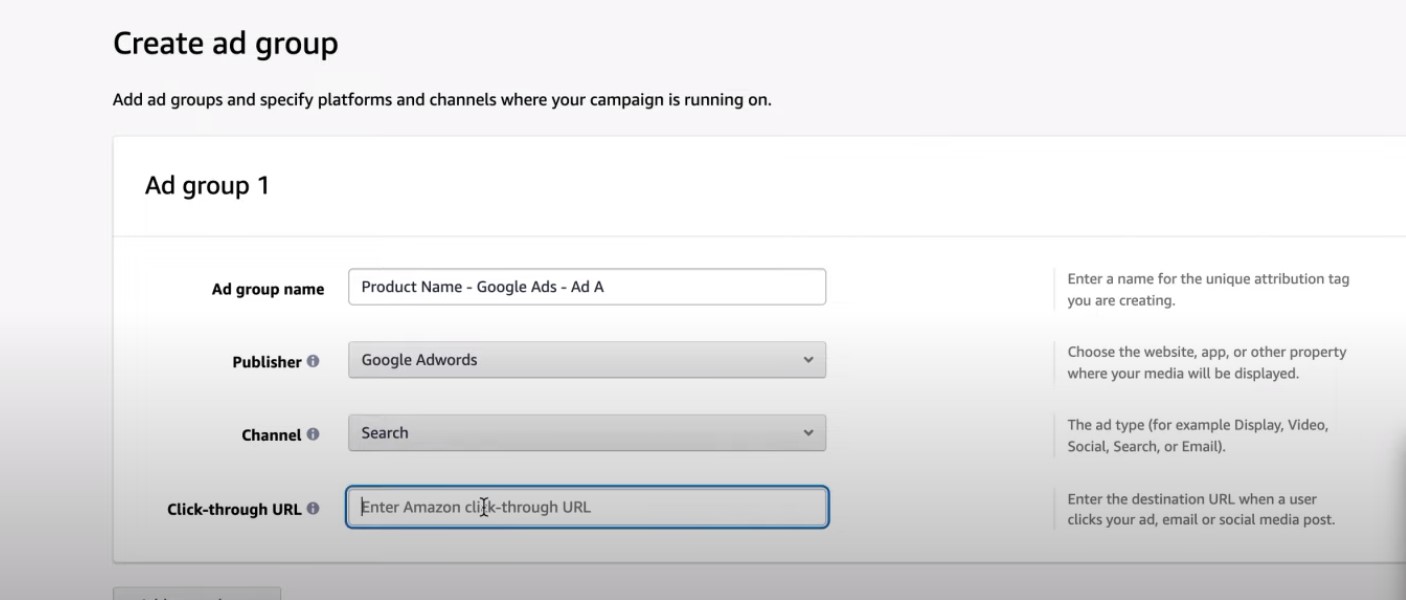
- Choose the name of attribution Ads and select the publisher and which channel.
- Add your product’s URL, ensuring that you include it up to your ASIN number, and aim to refrain from including the entire URL.
Define Conversion Windows:
- Specify the period during which customer actions will be attributed to your marketing efforts.
Step 4: Create a Tag
Generate Attribution Tags:
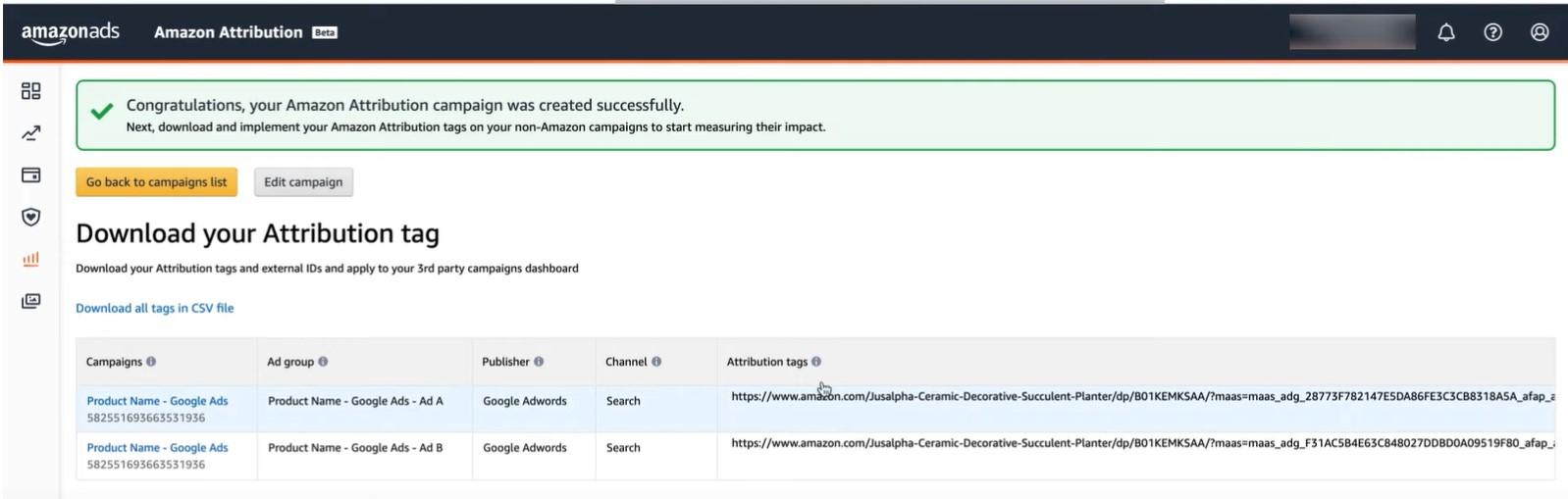
- Navigate to Attribution Tags: Once in the Amazon Attribution console, locate the section for creating attribution tags.
- Select Campaigns: Choose the specific campaigns you want to track with Amazon Attribution. This could include campaigns from social media, search engines, or other external channels.
- Generate Attribution Tags: Generate unique attribution tags for each selected campaign. These tags will be crucial for tracking user interactions and attributing sales to specific touchpoints.
Implement Tags:
- Copy the Attribution Tags: Copy them to your clipboard after generating the attribution tags.
- Implement Tags in External Channels: Paste the attribution tags into your campaigns’ respective ad creatives or settings on external channels. This integration allows Attribution to track user interactions and attribute conversions accurately.
- Verify Implementation: Double-check that the attribution tags are implemented correctly across all intended channels. This step ensures that data is accurately collected for analysis.
Step 5: Analyze Performance
Monitor Dashboard:
- Regularly check the dashboard to analyze the performance of your campaigns.
Review Reports:
- Explore the reports and insights provided by Amazon to understand how your non-Amazon marketing channels contribute to Amazon sales.
Verifying and Troubleshooting Setup:
- Access Reporting Dashboard: Once the tags are implemented, access the reporting dashboard in the Amazon Attribution console.
- Verify Data Accuracy: Review the data to accurately reflect user interactions and attributed sales. This step is important for assessing the effectiveness of your campaigns.
- Troubleshoot Issues: In case of discrepancies or issues, use the troubleshooting resources provided by Amazon Attribution. Common issues may include tag implementation errors or issues with data syncing.
- Optimize Setup as Needed: Based on the insights gathered, optimize your setup by adjusting attribution tags, refining campaigns, or exploring additional channels for enhanced performance.
Understanding Attribution Metrics
- Click-Through Attribution: Measures the impact of a user clicking on an ad and purchasing on Amazon.
- View-Through Attribution: Tracks conversions that occur after a user sees but doesn’t click on an ad. This provides insights into the influence of impressions on user behaviour.
- Attributed Sales: Quantifies the total sales attributed to your tracked campaigns, providing a direct correlation between marketing efforts and revenue.
- Conversion Rate: Calculates the percentage of users who take a desired action, such as purchasing after interacting with your ads.
- Cost per Click (CPC) and Cost per Mille (CPM): Evaluate the efficiency of your campaigns by measuring the cost associated with clicks or impressions.
Interpreting Data for Actionable Insights:
Identifying High-Performing Channels:
Analyze which external channels drive the most attributed sales on Amazon. Allocate resources to channels that contribute significantly to your overall success.
Optimizing Ad Creative and Messaging:
Evaluate the performance of specific ad creatives and messaging. Identify elements that appeal to the audience and optimize future campaigns based on these insights.
Understanding Customer Journey Touchpoints:
Gain insights into the customer journey by assessing the interplay of click-through and view-through attribution. Understand where customers first engage and how it influences their path to conversion.
Refining Targeting Strategies:
Utilize attribution metrics to refine audience targeting. Identify demographics, locations, or interests that align with high-converting users and adjust your targeting parameters accordingly.
Common Challenges in Understanding Attribution Metrics:
Attribution Window Confusion:
The attribution window defines the time frame during which conversions are attributed to specific touchpoints. Understand the impact of different attribution windows and choose one aligned with your campaign objectives.
Cross-Device Attribution Complexity:
Recognize the challenges of tracking user journeys across multiple devices. Consider cross-device attribution insights to gain a comprehensive understanding of user behaviour.
External Factors Impacting Conversions:
Be aware of external factors, such as seasonality or external promotions, that may influence attribution metrics. Differentiate between the impact of your campaigns and external variables.
Ad Fraud and Invalid Clicks:
Monitor for potential ad fraud or invalid clicks that may skew attribution data. Implement measures to filter out fraudulent activities and ensure the accuracy of your insights.
Integrating Amazon Attribution into Your Marketing Mix
Aligning Amazon Attribution with Existing Strategies:
- Assessment of Current Marketing Strategies: Evaluate your existing marketing strategies across various channels on and off Amazon.
- Identification of Key Touchpoints: Use Amazon Attribution insights to identify key points in the customer journey. Align your existing strategies with these touchpoints for a more integrated approach.
- Consistent Messaging and Branding: Ensure the messaging and branding across different channels are consistent. This insight can guide you in maintaining a cohesive brand presence throughout the customer journey.
Leveraging Insights for Cross-Channel Optimization:
- Data-Driven Decision Making: Utilize the insights from Amazon to make informed decisions about resource allocation and budget distribution across different channels.
- Optimizing Ad Spend: Identify high-performing channels and allocate resources accordingly. This optimization ensures that your budget is directed towards channels contributing significantly to Amazon sales.
- Refining Targeting Strategies: Fine-tune audience targeting based on the data. Adjust demographics, interests, and geographical targeting to align with the characteristics of high-converting users.
Conclusion
In conclusion, Amazon Attribution emerges as a powerful tool beyond traditional attribution models, offering Amazon sellers a comprehensive view of the customer journey and invaluable insights into campaign performance. By aligning Amazon’s Attribution with existing strategies and leveraging its insights for cross-channel optimization, marketers can precisely navigate the intricacies of the e-commerce landscape.
As illustrated by successful case studies, the integration of Amazon Attribution into the marketing mix has the potential to not only drive Amazon sales but also enhance brand-consumer relationships and overall marketing success. By embracing this Attribution, marketers embark on a journey towards a more nuanced, data-driven, and effective approach to e-commerce marketing in the ever-evolving digital landscape.
The post Amazon Attribution Decoded: Supercharge Your Marketing Efforts appeared first on Amazon-ASIN Blogs - Latest from Amazon Sellers: News, Advice, and Effective Strategies.
]]>The post Amazon Conversion Rate Mastery: Strategies to Skyrocket Your Sales appeared first on Amazon-ASIN Blogs - Latest from Amazon Sellers: News, Advice, and Effective Strategies.
]]>A quick peek into the article:
- What Is Amazon Conversion Rate?
- How To Calculate Conversion Rates On Amazon?
- What Is A Good Conversion Rate For Amazon?
- Introduction to Tools and Analytics for Tracking Conversion Rates
- How Can You Increase Amazon Conversion Rate?
- How Can You Monitor Your Amazon Conversion Rates?
- Final Thoughts
What Is Amazon Conversion Rate?
In the expansive realm of Amazon, the term “conversion rate” is more than just a statistical metric – it’s the heartbeat of successful e-commerce. At its core, the Amazon conversion rate is a numerical representation of how many potential customers take the desired action: making a purchase. It’s the vital sign that gauges the effectiveness of your product listings in turning browsers into buyers.
Importance of Amazon Conversion Rate
Understanding the importance of the Amazon conversion rate is akin to recognizing the pulse of your business on the platform. A high conversion rate is indicative of a well-optimized and compelling product listing. It signifies that your product not only attracts attention but also persuades customers to take the next step – completing the purchase.
For sellers, a robust conversion rate isn’t merely a badge of honor; it’s a strategic advantage. Amazon’s algorithm favors listings with higher conversion rates, propelling them to prominent positions in search results. This visibility, in turn, exposes your products to a broader audience, creating a self-reinforcing cycle of increased visibility and conversions.
Differentiating Between Product Conversion Rate and Session Conversion Rate
Now, let’s navigate the terrain of Amazon conversion rates with a finer lens, distinguishing between two key variants: product conversion rate and session conversion rate.
Product Conversion Rate:
This metric zooms in on the performance of individual product listings. It calculates the percentage of visitors who land on a specific product page and then go on to make a purchase. Essentially, it measures how well a particular product is converting potential interest into actual sales.
Session Conversion Rate:
On a broader scale, session conversion rate encompasses the overall performance of your entire Amazon store. It measures the proportion of visitors who complete a purchase throughout their entire stay on your storefront. This metric provides a holistic view of your store’s effectiveness in converting visitors into customers.
How To Calculate Conversion Rates On Amazon?
In the dynamic landscape of Amazon, understanding how to calculate conversion rates is akin to holding the compass that guides your e-commerce journey. Whether you’re an experienced vendor or just beginning to explore the expansive marketplace, decoding the nuances of conversion rates is crucial for optimizing your listings and maximizing sales. Here’s a step-by-step guide to demystify the process:
Step 1: Define Your Metrics
- Product Conversion Rate: To calculate the product conversion rate, you need two key numbers – the number of visitors to a specific product page and the number of those visitors who actually make a purchase. The formula is simple: divide the number of purchases by the total number of product page visits and multiply by 100 to get the percentage.

- Session Conversion Rate: For the session conversion rate, you’ll calculate the percentage of visitors to your entire store who make a purchase. This involves dividing the total number of orders by the overall number of store visits and multiplying by 100.

Step 2: Gather Data
Head to your Amazon Seller Central dashboard to access the necessary data. Amazon provides detailed metrics, including the number of page visits, orders, and other essential statistics.
Step 3: Perform Calculations
Plug in the numbers into the respective formulas. Keep in mind that these calculations can be done manually or by utilizing analytics tools available on the platform.
What Is A Good Conversion Rate For Amazon?
Determining what constitutes a good conversion rate is a pivotal quest for sellers. A high conversion rate is the digital currency that propels your products to the forefront, attracting more customers and boosting your overall success. Let’s delve into the benchmarks and industry standards that define a successful conversion rate on Amazon.
Establishing Benchmarks for a Successful Conversion Rate on Amazon
Product Conversion Rate Benchmarks:
- On a product level, a conversion rate in the range of 10% to 15% is generally considered healthy. This means that for every 100 visitors to a specific product page, 10 to 15 of them make a purchase.
- However, it’s essential to note that the ideal rate can vary based on factors such as price point, product type, and customer intent.
Session Conversion Rate Benchmarks:
- For the broader view of your entire store, a session conversion rate of 3% to 5% is often deemed satisfactory. This means that out of 100 visitors to your Amazon store, 3 to 5 of them complete a purchase.
- Again, variations in industry norms and your specific product category can influence what is considered a good session conversion rate.
Industry Standards and Variation Across Product Categories
Understanding the benchmarks is crucial, but it’s equally important to recognize that industry standards can vary across different product categories. Here are a few considerations:
High-Volume vs. Niche Products:
Products with high demand and broad appeal may have slightly lower conversion rate benchmarks. On the other hand, niche products or specialized items might aim for higher conversion rates due to a more targeted customer base.
Price Sensitivity:
The price point of your products can significantly impact conversion rates. Higher-priced items might naturally have lower conversion rates, but the revenue generated per conversion could be substantial.
Seasonal Variations:
Some product categories experience fluctuations in demand based on seasons or trends. Understanding these variations can help you set realistic expectations for conversion rates during specific times of the year.
Competitive Landscape:
The level of competition in your product category as a significant role in defining what is considered a good conversion rate. In highly competitive markets, achieving a conversion rate at the upper end of the benchmark range may be more challenging.
How To Track Your Conversion Rates On Amazon?
In the fast-paced world of Amazon, tracking your conversion rates is like having a compass that guides your journey through the vast marketplace. Precise measurement and analysis of conversion rates empower sellers to make well informed decisions, optimize their listings, and ultimately enhance their success. Let’s explore the tools and analytics available for tracking conversion rates, with a special focus on leveraging Amazon Seller Central.
Introduction to Tools and Analytics for Tracking Conversion Rates
Amazon Analytics Dashboard:
Start by exploring Amazon’s built-in analytics tools, available through your Seller Central account. The Amazon Analytics Dashboard provides a comprehensive overview of your store’s performance, including conversion rates. Here, you can access data on page views, sessions, and orders.
Business Reports:
Dive deeper into your data with Amazon’s Business Reports. These reports offer a wealth of information, allowing you to track sales, traffic, and conversion rates for specific time periods. The “Detail Page Sales and Traffic” report, in particular, is a goldmine for understanding how customers are interacting with your listings.
Amazon Attribution:
Amazon Attribution serves as a tool instrument for assessing the influence of your marketing endeavors outside of Amazon on your sales and conversion rates. Through the use of distinctive tags, you have the ability to trace the customer’s path from external channels to your Amazon listings, providing valuable insights into the efficacy of your marketing tactics.
Third-Party Analytics Tools:
For a more in-depth and customizable analysis, consider integrating third-party analytics tools. Platforms like Google Analytics, Kissmetrics, or Ahrefs can provide additional layers of insight, helping you understand customer behavior, identify trends, and refine your conversion rate optimization strategies.
Utilizing Amazon Seller Central for Monitoring Performance Metrics
Performance Dashboard:
Navigate to the Performance Dashboard within Amazon Seller Central to get a quick snapshot of your store’s overall performance. Here, you’ll find key metrics such as order defect rate, late shipment rate, and pre-fulfillment cancel rate, providing a holistic view of your account health.
Detailed Page Views and Sales Metrics:
Drill down into the “Detailed Page Sales and Traffic” section to gain insights into individual product performance. Track metrics like unit session percentage, page views, and Buy Box percentage to assess how well your listings are converting.
Inventory Performance Dashboard:
The Inventory Performance Dashboard is a valuable resource for monitoring the efficiency of your inventory management. By ensuring a healthy inventory, you contribute to maintaining consistent availability, which positively impacts conversion rates.
Customer Demographics:
Amazon recently introduced customer demographic data, allowing you to understand the demographics of your customers better. By accessing this information in Seller Central, you can tailor your listings and marketing efforts to resonate with your target audience, potentially boosting conversion rates.
How Can You Increase Amazon Conversion Rate?
In the competitive realm of Amazon, where every click holds potential, increasing your conversion rate is the key to unlocking higher sales and greater success. Let’s explore strategies that encompass optimizing product listings, leveraging customer reviews, and tapping into promotions and advertising.
Optimizing Product Listings and Images
Compelling Product Titles and Descriptions:
- Craft clear, concise, and compelling product titles that highlight key features and benefits.
- Write detailed yet easy-to-read product descriptions, focusing on how the product solves a problem or fulfills a need.
High-Quality Images:
- Use high resolution images that showcase your product from multiple angles.
- Incorporate lifestyle images to help customers visualize using the product in real-life scenarios.
Keyword Optimization:
- Integrate relevant keywords naturally seamlessly into your product titles and descriptions to boost visibility in search outcomes.
Clear and Concise Bullet Points:
- Break down product features into clear and concise bullet points for easy readability.
- Highlight USP and key benefits to grab the attention of potential buyers.
Importance of Customer Reviews and Feedback in Boosting Conversion Rates
Encourage Reviews:
- Implement post-purchase follow-up emails kindly requesting customers to leave a review.
- Emphasize the importance of feedback in improving your products and services.
Address Customer Concerns:
- Timely address any negative reviews or customer concerns. Demonstrating responsiveness builds trust among potential buyers.
Optimize Your Seller Rating:
- Ensure a strong seller rating through the delivery of exceptional customer service, ensuring timely shipments, and resolving issues promptly.
Leverage Amazon’s Early Reviewer Program:
- Explore the option of joining Amazon’s Early Reviewer Program, an initiative designed to prompt customers who have bought your product already to share their feedback.
Leveraging Promotions, Discounts, and Advertising for Increased Conversions
Strategic Promotions:
Run limited-time promotions or discounts to create a sense of urgency and incentivize purchases.
Utilize Amazon PPC Advertising:
Invest in Amazon’s Pay-Per-Click (PPC) advertising to increase visibility in search results and target specific keywords related to your product.
Participate in Amazon Deals and Coupons:
Leverage Amazon’s Deals and Coupons features to offer discounts and attract price-sensitive customers.
Cross-Promotions and Bundles:
Explore the option of developing product bundles or engaging in cross-promotions with complementary items to incentivize customers to include additional products in their shopping carts.
How Can You Monitor Your Amazon Conversion Rates?
Ensuring the health and effectiveness of your Amazon business requires vigilant monitoring of conversion rates. Let’s explore actionable strategies to keep a close eye on your conversion metrics and leverage tools for insightful analysis.
Implementing Routine Check-Ins and Analysis of Conversion Rate Metrics
Regularly Review Amazon Analytics:
- Schedule routine check-ins with Amazon Analytics to monitor key conversion rate metrics.
- Analyze product conversion rates and session conversion rates to identify trends and patterns.
Evaluate Individual Product Performance:
- Dive into the “Detailed Page Sales and Traffic” report to assess how individual products are converting.
- Identify top-performing products and those that may need optimization.
Track Changes Over Time:
- Use historical data to track changes in conversion rates over time.
- Monitor how adjustments to product listings, pricing, or promotions impact conversion rates.
Setting Up Alerts and Notifications for Significant Changes in Conversion Rates
Utilize Amazon’s Performance Notifications:
- Leverage Amazon’s built-in performance notifications within Seller Central.
- Set up alerts for significant changes in key metrics, including conversion rates, to receive timely notifications.
Third-Party Tools with Alert Features:
- Explore third-party analytics tools that offer alert features for Amazon sellers.
- Set up customized alerts for deviations in conversion rates, ensuring you’re promptly informed of any anomalies.
Establish Benchmark Thresholds:
- Define benchmark thresholds for acceptable conversion rates based on your historical performance.
- Establish a system where alerts are triggered when conversion rates fall below or rise above these benchmarks.
Utilizing Third-Party Tools for In-Depth Analysis and Insights
Google Analytics Integration:
- Integrate Google Analytics with your Amazon account for a more comprehensive analysis.
- Gain insights into traffic sources, customer behavior, and the effectiveness of external marketing efforts.
Amazon Seller Tools:
- Explore specialized Amazon seller tools that provide in-depth analytics and insights.
- These tools often offer features like sales trend analysis, competitor benchmarking, and recommendations for improving conversion rates.
Final Thoughts
In the ever-evolving landscape of Amazon, monitoring your conversion rates is not a one-time task; it’s an ongoing commitment to optimization and success. Regular check-ins, strategic analysis, and the proactive use of alerts are essential components of this commitment. By staying attuned to your conversion metrics and leveraging the power of third-party tools, you equip yourself with the knowledge needed to make informed decisions, adapt to market changes, and continually enhance your performance on the platform. As you navigate the intricacies of Amazon, remember that the journey to sustained success is marked by a commitment to monitoring, learning, and evolving.
The post Amazon Conversion Rate Mastery: Strategies to Skyrocket Your Sales appeared first on Amazon-ASIN Blogs - Latest from Amazon Sellers: News, Advice, and Effective Strategies.
]]>